 Gwangju Military Airport, selected as the site for the Honam semiconductor cluster [Photo = Yonhap News]
It has been confirmed that while the government is allocating 800 trillion won for semiconductor investments in the Honam region, it announced a “decision” to designate Gwangju Military Airport as the industrial complex site before any inter-ministerial consultations, candidate site selections, military airport relocation procedures, ROK-U.S. military consultations, or industrial complex designation plans were even prepared.
According to the government’s official announcement, the decision on the Gwangju Military Airport site was made not at a Cabinet meeting, but at the "Public-Private Joint Meeting for Mega Projects" chaired by Lee Jae-myung on the 6th. Chief of Staff Kang Hoon-sik stated that businesses had proposed Gwangju Military Airport as the most suitable location among potential Honam sites, adding, "We decided at today's meeting to establish a Honam semiconductor industrial complex on the Gwangju Military Airport site."
The government had not previously announced Gwangju Military Airport as a preliminary candidate or a site under review. It firmly declared that it had “decided” to establish the industrial complex by selecting the optimal site from among several candidates.
However, in the same announcement, the government stated, “We will promptly complete the candidate site selection process through inter-ministerial consultations and initiate follow-up procedures for industrial complex development.” By saying this, they effectively admitted that despite having “decided” on the site, the necessary inter-ministerial consultations and selection procedures had not yet been completed.
“Decision” precedes process, followed by “completion of candidate selection”
Interpreting the government’s announcement literally, the structure is for the public-private joint meeting to first decide on the Gwangju Military Airport site, then complete inter-ministerial consultations and candidate selection, and subsequently enter into administrative and legal procedures for the industrial complex development.
However, the industrial complex designation process is not a system designed to provide formal ex-post approval for a site that has already been decided.
According to the Industrial Sites and Development Act, designating a national industrial complex requires establishing an industrial complex development plan, hearing the opinions of the competent mayor or provincial governor, and consulting with relevant central administrative agencies. Only after undergoing the required deliberation process and being designated and publicly notified by the designating authority does it carry legal force.
The industrial complex development plan must include the site’s location and area, purpose of designation, project executor, targeted industries, land use plan, infrastructure, and financing plans.
However, it is currently difficult to verify the specific development plan, project executor, investment amounts per company, construction start dates, or the infrastructure costs to be borne by the state for the Gwangju Military Airport semiconductor industrial complex in the materials released by the government.
Statutory procedures are processes meant to reach a conclusion after reviewing whether a site is suitable, whether the project is feasible, and what the opinions of relevant agencies and the local community are. If a location is first “decided” and publicly announced at a meeting chaired by the President, it becomes realistically difficult for relevant ministries and statutory deliberation bodies to reach a different conclusion later.
Since the government announced that it would follow administrative and legal procedures only after the location was set at the public-private joint meeting, rather than determining the site through those statutory processes, critics argue that the consultations and deliberations—which should be conducted independently—may be reduced to a mere formality to support a foregone conclusion.
New military airport relocation and ROK-U.S. military consultations also incomplete
A greater uncertainty for the project lies in the fact that the relocation site for the Gwangju Military Airport has not yet been finalized.
The stage reached by the Ministry of National Defense on April 2, which selected areas around Mangun-myeon, Muan-gun, Jeollanam-do, is a “preliminary candidate site,” not the final relocation site. The Ministry of Defense also explained this as the first step in the military airport relocation process. The final site will be determined only after going through the selection of a candidate site by the Relocation Site Selection Committee, the establishment of a support plan, a local referendum, and the submission of a bid by the local government.
It is not yet determined where the new military airport will be located, whether it can gain the consent of residents, or when construction can begin to vacate the current Gwangju Military Airport. If the relocation project is delayed for a long period or falls through during the referendum or bid process, the semiconductor industrial complex plan, which is predicated on the Gwangju Military Airport site, will inevitably be shaken from the start.
Gwangju Military Airport is not just a domestic military facility used only by the South Korean Air Force. According to public documents from the U.S. 7th Air Force, the Gwangju base is a joint-use facility utilized by U.S. Air Forces in Korea for power projection and joint exercises. Personnel and facilities related to U.S. 7th Air Force logistics units are stationed there, and U.S. military fighter jets and troops have deployed there for operations and ROK-U.S. joint exercises in contingencies.
Therefore, the relocation of Gwangju Military Airport is not an issue that can be resolved solely through consultations between domestic local governments and the Ministry of National Defense. Consultations between ROK and U.S. military authorities regarding how to adjust U.S. Air Force facilities, logistics assets, and contingency power projection plans are also essential.
The government decided on the Gwangju Military Airport site for the semiconductor complex on July 6. The fact that ROK-U.S. consultations on the airport relocation had begun became known afterward, on July 10. The U.S. 7th Air Force also stated that it has significant military interests at the Gwangju base.
It is as if the future use of the currently operating military airport was decided before the new relocation site, resident consent, or the conclusions of ROK-U.S. military consultations were secured. They set the usage of the land to be vacated before determining where the facility would move or when.
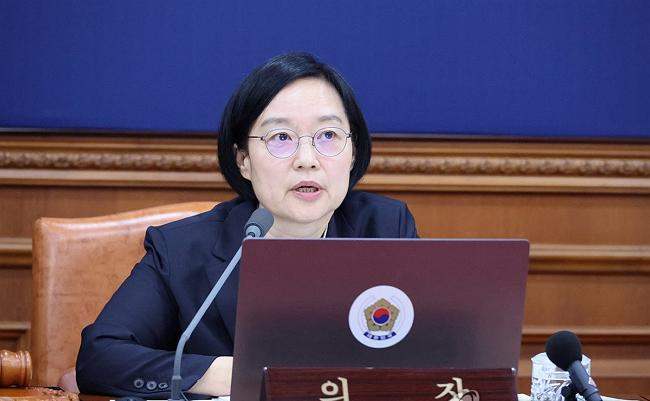 Prime Minister Han Seung-soo speaks at a Cabinet meeting held at the Government Complex Seoul in Jongno-gu, Seoul, on the 7th. [Photo = Yonhap News]June 30 Cabinet meeting shows no signs of deliberation on specific sites
The last regular Cabinet meeting held before the Gwangju Military Airport site decision was the 28th Cabinet meeting and Emergency Economic Review Meeting on June 30.
At that time, Lee Jae-myung instructed relevant ministries to provide full support for corporate investment activities related to the three major mega-projects. He also made remarks to the effect that the Honam region has more capacity for power, water, and land than the capital region, making large-scale semiconductor investment possible.
However, the disclosed opening remarks contain no mention of selecting Gwangju Military Airport as a specific site or deliberating on its feasibility.
In the results material for the 28th Cabinet meeting released by the Office for Government Policy Coordination, the decision on the Gwangju Military Airport site was not presented as an item for deliberation, resolution, discussion, or report.
The Cabinet meeting that day deliberated and passed 30 legislative promulgations, 2 bills, 7 presidential decrees, and 4 general items. It discussed responses to the Middle East conflict and received reports on “strengthening the bargaining power of the ‘minority’” and the “Comprehensive Plan for the Development of the Social Solidarity Economy,” but no decision on the Gwangju Military Airport site was identified in the public agenda.
While the possibility of undisclosed meeting materials or separate non-public discussions cannot be entirely ruled out, it cannot be concluded at this stage that any Cabinet deliberation took place.
However, it is difficult to find any record in the Cabinet meeting agendas, results, or related briefings released by the government that the decision to designate Gwangju Military Airport as the Honam semiconductor industrial complex site was deliberated in advance.
Conversely, in its July 6 briefing, the government clearly specified the venue and timing of the decision as “today’s meeting,” i.e., the public-private joint review meeting chaired by Lee Jae-myung.
Did the public-private meeting decision block Cabinet members’ deliberation rights; abuse of power?
The July 6 public-private joint meeting was attended by ministers of economy, industry, land, environment, education, budget, and defense, as well as representatives from Samsung Electronics and SK Hynix. However, the fact that several Cabinet members were present at a single meeting does not make that meeting a "Cabinet meeting" under the Constitution and Cabinet regulations.
Cabinet meetings are conducted according to established formats and procedures, including formal submission of agenda items, advance review, distribution of agendas, and legal quorum requirements.
Cabinet regulations dictate that important national policies must be sufficiently deliberated at the whole-of-government level and require that matters subject to constitutional deliberation be submitted as agenda items.
Article 89 of the Constitution specifies that basic national plans, general government policies, basic plans for the disposal of state property, important matters concerning finance, important military matters, and the establishment and coordination of important policies of each executive ministry are matters for Cabinet deliberation.
The decision on the Gwangju Military Airport site goes beyond a simple selection of an industrial complex location.
It is a matter simultaneously involving the relocation of active military facilities, the redeployment of the foundation for ROK-U.S. combined operations, the use of large-scale state-owned land, the input of national finances into power, water, and transportation networks, and policy coordination between the Ministry of National Defense, the Ministry of Industry, the Ministry of Land, Infrastructure and Transport, and fiscal authorities.
If the “decision” announced by the government was a final national policy binding relevant ministries, it is inevitable that critics would argue it should have undergone substantive deliberation at a Cabinet meeting as an important policy under the Constitution.
The Cabinet is a constitutional institution that does not merely receive reports on foregone conclusions, but one where Cabinet members, based on the expertise of their respective ministries, deliberate on important government policies by presenting financial, security, and legal risks, as well as alternatives.
If the public-private joint meeting first decided on the Gwangju Military Airport site and then directed relevant ministries to follow the candidate selection process, what remains for Cabinet members is not deliberating the site's suitability, but discussing how to execute a conclusion already reached.
In particular, the Minister of National Defense must independently review the military airport relocation and combined defense posture; fiscal authorities must independently review the state-borne costs and the necessity of preliminary feasibility studies; and the Ministry of Land, Infrastructure and Transport must independently review the industrial complex location and designation procedures. If the final conclusion was announced first, the actual opportunity for Cabinet members to suggest alternative sites or express dissenting opinions may have been limited.
However, the suspicion that deliberation rights of Cabinet members were infringed does not immediately imply the establishment of criminal abuse of power.
Whether the decision was a mandatory subject of Cabinet deliberation, whether prior deliberation was indeed absent, and whether Lee Jae-myung hindered the specific exercise of rights of Cabinet members by pre-determining the outcome are matters that require further verification. This is a point that requires a compulsory investigation.
On July 9, the Supreme Court confirmed a lower court ruling that recognized the Cabinet’s deliberation right in relation to the declaration of emergency martial law as the authority of Cabinet members, and upheld a guilty verdict for abuse of power against former President Yoon Suk-yeol.
Corporate opinions and meeting records must be disclosed
The government stated that businesses proposed Gwangju Military Airport as the most suitable site, but did not disclose which candidates were compared, what evaluation criteria were applied, or in what format Samsung Electronics and SK Hynix submitted their opinions.
It is also not confirmed in government announcements whether the two companies decided on or publicly disclosed investment plans for building fabs at the Gwangju Military Airport site. The 800 trillion won scale Southwest region investment plan announced by the government on June 29 did not present specific investment amounts per company, construction start dates, or detailed business plans.
Since the entire 800 trillion won is a private sector investment plan, it is not subject to direct preliminary feasibility studies. However, separate feasibility reviews and preliminary feasibility studies or exemption procedures may apply to individual national fiscal projects such as military airport relocation and power, water, roads, and railways. At present, even the scale of the government’s fiscal burden has not been disclosed, leaving insufficient data to judge this.
To resolve these suspicions, the government must first clarify whether the Gwangju Military Airport site was deliberated at the June 30 Cabinet meeting. It must also disclose what data and legal basis were used to decide the site at the July 6 public-private joint meeting. Corporate opinion papers, candidate comparative evaluation data, the military airport relocation schedule, details of ROK-U.S. consultations, the industrial complex development plan, and the national fiscal burden are all subjects for disclosure.
The policy of fostering the semiconductor industry in the Honam region itself is not the problem. The problem is whether the political decision was made before reviewing corporate demand and investment capacity, the feasibility of the new military airport relocation, resident consent, ROK-U.S. military consultations, and the burden on power, water, and national finances.
While the government states that the candidate selection process has not ended, it has already “decided” on Gwangju Military Airport at the public-private joint meeting. Whether the Cabinet meeting, inter-ministerial consultations, and statutory deliberations were intended as a process to determine the site, or merely to provide an administrative and legal facade to a pre-determined site, must be answered by meeting minutes and documents.
※ Editor’s Note = This article was written based on data released by the government, the Ministry of National Defense, and the U.S. Air Force, as well as Cabinet meeting results and relevant laws as of July 12, 2026. The factual and legal assessment may change if undisclosed Cabinet deliberation materials or corporate investment commitment documents are verified.

 Iranian Foreign Ministry: "Continuing Message Exchanges with the U.S. and Activities of Mediating Countries"
Esmaeil Baghaei, Spokesperson for the Iranian Ministry of Foreign Affairs [Xinhua, Yonhap News file photo]Esmaeil Baghaei, spokesperson for the Iranian Ministry of Foreign Affairs, stated on the 26th
Iranian Foreign Ministry: "Continuing Message Exchanges with the U.S. and Activities of Mediating Countries"
Esmaeil Baghaei, Spokesperson for the Iranian Ministry of Foreign Affairs [Xinhua, Yonhap News file photo]Esmaeil Baghaei, spokesperson for the Iranian Ministry of Foreign Affairs, stated on the 26th
 President Yoon: "Do You Think You Are Safe from the Special Counsel?"... Final Statement Video Released
President Yoon Suk Yeol rebuking the special prosecutor on the 24th. [Court video / @birds_justice X account subtitle GIF] A video of President Yoon Suk Yeol's closing statement at his trial rega
President Yoon: "Do You Think You Are Safe from the Special Counsel?"... Final Statement Video Released
President Yoon Suk Yeol rebuking the special prosecutor on the 24th. [Court video / @birds_justice X account subtitle GIF] A video of President Yoon Suk Yeol's closing statement at his trial rega
 President Yoon, regarding the first-instance ruling on the Public Official Election Act: “An excessive political verdict that distorts the facts… We will appeal immediately.”
The first-instance sentencing hearing for President Yoon Suk Yeol regarding violations of the Public Official Election Act is being broadcast live at Seoul Station on the 27th. [Photo=Yonhap News]Pres
President Yoon, regarding the first-instance ruling on the Public Official Election Act: “An excessive political verdict that distorts the facts… We will appeal immediately.”
The first-instance sentencing hearing for President Yoon Suk Yeol regarding violations of the Public Official Election Act is being broadcast live at Seoul Station on the 27th. [Photo=Yonhap News]Pres
 WSJ: "SK Hynix ADR Premium Is a Sign of AI Trading Overheat"
Advertisement for SK Hynix ADR listing in New York's Times Square [Reuters=Yonhap News file photo]The Wall Street Journal (WSJ) has pointed out that the price of SK Hynix’s American Depositary Recei
WSJ: "SK Hynix ADR Premium Is a Sign of AI Trading Overheat"
Advertisement for SK Hynix ADR listing in New York's Times Square [Reuters=Yonhap News file photo]The Wall Street Journal (WSJ) has pointed out that the price of SK Hynix’s American Depositary Recei
 'Godfather of Japanese Mystery Novels' Keigo Higashino Passes Away After Battle with Cancer at 68
Famous Japanese mystery novelist Keigo Higashino [AFP=Yonhap News]It has been belatedly reported that Keigo Higashino, the "godfather of Japanese mystery novels" and author of bestsellers such as "The
'Godfather of Japanese Mystery Novels' Keigo Higashino Passes Away After Battle with Cancer at 68
Famous Japanese mystery novelist Keigo Higashino [AFP=Yonhap News]It has been belatedly reported that Keigo Higashino, the "godfather of Japanese mystery novels" and author of bestsellers such as "The
 [Park Pil-kyu Security Column] To the Ignorant Trying to Clothe a Beast in Sheep's Clothing
Rep. Kim Byung-joo of the Democratic Party of Korea [Photo=Yonhap News]“The Air Force Academy doesn't teach you how to fly a plane!” “The Army, Navy, and Air Force academies are exactly the
[Park Pil-kyu Security Column] To the Ignorant Trying to Clothe a Beast in Sheep's Clothing
Rep. Kim Byung-joo of the Democratic Party of Korea [Photo=Yonhap News]“The Air Force Academy doesn't teach you how to fly a plane!” “The Army, Navy, and Air Force academies are exactly the
 [Issue Diagnosis] Two Effects of the Election Petition Review
 [Photo] Evidence of Election Fraud Flooding U.S. Media… Trump Had 2.7 Million Votes Stolen
 [Video] U.S. Semiquincentennial Air Show... 'Art in the Sky' streaks across New York
 [Editorial Cartoon] A Draconian Law That Undermines Freedom of Expression

 List
List










