 While demand from AI data centers is driving the memory market, the entry of new capacity after 2027 makes it increasingly likely that supply and demand dynamics will diverge by product type around 2030. [Photo = Hanmi Ilbo Graphics]The current memory supercycle is likely to continue until 2027. However, as new domestic and international production capacity gradually enters the market, the period around 2029–2030 is more likely to shift into a market where supply and demand conditions vary between HBM/server-use products and general-purpose products, rather than a broad-based boom where all products rise in tandem.
As AI data centers expand rapidly, both the volume and prices of server DRAM, high-bandwidth memory (HBM), and enterprise storage devices are on the rise. Conversely, new factory and packaging facility supplies are set to enter the market starting in 2027.
Synthesizing currently public demand and supply plans, while tight supply-demand conditions may persist for HBM and advanced server DRAM, there is a possibility that supply will catch up with demand for general-purpose DRAM and NAND as new production capacity accumulates.
Semiconductor exports up 162%... Price impact greater than volume
In the first half of 2026, South Korea's information and communications technology (ICT) exports reached $253.86 billion, a 120.5% increase compared to the same period last year. Semiconductor exports rose 162.5% to $192.43 billion, while memory exports increased by 245.1% to $163.73 billion. Exports of computers and peripherals also surged by 233.8% due to the strong performance of SSDs.
The government cited increased memory demand and rising prices resulting from expanded investment in AI servers as the primary drivers.
However, the increase in export value should not be interpreted purely as an increase in volume. The 162.5% figure announced by the government is the growth rate in dollar-denominated export value. Estimates that global DRAM bit shipments would increase by the low-to-mid 20% range and NAND by about 20% are projections for the 2026 global market provided by U.S. memory manufacturer Micron. These are not government statistics indicating that South Korea's semiconductor export volume itself grew by 20%.
It is clear that volume growth was involved. Micron projected that bit shipments for data center DRAM and NAND in 2026 would more than double compared to 2024, and total server shipments would grow by the high teens.
However, the price impact was greater than the volume effect. In Micron's fiscal Q3 2026 earnings, DRAM bit shipments grew by a low single-digit percentage compared to the previous quarter, while the average selling price (ASP) rose by a low 60% range. For NAND, shipments grew by a mid-single-digit percentage, but the ASP jumped by a mid-80% range.
The recent surge in memory revenue and profit is the result of a combination of volume expansion, price hikes, and an increased share of high-value products like HBM.
Data center power consumption to more than double by 2030
A relatively independent indicator of the sustainability of AI data center demand is power consumption.
The International Energy Agency (IEA) projects that global data center power consumption will grow by an average of about 15% per year from 2024 to 2030, reaching approximately 945 terawatt-hours by 2030—more than double the 2024 level.
Power consumption for AI-accelerated servers is expected to grow by about 30% annually over the same period, while general servers are expected to grow by about 9%. The projection suggests that AI-accelerated servers will account for nearly half of the net increase in global data center power consumption.
Applying the 30% annual growth rate, the power consumption of AI-accelerated servers will grow about 4.8 times between 2024 and 2030. However, this cannot be interpreted as the number of servers or accelerators increasing by 4.8 times, as the computational performance and energy efficiency of semiconductors improve and equipment configurations vary across data centers.
What matters is that the global data center power consumption scale is highly likely to more than double by 2030, and AI computing facilities are likely to account for a significant portion of that increase.
AI servers use more DRAM and storage devices than general servers. As accelerator generations evolve, the HBM capacity mounted on each accelerator also increases. It is a structure where both the number of servers and the memory capacity per unit are increasing simultaneously.
Alphabet, Meta, and Amazon also plan to significantly increase their capital expenditures (CAPEX) in 2026. While these investments include logistics facilities, robotics, and communication networks, and cannot be viewed entirely as data center investments, the fact that each company has presented AI infrastructure and data centers as the key context for these investment expansions supports the sustainability of demand.
Although precise memory bit demand cannot be calculated using only public data, it is highly likely that demand for HBM, server DRAM, and enterprise SSDs will continue to expand for a long period.
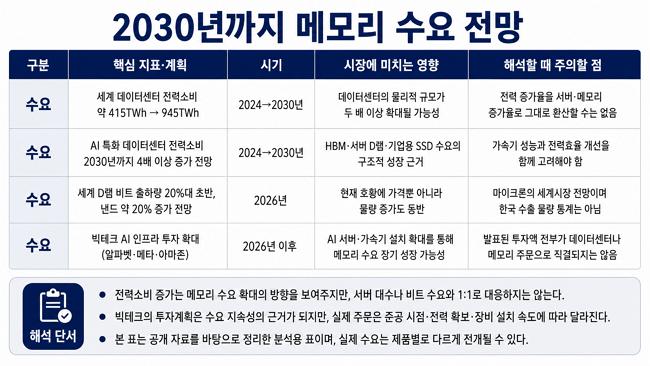 Memory demand outlook through 2030. Data center power consumption and AI infrastructure investment support the long-term growth potential of memory demand. However, power growth rates cannot be directly converted into server unit counts or bit demand. [Photo = Hanmi Ilbo Graphics]Will supply shortages ease with new fabs after 2027?
In the short term, the outlook for supply shortages remains dominant.
Micron has projected that as AI spreads not only to data centers but also to PCs, smartphones, automobiles, and robotics, demand for DRAM and NAND is outpacing supply, and tight conditions will likely persist beyond 2027.
However, this is the memory suppliers' own outlook. It must be considered that suppliers have an incentive to describe the supply-demand situation optimistically in terms of price and profitability.
Nevertheless, there are structural reasons why supply is difficult to increase rapidly.
HBM requires more wafer production capacity than general-purpose DRAM and involves complex processes like DRAM chip stacking and advanced packaging. As the share of HBM production increases, the volume allocated to general-purpose DRAM may be restricted even if total DRAM production capacity grows.
 Three pillars of investment determining memory supply-demand. Front-end processes directly increase DRAM/NAND bit supply, while HBM back-end processes alleviate stacking and packaging bottlenecks. AI logic/accelerator investment stimulates demand by expanding servers, not memory supply. [Photo = Hanmi Ilbo Graphics]Transitions to finer process nodes have also become more complex. Even if new cleanrooms and equipment investments increase, production capacity does not immediately translate into effective bit supply.
However, supply shortages will not last forever. The effects of factories already under construction and equipment investments will begin to appear from 2027.
In South Korea, SK Hynix's Cheongju M15X will expand next-generation DRAM production capacity before the Yongin site. The M15X is planned as a production base for next-generation DRAM including HBM, while the first fab of the Yongin Semiconductor Cluster is aiming for completion in May 2027.
Micron plans to produce its first wafers at its Idaho Fab 1 in mid-2027 and at Fab 2 in late 2028. The Taichung plant in Taiwan will begin meaningful shipments from mid-2027, and the advanced packaging facility in Singapore is expected to contribute to HBM supply starting in the first half of 2027.
Japan's Kioxia and SanDisk began operating the Kitakami No. 2 NAND fab in September 2025. SK Hynix also plans to build an HBM advanced packaging facility in Indiana, USA, with operations expected to start in the second half of 2028.
Fab completion and actual supply increases do not happen simultaneously. Because equipment installation, test production, customer certification, and yield stabilization are required, supply increases over the course of several years.
Memory supply must be viewed in terms of front-end capabilities for DRAM/NAND wafer production, HBM stacking and packaging capabilities, and bit-per-wafer increases driven by process migration and yield improvement.
Since Samsung Electronics has not provided specific details regarding fab-specific products, capacity, and operational schedules, there are limits to accurately calculating global memory supply.
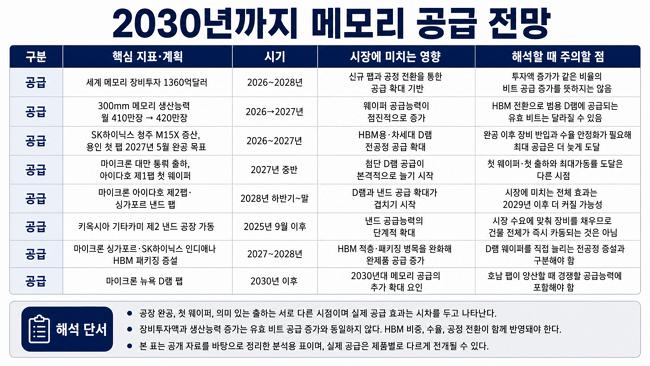 Memory supply outlook through 2030. New domestic and international fabs and HBM packaging expansions are factors for supply growth after 2027. However, factory completion and actual effective supply increases do not occur at the same time. [Photo = Hanmi Ilbo Graphics]
Supply effect to materialize in 2029–2030
SEMI (Semiconductor Equipment and Materials International) projects that global 300mm fab equipment investment in the memory sector will reach $175 billion from 2027 to 2029, with $111 billion for DRAM and $62 billion for 3D NAND.
Global 300mm memory production capacity is expected to increase from 4.1 million wafers per month in 2026 to 4.2 million wafers per month in 2027. Memory equipment investment is also forecast to rise from $52 billion in 2026 to $57 billion in 2027, nearing $80 billion by 2029.
Equipment investment and wafer production capacity increases cannot be directly converted into effective bit supply growth rates. Factors such as HBM production share, process complexity, yield, and equipment installation timing will determine the actual supply.
Synthesizing the disclosed schedules, demand is highly likely to exceed supply in 2026–2027. Starting in 2027–2028, volume from SK Hynix and Micron’s new fabs and HBM packaging facilities will begin to enter the market.
By 2029–2030, the supply effect may become more pronounced as the yield of previously installed equipment and new fabs stabilizes. Beyond 2030, even more supply could enter from Micron's New York plant and subsequent domestic and international fabs.
The first phase of easing the current supply shortage is likely to occur around 2028, and the point where the supply expansion effect becomes clearly visible across the entire market is highly likely to be 2029–2030.
Supercycle to differentiate by product after 2027
It is difficult to calculate total 2030 memory demand and supply as a single number using only currently available data, as companies do not disclose wafer capacity, product mix, yield, or bit-growth rates by fab.
Nevertheless, a basic scenario for each product type can be derived.
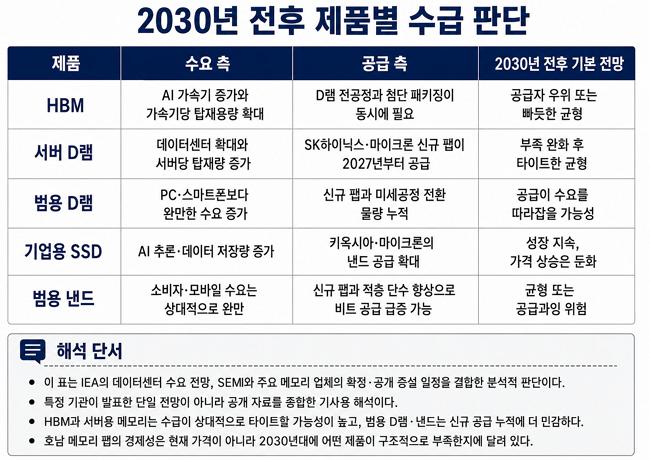
For HBM, demand is increasing rapidly due to the growth of AI accelerators and the expansion of capacity per accelerator. To expand supply, companies must simultaneously secure advanced DRAM front-end processes and stacking/packaging capabilities.
Therefore, it is highly likely that HBM will remain tighter in supply than other memory types even in 2030. This suggests a supplier-dominant or tightly balanced outlook, rather than the continuation of current price spikes.
Advanced server DRAM will also be supported by data center expansion and increased capacity per server. While new DRAM fabs will begin contributing to supply from 2027, relatively firm supply-demand balance is expected when considering AI server demand and the cannibalization effect on general-purpose DRAM capacity due to HBM production.
For general-purpose DRAM, while demand for PCs and smartphones is growing relatively moderately, volume from new front-end fabs and process migrations will accumulate after 2028. It is possible that the market will shift away from the current extreme shortages to a normal price and inventory cycle.
For NAND, demand for enterprise SSDs is increasing due to AI inference and data storage requirements. However, storage capacity per wafer can be expanded rapidly through both new fabs and by increasing the number of layers and bit density.
Even if the enterprise SSD market grows, the risk that supply will catch up to or exceed demand for general-purpose NAND is relatively higher than for DRAM.
Ultimately, the memory supercycle is more likely to differentiate by product type after 2027 rather than ending for all products simultaneously.
While tight supply-demand conditions may persist for HBM and advanced server DRAM for the long term, the basic scenario based on currently available data is that general-purpose DRAM and NAND will return to a normal price and inventory cycle around 2029–2030.
This is an analytical judgment based on a synthesis of the IEA’s data center power outlook, memory companies’ bit demand forecasts, and domestic and international fab operational schedules and investment plans, rather than a single forecast published by a specific organization.

 Iranian Foreign Ministry: "Continuing Message Exchanges with the U.S. and Activities of Mediating Countries"
Esmaeil Baghaei, Spokesperson for the Iranian Ministry of Foreign Affairs [Xinhua, Yonhap News file photo]Esmaeil Baghaei, spokesperson for the Iranian Ministry of Foreign Affairs, stated on the 26th
Iranian Foreign Ministry: "Continuing Message Exchanges with the U.S. and Activities of Mediating Countries"
Esmaeil Baghaei, Spokesperson for the Iranian Ministry of Foreign Affairs [Xinhua, Yonhap News file photo]Esmaeil Baghaei, spokesperson for the Iranian Ministry of Foreign Affairs, stated on the 26th
 President Yoon: "Do You Think You Are Safe from the Special Counsel?"... Final Statement Video Released
President Yoon Suk Yeol rebuking the special prosecutor on the 24th. [Court video / @birds_justice X account subtitle GIF] A video of President Yoon Suk Yeol's closing statement at his trial rega
President Yoon: "Do You Think You Are Safe from the Special Counsel?"... Final Statement Video Released
President Yoon Suk Yeol rebuking the special prosecutor on the 24th. [Court video / @birds_justice X account subtitle GIF] A video of President Yoon Suk Yeol's closing statement at his trial rega
 President Yoon, regarding the first-instance ruling on the Public Official Election Act: “An excessive political verdict that distorts the facts… We will appeal immediately.”
The first-instance sentencing hearing for President Yoon Suk Yeol regarding violations of the Public Official Election Act is being broadcast live at Seoul Station on the 27th. [Photo=Yonhap News]Pres
President Yoon, regarding the first-instance ruling on the Public Official Election Act: “An excessive political verdict that distorts the facts… We will appeal immediately.”
The first-instance sentencing hearing for President Yoon Suk Yeol regarding violations of the Public Official Election Act is being broadcast live at Seoul Station on the 27th. [Photo=Yonhap News]Pres
 WSJ: "SK Hynix ADR Premium Is a Sign of AI Trading Overheat"
Advertisement for SK Hynix ADR listing in New York's Times Square [Reuters=Yonhap News file photo]The Wall Street Journal (WSJ) has pointed out that the price of SK Hynix’s American Depositary Recei
WSJ: "SK Hynix ADR Premium Is a Sign of AI Trading Overheat"
Advertisement for SK Hynix ADR listing in New York's Times Square [Reuters=Yonhap News file photo]The Wall Street Journal (WSJ) has pointed out that the price of SK Hynix’s American Depositary Recei
 'Godfather of Japanese Mystery Novels' Keigo Higashino Passes Away After Battle with Cancer at 68
Famous Japanese mystery novelist Keigo Higashino [AFP=Yonhap News]It has been belatedly reported that Keigo Higashino, the "godfather of Japanese mystery novels" and author of bestsellers such as "The
'Godfather of Japanese Mystery Novels' Keigo Higashino Passes Away After Battle with Cancer at 68
Famous Japanese mystery novelist Keigo Higashino [AFP=Yonhap News]It has been belatedly reported that Keigo Higashino, the "godfather of Japanese mystery novels" and author of bestsellers such as "The
 [Park Pil-kyu Security Column] To the Ignorant Trying to Clothe a Beast in Sheep's Clothing
Rep. Kim Byung-joo of the Democratic Party of Korea [Photo=Yonhap News]“The Air Force Academy doesn't teach you how to fly a plane!” “The Army, Navy, and Air Force academies are exactly the
[Park Pil-kyu Security Column] To the Ignorant Trying to Clothe a Beast in Sheep's Clothing
Rep. Kim Byung-joo of the Democratic Party of Korea [Photo=Yonhap News]“The Air Force Academy doesn't teach you how to fly a plane!” “The Army, Navy, and Air Force academies are exactly the
 [Issue Diagnosis] Two Effects of the Election Petition Review
 [Photo] Evidence of Election Fraud Flooding U.S. Media… Trump Had 2.7 Million Votes Stolen
 [Video] U.S. Semiquincentennial Air Show... 'Art in the Sky' streaks across New York
 [Editorial Cartoon] A Draconian Law That Undermines Freedom of Expression

 List
List









