 Maeng Jeong-seop, a former Chungju mayoral candidate for the Democratic Party of Korea who filed an election appeal, protests while demanding the disclosure of CCTV footage and ballot image scan files. [Photo = Capture from Seoul Shinmun YouTube channel]
The outcome of the Chungju mayoral election remains unchanged. However, suspicions regarding election fraud have not been resolved.
This is because while the Chungcheongbuk-do Election Commission recounted all 108,077 physical ballots, it rejected requests for on-site disclosure and verification of the CCTV footage and ballot scanner image scan files (ISF) that would have allowed for an examination of the original counting process.
The result was re-verified, but the process was not. The Election Commission squandered an opportunity to clear up suspicions and restore public trust in the election by its own actions.
On the 15th, the Chungbuk Provincial Election Commission conducted a ballot verification at the multipurpose auditorium of Korea National University of Transportation in Chungju, following an appeal to invalidate the Chungju mayoral election. The process involved 47 election officials manually counting 108,077 ballots from 18 ballot boxes, one by one.
The recount results showed that Chungju Mayor Lee Dong-seok of the People Power Party received 52,961 votes—one fewer than in the original count—while former Democratic Party candidate Maeng Jeong-seop received 52,839 votes, an increase of one. The gap between the two candidates narrowed from 124 to 122 votes. The number of invalid ballots remained unchanged at 2,277, meaning the election outcome was unaffected.
A change of two votes alone does not constitute proof of election fraud, as determinations of valid votes or candidate classifications may differ between the initial count and the recount. However, if the initial results and the recount results do not match, there must be an explanation as to why the judgment of those specific ballots changed.
In particular, the 2,277 invalid ballots are more than 18 times the final margin of 122 votes. Candidate Maeng filed the appeal for invalidation citing, among other reasons, an excessive number of invalid ballots, and he pre-paid 54.87 million won for the cost of the recount.
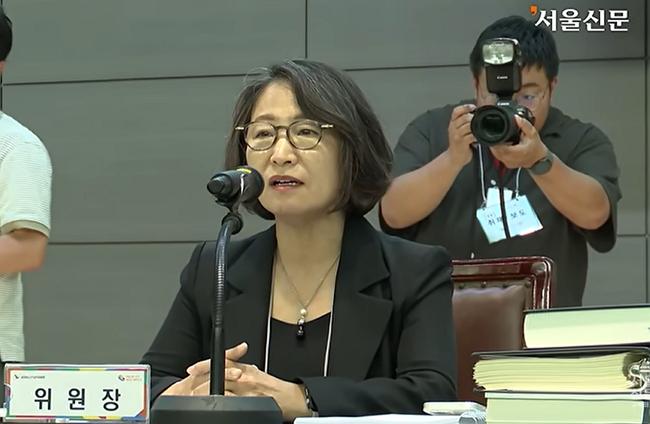 Jo Mi-yeon, Chairperson of the Chungbuk Provincial Election Commission, stops protests to proceed with the recount. [Photo = Capture from Seoul Shinmun YouTube channel]
Ballots opened, but verification data kept closed
The controversy arose even before the recount began.
Former candidate Maeng requested that Jo Mi-yeon, Chairperson of the Chungbuk Provincial Election Commission, release the CCTV footage and ballot image scan files from the original count. Chairperson Jo replied, "This recount is a session for recounting ballot papers, not a venue for requesting CCTV footage, so please utilize other procedures."
When Maeng continued to press his request, Chairperson Jo warned him of eviction, and eventually, police removed him from the recount site. Observers blocked the opening of the ballot boxes, causing the recount to start 30 minutes behind schedule.
There is merit in the Election Commission's stance that order must be maintained at the recount site and established procedures followed. The petitioner and observers also have a responsibility to comply with the Chairperson’s direction and the recount process.
However, whether or not there was a disturbance at the site is a separate issue from whether there is a need to verify CCTV and image files. Questioning the appropriateness of the petitioner's behavior cannot serve as a substitute for answering the request for the disclosure of data.
Although Chairperson Jo is the incumbent Chief Judge of the Cheongju District Court, she carried out the evidentiary proceedings for the election appeal in her capacity as the Chairperson of the Chungbuk Provincial Election Commission. Therefore, this judgment represents a decision by the Chungbuk Provincial Election Commission to limit the scope of verification in the appeal process to physical ballots.
Upon being elected as Chairperson of the Chungbuk Provincial Election Commission in 2025, Jo stated, "I will manage elections accurately and transparently in accordance with the law and principles."
Verifying election outcomes is different from verifying the counting process
The manual recount of physical ballots is a procedure to re-determine which candidate a currently stored ballot belongs to and to confirm the final totals.
On the other hand, CCTV footage is data used to confirm the order and path by which ballot boxes and ballots were moved, stored, and handled at the counting site. Ballot image scan files are records that allow one to cross-reference how the ballot scanners read and classified each ballot during the original count against the physical ballots and final totals.
These datasets serve different purposes. Just because the recount of physical ballots maintained the election outcome does not automatically resolve questions regarding the process of moving, scanning, classifying, judging, and aggregating the ballots.
For the Election Commission to claim that "Mayor Lee Dong-seok’s election remains valid," this recount might be sufficient. However, to claim that "there were no issues with the original counting process," it must cross-reference not only the physical ballots but also the CCTV footage, image files, and the vote counting reports.
Disclosing data does not equate to proving election fraud. In fact, if the CCTV and image files all align with the physical ballots and aggregate records, they would serve as the strongest evidence supporting the Election Commission's position.
Yet, the Election Commission chose not to take that opportunity. They merely stated, "Use other procedures," without explaining what those procedures are, whether the materials are currently preserved, or whether the Chungbuk Provincial Election Commission intends to conduct separate evidentiary investigations.
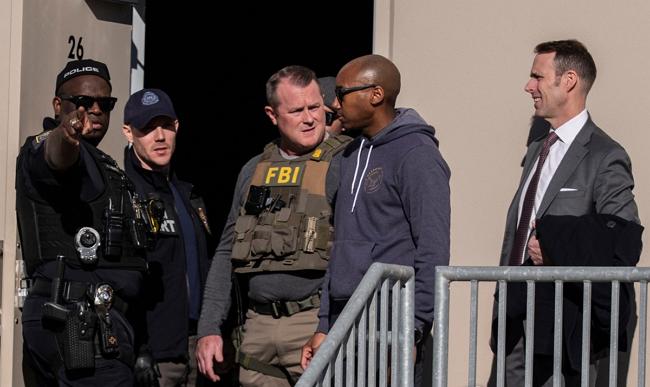 On January 28, the FBI raided the Fulton County Election Commission in Georgia and seized hundreds of boxes of election-related records. They plan to announce the investigation results on July 17 (Korea Standard Time). [Photo = Yonhap News]Fulton County did not just recount physical ballots
The significance of the case in Fulton County, Georgia, lies not in whether there was fraud, but in the verification method used.
In January 2026, the U.S. Federal Bureau of Investigation (FBI) obtained a court warrant to secure approximately 600 boxes of materials related to the 2020 presidential election stored by Fulton County. The scope included not only the original paper ballots but also digital ballot images and voter registration records.
The structure is designed not just to recount the number of physical ballots, but to cross-reference the physical ballots, digital images, and election records to verify suspicions such as missing images.
There is fierce debate within the United States regarding the grounds for the Fulton County investigation and its political neutrality. It cannot be concluded that election fraud has been confirmed in Fulton County or that the legitimacy of the FBI's investigation has been established.
However, the difference in verification methods is clear.
"If you want to verify the result, you can recount the ballots. If you want to verify the process, you must cross-reference physical ballots with images, footage, and aggregate records."
The Chungbuk Provincial Election Commission only recounted the physical ballots. A recount that fails to cross-reference CCTV footage and ballot image files can confirm the outcome, but it is insufficient to resolve the suspicions raised about the original counting process.
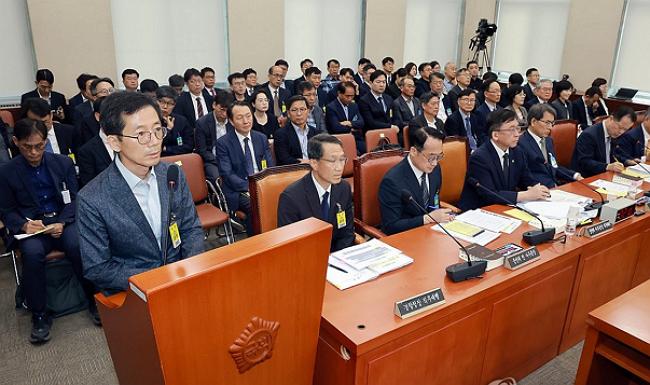 Witnesses attending the first hearing of the Special Committee on the National Assembly's investigation into the Election Commission. [Photo = Yonhap News]A closed door to verification even during a parliamentary investigation
The decision made by the Chungbuk Provincial Election Commission is not a matter limited to a single local election appeal.
At the National Assembly, a parliamentary investigation is underway to uncover the truth behind the infringement of voting rights, such as the ballot paper shortage during the June 3rd local elections, and to pursue reforms in election management. The necessity for public verification and a special counsel has become a key agenda in political circles.
The preservation, disclosure, and external verification of election records are more critical than ever. Yet, the Chungbuk Provincial Election Commission only recounted physical ballots and refused demands for on-site verification of the CCTV footage and ballot image files that would confirm the original count.
If they had disclosed the data to prove that there were no problems, the controversy could have been largely resolved. Conversely, if problems were identified in the data, they could have been rectified and those responsible held accountable. In either case, disclosure and verification are the starting point for restoring trust in elections.
The mere fact that data was not disclosed is not proof of election fraud. However, if one is asked to trust the results without being able to verify the available data, suspicions will not vanish. Instead, it leaves the public with only one question:
"What are you afraid of that prevents you from allowing verification?"
Trust in elections is not built by simply saying, "Please trust us." It is formed when records are preserved, disclosed, and cross-referenced so that anyone can reach the same conclusion.
The Chungbuk Provincial Election Commission recounted 108,077 ballots to confirm the election outcome. However, it did not verify the original counting process, which is what the public demanded to see. This is why the responsibility for missing the best opportunity to clear suspicions of election fraud cannot be placed solely on the candidate who raised the concerns or the public.

 Iranian Foreign Ministry: "Continuing Message Exchanges with the U.S. and Activities of Mediating Countries"
Esmaeil Baghaei, Spokesperson for the Iranian Ministry of Foreign Affairs [Xinhua, Yonhap News file photo]Esmaeil Baghaei, spokesperson for the Iranian Ministry of Foreign Affairs, stated on the 26th
Iranian Foreign Ministry: "Continuing Message Exchanges with the U.S. and Activities of Mediating Countries"
Esmaeil Baghaei, Spokesperson for the Iranian Ministry of Foreign Affairs [Xinhua, Yonhap News file photo]Esmaeil Baghaei, spokesperson for the Iranian Ministry of Foreign Affairs, stated on the 26th
 President Yoon: "Do You Think You Are Safe from the Special Counsel?"... Final Statement Video Released
President Yoon Suk Yeol rebuking the special prosecutor on the 24th. [Court video / @birds_justice X account subtitle GIF] A video of President Yoon Suk Yeol's closing statement at his trial rega
President Yoon: "Do You Think You Are Safe from the Special Counsel?"... Final Statement Video Released
President Yoon Suk Yeol rebuking the special prosecutor on the 24th. [Court video / @birds_justice X account subtitle GIF] A video of President Yoon Suk Yeol's closing statement at his trial rega
 President Yoon, regarding the first-instance ruling on the Public Official Election Act: “An excessive political verdict that distorts the facts… We will appeal immediately.”
The first-instance sentencing hearing for President Yoon Suk Yeol regarding violations of the Public Official Election Act is being broadcast live at Seoul Station on the 27th. [Photo=Yonhap News]Pres
President Yoon, regarding the first-instance ruling on the Public Official Election Act: “An excessive political verdict that distorts the facts… We will appeal immediately.”
The first-instance sentencing hearing for President Yoon Suk Yeol regarding violations of the Public Official Election Act is being broadcast live at Seoul Station on the 27th. [Photo=Yonhap News]Pres
 WSJ: "SK Hynix ADR Premium Is a Sign of AI Trading Overheat"
Advertisement for SK Hynix ADR listing in New York's Times Square [Reuters=Yonhap News file photo]The Wall Street Journal (WSJ) has pointed out that the price of SK Hynix’s American Depositary Recei
WSJ: "SK Hynix ADR Premium Is a Sign of AI Trading Overheat"
Advertisement for SK Hynix ADR listing in New York's Times Square [Reuters=Yonhap News file photo]The Wall Street Journal (WSJ) has pointed out that the price of SK Hynix’s American Depositary Recei
 'Godfather of Japanese Mystery Novels' Keigo Higashino Passes Away After Battle with Cancer at 68
Famous Japanese mystery novelist Keigo Higashino [AFP=Yonhap News]It has been belatedly reported that Keigo Higashino, the "godfather of Japanese mystery novels" and author of bestsellers such as "The
'Godfather of Japanese Mystery Novels' Keigo Higashino Passes Away After Battle with Cancer at 68
Famous Japanese mystery novelist Keigo Higashino [AFP=Yonhap News]It has been belatedly reported that Keigo Higashino, the "godfather of Japanese mystery novels" and author of bestsellers such as "The
 [Park Pil-kyu Security Column] To the Ignorant Trying to Clothe a Beast in Sheep's Clothing
Rep. Kim Byung-joo of the Democratic Party of Korea [Photo=Yonhap News]“The Air Force Academy doesn't teach you how to fly a plane!” “The Army, Navy, and Air Force academies are exactly the
[Park Pil-kyu Security Column] To the Ignorant Trying to Clothe a Beast in Sheep's Clothing
Rep. Kim Byung-joo of the Democratic Party of Korea [Photo=Yonhap News]“The Air Force Academy doesn't teach you how to fly a plane!” “The Army, Navy, and Air Force academies are exactly the
 [Issue Diagnosis] Two Effects of the Election Petition Review
 [Photo] Evidence of Election Fraud Flooding U.S. Media… Trump Had 2.7 Million Votes Stolen
 [Video] U.S. Semiquincentennial Air Show... 'Art in the Sky' streaks across New York
 [Editorial Cartoon] A Draconian Law That Undermines Freedom of Expression

 List
List









