 Consultation between the ruling party and the government on fostering a smart elite military and the establishment of the Armed Forces Academy. (Seoul=Yonhap News) Reporter Bae Jae-man — Attendees including Han Byung-do, acting representative and floor leader of the Democratic Party of Korea, pose for a commemorative photo during a ruling party-government consultation on fostering a smart elite military and establishing the Armed Forces Academy held at the National Assembly Member's Office Building on the 16th. From the right: Han Jeoung-ae, Chair of the Democratic Party's Policy Committee; Han Byung-do, acting representative and floor leader; Ahn Gyu-baek, Minister of National Defense; and Jin Seong-jun, Chairman of the National Assembly National Defense Committee. 2026.7.16 scoop@yna.co.kr
The government announced on the 16th that it will establish a four-year Armed Forces Academy—integrating the existing Army, Navy, and Air Force academies—in Jaundae, Daejeon, an area concentrated with military education and training facilities.
The government and the ruling party held a consultation meeting at the National Assembly that morning and announced the basic plan for the establishment of the Armed Forces Academy.
Defense Minister Ahn Gyu-baek stated during the briefing, "The new Armed Forces Academy will be located in Jaundae, Daejeon," adding, "We will build a state-of-the-art smart campus at the heart of science and technology."
Minister Ahn emphasized, "The Armed Forces Academy will introduce autonomous and specialized academic operations that can fully unlock the potential of each individual cadet," and "We will design a curriculum that combines specialized military training with the cultivation of international competence."
He further stated, "We will design the curriculum to lead AI-based, multi-domain operations—including space, cyber, and electromagnetic spectrum—and to cultivate international expertise in preparation for the post-transfer of Wartime Operational Control (OPCON)."
The plan is for cadets to spend their four years training and living at Jaundae in Daejeon, while receiving specialized major education tailored to each service starting in their upper-class years.
A Ministry of National Defense official told reporters, "The concept is that cadets, having a foundation in the Armed Forces, will receive AI and multi-domain operation training in their first and second years, and service-specific education in their third and fourth years."
The expected architectural rendering released by the Ministry shows facilities for the "Armed Forces Academy Headquarters," the "Army School," the "Air Force School," and the "Navy School." The existing service academies are expected to be reorganized into departments under the umbrella of the Armed Forces Academy.
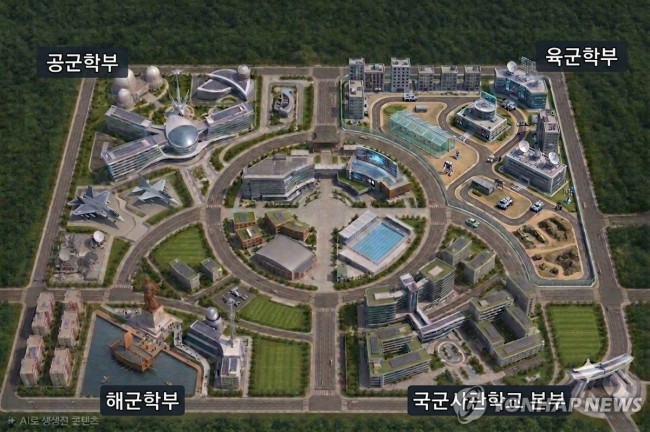 Ministry of National Defense announces basic plan for the establishment of the Armed Forces Academy as the first step in the grand reform of defense education. (Seoul=Yonhap News) The Ministry of National Defense announced that Defense Minister Ahn Gyu-baek presented the 'Basic Plan for the Establishment of the Armed Forces Academy' on the 16th to innovate the officer training system in response to changing future security environments. The photo shows an expected conceptual rendering of the Armed Forces Academy (Graphic). 2026.7.16 [Provided by the Ministry of National Defense. Resale and DB prohibited] photo@yna.co.kr
The government had initially considered a "2+2 approach"—common training at the Armed Forces Academy for the first two years, followed by specialized training at individual service branches—but shifted to a fully integrated four-year model to maintain cadet self-governance and other activities.
For recruitment, the government is considering a plan to determine the number of incoming cadets for the Army, Navy, and Air Force in advance, while also introducing a common recruitment quota.
To this end, they are pushing to increase the total number of recruits beyond the current level of approximately 735 (330 for the Army Academy, 230 for the Air Force Academy, and 170 for the Naval Academy).
The government also plans to increase the proportion of civilian professors, currently at only 24%, to over 50%, and ensure their compensation is on par with professors at national universities to attract top-tier talent. Currently, the majority of the faculty at military academies consist of active-duty officers or civilian military personnel.
The government did not disclose a specific target date for the enrollment of the first class of the Armed Forces Academy at this meeting.
A Ministry official noted that detailed plans will be released in October, adding, "In the meantime, we will gather opinions and hold public hearings. We aren't announcing a year yet because various opinions may emerge during that process."
However, it is reported that the government aims to speed up the legislation of the Armed Forces Academy Establishment Act within this year.
While there were views within the government that the first integrated class could potentially enroll as early as the 2028 academic year if legislation is completed this year, it appears they have decided to undergo a sufficient opinion-gathering process following concerns that students need adequate preparation time.
As it will take several years for the facilities at Jaundae to be completed, various plans are under review, including a phased relocation versus a relocation after total completion.
A Ministry official said, "We believe it would be best to conduct training at the new school starting from the first year if possible, and we are reviewing various alternatives alongside that option."
In the long term, the plan is to transform the 720,000-pyeong Jaundae site into a hub for defense education.
The Ministry of National Defense stated that it intends to develop the site into a "Mecca for Armed Forces Cultivation" by centering it on the Armed Forces Academy (Phase 1), followed by integrating other programs such as the Nursing Academy, Advanced Technology Academy, and ROTC/OCS programs (Phase 2), and finally incorporating the Joint Forces Military University and graduate schools.
![[Graphic] Armed Forces Academy Establishment Plan](/data/cheditor4/2607/GYH2026071600040004400_P2.jpg) [Graphic] Armed Forces Academy Establishment Plan (Seoul=Yonhap News) Reporter Kim Min-ji — The government announced on the 16th that it will establish a four-year Armed Forces Academy—integrating the existing Army, Navy, and Air Force academies—in Jaundae, Daejeon, an area concentrated with military education and training facilities.
[Graphic] Armed Forces Academy Establishment Plan (Seoul=Yonhap News) Reporter Kim Min-ji — The government announced on the 16th that it will establish a four-year Armed Forces Academy—integrating the existing Army, Navy, and Air Force academies—in Jaundae, Daejeon, an area concentrated with military education and training facilities.
A Ministry official added, "We will relocate the Army, Navy, and Air Force colleges currently at Jaundae to the Air Force Academy site in Cheongju to reintegrate them with the Joint Forces Military University, thereby accelerating the strengthening of joint military education. The Army Education Command and the Army Logistics School will be moved to Sangmudae (Jangseong, South Jeolla Province) to make it the hub of Army education."
The government also decided to prepare measures to preserve and utilize the existing service academy sites as commemorative spaces. This appears to be in response to public opinion that Hwarangdae, the site of the current Army Academy, is a "sacred ground for national defense" and should not be damaged.
The Ministry of National Defense plans to gather public feedback through parliamentary briefings and public hearings next week. To drive the integration of the academies, a new 'Advanced Education Policy Bureau' will be established as an organization dedicated to the reform of defense education.
Addressing the significant public opposition to the integration plan, Minister Ahn Gyu-baek added, "Reform must be based on the trust of the people. The Ministry of National Defense will actively gather public opinion with an open mind." [Yonhap News]

 Iranian Foreign Ministry: "Continuing Message Exchanges with the U.S. and Activities of Mediating Countries"
Esmaeil Baghaei, Spokesperson for the Iranian Ministry of Foreign Affairs [Xinhua, Yonhap News file photo]Esmaeil Baghaei, spokesperson for the Iranian Ministry of Foreign Affairs, stated on the 26th
Iranian Foreign Ministry: "Continuing Message Exchanges with the U.S. and Activities of Mediating Countries"
Esmaeil Baghaei, Spokesperson for the Iranian Ministry of Foreign Affairs [Xinhua, Yonhap News file photo]Esmaeil Baghaei, spokesperson for the Iranian Ministry of Foreign Affairs, stated on the 26th
 President Yoon: "Do You Think You Are Safe from the Special Counsel?"... Final Statement Video Released
President Yoon Suk Yeol rebuking the special prosecutor on the 24th. [Court video / @birds_justice X account subtitle GIF] A video of President Yoon Suk Yeol's closing statement at his trial rega
President Yoon: "Do You Think You Are Safe from the Special Counsel?"... Final Statement Video Released
President Yoon Suk Yeol rebuking the special prosecutor on the 24th. [Court video / @birds_justice X account subtitle GIF] A video of President Yoon Suk Yeol's closing statement at his trial rega
 President Yoon, regarding the first-instance ruling on the Public Official Election Act: “An excessive political verdict that distorts the facts… We will appeal immediately.”
The first-instance sentencing hearing for President Yoon Suk Yeol regarding violations of the Public Official Election Act is being broadcast live at Seoul Station on the 27th. [Photo=Yonhap News]Pres
President Yoon, regarding the first-instance ruling on the Public Official Election Act: “An excessive political verdict that distorts the facts… We will appeal immediately.”
The first-instance sentencing hearing for President Yoon Suk Yeol regarding violations of the Public Official Election Act is being broadcast live at Seoul Station on the 27th. [Photo=Yonhap News]Pres
 WSJ: "SK Hynix ADR Premium Is a Sign of AI Trading Overheat"
Advertisement for SK Hynix ADR listing in New York's Times Square [Reuters=Yonhap News file photo]The Wall Street Journal (WSJ) has pointed out that the price of SK Hynix’s American Depositary Recei
WSJ: "SK Hynix ADR Premium Is a Sign of AI Trading Overheat"
Advertisement for SK Hynix ADR listing in New York's Times Square [Reuters=Yonhap News file photo]The Wall Street Journal (WSJ) has pointed out that the price of SK Hynix’s American Depositary Recei
 'Godfather of Japanese Mystery Novels' Keigo Higashino Passes Away After Battle with Cancer at 68
Famous Japanese mystery novelist Keigo Higashino [AFP=Yonhap News]It has been belatedly reported that Keigo Higashino, the "godfather of Japanese mystery novels" and author of bestsellers such as "The
'Godfather of Japanese Mystery Novels' Keigo Higashino Passes Away After Battle with Cancer at 68
Famous Japanese mystery novelist Keigo Higashino [AFP=Yonhap News]It has been belatedly reported that Keigo Higashino, the "godfather of Japanese mystery novels" and author of bestsellers such as "The
 [Park Pil-kyu Security Column] To the Ignorant Trying to Clothe a Beast in Sheep's Clothing
Rep. Kim Byung-joo of the Democratic Party of Korea [Photo=Yonhap News]“The Air Force Academy doesn't teach you how to fly a plane!” “The Army, Navy, and Air Force academies are exactly the
[Park Pil-kyu Security Column] To the Ignorant Trying to Clothe a Beast in Sheep's Clothing
Rep. Kim Byung-joo of the Democratic Party of Korea [Photo=Yonhap News]“The Air Force Academy doesn't teach you how to fly a plane!” “The Army, Navy, and Air Force academies are exactly the
 [Issue Diagnosis] Two Effects of the Election Petition Review
 [Photo] Evidence of Election Fraud Flooding U.S. Media… Trump Had 2.7 Million Votes Stolen
 [Video] U.S. Semiquincentennial Air Show... 'Art in the Sky' streaks across New York
 [Editorial Cartoon] A Draconian Law That Undermines Freedom of Expression

 List
List









