 An image depicting China's political interference in the U.S. It symbolically illustrates how Chinese-originated cyberattacks targeted U.S. power institutions, including the White House and Congress. [Photo=Han-Mi Ilbo Graphic]
A declassified Central Intelligence Agency (CIA) report has revealed that the Chinese Communist Party (CCP) attempted to mobilize businesses, political donors, influential figures, and the media to reduce the vote count for then-U.S. President Donald Trump and prevent his reelection.
According to the report, a state-sponsored Chinese hacking group known as APT31 targeted the personal accounts of individuals within the White House, the executive branch, Congress, and the federal judiciary, while also gathering information from U.S. voter databases and polling firms. The campaign of Joe Biden, Trump’s opponent, was also among the targets.
China exerted pressure on Trump’s political base through tariffs, business transactions, donors, and the media, while simultaneously employing illicit cyber tactics against U.S. power institutions and potential future administrations. The declassified documents, released on the night of the 16th (local time), unveil a complex political operation that sought to undermine the current U.S. power structure while infiltrating the policy networks and human intelligence of the next potential leadership.
“Goal: Reduce votes and prevent Trump’s reelection”
The CIA’s “2018–2020 China-Related Sensitive Intelligence Report” states that by mid-2018, the CCP had initiated policies aimed at utilizing anti-Trump forces both inside and outside the U.S. to diminish his vote share, force his resignation, or block his reelection.
It is reported that China acted to influence the 2018 U.S. midterm elections and subsequently the outcome of the 2020 presidential election. To this end, they analyzed the results of the 2016 election to identify states that supported Trump and the key industries within those regions.
The CIA report suggests that China then sought to impose tariffs or create export disadvantages for these industries, causing economic losses and pressuring affected companies and industry leaders to demand policy changes from Trump.
The documents record that China's ultimate goal was to prevent Trump's reelection, noting that China viewed the unpredictability of the Trump administration as a significant source of instability.
In 2019, discussions even included deploying additional resources to key battleground states that would decide the election outcome and pressuring financial donors of the Trump reelection campaign. Tariffs and trade retaliation were not mere economic responses but were utilized as electoral tools to shake the foundation of Trump’s political support.
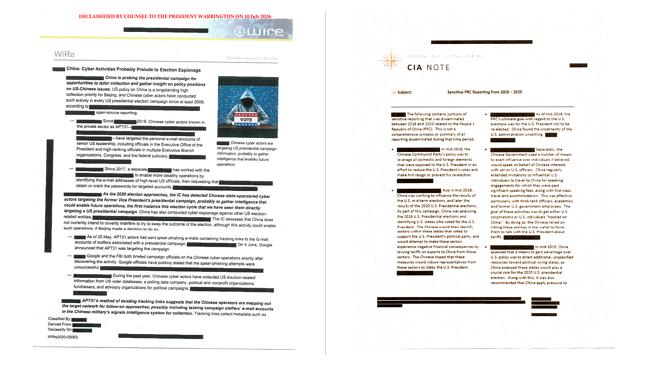 Declassified CIA documents released by the White House. The document on the left contains details about the Chinese Communist Party's attempts to reduce then-President Donald Trump's votes and prevent his reelection, while the one on the right details how the Chinese hacking group APT31 targeted the White House, Congress, the judiciary, and the Joe Biden campaign. [Photo=Screenshot of White House released documents]Mobilizing business contracts, speaking fees, and the media
China also attempted to use U.S. corporations and prominent individuals as conduits for political influence.
According to the CIA report, the Chinese government sought to leverage U.S. companies that held large-scale contracts in China, pushing corporate leaders to turn against Trump. They used market access and corporate contracts as leverage to force business executives to demand that the Trump administration relax tariffs and change its policies toward China.
For influential figures deemed capable of conveying China’s interests to high-level U.S. officials, the Chinese government offered invitations for visits and speaking engagements. The documents state that these individuals were provided with substantial honorariums, first-class airfare, and luxury accommodations.
This approach was considered particularly effective with think-tank personnel, scholars, and former U.S. government officials. The intent was to induce U.S. companies and individuals with economic ties to China to push Trump toward tariff relief and policy reversals.
The media was also a target of these operations. The CIA report includes claims that the Chinese government sought to pay American journalists who had been reporting negatively on Trump to write even more critical articles about him. The goal was to ensure Trump’s defeat in the subsequent election.
However, the documents do not disclose the names of the journalists contacted, the amounts offered, or whether any money was actually paid. While the CIA intelligence suggests that the Chinese government attempted to provide financial incentives to journalists critical of Trump, it cannot be confirmed that funds were definitively transferred to specific individuals.
Hacking targets: White House, Congress, and the judiciary
China’s political interference went beyond economic pressure and financial incentives.
A CIA Worldwide Intelligence Review document dated July 1, 2020, assessed that China extensively probed U.S. political circles to understand the China policies of the presidential campaigns and to design future intelligence-gathering operations.
According to the document, starting in 2018, APT31 targeted the personal email accounts of senior officials in the White House, various executive branch agencies, Congress, and the federal judiciary.
Ahead of the 2020 election, Chinese cyber actors were assessed to have collected election-related information from U.S. voter databases, polling firms, political and non-profit organizations, political fundraisers, and campaign advisory groups.
This was not a one-off attack to steal the campaign strategy of a single candidate; rather, it was cyber reconnaissance aimed at long-term mapping of the U.S. political landscape, its human networks, decision-making structures, and private election-related organizations.
In 2024, the U.S. Department of Justice indicted seven Chinese nationals identified as members of APT31, defining the group as a cyber-espionage unit supporting the Hubei Provincial State Security Department of the Chinese Ministry of State Security. According to the Justice Department, APT31 has long targeted U.S. government officials, politicians, businesses, journalists, and critics of the Chinese government.
Attacking the opponent: The Biden campaign
China’s hacking targets also included the Biden campaign, Trump’s opponent.
According to CIA documents, in May 2020, APT31 sent spear-phishing emails containing tracking links to personal Gmail accounts used by staff members of the Biden campaign. Although the candidate's name was redacted in the documents, they described the target as the “former Vice President's presidential campaign.”
In June of the same year, Google disclosed that Chinese-linked APT31 had targeted the personal emails of Biden campaign staff. Google reported at the time that while China's APT31 targeted the Biden campaign and Iran's APT35 targeted the Trump campaign, there was no evidence that the attacks resulted in actual account breaches.
However, tracking links can be used for information gathering even if they fail to steal account passwords. The CIA analyzed that even if a target simply opens the email without clicking the link, it allows the adversary to confirm that the account is active and to collect information about the internet connection environment, operating system, and software used.
Such gathered intelligence is used to determine whether known vulnerabilities can be exploited immediately or if custom malware needs to be developed, helping to narrow down subsequent targets. APT31 was assessed to have used these tracking links to map target networks and select staff accounts for follow-up intelligence collection.
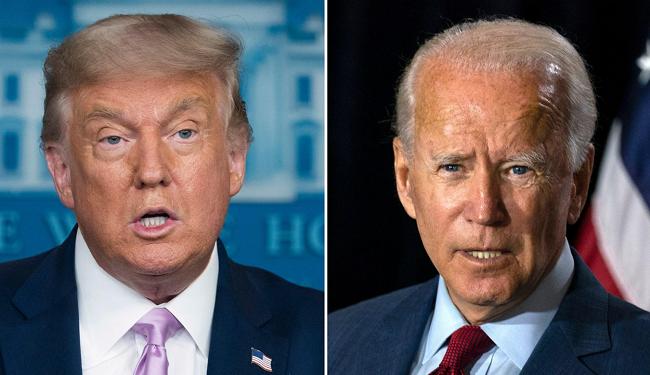
Undermining Trump, surveilling Biden
If China wanted to prevent Trump’s reelection, why did it also attack the campaign of his opponent, Biden?
This is because China’s objectives were not limited to simply electing Biden. While they sought to undermine Trump’s political base, they also needed to gain advance insight into the China policies, core staff, and internal decision-making structures of the Biden campaign, which had an increasing chance of taking power.
Whether both operations were conducted under the same chain of command cannot be concluded from the public documents alone. However, it is clearly evident that China was concurrently shaking Trump’s political foundation while using illicit cyber means to penetrate U.S. power institutions and the Biden campaign.
They undermined Trump and surveilled Biden. They leveraged contracts for businesses, tariffs for industries, speaking fees and travel perks for influential figures, and financial incentives for the media.
China’s political interference in the U.S. was not mere cyber espionage. It was a state-level hybrid war that used hacking to scour the inner workings of power, economic pressure via tariffs and corporate contracts to exert political influence, and money to sway influential figures and the media.

 Iranian Foreign Ministry: "Continuing Message Exchanges with the U.S. and Activities of Mediating Countries"
Esmaeil Baghaei, Spokesperson for the Iranian Ministry of Foreign Affairs [Xinhua, Yonhap News file photo]Esmaeil Baghaei, spokesperson for the Iranian Ministry of Foreign Affairs, stated on the 26th
Iranian Foreign Ministry: "Continuing Message Exchanges with the U.S. and Activities of Mediating Countries"
Esmaeil Baghaei, Spokesperson for the Iranian Ministry of Foreign Affairs [Xinhua, Yonhap News file photo]Esmaeil Baghaei, spokesperson for the Iranian Ministry of Foreign Affairs, stated on the 26th
 President Yoon: "Do You Think You Are Safe from the Special Counsel?"... Final Statement Video Released
President Yoon Suk Yeol rebuking the special prosecutor on the 24th. [Court video / @birds_justice X account subtitle GIF] A video of President Yoon Suk Yeol's closing statement at his trial rega
President Yoon: "Do You Think You Are Safe from the Special Counsel?"... Final Statement Video Released
President Yoon Suk Yeol rebuking the special prosecutor on the 24th. [Court video / @birds_justice X account subtitle GIF] A video of President Yoon Suk Yeol's closing statement at his trial rega
 President Yoon, regarding the first-instance ruling on the Public Official Election Act: “An excessive political verdict that distorts the facts… We will appeal immediately.”
The first-instance sentencing hearing for President Yoon Suk Yeol regarding violations of the Public Official Election Act is being broadcast live at Seoul Station on the 27th. [Photo=Yonhap News]Pres
President Yoon, regarding the first-instance ruling on the Public Official Election Act: “An excessive political verdict that distorts the facts… We will appeal immediately.”
The first-instance sentencing hearing for President Yoon Suk Yeol regarding violations of the Public Official Election Act is being broadcast live at Seoul Station on the 27th. [Photo=Yonhap News]Pres
 WSJ: "SK Hynix ADR Premium Is a Sign of AI Trading Overheat"
Advertisement for SK Hynix ADR listing in New York's Times Square [Reuters=Yonhap News file photo]The Wall Street Journal (WSJ) has pointed out that the price of SK Hynix’s American Depositary Recei
WSJ: "SK Hynix ADR Premium Is a Sign of AI Trading Overheat"
Advertisement for SK Hynix ADR listing in New York's Times Square [Reuters=Yonhap News file photo]The Wall Street Journal (WSJ) has pointed out that the price of SK Hynix’s American Depositary Recei
 'Godfather of Japanese Mystery Novels' Keigo Higashino Passes Away After Battle with Cancer at 68
Famous Japanese mystery novelist Keigo Higashino [AFP=Yonhap News]It has been belatedly reported that Keigo Higashino, the "godfather of Japanese mystery novels" and author of bestsellers such as "The
'Godfather of Japanese Mystery Novels' Keigo Higashino Passes Away After Battle with Cancer at 68
Famous Japanese mystery novelist Keigo Higashino [AFP=Yonhap News]It has been belatedly reported that Keigo Higashino, the "godfather of Japanese mystery novels" and author of bestsellers such as "The
 [Park Pil-kyu Security Column] To the Ignorant Trying to Clothe a Beast in Sheep's Clothing
Rep. Kim Byung-joo of the Democratic Party of Korea [Photo=Yonhap News]“The Air Force Academy doesn't teach you how to fly a plane!” “The Army, Navy, and Air Force academies are exactly the
[Park Pil-kyu Security Column] To the Ignorant Trying to Clothe a Beast in Sheep's Clothing
Rep. Kim Byung-joo of the Democratic Party of Korea [Photo=Yonhap News]“The Air Force Academy doesn't teach you how to fly a plane!” “The Army, Navy, and Air Force academies are exactly the
 [Issue Diagnosis] Two Effects of the Election Petition Review
 [Photo] Evidence of Election Fraud Flooding U.S. Media… Trump Had 2.7 Million Votes Stolen
 [Video] U.S. Semiquincentennial Air Show... 'Art in the Sky' streaks across New York
 [Editorial Cartoon] A Draconian Law That Undermines Freedom of Expression

 List
List









