 Regarding the intense investigation by South Korean regulatory authorities into Seattle-based Fortune 150 e-commerce firm Coupang, the U.S. side has characterized it not as mere domestic law enforcement but as a "discriminatory attack on an ally," signaling strong impending trade pressure. [Reuters=WSJ]
Recently, criticism has been mounting—centered in Washington political circles and major foreign media—that the South Korean government's regulatory policies are discriminating against U.S. companies.
Drawing on recent movements in U.S. politics, The Wall Street Journal (WSJ) examined the U.S. perspective on the "Coupang situation" in South Korea and the resulting trade conflicts in its article dated the 16th (local time).
According to the report, regarding the high-intensity investigation by South Korean regulators into Seattle-based Fortune 150 e-commerce firm "Coupang," the U.S. side has defined it not as mere domestic law enforcement, but as a "discriminatory attack on an ally," warning of strong impending trade pressure.
U.S. House Judiciary Committee: "A Country That Rejects Competition"
A subcommittee of the U.S. House Judiciary Committee recently released a staff report titled, "A Country That Rejects Competition: South Korea's Discriminatory Attacks on U.S. Companies." The WSJ reported that more than half of the 35-page report is dedicated to matters related to Coupang, heavily criticizing the South Korean government.
The report further alleges that the South Korean government, leveraging agencies like the Korea Fair Trade Commission, is imposing harsh regulatory burdens, punitive enforcement, and disproportionate fines on U.S. companies.
In particular, regarding the investigation into Coupang’s large-scale personal data breach or algorithm-related issues, the report highlights discrimination by comparing them to similar cases involving domestic conglomerates (such as SK Telecom), stating, "The treatment meted out to U.S. firms was far harsher than that given to Korean firms."
Moreover, the report includes explosive allegations that the National Intelligence Service and other agencies excessively intervened in and coerced Coupang during the process of recovering overseas assets.
According to the report, "The South Korean government has systematically conducted discriminatory investigations to disadvantage U.S. companies, protecting other competitors within South Korea while imposing regulatory burdens and punitive enforcement measures. Furthermore, the National Assembly, led by the Democratic Party of Korea, has recently pushed for anti-competitive legislation to prevent U.S. companies from succeeding in the domestic market."
It subsequently raises fundamental questions about whether South Korea is honoring its non-discrimination and fairness commitments to the U.S., reporting as follows:
"Following an incident last year where a former Coupang employee—a Chinese national—accessed customer data without authorization, the South Korean government launched a massive, large-scale investigation into Coupang, most of which went far beyond the scope of data security. Although the South Korean National Police Agency stated there were no 'cases of suspected secondary damage' from the leak and that the accessed data was of 'low sensitivity,' the South Korean government has continuously imposed hostile restrictions and excessive fines on Coupang that other competitors have not experienced."
The report also singled out Prime Minister Kim Min-seok's December 2025 call to "eradicate illegal market practices with the same determination used to wipe out the mafia," as well as President Lee Jae-myung's remarks that "Coupang violated regulations and violating companies should face sanctions amounting to 'near bankruptcy.'"
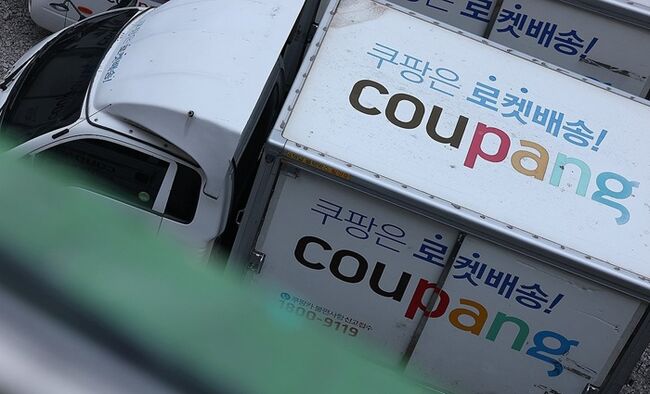 Regarding the intense investigation by South Korean regulatory authorities into Seattle-based Fortune 150 e-commerce firm Coupang, the U.S. side has characterized it not as mere domestic law enforcement but as a "discriminatory attack on an ally," signaling strong impending trade pressure. [Photo=Yonhap News]
Furthermore, the House report cites testimony from Coupang’s interim CEO Harold L. Rogers before the National Assembly, stating, "There was an instance where South Korea’s National Intelligence Service directed Coupang to carry out an operation to recover a laptop discarded in the Huangpu River in Shanghai, China," and that Coupang successfully completed the task to secure the leaked data.
However, the South Korean government has denied involvement in this operation and has instead alleged perjury regarding Rogers’ statements during the parliamentary hearing. The WSJ pointed out, "If the findings of the U.S. House Judiciary Committee are accurate, the South Korean government forced the operation and then set a trap for the witness."
Additionally, the report notes, "In the Strategic Trade and Investment Agreement signed last year, South Korea promised that U.S. companies would not face discrimination or unnecessary barriers in digital services," diagnosing the Coupang case as something more than just an allegation of serious unfair treatment against a single U.S. firm.
The report also notes that while the South Korean government claims its actions regarding Coupang are being carried out in accordance with domestic law and due process, it has "failed to present facts to refute the vast and detailed evidence contained in the Congressional report."
Direct Damage to U.S. Investors and National Interest
The WSJ noted that announcing a good trade agreement does not automatically guarantee success, as provisions only work if officials in partner countries implement and enforce them; South Korea's failure to keep its promises has real-world consequences, it pointed out.
According to the report, Coupang has suffered a loss of over $30 billion (approx. 40 trillion KRW) in U.S. investor value since the end of 2025 due to the South Korean government's all-out pressure.
Large U.S. investment firms, such as Greenoaks and Altimeter, have protested that the South Korean government’s actions are fundamentally undermining U.S. economic interests.
Citing analysis from a U.S. think tank (The Competere Foundation), the report projected that "due to South Korea’s aggressive regulatory approach, the U.S. economy could face losses of up to $525 billion over the next decade, which would translate to an economic impact of approximately $3,800 (approx. 5 million KRW) per U.S. household."
It stated that "if U.S. companies are treated differently from local competitors, the U.S. government could suspend tariff benefits, procurement access, and investment approvals."
It also pointed out that when South Korea neutralizes U.S. companies through discretionary enforcement, they are unintentionally aiding China, noting that Korea's actions open space for China's expansion into Korea. It further warned that such selective prosecution makes U.S. investors think twice before starting businesses in linked markets.
"Targeted Investigation Beyond Reasonable Standards"... The White House Joins In
The White House immediately aligned itself with this move by the U.S. Congress.
A White House spokesperson stated in a briefing, "The Trump administration is deeply concerned that the South Korean government is discriminatorily targeting U.S. technology companies," adding that "by any reasonable standard, Coupang has been singled out by the South Korean government."
This clearly demonstrates that the U.S. government views the Coupang situation as a serious trade barrier and a violation of the "U.S.-Korea Strategic Trade and Investment Agreement."
Furthermore, "South Korea has benefited tremendously from America's markets, military, capital, and restraint. These benefits are not a right. If South Korea wishes to remain a trusted partner, it must act like a trusted partner. If it chooses anti-American economic nationalism, Washington will respond with harsh consequences."
The severity of this situation lies in the fact that as the U.S. government and Congress define the Coupang crisis as a "discriminatory attack by an ally," it could become a volatile powder keg for U.S.-Korea trade conflicts, following batteries and semiconductors, and extending into the platform and e-commerce sectors.
Reporter Im Yo-hee

 Iranian Foreign Ministry: "Continuing Message Exchanges with the U.S. and Activities of Mediating Countries"
Esmaeil Baghaei, Spokesperson for the Iranian Ministry of Foreign Affairs [Xinhua, Yonhap News file photo]Esmaeil Baghaei, spokesperson for the Iranian Ministry of Foreign Affairs, stated on the 26th
Iranian Foreign Ministry: "Continuing Message Exchanges with the U.S. and Activities of Mediating Countries"
Esmaeil Baghaei, Spokesperson for the Iranian Ministry of Foreign Affairs [Xinhua, Yonhap News file photo]Esmaeil Baghaei, spokesperson for the Iranian Ministry of Foreign Affairs, stated on the 26th
 President Yoon: "Do You Think You Are Safe from the Special Counsel?"... Final Statement Video Released
President Yoon Suk Yeol rebuking the special prosecutor on the 24th. [Court video / @birds_justice X account subtitle GIF] A video of President Yoon Suk Yeol's closing statement at his trial rega
President Yoon: "Do You Think You Are Safe from the Special Counsel?"... Final Statement Video Released
President Yoon Suk Yeol rebuking the special prosecutor on the 24th. [Court video / @birds_justice X account subtitle GIF] A video of President Yoon Suk Yeol's closing statement at his trial rega
 President Yoon, regarding the first-instance ruling on the Public Official Election Act: “An excessive political verdict that distorts the facts… We will appeal immediately.”
The first-instance sentencing hearing for President Yoon Suk Yeol regarding violations of the Public Official Election Act is being broadcast live at Seoul Station on the 27th. [Photo=Yonhap News]Pres
President Yoon, regarding the first-instance ruling on the Public Official Election Act: “An excessive political verdict that distorts the facts… We will appeal immediately.”
The first-instance sentencing hearing for President Yoon Suk Yeol regarding violations of the Public Official Election Act is being broadcast live at Seoul Station on the 27th. [Photo=Yonhap News]Pres
 WSJ: "SK Hynix ADR Premium Is a Sign of AI Trading Overheat"
Advertisement for SK Hynix ADR listing in New York's Times Square [Reuters=Yonhap News file photo]The Wall Street Journal (WSJ) has pointed out that the price of SK Hynix’s American Depositary Recei
WSJ: "SK Hynix ADR Premium Is a Sign of AI Trading Overheat"
Advertisement for SK Hynix ADR listing in New York's Times Square [Reuters=Yonhap News file photo]The Wall Street Journal (WSJ) has pointed out that the price of SK Hynix’s American Depositary Recei
 'Godfather of Japanese Mystery Novels' Keigo Higashino Passes Away After Battle with Cancer at 68
Famous Japanese mystery novelist Keigo Higashino [AFP=Yonhap News]It has been belatedly reported that Keigo Higashino, the "godfather of Japanese mystery novels" and author of bestsellers such as "The
'Godfather of Japanese Mystery Novels' Keigo Higashino Passes Away After Battle with Cancer at 68
Famous Japanese mystery novelist Keigo Higashino [AFP=Yonhap News]It has been belatedly reported that Keigo Higashino, the "godfather of Japanese mystery novels" and author of bestsellers such as "The
 [Park Pil-kyu Security Column] To the Ignorant Trying to Clothe a Beast in Sheep's Clothing
Rep. Kim Byung-joo of the Democratic Party of Korea [Photo=Yonhap News]“The Air Force Academy doesn't teach you how to fly a plane!” “The Army, Navy, and Air Force academies are exactly the
[Park Pil-kyu Security Column] To the Ignorant Trying to Clothe a Beast in Sheep's Clothing
Rep. Kim Byung-joo of the Democratic Party of Korea [Photo=Yonhap News]“The Air Force Academy doesn't teach you how to fly a plane!” “The Army, Navy, and Air Force academies are exactly the
 [Issue Diagnosis] Two Effects of the Election Petition Review
 [Photo] Evidence of Election Fraud Flooding U.S. Media… Trump Had 2.7 Million Votes Stolen
 [Video] U.S. Semiquincentennial Air Show... 'Art in the Sky' streaks across New York
 [Editorial Cartoon] A Draconian Law That Undermines Freedom of Expression

 List
List









