 Park Mi-kyung, chair of the Committee on the Light, reviews agenda items at the first plenary meeting held at the Government Complex Seoul in Jongno-gu, Seoul, on the 13th. Prior to the committee's launch, the government defined citizens' actions during the lifting of the December 3 martial law as the "Revolution of Light" via presidential decree. [Photo=Ministry of the Interior and Safety] The constitutional judgment regarding the unconstitutionality and illegality of the December 3 martial law has concluded.
On April 4, 2025, the Constitutional Court unanimously ruled to remove then-President Yoon Suk Yeol from office, determining that his declaration of emergency martial law and the deployment of military and police against the National Assembly and other institutions were a grave violation of the Constitution and the law. The Constitutional Court's decision is final, and state institutions must respect it.
However, the judgment concerning the crime of insurrection under the Criminal Act is a separate judicial process. The case involving former President Yoon Suk Yeol and others, charged with leading an insurrection, is currently undergoing an appellate trial at the Seoul High Court as case 2026No648 (as of July 2026). Even with a first-instance ruling, the final judgment regarding each defendant's intent, specific role, and criminal liability has not yet been finalized. The Seoul High Court continued to hold trials and public hearings for the case in July.
Nevertheless, in March, before the conclusion of the criminal trial, the government established the "Committee on the Light" through a presidential decree. It named the citizens' actions against the December 3 martial law the "Revolution of Light" and mandated the committee to oversee the certification and honoring of contributors, the compilation of archives, the designation of national memorial days and symbols, and even educational and promotional projects. A total of 5.2109 billion won in general reserve funds has been allocated to these related projects.
Documenting the unconstitutionality of martial law is not the same as the government unilaterally defining the historical name, key figures, and the spirit of the event to be inherited.
The first question that must be posed to the Committee on the Light is: "Why, at a time when criminal trials and historical evaluations are still ongoing, must the state use taxpayer money to institutionalize a conclusion called a 'revolution'?"
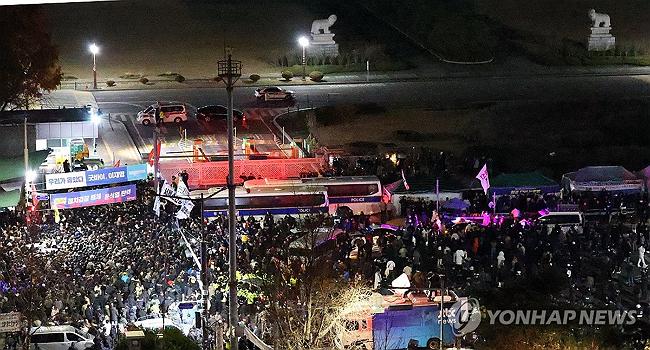 On the dawn of December 4, 2024, when emergency martial law was declared, citizens opposing the martial law confront military and police forces in front of the National Assembly building in Yeouido, Seoul. On that day, the National Assembly demanded the lifting of martial law in accordance with the Constitution. [Photo=Yonhap News] □ The Issue of Timing… A Constitutional Court Ruling Does Not Grant the Right to Label a 'Revolution'
The Constitutional Court ruled on whether the president’s exercise of official duties violated the Constitution and the law, and whether those violations were serious enough to warrant his removal.
While there are those who do not accept the Court's removal decision, the judgment must be respected. However, the Court’s decision did not authorize the government to label the event a "revolution," certify specific citizens as contributors to democracy, or create national memorial days and symbols.
Accepting the Constitutional Court's decision and agreeing with the historical label of the "Revolution of Light" are two separate issues.
Even citizens who acknowledge the unconstitutionality of the martial law may not necessarily believe the event should be called a "revolution." While they may highly value the actions taken by citizens, they may disagree with the method of a presidentially appointed body selecting contributors and using national budgets for commemoration and promotion.
The fact that criminal trials are ongoing is also significant. The impeachment trial and the criminal trial differ in purpose, standards of proof, and the scope of judgment. If the executive branch preemptively sets the official historical name and key figures of the event before the formation of the insurrection crime and the individual criminal responsibility of the defendants are determined, the government's political conclusion could override future judicial rulings, academic research, and the public's freedom of assessment.
Securing documents, photographs, videos, and preserving testimonies from those involved before the material disappears is a task that must begin now.
However, issuing certificates, providing commemorative gifts, establishing national memorial days, creating symbols, and conducting educational/promotional projects are different in nature from simple archival preservation. These are projects that can only be pursued under the premise that the judgment on the event's value and historical significance has already been settled.
The government must explain why that judgment needs to be made now.
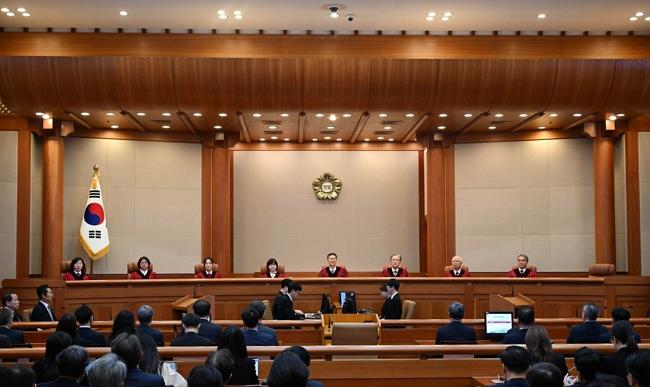 On April 4, 2025, the Constitutional Court unanimously decides to remove then-President Yoon Suk Yeol from office in an impeachment trial. The Court's judgment focused on the unconstitutionality and illegality of the martial law and the necessity of his removal; naming the event a "revolution" was not part of the court's judgment. [Photo=Yonhap News]
□ If the Constitutional Order Functioned, Why Is It a 'Revolution'?
A "revolution" is not merely a term for large-scale or moving civic action.
The National Institute of Korean Language explains that a "coup d'état" is "achieved through a simple transfer of power within the ruling class, and is distinguished from a revolution that aims for systemic transformation." In both dictionary and political science definitions, the core of a revolution lies in the "fundamental transformation of the existing political and social order and the formation of a new order."
Therefore, we must ask what exactly collapsed and what new political system was established during the process of lifting the December 3 martial law.
The National Assembly exercised its constitutional power to demand the lifting of martial law, and the government accepted that demand and rescinded it. Subsequently, the Constitutional Court judged the unconstitutionality and illegality of the declaration and the deployment of military and police.
It was not a case of abolishing the existing constitutional order and establishing a new one. Rather, it was an event where the constitutional order, placed in crisis, functioned and was restored through the National Assembly's resolution and judicial control.
There is no reason to undervalue the actions of citizens who gathered around the National Assembly to demand the lifting of martial law and confronted military troops. Recording and honoring the courage of citizens and the response of constitutional institutions may also be necessary.
However, honoring citizen action and labeling the event a "revolution" are separate matters.
The word "revolution" carries assessments of the event's key figures, historical significance, and political legitimacy beyond simple factual description. The moment the government inserts this expression into a presidential decree, political rhetoric becomes official state administrative terminology.
Therefore, "Revolution of Light" is closer to a political and historical evaluation chosen by the government than a neutral name for the event.
Why must the lifting of martial law in accordance with the Constitution and the restoration of the constitutional order be defined as a revolution? Does the government have the authority to preemptively assign such a name to an event for which criminal trials and social evaluations are still underway? The Lee Jae-myung administration must answer these questions.
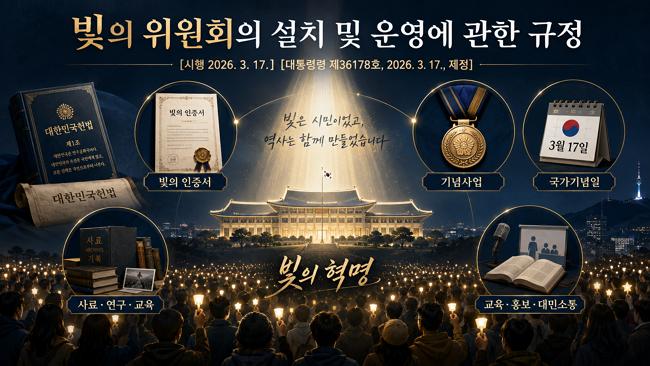 The purpose and main functions of the 'Regulations on the Establishment and Operation of the Committee on the Light' enacted by the government. The presidential decree defines the event as the 'Revolution of Light' and stipulates the issuance of certificates, record-keeping, research, education, promotion, and commemorative projects as the committee's duties. [Photo=Hanmi Ilbo Graphic]□ The Problem of Structure… From Naming to Certification, Education, and Promotion, All Under One Body
Article 1 of the presidential decree states that the purpose of the committee is to carry out "projects to honor citizens who contributed to the protection of the Constitution and democracy through the 'Revolution of Light'—the resistance against the December 3 martial law—and to inherit that spirit."
The committee did not define the character of the event after collecting records and testimonies and reviewing conflicting interpretations.
Before the committee even began its activities, the government had already inserted the conclusion, "Revolution of Light," into the presidential decree. The committee was launched not as a body to verify whether this name is appropriate, but as one to carry out commemorative and inheritance projects based on a predetermined name and assessment.
The scope of its duties also extends beyond the simple awarding of certificates.
The committee deliberates on: △ policy directions for the settlement and diffusion of Korean-style participatory democracy, △ the reception, verification, examination, and issuance of "Light Certificates," △ the treatment of certified contributors and the designation of national memorial days, and △ the collection, preservation, recording, research, education, and promotion of related historical materials. The President appoints the chair and commissioners, and ministers of relevant ministries also participate as government members.
At the first meeting held on July 13, the committee deliberated on operational guidelines and the "Basic Plan for Managing Records of the Revolution of Light." The committee announced it would push for the designation of memorial days, the installation of symbols, competitions, and civic forums, and would spread the "K-democracy" model of citizen participation to the world. The government stated it would support the inheritance of that spirit to future generations "correctly and without any distortion."
The structure can be summarized as follows:
Naming the event → Certifying contributors → Honoring awardees → Collecting/compiling records → Memorial days/symbols → Education/promotion → Domestic and international expansion.
The entire process is concentrated in a single presidential advisory body.
The committee has the authority to request data and opinions from relevant agencies and to request the secondment or dual appointment of public officials and staff. Conversely, there is no evidence of powers regarding mandatory attendance, search and seizure, or punishment for non-compliance with data requests. It is not an enforcement body like an investigative agency or a parliamentary probe.
However, the lack of compulsory investigative powers does not eliminate the structural problem.
When the authority of a presidential office is combined with government budget and the cooperation of multiple ministries and administrative agencies, official authority and the means of dissemination are concentrated on the government's chosen historical interpretation. Even if other perspectives are not legally prohibited, a public status gap arises between the narrative certified and funded by the state and those that are not.
If the government judges who protected democracy, where are citizens who do not receive such certification placed?
Are records containing assessments different from the government's also collected and preserved under the same standards?
In the phrase "correctly inherit without distortion," who decides what constitutes a clear factual error and what is a political or historical interpretation that should be permitted?
The official launch press release provided by the government did not include the full text of the operational guidelines and the basic plan for record management. Detailed information on certification criteria, notification of reasons for rejection, and appeal or re-examination procedures is difficult to confirm through public documents alone.
□ The Government's Counterargument… "The Constitutional Court's Judgment Is Final, and Record Preservation Cannot Wait"
There is a counterargument the government might raise.
The claim is that because the Constitutional Court has finalized the unconstitutionality and illegality of the emergency martial law and the citizens' actions contributed to the National Assembly's resolution to lift martial law and the restoration of constitutional order, it is possible to honor the citizens' contributions and preserve related records immediately, regardless of whether the criminal insurrection trial has concluded.
Records can disappear over time. There is a possibility that on-site videos, photos, online posts, and documents or testimonies held by individuals could be damaged or lost if not collected now.
The government may also point to the fact that the committee operates as an advisory and deliberative body for the President, without powers of investigation, punishment, or regulation of expression. The government explains that it intends to connect the recording of citizens' courage and the democratic spirit to national unity and the expansion of participatory democracy.
However, this counterargument, while explaining the need for swift record preservation, does not fully explain why the event must be labeled a "revolution" and why certification of contributors, award products, national memorial days, symbols, education, and promotion must be entrusted to a presidential body.
Records can be collected separately from evaluation.
Original documents, photos, and video acquisition, as well as oral testimony collection, can be carried out by the National Archives or independent professional institutions based on neutral standards, while the naming of the event, certification of contributors, and commemorative projects could be judged after the criminal trial and sufficient public deliberation.
If the government chose a stronger method for commemorative projects, it must prove the necessity, urgency, and why other alternatives could not achieve the purpose.
□ Tension with International Norms… Democracy Is Not a Single Historical Answer
The reason international organizations' principles on historical commemoration are important is that the Committee on the Light itself bases its existence on the protection of the Constitution and democracy.
Democracy is not a historical conclusion that the government declares to be correct. It is a process and system that guarantees free debate on the meaning, responsibility, and ways of remembering facts, while respecting confirmed truths.
The UN Special Rapporteur in the field of cultural rights explains that "historical narratives have a decisive influence on collective identity, and how we learn and remember the past can strengthen peace and human rights, or it can perpetuate division and tension between social groups."
The principle is that commemorative projects should provide space for those affected by human rights violations to tell their experiences and narratives, and encourage citizen participation, critical thinking, and discussion on how the past is represented.
The Parliamentary Assembly of the Council of Europe emphasized in 2025 that sensitive and controversial history in history education and commemorative projects should be dealt with through multiple perspectives and historical sources.
Only then can one distinguish between facts, memory, interpretation, and viewpoints, identify distortion and propaganda, and respect differing opinions, pluralism, tolerance, and diversity. It also recommended that memorial sites and museums should become spaces for learning democracy based on academic research, human rights analysis, and multiple perspectives.
These international organizations have not directly investigated the Committee on the Light or deemed it a violation of international norms. The Council of Europe's standards are also not legally binding on the Republic of Korea.
However, common principles exist as a benchmark for evaluating historical commemorative projects in democratic states.
"The state can investigate and record the facts of the past. It can also commemorate citizens. However, it should not turn one historical interpretation into the state's sole official memory, nor should it shrink the space for research and expression of other interpretations."
Whether the Committee on the Light aligns with this principle cannot be judged by name alone. It must be judged by the committee's composition, the selection of records, certification criteria, transparency of meetings, and whether it accepts critical materials.
However, the current structure, which fixed the evaluation of "Revolution of Light" via presidential decree before conducting fact-finding, seems distant from the multi-perspectivity emphasized by international organizations.
If it is a committee that claims to stand for democracy, it must guarantee interpretations that differ from the government's more actively than anyone else.
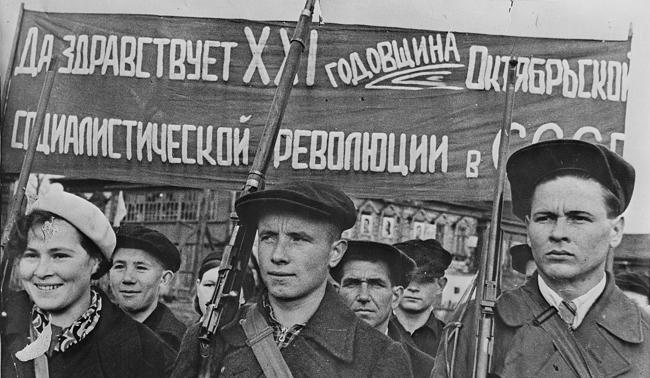 A propaganda image of 'October Revolution Day' produced by the Soviet Union in 1938. The Soviet Union combined the collection of revolution records, compilation of official history, national memorial days, and mass propaganda to establish the ruling legitimacy of the Communist Party. [Photo=U.S. Library of Congress/Wikimedia] □ Soviet Istpart… The Record Committee Becomes the Party's Official Revolutionary History
Looking at modern and contemporary history, communist dictatorial regimes have used national commemorative projects not as simple remembrance or archival preservation, but as a means to justify the regime and manage public memory.
In 1920, the Soviet Union established the "Commission for the Study of the October Revolution and the History of the Russian Communist Party," known as Istpart.
Istpart began as a research institution to collect, preserve, and publish documents and memoirs related to the revolution. However, it was incorporated into the Central Committee of the Communist Party in 1921 and set up regional organizations nationwide to systematically collect and compile the history of the revolution and the Party.
Research and record preservation gradually shifted to work on maintaining the Party's official history and ideological unity. Related studies evaluate that Istpart took on the mission of maintaining ideological consistency of the state narrative regarding the 1917 revolution while preserving documents and memoirs. As power struggles within the Party intensified, past records were used as political tools to attack the opposition, and the needs of the current power took precedence over historical accuracy.
The Soviet experience shows that a record-collecting institution does not need to be a secret police or censorship agency from the start.
If the state determines which materials to adopt as official records, who to recognize as the protagonists of a revolution, and spreads the results through education and commemorative events, the past can be turned into a political resource supporting the legitimacy of the current power.
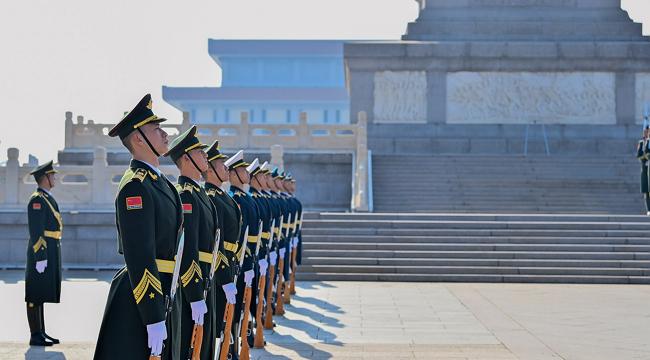 A wreath-laying ceremony held at the Monument to the People's Heroes in Tiananmen Square, Beijing, China. China has expanded official historical narratives by linking state-recognized martyrs to certificates, memorial days, memorial facilities, and school education. [Photo=Presidential Office of Maldives/Wikimedia] □ China… A System Linking 'Martyr Certification' to Memorial Days and Education
China has institutionalized a system where the state judges the contributors to the revolution and the defense of the regime and connects them to certificates, memorial days, facilities, and education.
China's "Regulations on Commemorating Martyrs" specify that martyr commemoration projects must be carried out under the leadership of the Communist Party of China. The state commemorates and protects martyrs, promotes their deeds and spirit, and disseminates socialist core values. Related budgets are allocated in state and local finances, and administrative agencies are responsible for identifying martyrs, honoring bereaved families, and commemorative projects.
China's martyr system is different from the "Light Certificates" awarded to living citizens, in that it is a veterans' benefits system for those who died for the state and their families. However, the institutional order is worth comparing.
The state judges contributors.
The state issues certificates in its name.
It creates memorial days and facilities.
It educates and spreads the spirit through schools, media, and cultural projects.
The Chinese government is actively utilizing martyr memorial facilities and so-called "red resources" for propaganda education, stating it will foster an atmosphere of respecting heroes and dedication throughout society. The current system serves the function of disseminating socialist values and political identity centered on the Communist Party, in addition to honoring contributors.
One cannot conclude that the Committee on the Light is an institution like the Soviet "Istpart" or China's "martyr system."
The Republic of Korea has a multi-party system, elections, judicial review, and freedom of the press, academia, and expression. The Committee on the Light has no powers for censorship, punishment of opposing opinions, mandatory investigations, or purges. The coercive power of a communist dictatorial system should not be equated directly with a presidential committee in a democratic country.
However, the similarity in the institutional grammar as follows is subject to verification:
The state determines the name of the event first.
The state examines and certifies contributors.
The state selects and compiles records.
The official narrative is spread through memorial days, symbols, education, and promotion.
The purpose of examining communist dictatorial examples is not to immediately define the Committee on the Light as a totalitarian institution. It is to verify how national commemorative projects can be transformed into ruling tools that create regime legitimacy and manage public memory when left unchecked.
A historical monopoly does not only occur when direct censorship and punishment begin. Just by the state providing official names, certifications, budgets, and administrative organizations only to one side's interpretation, the balance of the public sphere can tilt.
□ 5.2 Billion Won in Reserve Funds… Why It Was Urgent Must Also Be Explained
The government decided to invest 5.2109 billion won in general reserve funds for projects related to the Committee on the Light.
Reserve funds are resources for expenditures that were difficult to predict when preparing the main budget or for responding to urgent financial needs.
Then, the government must explain why certifying contributors to an event for which a criminal trial is underway, and pushing for commemorative, educational, and promotional projects, was so urgent that it could not wait for the preparation of the main budget and sufficient deliberation by the National Assembly.
Ways to separate record preservation and political commemorative projects should also be reviewed.
Acquiring original documents, photos, and videos, and recording oral testimonies can be performed by the National Archives and professional research institutions separate from value judgment. On the other hand, the official name "Revolution of Light," certification of contributors, honorifics, national memorial days, symbols, education, and promotional projects could wait until after the criminal trial and sufficient social public discussion.
To prove the legitimacy of the committee, it must disclose the operational guidelines, the basic plan for record management, certification screening criteria and fact-finding manuals, reasons for rejection of certification and appeal procedures, the process of recommending/selecting committee members, minutes, budgets and contract/service plans for each project, and the principles for selecting/excluding records.
It must also reveal whether it will collect data containing evaluations different from the "Revolution of Light," and whether researchers and citizens critical of the government's naming can participate in the compilation of records and discussions.
□ If Celebrating Democracy, Operation Must Be Democratic from the Start
The unconstitutionality and illegality of the December 3 martial law and the citizens' response must be recorded. Projects by the state to honor the courage of citizens can also be legitimate public interest projects. However, that fact does not grant the government the authority to exclusively decide the historical name of the event, the key figures, and the spirit to be inherited.
The legitimacy of the Committee on the Light is not secured simply by the fact that the words "Constitution" and "democracy" were included in the purpose clause. It must be proven through whether the name is neutral, whether the composition and procedures are balanced, whether certification criteria and budgets are transparent, whether other perspectives and uncomfortable records are also preserved, and whether the freedom to criticize the government's conclusion is guaranteed.
Democracy is not a system where the state determines one historical correct answer and teaches it to the people. If the state begins to use its authority and tax money to make only a specific interpretation an official memory, the spontaneous actions of citizens can be turned into political assets of the regime.
Documenting unconstitutional martial law is not the same as the government creating a "Revolution of Light."
The state has a responsibility to preserve history.
However, in a democratic country, the ultimate owners of historical interpretation are neither the president nor a presidential committee. It is the people who examine, debate, and judge the meaning of records.

 Iranian Foreign Ministry: "Continuing Message Exchanges with the U.S. and Activities of Mediating Countries"
Esmaeil Baghaei, Spokesperson for the Iranian Ministry of Foreign Affairs [Xinhua, Yonhap News file photo]Esmaeil Baghaei, spokesperson for the Iranian Ministry of Foreign Affairs, stated on the 26th
Iranian Foreign Ministry: "Continuing Message Exchanges with the U.S. and Activities of Mediating Countries"
Esmaeil Baghaei, Spokesperson for the Iranian Ministry of Foreign Affairs [Xinhua, Yonhap News file photo]Esmaeil Baghaei, spokesperson for the Iranian Ministry of Foreign Affairs, stated on the 26th
 President Yoon: "Do You Think You Are Safe from the Special Counsel?"... Final Statement Video Released
President Yoon Suk Yeol rebuking the special prosecutor on the 24th. [Court video / @birds_justice X account subtitle GIF] A video of President Yoon Suk Yeol's closing statement at his trial rega
President Yoon: "Do You Think You Are Safe from the Special Counsel?"... Final Statement Video Released
President Yoon Suk Yeol rebuking the special prosecutor on the 24th. [Court video / @birds_justice X account subtitle GIF] A video of President Yoon Suk Yeol's closing statement at his trial rega
 President Yoon, regarding the first-instance ruling on the Public Official Election Act: “An excessive political verdict that distorts the facts… We will appeal immediately.”
The first-instance sentencing hearing for President Yoon Suk Yeol regarding violations of the Public Official Election Act is being broadcast live at Seoul Station on the 27th. [Photo=Yonhap News]Pres
President Yoon, regarding the first-instance ruling on the Public Official Election Act: “An excessive political verdict that distorts the facts… We will appeal immediately.”
The first-instance sentencing hearing for President Yoon Suk Yeol regarding violations of the Public Official Election Act is being broadcast live at Seoul Station on the 27th. [Photo=Yonhap News]Pres
 WSJ: "SK Hynix ADR Premium Is a Sign of AI Trading Overheat"
Advertisement for SK Hynix ADR listing in New York's Times Square [Reuters=Yonhap News file photo]The Wall Street Journal (WSJ) has pointed out that the price of SK Hynix’s American Depositary Recei
WSJ: "SK Hynix ADR Premium Is a Sign of AI Trading Overheat"
Advertisement for SK Hynix ADR listing in New York's Times Square [Reuters=Yonhap News file photo]The Wall Street Journal (WSJ) has pointed out that the price of SK Hynix’s American Depositary Recei
 'Godfather of Japanese Mystery Novels' Keigo Higashino Passes Away After Battle with Cancer at 68
Famous Japanese mystery novelist Keigo Higashino [AFP=Yonhap News]It has been belatedly reported that Keigo Higashino, the "godfather of Japanese mystery novels" and author of bestsellers such as "The
'Godfather of Japanese Mystery Novels' Keigo Higashino Passes Away After Battle with Cancer at 68
Famous Japanese mystery novelist Keigo Higashino [AFP=Yonhap News]It has been belatedly reported that Keigo Higashino, the "godfather of Japanese mystery novels" and author of bestsellers such as "The
 [Park Pil-kyu Security Column] To the Ignorant Trying to Clothe a Beast in Sheep's Clothing
Rep. Kim Byung-joo of the Democratic Party of Korea [Photo=Yonhap News]“The Air Force Academy doesn't teach you how to fly a plane!” “The Army, Navy, and Air Force academies are exactly the
[Park Pil-kyu Security Column] To the Ignorant Trying to Clothe a Beast in Sheep's Clothing
Rep. Kim Byung-joo of the Democratic Party of Korea [Photo=Yonhap News]“The Air Force Academy doesn't teach you how to fly a plane!” “The Army, Navy, and Air Force academies are exactly the
 [Issue Diagnosis] Two Effects of the Election Petition Review
 [Photo] Evidence of Election Fraud Flooding U.S. Media… Trump Had 2.7 Million Votes Stolen
 [Video] U.S. Semiquincentennial Air Show... 'Art in the Sky' streaks across New York
 [Editorial Cartoon] A Draconian Law That Undermines Freedom of Expression

 List
List









