
A new report from the U.S. Department of State alleges that Cuba has built a network of American activist groups capable of mobilizing protests against U.S. policy, pointing to recent publicly posted plans for demonstrations targeting U.S. military bases, Immigration and Customs Enforcement (ICE) facilities, and federal buildings.
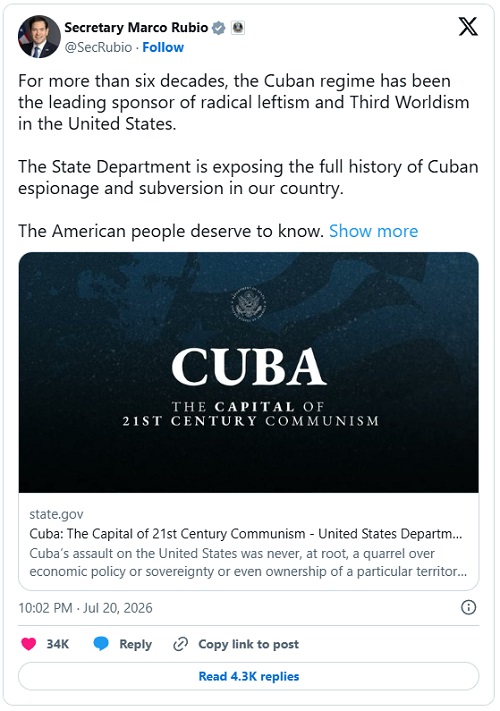
The "National Quick Response Plan," released in June, was distributed through the National Network on Cuba, a coalition of more than 60 U.S. organizations. The State Department believes this coalition is linked to the Cuban government through its ties to the Cuban Institute for Friendship with the Peoples (ICAP), a government agency sanctioned last June for its role in supporting Cuban intelligence activities.
The plan calls for "national joint actions" to be taken within 24 hours in the event of U.S. military aggression or an "imminent threat," stating that its objective is to "make it politically and materially costly for the U.S. government to wage war on Cuba."
While the plan had already been made public, the State Department report asserts that materials from the National Network on Cuba "demonstrate that Cuba’s subversive activities within U.S. territory are persistent, extensive, organized, and sophisticated."
The "Quick Response Plan" in question provides a timetable for calling for protests and mobilizing supporters nationwide. If the U.S. initiates military action against Cuba before 3:00 PM Eastern Time, protests are to begin at 6:00 PM local time that same day. If action occurs after that time, the plan dictates that activists will gather at 6:00 PM the following day.
Organizers are instructed to gather at federal buildings, courthouses and post offices, military bases and recruitment offices, or ICE detention centers and field offices. The plan also specifies sports stadiums as optional locations during major events.
The State Department report comes amid rising U.S. pressure on Cuba and ongoing discussions regarding potential military intervention or regime change. President Trump has hinted at a "friendly takeover" of Cuba, stating in May, when asked about the possibility of intervention, "I think I’ll be the one to handle it."
According to Fox News, Secretary of State Marco Rubio stated that while the U.S. administration prefers a diplomatic solution, it is not ruling out the possibility of military action.
The plan also specifies that protests at immigration facilities would "link Cuba solidarity to the anti-ICE/immigrant advocacy work already underway nationwide."
The organization directs activists to refer to a database by the Black Alliance for Peace, which, according to the State Department report, maps the locations of 1,335 U.S. military and law enforcement sites across the Western Hemisphere. The group describes this map as a foundation for local organizing, claiming it can help activists "strategize on where and how to organize and agitate."
The National Network on Cuba publicly promotes this plan on its website as part of its "No War on Cuba" campaign, calling for participation in rallies, banner drops, car caravans, educational forums, and other demonstrations.
The National Network on Cuba represents over 60 organizations and works closely with ICAP. ICAP is led by Fernando González Llort, a former member of the "Wasp Network," a Cuban intelligence ring.
The report describes ICAP as a cornerstone of Cuba’s international influence operations, claiming that the group coordinates over 2,000 solidarity organizations across more than 150 countries.
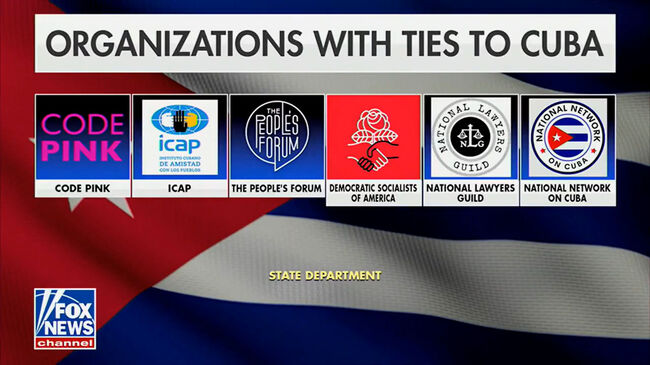
The report specifically highlights six groups that bridge the gap between the Cuban government's foreign operations and American leftist movements. While ICAP is a Cuban government entity, the "National Network on Cuba" is a U.S.-based coalition of over 60 organizations advocating for stronger ties with Havana.
The remaining groups are all based in the United States. Code Pink is a leftist anti-war group; the People’s Forum is a New York-based activist and political education center; the Democratic Socialists of America (DSA) is a socialist political organization; and the National Lawyers Guild is a progressive legal organization.
Code Pink, the DSA, and the National Lawyers Guild’s Cuba Committee are listed as members of the National Network on Cuba, alongside the Communist Party USA and dozens of smaller groups.
The extent of each group’s involvement in the quick response plan is unclear. The report argues that the overlapping relationships, delegation exchanges, and campaigns between these groups provide Cuba with access to a broad infrastructure of activists within the U.S.
According to the report, the DSA has sent multiple delegations to Cuba, including a 2023 visit where members held private meetings with Cuban President Miguel Díaz-Canel and sought to establish official communication channels with various Cuban ministries. However, the report clarifies that the DSA was not founded or controlled by Cuban intelligence and that its support for Havana stems primarily from an ideological perspective.
Meanwhile, the People’s Forum is described as a key organizational hub that connects pro-Cuba movements with anti-ICE and pro-Palestine activism. According to the report, the group has served as a financial sponsor for the "Venceremos Brigade," which has transported U.S. activists to Cuba for decades, and has supported delegations that met with high-ranking Cuban officials.
The report states that Code Pink and the National Lawyers Guild have also participated in Cuban delegation activities and campaigns against the U.S. embargo on Cuba. In 2026, the National Lawyers Guild adopted a resolution pledging to work with the National Network on Cuba and the broader Cuba solidarity movement.
The report does not announce sanctions or legal action against the U.S.-based groups, and a significant portion of its supporting material is derived from public records, organizational materials, and existing news reports. The report's core conclusion is that Cuba treats traditional espionage, political advocacy, and ideological influence operations as part of a single, long-term campaign against the United States.
The Trump administration significantly expanded its pressure campaign in 2026. In January, President Trump signed an executive order allowing for tariffs on imports from countries that supply oil to Cuba. In May, he imposed additional sanctions on foreign entities operating in or supporting key sectors of the Cuban economy, building upon the long-standing U.S. trade embargo.
Code Pink is separately under federal investigation regarding the funding network of Neville Roy Singham, a major donor to the group and the husband of co-founder Jodie Evans. A federal grand jury in Manhattan is investigating potential violations of the Foreign Agents Registration Act and tax laws related to Singham's network.
Code Pink has not been officially named as a target of the investigation, nor have any charges been filed against the group.
Additionally, as part of a review into potential sanctions violations, the Treasury Department requested information from Code Pink co-founder Medea Benjamin regarding an aid convoy to Cuba last March. Code Pink denies any wrongdoing, stating that the delegation delivered humanitarian aid amidst worsening shortages in Cuba.
The controversy does not end there, as the DSA and Code Pink are also connected to leftist groups in South Korea. While they publicly chant slogans of "anti-war and peace," they are effectively in solidarity with anti-imperialist, or anti-American, movements.
Through its "Korea Solidarity Program," the DSA International Committee states: "The DSA, along with many Korean organizations such as Korea Peace Now, the Korea Strategy Center, Women Cross DMZ, and Nodutdol, calls for the lifting of the U.S. travel ban on North Korea, the lifting of sanctions, and official moves toward ending the Korean War."
Furthermore, it states: "Through our political platform, we reaffirm our commitment to opposing the presence of U.S. troops and bases abroad, formally ending the Korean War through a peace treaty, and supporting the peace and reconciliation process in Korea, which is supported by the majority of Koreans and is the product of the struggles of the Korean left and mass movements."
Code Pink also consistently shows solidarity at events organized by these groups. Code Pink and South Korean leftist organizations have been conducting movements to stop joint U.S.-ROK military exercises, sign a peace treaty, lift sanctions, and oppose the withdrawal of U.S. Forces Korea and the deployment of THAAD batteries.
Indeed, the activities of these U.S. groups are increasingly seen as conduits for raising anti-war sentiment in the U.S. to deliver the arguments of the South Korean left-wing camp to the Washington political establishment and the international community.
The State Department and U.S. conservatives strongly criticize these alliances, viewing them as a "pro-North Korea, pro-China far-left front."
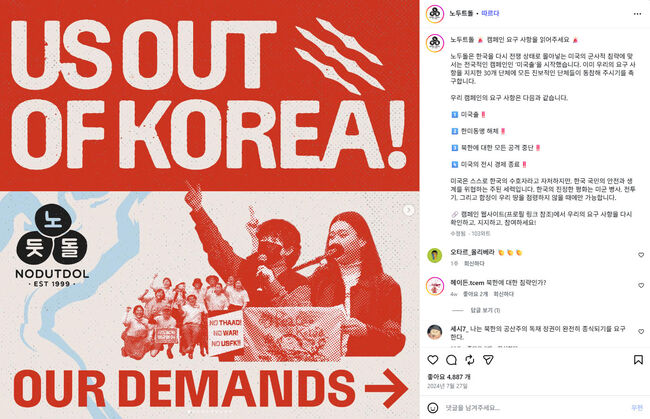 A screen capture of the Nodutdol Instagram account with the original English text translated into Korean.
Lawrence Peck, an advisor to the North Korea Freedom Coalition who has long investigated the activities of pro-North Korea and far-left groups and activists in the U.S., stated in an op-ed for PenN Mike on the 19th (Korean time) that "the fanatical U.S. pro-North Korean youth group Nodutdol" will send a delegation to South Korea this coming August, as they did in 2023 and prior years.
Lawrence Peck pointed out that until 2017, when President Trump issued a travel ban on North Korea, members of Nodutdol sent delegations to North Korea under the guise of "solidarity" visits and that the group has openly supported communist activists.
U.S. NNP = Hong Sung-gu, Editor-in-Chief / Special Correspondent for this publication NNP info@newsandpost.com

 Iranian Foreign Ministry: "Continuing Message Exchanges with the U.S. and Activities of Mediating Countries"
Esmaeil Baghaei, Spokesperson for the Iranian Ministry of Foreign Affairs [Xinhua, Yonhap News file photo]Esmaeil Baghaei, spokesperson for the Iranian Ministry of Foreign Affairs, stated on the 26th
Iranian Foreign Ministry: "Continuing Message Exchanges with the U.S. and Activities of Mediating Countries"
Esmaeil Baghaei, Spokesperson for the Iranian Ministry of Foreign Affairs [Xinhua, Yonhap News file photo]Esmaeil Baghaei, spokesperson for the Iranian Ministry of Foreign Affairs, stated on the 26th
 President Yoon: "Do You Think You Are Safe from the Special Counsel?"... Final Statement Video Released
President Yoon Suk Yeol rebuking the special prosecutor on the 24th. [Court video / @birds_justice X account subtitle GIF] A video of President Yoon Suk Yeol's closing statement at his trial rega
President Yoon: "Do You Think You Are Safe from the Special Counsel?"... Final Statement Video Released
President Yoon Suk Yeol rebuking the special prosecutor on the 24th. [Court video / @birds_justice X account subtitle GIF] A video of President Yoon Suk Yeol's closing statement at his trial rega
 President Yoon, regarding the first-instance ruling on the Public Official Election Act: “An excessive political verdict that distorts the facts… We will appeal immediately.”
The first-instance sentencing hearing for President Yoon Suk Yeol regarding violations of the Public Official Election Act is being broadcast live at Seoul Station on the 27th. [Photo=Yonhap News]Pres
President Yoon, regarding the first-instance ruling on the Public Official Election Act: “An excessive political verdict that distorts the facts… We will appeal immediately.”
The first-instance sentencing hearing for President Yoon Suk Yeol regarding violations of the Public Official Election Act is being broadcast live at Seoul Station on the 27th. [Photo=Yonhap News]Pres
 WSJ: "SK Hynix ADR Premium Is a Sign of AI Trading Overheat"
Advertisement for SK Hynix ADR listing in New York's Times Square [Reuters=Yonhap News file photo]The Wall Street Journal (WSJ) has pointed out that the price of SK Hynix’s American Depositary Recei
WSJ: "SK Hynix ADR Premium Is a Sign of AI Trading Overheat"
Advertisement for SK Hynix ADR listing in New York's Times Square [Reuters=Yonhap News file photo]The Wall Street Journal (WSJ) has pointed out that the price of SK Hynix’s American Depositary Recei
 'Godfather of Japanese Mystery Novels' Keigo Higashino Passes Away After Battle with Cancer at 68
Famous Japanese mystery novelist Keigo Higashino [AFP=Yonhap News]It has been belatedly reported that Keigo Higashino, the "godfather of Japanese mystery novels" and author of bestsellers such as "The
'Godfather of Japanese Mystery Novels' Keigo Higashino Passes Away After Battle with Cancer at 68
Famous Japanese mystery novelist Keigo Higashino [AFP=Yonhap News]It has been belatedly reported that Keigo Higashino, the "godfather of Japanese mystery novels" and author of bestsellers such as "The
 [Park Pil-kyu Security Column] To the Ignorant Trying to Clothe a Beast in Sheep's Clothing
Rep. Kim Byung-joo of the Democratic Party of Korea [Photo=Yonhap News]“The Air Force Academy doesn't teach you how to fly a plane!” “The Army, Navy, and Air Force academies are exactly the
[Park Pil-kyu Security Column] To the Ignorant Trying to Clothe a Beast in Sheep's Clothing
Rep. Kim Byung-joo of the Democratic Party of Korea [Photo=Yonhap News]“The Air Force Academy doesn't teach you how to fly a plane!” “The Army, Navy, and Air Force academies are exactly the
 [Issue Diagnosis] Two Effects of the Election Petition Review
 [Photo] Evidence of Election Fraud Flooding U.S. Media… Trump Had 2.7 Million Votes Stolen
 [Video] U.S. Semiquincentennial Air Show... 'Art in the Sky' streaks across New York
 [Editorial Cartoon] A Draconian Law That Undermines Freedom of Expression

 List
List









