U.S. Anti-dumping Measures (CG). Yonhap News TV.
Due to the strengthening of protectionist trade policies, including the U.S. imposition of a 50% tariff on imported steel products, half of the new import regulations imposed on South Korean goods in the first half of this year were found to be concentrated in the steel sector.
Experts point out that as the second Trump administration indiscriminately raises tariff barriers, it is also intensifying offensives through existing import regulations—such as anti-dumping duties, countervailing duties, and safeguards—necessitating urgent preparedness.
According to the Korea Trade-Investment Promotion Agency (KOTRA) on the 18th, there were a total of 218 import regulations against South Korean products in the first half of this year, an increase of two cases from the second half of last year (as of the end of December).
Of these, 10 new import regulation cases were initiated by nine different countries.
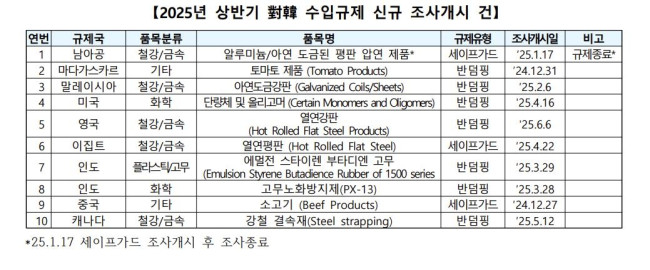 New Import Regulation Investigations Against South Korea in H1 2025 [Source: KOTRA].
By sector, steel and metal accounted for half of the new cases, with five. This was followed by chemicals (2 cases), others (2 cases), and plastic/rubber (1 case).
South Africa initiated and subsequently concluded a safeguard investigation into Korean aluminum and zinc-coated flat-rolled products, while Egypt launched a safeguard investigation into Korean hot-rolled flat steel.
The U.K. initiated a new anti-dumping investigation into Korean hot-rolled steel sheets, Canada into Korean steel fasteners, and Malaysia into Korean zinc-coated steel sheets.
The report analyzed that following the second Trump administration's move to impose a 25% tariff on steel and aluminum products starting in March and increasing it to 50% in June, trade protectionism regarding steel products is spreading globally as trade barriers rise.
It also projected that Taiwan would strengthen import regulations on steel structures due to concerns over "dumped" export volumes resulting from U.S. steel tariffs, and that the European Union (EU), Egypt, and Malaysia would also likely tighten import regulations on steel products.
As of the first half of the year, the United States was found to have a total of 54 import regulations in place against South Korean products.
This accounts for 25% of the total 218 import regulations against Korea in the first half, the highest figure among all nations.
By type, these included 38 anti-dumping cases, 12 countervailing duties, two safeguards, and two investigations related to circumvention.
By sector, steel and metal were the most frequent at 36 cases, followed by chemicals (5), plastic/rubber (4), textiles/apparel (4), electrical/electronics (3), and others (2).
Notably, the U.S. has shown no signs of loosening its grip, having launched a new anti-dumping investigation into Korean monomers and oligomers on April 16 of this year.
Monomers and oligomers are widely used in printing inks for packaging, coatings for wooden flooring and electronic components, and adhesives for optical materials, with rapidly growing demand in the 3D printing industry and the next-generation electronic materials market.
KOTRA advised, "Since the end of last year, the U.S. has been raising trade barriers by pushing to strengthen anti-dumping and countervailing duty systems, utilizing Section 232 of the Trade Expansion Act in the name of national security, and invoking Section 301 of the Trade Act to counter unfair trade practices," adding, "Continuous monitoring of items under investigation and those expected to be subject to regulations is necessary."
Yonhap News

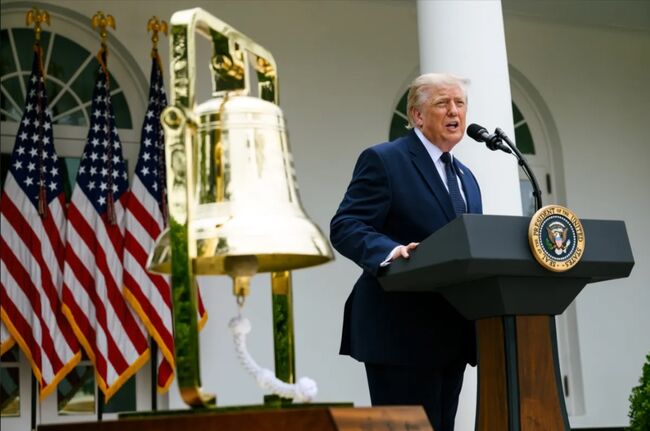 Trump pressures for rate cut again ahead of FOMC... "Should be the lowest in the world"
U.S. President Donald Trump. [Photo = The White House] U.S. President Donald Trump once again pressured the Federal Reserve, the U.S. central bank, to lower interest rates on the 27th (local time
Trump pressures for rate cut again ahead of FOMC... "Should be the lowest in the world"
U.S. President Donald Trump. [Photo = The White House] U.S. President Donald Trump once again pressured the Federal Reserve, the U.S. central bank, to lower interest rates on the 27th (local time
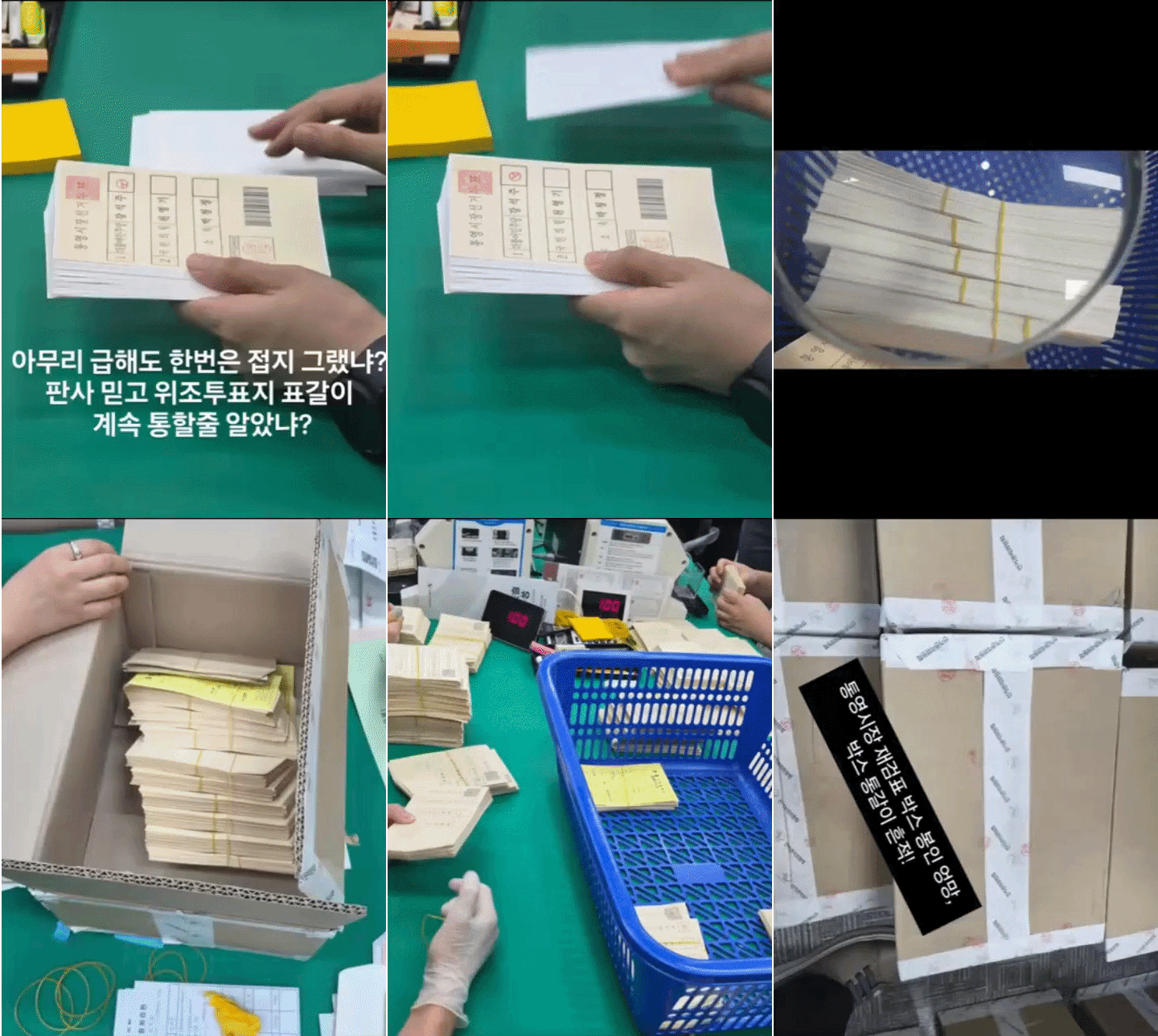 “Ignoring crisp ballots and damaged seals”… Tongyeong mayoral recount concludes with ‘no change in outcome,’ leaving suspicions and public outrage behind
Suspected counterfeit ballots discovered in Tongyeong [GIF from social media of Representative Hwang Kyo-ahn / Attorney Park Joo-hyun]During a recount of the Tongyeong mayoral election in South Gyeong
“Ignoring crisp ballots and damaged seals”… Tongyeong mayoral recount concludes with ‘no change in outcome,’ leaving suspicions and public outrage behind
Suspected counterfeit ballots discovered in Tongyeong [GIF from social media of Representative Hwang Kyo-ahn / Attorney Park Joo-hyun]During a recount of the Tongyeong mayoral election in South Gyeong
 President Yoon, regarding the first-instance ruling on the Public Official Election Act: “An excessive political verdict that distorts the facts… We will appeal immediately.”
The first-instance sentencing hearing for President Yoon Suk Yeol regarding violations of the Public Official Election Act is being broadcast live at Seoul Station on the 27th. [Photo=Yonhap News]Pres
President Yoon, regarding the first-instance ruling on the Public Official Election Act: “An excessive political verdict that distorts the facts… We will appeal immediately.”
The first-instance sentencing hearing for President Yoon Suk Yeol regarding violations of the Public Official Election Act is being broadcast live at Seoul Station on the 27th. [Photo=Yonhap News]Pres
 WSJ: "SK Hynix ADR Premium Is a Sign of AI Trading Overheat"
Advertisement for SK Hynix ADR listing in New York's Times Square [Reuters=Yonhap News file photo]The Wall Street Journal (WSJ) has pointed out that the price of SK Hynix’s American Depositary Recei
WSJ: "SK Hynix ADR Premium Is a Sign of AI Trading Overheat"
Advertisement for SK Hynix ADR listing in New York's Times Square [Reuters=Yonhap News file photo]The Wall Street Journal (WSJ) has pointed out that the price of SK Hynix’s American Depositary Recei
 'Godfather of Japanese Mystery Novels' Keigo Higashino Passes Away After Battle with Cancer at 68
Famous Japanese mystery novelist Keigo Higashino [AFP=Yonhap News]It has been belatedly reported that Keigo Higashino, the "godfather of Japanese mystery novels" and author of bestsellers such as "The
'Godfather of Japanese Mystery Novels' Keigo Higashino Passes Away After Battle with Cancer at 68
Famous Japanese mystery novelist Keigo Higashino [AFP=Yonhap News]It has been belatedly reported that Keigo Higashino, the "godfather of Japanese mystery novels" and author of bestsellers such as "The
 [Park Pil-kyu Security Column] To the Ignorant Trying to Clothe a Beast in Sheep's Clothing
Rep. Kim Byung-joo of the Democratic Party of Korea [Photo=Yonhap News]“The Air Force Academy doesn't teach you how to fly a plane!” “The Army, Navy, and Air Force academies are exactly the
[Park Pil-kyu Security Column] To the Ignorant Trying to Clothe a Beast in Sheep's Clothing
Rep. Kim Byung-joo of the Democratic Party of Korea [Photo=Yonhap News]“The Air Force Academy doesn't teach you how to fly a plane!” “The Army, Navy, and Air Force academies are exactly the
 [Issue Diagnosis] Two Effects of the Election Petition Review
 [Photo] Evidence of Election Fraud Flooding U.S. Media… Trump Had 2.7 Million Votes Stolen
 [Video] U.S. Semiquincentennial Air Show... 'Art in the Sky' streaks across New York
 [Editorial Cartoon] A Draconian Law That Undermines Freedom of Expression

 List
List