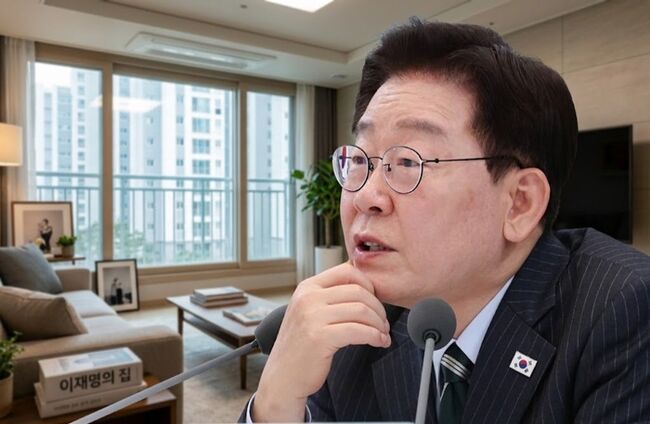
 [Image created with the help of AI]
Since you managed to defend your asking price and sell your home successfully, there is a point I have long wanted to address that must be brought to light.
For everyone, a space is more than just its physical volume. To ordinary people, a home is the wallpaper soaked in the sweat of arduous labor and a repository of time, where the growing heights of their children are marked on the doorframes each year.
Everyone crosses the threshold of a bank to take on debt, barely securing a fragile place to live. The hope that, as time passes, that pile of old concrete will return the warmth of capital and serve as a small shield for one's old age is not corrupt greed, but a deeply poignant and universal way of survival to protect one's family in a harsh world.
However, in modern South Korea, this scent of humble humanity has become a luxurious romance permitted only to a handful of the wealthy and foreigners holding thick wads of cash.
The emotional melodrama displayed by Lee Jae-myung in the process of selling his Bundang apartment for 2.9 billion won is a sad comedy that proves just how arrogantly they look down upon the lives of the public.
The initial report by the JoongAng Ilbo regarding the presidential candidate’s sale of his apartment was dry. It was a dispassionate statement of fact: a house purchased for 360 million won in 1998 had become worth 2.9 billion won, yielding a profit of 2.5 billion won.
Lee Jae-myung, unable to hide his displeasure, set out to correct the text. From his lips, as he poured out complaints about the "malicious" article, flowed a line that sounded like something out of a literary work.
He described it as a home first purchased during the bitter cold of the IMF era, a space as dear as a favorite toy he used to raise his children. He claimed he was not a speculator seeking profit, but a seeker who, with tears in his eyes, was letting go of a lifetime of memories only to set an example for the "normalization of real estate."
In the end, the headline of the article had its secular term "capital gains" erased, replaced by the noble paean of "will for real estate normalization."
At this point, I encounter the deep disgust stirred up by the political engineering typical of the left. Worse than the monopoly of wealth is the "monopoly of narrative." How many people in this land truly buy up empty houses solely for the purpose of capital gains?
Ordinary commoners, just like Lee Jae-myung, lose sleep while signing loan documents and write their own tearful narratives of life while raising their children in those homes.
Yet, why is it that when an ordinary neighbor takes on debt to buy a house, they are reduced to a speculator who sickens the national economy and becomes a target for punitive taxes, while the process by which Lee Jae-myung realizes a 2.5 billion won profit must be praised as a holy sacrifice and moving familial love?
While they denounce the asset growth of others as a scourge of capitalism that must be eradicated, they lock their own massive wealth away in a sterile room labeled "memories" and "romance," bleaching it clean.
This terrible self-righteousness—where my profit is a beautiful essay, while yours is base greed. That sadism, which seeks to strip the public not only of their sense of moral superiority but even of the narrative of their ordinary lives, is the true face of left-wing politics.
If you pull back the curtain of this lyrical melodrama, you find cold, calculating capital logic behind it. Beneath that elegant farewell, where he claimed to be setting an example, was hidden a world of perfect private leverage, where he set a 1.77 billion won mortgage for the buyer.
It was a brilliant transaction where the desperation of the buyer, who needed to secure the status of a reconstruction union member, and the interests of the seller, who wanted to capture the absolute peak price of 2.9 billion won, locked together like gears. They were utilizing the grammar of capitalism better than anyone else.
While the ink was drying on those documents, the streets were facing a brutal winter. Ordinary people in their 30s and 40s were bowing their heads at clogged bank windows, trying to secure tens of millions of won in loans for Jeonse or monthly rent just so they wouldn't end up on the street. The very authority figure who so mercilessly burned the ladder of loans that commoners depend on was, in fact, leisurely strolling through the springtime of a massive 1.77 billion won in private financing.
In the face of this elegant barbarism—which confines the sweat-stained desires of others to a poverty-stricken equality while placing only their own wealth and memories on a sacred altar—we must think quietly.
How long must we endure those noble excuses, recited while the loans that serve as lifelines for the common people are strictly blocked, and the text is rewritten to suit their tastes?
If we cannot tear down the curtain of that hypocritical narrative monopolized by power ourselves, the tearful time you have endured to keep your home will forever be recorded only as a sin called speculation.

◆ Author Park Joo-hyun
Composer, music director, columnist, and essayist. He actively expresses his opinions on political, current, and social issues on Facebook, garnering widespread sympathy from many. He is the author of the essay collection 'Crossing the Stormy Sea.'

 Iranian Foreign Ministry: "Continuing Message Exchanges with the U.S. and Activities of Mediating Countries"
Esmaeil Baghaei, Spokesperson for the Iranian Ministry of Foreign Affairs [Xinhua, Yonhap News file photo]Esmaeil Baghaei, spokesperson for the Iranian Ministry of Foreign Affairs, stated on the 26th
Iranian Foreign Ministry: "Continuing Message Exchanges with the U.S. and Activities of Mediating Countries"
Esmaeil Baghaei, Spokesperson for the Iranian Ministry of Foreign Affairs [Xinhua, Yonhap News file photo]Esmaeil Baghaei, spokesperson for the Iranian Ministry of Foreign Affairs, stated on the 26th
 President Yoon: "Do You Think You Are Safe from the Special Counsel?"... Final Statement Video Released
President Yoon Suk Yeol rebuking the special prosecutor on the 24th. [Court video / @birds_justice X account subtitle GIF] A video of President Yoon Suk Yeol's closing statement at his trial rega
President Yoon: "Do You Think You Are Safe from the Special Counsel?"... Final Statement Video Released
President Yoon Suk Yeol rebuking the special prosecutor on the 24th. [Court video / @birds_justice X account subtitle GIF] A video of President Yoon Suk Yeol's closing statement at his trial rega
 President Yoon, regarding the first-instance ruling on the Public Official Election Act: “An excessive political verdict that distorts the facts… We will appeal immediately.”
The first-instance sentencing hearing for President Yoon Suk Yeol regarding violations of the Public Official Election Act is being broadcast live at Seoul Station on the 27th. [Photo=Yonhap News]Pres
President Yoon, regarding the first-instance ruling on the Public Official Election Act: “An excessive political verdict that distorts the facts… We will appeal immediately.”
The first-instance sentencing hearing for President Yoon Suk Yeol regarding violations of the Public Official Election Act is being broadcast live at Seoul Station on the 27th. [Photo=Yonhap News]Pres
 WSJ: "SK Hynix ADR Premium Is a Sign of AI Trading Overheat"
Advertisement for SK Hynix ADR listing in New York's Times Square [Reuters=Yonhap News file photo]The Wall Street Journal (WSJ) has pointed out that the price of SK Hynix’s American Depositary Recei
WSJ: "SK Hynix ADR Premium Is a Sign of AI Trading Overheat"
Advertisement for SK Hynix ADR listing in New York's Times Square [Reuters=Yonhap News file photo]The Wall Street Journal (WSJ) has pointed out that the price of SK Hynix’s American Depositary Recei
 'Godfather of Japanese Mystery Novels' Keigo Higashino Passes Away After Battle with Cancer at 68
Famous Japanese mystery novelist Keigo Higashino [AFP=Yonhap News]It has been belatedly reported that Keigo Higashino, the "godfather of Japanese mystery novels" and author of bestsellers such as "The
'Godfather of Japanese Mystery Novels' Keigo Higashino Passes Away After Battle with Cancer at 68
Famous Japanese mystery novelist Keigo Higashino [AFP=Yonhap News]It has been belatedly reported that Keigo Higashino, the "godfather of Japanese mystery novels" and author of bestsellers such as "The
 [Park Pil-kyu Security Column] To the Ignorant Trying to Clothe a Beast in Sheep's Clothing
Rep. Kim Byung-joo of the Democratic Party of Korea [Photo=Yonhap News]“The Air Force Academy doesn't teach you how to fly a plane!” “The Army, Navy, and Air Force academies are exactly the
[Park Pil-kyu Security Column] To the Ignorant Trying to Clothe a Beast in Sheep's Clothing
Rep. Kim Byung-joo of the Democratic Party of Korea [Photo=Yonhap News]“The Air Force Academy doesn't teach you how to fly a plane!” “The Army, Navy, and Air Force academies are exactly the
 [Issue Diagnosis] Two Effects of the Election Petition Review
 [Photo] Evidence of Election Fraud Flooding U.S. Media… Trump Had 2.7 Million Votes Stolen
 [Video] U.S. Semiquincentennial Air Show... 'Art in the Sky' streaks across New York
 [Editorial Cartoon] A Draconian Law That Undermines Freedom of Expression

 List
List