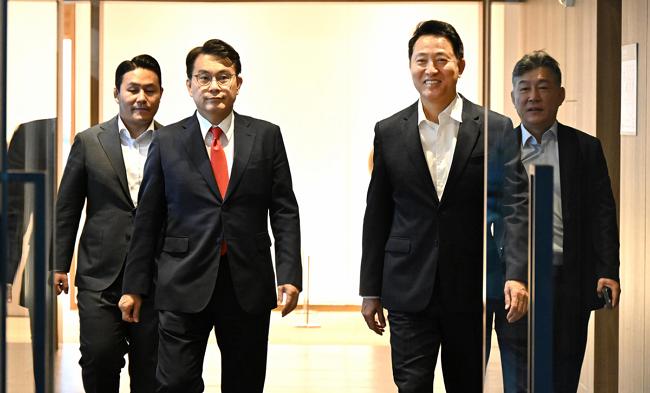
 Seoul Mayor Oh Se-hoon (second from right) and People Power Party lawmaker Yoon Sang-hyun (second from left) are seen leaving after a breakfast meeting at Seoul City Hall in Jung-gu, Seoul, on the 21st. The two discussed People Power Party reform measures, including the abolition of the party leader system, transforming into a parliamentary-centered party, and institutionalizing citizen nominations. [Photo: Yonhap News]
Seoul Mayor Oh Se-hoon and People Power Party lawmaker Yoon Sang-hyun have discussed a proposal to abolish the party leader system and transition into a party centered on the floor leader. They argue that the purpose is to eliminate conflicts between the party leader and the floor leader and to realize responsible politics centered on the National Assembly.
However, their concept leaves out the most important subject of a political party: its members.
The two-top system of a party leader and a floor leader was not created just to increase the number of positions. It was designed to split the authority between a party leader—who represents the entire party—and a floor leader—who represents incumbent lawmakers—to prevent the past abuses where omnipotent party presidents monopolized party operations, candidate nominations, and parliamentary strategies.
The two-top system may be inefficient. There are issues where the party leader and floor leader speak with different voices and the lines of accountability become blurred. Nevertheless, abolishing the party leader position and consolidating party power under the floor leader does not constitute party reform. Reducing the number of powerful figures is entirely different from democratizing power.
First, one must ask: Who is the owner of a political party—the party members or the lawmakers?
The floor leader is elected by incumbent lawmakers. The party leader is elected through the participation of party members and the public, representing the entire party, including regional committee chairs who do not hold office, local council members, defeated candidates, and ordinary party members. If the party leader position is abolished and the floor leader assumes the role of representing the party, the right to elect the party's leadership shifts from numerous party members to a small group of incumbent lawmakers.
This is not a decentralization of power; it is the abolition of the right of party members to be represented.
If an omnipotent party leader is the problem, the leader's power over nominations and organizational management should be distributed to party members, regional organizations, and an independent nomination committee. The party should strengthen party member voting and leadership recall systems, and entrust key revisions to the party constitution, party mergers, and nomination rules to the decisions of its members.
Simply transferring the authority of the party leader to the floor leader is not decentralization, but a new concentration of power that merges parliamentary power with party control.
They must also clarify who will exercise the power of nomination.
If the floor leader exerts influence not only over parliamentary strategy but also over the composition of nomination management bodies and the finalization of candidates, the structure becomes one where incumbent lawmakers elect their own representative, who in turn dictates the nominations for those very same lawmakers. Political newcomers and non-incumbents would then have to pass through a gate built by the current group of lawmakers.
That is neither citizen nomination nor member nomination. It is a "lawmaker cartel" where incumbents control the party's entry point.
And how do they explain party financing?
For example, if 1 million members each pay 1,000 won in monthly dues, that is 1 billion won per month, or 12 billion won annually. On top of this, political parties receive government subsidies from taxpayers' money based on the number of parliamentary seats and the percentage of votes in general elections. Central parties, provincial/city chapters, policy organizations, and regional branches are operated with money from party members and taxes from the public.
Are they saying that while they collect dues from members and subsidies from the public, only incumbent lawmakers will exercise power within the party? If members have no right to elect leadership or control nominations, they are not sovereign stakeholders. They are merely donors who pay money and are mobilized for election campaigns.
If members are not given rights, the justification for continuing to pay dues weakens. If the base of party dues collapses, the party organization will become even more dependent on government subsidies and incumbent lawmakers. The party will transform from a member-based organization into a parliamentary political syndicate operated by tax money and the legislative bloc.
What is even more startling is that such a proposal has emerged from the People Power Party, which has been criticizing the "one-man rule" of Lee Jae-myung in the Democratic Party.
Former Democratic Party leader Lee Jae-myung faced criticism for turning the party into a personal entity and centralizing power. Yet, even Lee did not abolish the party leader system to hand over party control to a floor leader elected only by lawmakers. On the contrary, the Democratic Party has expanded the influence of active party members in the process of electing the party leader, floor leader, and National Assembly speaker candidates.
Whether the goal was party-member sovereignty or consolidating power based on a hardcore support base is a separate issue to be evaluated. What is clear is that the direction was to shift the legislative bloc's power toward the members, not for the legislative bloc to retract the rights of the members.
If the People Power Party, which criticized the "privatization" of the Democratic Party, presents the abolition of the members' right to representation—something even Lee Jae-myung did not do—as "reform," who will be convinced?
Mayor Oh and lawmaker Yoon must answer four questions:
How will they guarantee the members' right to elect the leadership?
To whom will they entrust the power of nomination?
What authority will members who pay dues possess?
Who will check the power concentrated in the floor leader?
Abolishing the party leader position without answers is not "intra-party democracy." It is merely a "reorganization of power" that strips the party from its members and hands it over to incumbent lawmakers.
If members pay the dues and the public pays the taxes, are the lawmakers the only ones meant to hold the power?
If the "member sovereignty" that the People Power Party has been preaching was genuine, they should first propose ways to return more power to the members rather than abolishing the party leader position.

 Iranian Foreign Ministry: "Continuing Message Exchanges with the U.S. and Activities of Mediating Countries"
Esmaeil Baghaei, Spokesperson for the Iranian Ministry of Foreign Affairs [Xinhua, Yonhap News file photo]Esmaeil Baghaei, spokesperson for the Iranian Ministry of Foreign Affairs, stated on the 26th
Iranian Foreign Ministry: "Continuing Message Exchanges with the U.S. and Activities of Mediating Countries"
Esmaeil Baghaei, Spokesperson for the Iranian Ministry of Foreign Affairs [Xinhua, Yonhap News file photo]Esmaeil Baghaei, spokesperson for the Iranian Ministry of Foreign Affairs, stated on the 26th
 President Yoon: "Do You Think You Are Safe from the Special Counsel?"... Final Statement Video Released
President Yoon Suk Yeol rebuking the special prosecutor on the 24th. [Court video / @birds_justice X account subtitle GIF] A video of President Yoon Suk Yeol's closing statement at his trial rega
President Yoon: "Do You Think You Are Safe from the Special Counsel?"... Final Statement Video Released
President Yoon Suk Yeol rebuking the special prosecutor on the 24th. [Court video / @birds_justice X account subtitle GIF] A video of President Yoon Suk Yeol's closing statement at his trial rega
 President Yoon, regarding the first-instance ruling on the Public Official Election Act: “An excessive political verdict that distorts the facts… We will appeal immediately.”
The first-instance sentencing hearing for President Yoon Suk Yeol regarding violations of the Public Official Election Act is being broadcast live at Seoul Station on the 27th. [Photo=Yonhap News]Pres
President Yoon, regarding the first-instance ruling on the Public Official Election Act: “An excessive political verdict that distorts the facts… We will appeal immediately.”
The first-instance sentencing hearing for President Yoon Suk Yeol regarding violations of the Public Official Election Act is being broadcast live at Seoul Station on the 27th. [Photo=Yonhap News]Pres
 WSJ: "SK Hynix ADR Premium Is a Sign of AI Trading Overheat"
Advertisement for SK Hynix ADR listing in New York's Times Square [Reuters=Yonhap News file photo]The Wall Street Journal (WSJ) has pointed out that the price of SK Hynix’s American Depositary Recei
WSJ: "SK Hynix ADR Premium Is a Sign of AI Trading Overheat"
Advertisement for SK Hynix ADR listing in New York's Times Square [Reuters=Yonhap News file photo]The Wall Street Journal (WSJ) has pointed out that the price of SK Hynix’s American Depositary Recei
 'Godfather of Japanese Mystery Novels' Keigo Higashino Passes Away After Battle with Cancer at 68
Famous Japanese mystery novelist Keigo Higashino [AFP=Yonhap News]It has been belatedly reported that Keigo Higashino, the "godfather of Japanese mystery novels" and author of bestsellers such as "The
'Godfather of Japanese Mystery Novels' Keigo Higashino Passes Away After Battle with Cancer at 68
Famous Japanese mystery novelist Keigo Higashino [AFP=Yonhap News]It has been belatedly reported that Keigo Higashino, the "godfather of Japanese mystery novels" and author of bestsellers such as "The
 [Park Pil-kyu Security Column] To the Ignorant Trying to Clothe a Beast in Sheep's Clothing
Rep. Kim Byung-joo of the Democratic Party of Korea [Photo=Yonhap News]“The Air Force Academy doesn't teach you how to fly a plane!” “The Army, Navy, and Air Force academies are exactly the
[Park Pil-kyu Security Column] To the Ignorant Trying to Clothe a Beast in Sheep's Clothing
Rep. Kim Byung-joo of the Democratic Party of Korea [Photo=Yonhap News]“The Air Force Academy doesn't teach you how to fly a plane!” “The Army, Navy, and Air Force academies are exactly the
 [Issue Diagnosis] Two Effects of the Election Petition Review
 [Photo] Evidence of Election Fraud Flooding U.S. Media… Trump Had 2.7 Million Votes Stolen
 [Video] U.S. Semiquincentennial Air Show... 'Art in the Sky' streaks across New York
 [Editorial Cartoon] A Draconian Law That Undermines Freedom of Expression

 List
List