 Roy Kim, co-author of the "Dandong Project," is being interviewed by the . ©Korea-America Daily
1. Voter Turnout: The Core Secret of Election Fraud
In "Hacker's Fingerprint: Understanding 100 Puzzles," Commentary 91 defines the relationship between elections and voter turnout as follows:
“'Voter turnout' contains the most significant secret regarding election fraud. Along with the electoral roll itself, which increases the number of voters, it is the blind spot most difficult to monitor.” -p354
This is not merely raising suspicions. It is the result of analyzing the data from the April 15 general election, asserting with concrete evidence that voter turnout can function as a core tool for manipulation.
The design logic behind election manipulation is clear. As revealed in Commentary 83 of the same book, election manipulation is not simply about adding votes.
“The reason the total voter turnout in each constituency must not exceed a certain value (e.g., a maximum of 73%) is that an abnormally high turnout compared to previous elections would raise suspicions of manipulation.” -p320~321
In other words, the architects set an upper limit for turnout to avoid suspicion and then stuffed as many votes as possible within that threshold. A critical problem arises here: to insert fraudulent votes while staying under the turnout limit, the denominator must be increased. Specifically, the voter pool itself must be inflated.
“The only way to significantly increase the number of votes without making the turnout rise too noticeable is to expand the voter pool. In fact, there has been testimony that over 2 million deceased individuals or ineligible persons were included.” -p320~321
This is why the issues of voter turnout manipulation and the unified electoral roll are connected within a single structure.
2. Four Blind Spots Enabling Turnout Manipulation
Commentary 91 of the same book specifically points to four ways the National Election Commission (NEC) structurally blocks the monitoring of turnout manipulation through early voting:
“(i) Prevents accurate counting of early voters through measures like restrictions on CCTV and recording.”
“(ii) Since voter turnout is announced based on the voters' registered addresses (where mail reaches), there is no way to verify if the turnout was counted accurately at the voting location.”
“(iii) Even early voting observers are not informed of the exact number of voters at the site.”
“(iv) Voters only verify with their fingerprints but do not leave a handwritten signature, making post-election audits of the exact number of voters difficult.” -p354~357
These four points are not independent issues but a structure designed toward one consistent goal. That goal is to make it impossible for anyone to independently verify the number of early voters. The key is to ensure that regular citizens have no way of knowing exactly how many people voted early.
Furthermore, the facts revealed when the National Intelligence Service (NIS) conducted a virtual hacking check of the NEC’s computer network in 2023 were shocking.
“When the NIS virtually hacked the NEC’s network in 2023, many problems were discovered. The fact that the internet network, administrative network, and election network were not separated, and that the password was simply '12345,' left even IT-illiterate citizens in deep shock.” -p354~355
The password for an election system used by the entire nation was ‘12345.’ This single fact is sufficient to judge how insensitive the NEC was to computer security—or whether they intentionally neglected it.
The mechanism of election fraud is explained in Commentary 17 as follows:
“The essence of election fraud lies in increasing and announcing the turnout every hour during the voting process. It is estimated that the so-called 'shape-memory ballots'—perfectly crisp stacks of new bills—appear because most of the physical ballots corresponding to that inflated turnout are inserted before the vote count begins.” -p066~067
The process involves announcing an artificially high turnout via computer systems first, then injecting the corresponding physical ballots afterward. For this to be possible, the computer network must be accessible from the outside, the electoral roll must be manipulatable, and verification of early voter counts must be blocked. The NEC possessed all three of these conditions.
3. The Unified Electoral Roll — Legal Obligations vs. NEC Reality
Article 44-2 of the Public Official Election Act mandates the creation of a unified electoral roll:
“The National Election Commission must take necessary technical measures when creating a unified electoral roll to ensure that the same person cannot vote more than twice.” -p322~323
The law is clear. However, the National Intelligence Service confirmed in an official announcement on October 10, 2023, that this provision has been effectively neutralized.
“On October 10, 2023, the NIS announced that 'it was possible to change the status of someone who did not vote to having voted, and to register deceased persons as voters.' In 2025, Baek Jong-wook, the former 3rd Deputy Director of the NIS who led this investigation, stated during the Constitutional Court's presidential impeachment hearing that 'it is possible for a hacker to modify the unified electoral roll.'” -p322
The technical measures meant to prevent the same person from voting twice actually contained loopholes allowing deceased persons to be registered as living voters and those who did not vote to be marked as having voted. The NIS, a national agency responsible for the core of South Korea’s election system, officially confirmed this.
The NEC responded by stating that “the unified electoral roll system can only be accessed via a closed communication network isolated from the outside, and can only be accessed during a limited period, making it practically impossible to obtain the corresponding image files from the outside” (p374~375). However, this explanation contains a fatal self-contradiction.
“Above all, the claim that access is possible only during a 'limited period' means that there is a time window when the network is opened to the outside because it is not properly isolated. Does that 'limited time' refer to the time when 'hacking freedom' is granted?” -p374~377
The NEC’s own admission that it is “accessible only during a limited period” implies that the connection is open during that time. The claim of a closed network and the explanation of “limited access” are mutually exclusive.
4. Discrepancy Between NEC and Ministry of the Interior Rolls — Material Proof of Manipulation
The most specific issue regarding the unified electoral roll is the discrepancy between the NEC’s roll and the Ministry of the Interior and Safety’s (MOIS) records. Commentary 96 (p378~381) addresses this head-on.
In the 2021 recount for Yeongdeungpo-B, the submitted roll included 14 people born between 1886 and 1902. At the time, the world’s oldest person was Kane Tanaka of Japan, born in 1903. This means 14 people older than the Guinness World Record holder were listed as alive on the South Korean electoral roll. The fact that 14 people were over 118 years old was also confirmed in the records.
In the case of Incheon Yeonsu-B, the unified electoral roll listed 30 voters over the age of 100, but the actual roll submitted by the MOIS showed 21. Regarding this difference of 9, the NEC explained:
“As of March 31, 2020, the number of residents over 100 in Yeonsu-gu B on the MOIS resident registration system is indeed 21. It is presumed that the difference occurred because the number of voters over 100 on the unified electoral roll submitted at the time was calculated based only on the year of birth, rather than calculating age based on the date of birth as of the election day.”
The word ‘presumed’ stands out. An agency managing national elections explains a discrepancy of 9 people between its own roll and the MOIS roll as a ‘presumption.’ Commentary 83 (p320~321) points out that this is no coincidence.
“The appearance of a 134-year-old woman born in 1886 on the 2020 Yeongdeungpo-B electoral roll is presumed to be a desperate measure to offset the significant rise in voter turnout by expanding the voter pool. If a large number of deceased people are kept on the electoral roll to increase the number of voters, the increase in turnout is reduced even when phantom votes are inserted.”
The structure is visible. To avoid suspiciously high turnout while injecting fraudulent votes, the number of voters (the denominator) must be increased. The means to do so is keeping deceased and ineligible persons on the roll. This means turnout manipulation and roll inflation are linked within a single design.
5. What the NEC Submitted Is Not a Genuine Roll
During election litigation, the NEC submitted the unified electoral roll to the court. However, they submitted it with core information such as names, addresses, and birth dates redacted. The NEC's explanation is as follows:
“(ii) The fact that the voter's name, etc., were not displayed in the copy of the unified electoral roll submitted as a separate document is because, in accordance with the Supreme Court's order to produce documents, personal information that could identify voters—such as names, addresses, birth dates (excluding year), and household head status—was excluded.”
The book critiques this as follows:
“This is the same as being asked to submit CCTV footage because a serious felony occurred, and then preemptively redacting everything that could confirm the crime while claiming, ‘We consulted with the court and were concerned about personal information leakage.’” -p378
Even more serious is that the relationship between the court that requested the submission and the NEC is already a structure incapable of checks and balances. The head of the national NEC is a judge. The fact that the NEC and the courts do not check each other is a structural reality. Yet, they demand that the side filing the lawsuit identify the culprit.
“Furthermore, asking them to count the number of voters on a roll that they themselves have altered is essentially asking them to verify only the numbers they have matched, in a situation where one cannot even know if the voters are dead or alive. They are mocking the public even more severely than the idiom '朝三暮四' (deceiving someone with changing promises).” -p378~379
6. There Are No Signatures in Early Voting
The most decisive difference between early voting and election-day voting is the presence or absence of a signature. Commentary 83 points this out directly.
“During election-day voting, voters sign by hand at the polling station. At this time, those who voted early are already marked as having voted on the on-site roll. (The fact that early voting doesn’t even leave this signature! Doesn't it smell fishy?)” -p322
The absence of a signature means there is no independent way to verify the actual number of voters after the fact. The paper roll printed and kept at the polling station on election day indicates that early voters have already voted. If these paper rolls were collected and the actual number of voters counted, it would immediately become clear if they had been inflated. However, the NEC does not allow this verification.
“The NEC must submit all the unified rolls from each polling station, where voters sign on election day, to the investigative authorities. That is the only genuine roll. Don't you leave signatures one by one to verify when there is suspicion of alteration? Important clues are contained in those rolls. Do you mean you have already incinerated and destroyed them? If this is true, it is a terrifying state crime of destroying evidence.” -p380~381
A structure where citizens who were signing in at restaurants during the COVID-19 pandemic do not leave signatures when voting has been cemented by the NEC. The expression in Commentary 90 illustrates this bluntly.
“During the COVID-19 pandemic, the entire nation often signed in when using restaurants, but they don't even leave a signature during early voting. Although they leave signatures during election-day voting, in no case is the submission of these signed rolls allowed for counting the number of voters. Not even the President can inspect them.” -p352~353
7. An Uncheckable Structure — That Is the Key
The most fundamental problem surrounding the NEC is not the incompetence or mistake of a single agency. It is that a structure is already complete in which even the President, the NIS, and the prosecution cannot check the NEC.
Commentary 83 diagnoses this clearly.
“In short, it’s whatever the ‘NEC’ wants. No method of oversight is visible. If the NEC decides, the roll will expand and contract like a rubber band, won't it?” -p322
The Seoul Administrative Court ruled on October 4, 2022, that violating the Public Official Election Act provision requiring the personal seal of the poll supervisor is illegal (2022Guhap491). However, Commentary 90 writes:
“But even this is useless. As long as the Supreme Court and the NEC are tied together as one gang, the rulings of the High Court are meaningless.” -p352~353
It is a structure where the NEC continues to perform acts that the court has ruled illegal, and the Supreme Court condones it. The book summarizes the most serious problem in investigating election fraud to date as follows: -p322
“I believe the most serious problem in investigating election fraud to date lies in hiding this 'roll.' It is reminiscent of Umberto Eco's 'The Name of the Rose.' Does the electoral roll have poison on it? Is it a book with secrets that must be hidden at all costs?”
An agency that manages South Korea’s elections submits the unified electoral roll—the core record of a national election—with core information redacted even when a court order is issued, blocks the verification of election-day signature rolls at the source, and seals off all paths for independent verification of the number of early voters. Voter turnout and the unified electoral roll are the two key links in this structure. And both links are currently receiving no independent monitoring at this very moment.
8. “Circumstantial Evidence of False Turnout Input” — The Investigation Now Speaks
The suspicion of turnout manipulation, which the book has raised over several years, is no longer just in the realm of suspicion as of today (July 23, 2026).
The joint investigation team of the prosecution and police for the investigation into the infringement of citizens' suffrage rights announced that they have been conducting search and seizure operations since this morning at the NEC in Gwacheon, as well as the NECs of Songpa-gu, Gangnam-gu, and Seocho-gu. The joint investigation team explained, “We have discovered circumstantial evidence of false turnout input by officials at the central and Gyeonggi provincial NECs during this local election and are conducting searches and seizures on them.”
It is reported that the joint investigation team has also secured messenger conversations and traces of staff arbitrarily modifying computer figures to hide input mistakes. The possibility of intentional illegal activity, beyond simple negligence, has grown.
What should be noted even more is the potential for the expansion of the investigation. If turnout manipulation is proven to be true, there is a possibility that the investigation will expand to overall election management, including past elections.
It is reported that they have also secured messenger chat logs where NEC employees conspired to arbitrarily adjust numbers to “match the figures” instead of reporting input errors to their superiors.
At this point, the warning that the book has repeatedly emphasized for years must be brought back. "Hacker's Fingerprint" Commentary 91 wrote:
“'Voter turnout' contains the most significant secret regarding election fraud. Along with the electoral roll itself, which increases the number of voters, it is the blind spot most difficult to monitor.” -p354~355
And Commentary 17 of the same book had already explained the mechanism of manipulation:
“The essence of election fraud lies in increasing and announcing the turnout every hour during the voting process. It is estimated that the so-called 'shape-memory ballots'—perfectly crisp stacks of new bills—appear because most of the physical ballots corresponding to that inflated turnout are inserted before the vote count begins.” p066~067
What the book warned—the claim that the NEC can manipulate turnout by arbitrarily adjusting figures via computer and then stuffing physical ballots to match those numbers—is starting to reveal its reality through the forced investigation by investigative authorities today. The fact that employees conspired via messenger not to report to their superiors but to match the numbers proves that this was not an individual mistake but an organized cover-up.
Now, one must ask
I ask those who called the discovery of ‘follow_the_party’ in the April 15, 2020, general election data a conspiracy theory.
You called it a conspiracy theory even when the NIS officially confirmed in 2023 that they could register deceased persons as living voters in the NEC network and that changing the unified electoral roll was possible; even when it was revealed that the NEC roll and the MOIS roll were different; even when a 134-year-old woman born in 1886 was listed as alive on the Yeongdeungpo-B roll.
And today, the joint prosecution-police investigation team raided the NEC, captured “circumstantial evidence of false turnout input,” and launched an investigation on charges of falsification of public electronic records. Employees conspired on messengers to match the numbers and did not even report it to their superiors.
The book wrote:
“I believe the most serious problem in investigating election fraud to date lies in hiding this 'roll.'” -p322
The messenger conversations of the NEC employees who hid that roll, arbitrarily changed the turnout numbers, and conspired to do so are now in the hands of investigative authorities.
Do you still call ‘follow_the_party’ a conspiracy theory? The artificial pattern that the author of this book (Roy Kim himself) discovered in the official NEC data 6 years ago was pointing in exactly the same direction as the reality revealed by today's search and seizure.
◆ Who is Roy Kim?
He majored in Accounting at California State University, Long Beach, and served as a director at the venture company ‘E. Color.’ Afterward, he worked as a senior researcher on a joint international nano-material research project between Sungkyunkwan University and Seoul National University.
He served as an Owner Operator at McDonald’s Korea, and as an accounting and data analysis expert, he has appeared on numerous media outlets such as VON News and OKN to identify key facts regarding the suspicions of election fraud in the April 15 general election.
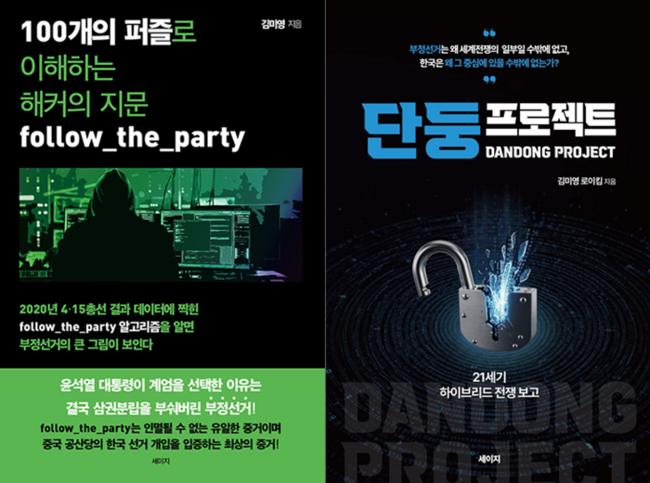
He is the author of ‘Hacker’s Fingerprint’ (co-author), ‘Discovery of the Hacker’s Fingerprint: How I Found follow_the_party,’ and ‘Dandong Project’ (co-author), and participated as an advisor for ‘Hacker’s Fingerprint: Understanding 100 Puzzles of follow_the_party.’
He also appeared in documentaries produced to investigate election fraud, such as ‘Your Vote is at Risk’ and ‘Why The Cartel,’ and participated as a lead contributor to the animation ‘The Secret of the Birth of Cabbage Leaf Ballots’ and the documentary ‘The Big Story.’ Additionally, he has authored numerous white papers and reports related to election fraud.

 Iranian Foreign Ministry: "Continuing Message Exchanges with the U.S. and Activities of Mediating Countries"
Esmaeil Baghaei, Spokesperson for the Iranian Ministry of Foreign Affairs [Xinhua, Yonhap News file photo]Esmaeil Baghaei, spokesperson for the Iranian Ministry of Foreign Affairs, stated on the 26th
Iranian Foreign Ministry: "Continuing Message Exchanges with the U.S. and Activities of Mediating Countries"
Esmaeil Baghaei, Spokesperson for the Iranian Ministry of Foreign Affairs [Xinhua, Yonhap News file photo]Esmaeil Baghaei, spokesperson for the Iranian Ministry of Foreign Affairs, stated on the 26th
 President Yoon: "Do You Think You Are Safe from the Special Counsel?"... Final Statement Video Released
President Yoon Suk Yeol rebuking the special prosecutor on the 24th. [Court video / @birds_justice X account subtitle GIF] A video of President Yoon Suk Yeol's closing statement at his trial rega
President Yoon: "Do You Think You Are Safe from the Special Counsel?"... Final Statement Video Released
President Yoon Suk Yeol rebuking the special prosecutor on the 24th. [Court video / @birds_justice X account subtitle GIF] A video of President Yoon Suk Yeol's closing statement at his trial rega
 President Yoon, regarding the first-instance ruling on the Public Official Election Act: “An excessive political verdict that distorts the facts… We will appeal immediately.”
The first-instance sentencing hearing for President Yoon Suk Yeol regarding violations of the Public Official Election Act is being broadcast live at Seoul Station on the 27th. [Photo=Yonhap News]Pres
President Yoon, regarding the first-instance ruling on the Public Official Election Act: “An excessive political verdict that distorts the facts… We will appeal immediately.”
The first-instance sentencing hearing for President Yoon Suk Yeol regarding violations of the Public Official Election Act is being broadcast live at Seoul Station on the 27th. [Photo=Yonhap News]Pres
 WSJ: "SK Hynix ADR Premium Is a Sign of AI Trading Overheat"
Advertisement for SK Hynix ADR listing in New York's Times Square [Reuters=Yonhap News file photo]The Wall Street Journal (WSJ) has pointed out that the price of SK Hynix’s American Depositary Recei
WSJ: "SK Hynix ADR Premium Is a Sign of AI Trading Overheat"
Advertisement for SK Hynix ADR listing in New York's Times Square [Reuters=Yonhap News file photo]The Wall Street Journal (WSJ) has pointed out that the price of SK Hynix’s American Depositary Recei
 'Godfather of Japanese Mystery Novels' Keigo Higashino Passes Away After Battle with Cancer at 68
Famous Japanese mystery novelist Keigo Higashino [AFP=Yonhap News]It has been belatedly reported that Keigo Higashino, the "godfather of Japanese mystery novels" and author of bestsellers such as "The
'Godfather of Japanese Mystery Novels' Keigo Higashino Passes Away After Battle with Cancer at 68
Famous Japanese mystery novelist Keigo Higashino [AFP=Yonhap News]It has been belatedly reported that Keigo Higashino, the "godfather of Japanese mystery novels" and author of bestsellers such as "The
 [Park Pil-kyu Security Column] To the Ignorant Trying to Clothe a Beast in Sheep's Clothing
Rep. Kim Byung-joo of the Democratic Party of Korea [Photo=Yonhap News]“The Air Force Academy doesn't teach you how to fly a plane!” “The Army, Navy, and Air Force academies are exactly the
[Park Pil-kyu Security Column] To the Ignorant Trying to Clothe a Beast in Sheep's Clothing
Rep. Kim Byung-joo of the Democratic Party of Korea [Photo=Yonhap News]“The Air Force Academy doesn't teach you how to fly a plane!” “The Army, Navy, and Air Force academies are exactly the
 [Issue Diagnosis] Two Effects of the Election Petition Review
 [Photo] Evidence of Election Fraud Flooding U.S. Media… Trump Had 2.7 Million Votes Stolen
 [Video] U.S. Semiquincentennial Air Show... 'Art in the Sky' streaks across New York
 [Editorial Cartoon] A Draconian Law That Undermines Freedom of Expression

 List
List










