An open letter urging the rescue of former U.S. Ambassador-at-Large for Global Criminal Justice Morse Tan was published in the July 23rd edition (local time) of The Hill, a U.S. congressional newspaper. Pictured is Ambassador Tan during an interview with <Hanmi Ilbo> at his residence last month. The content of this interview has not yet been reported. [Photo by Reporter Heo Gyeom]
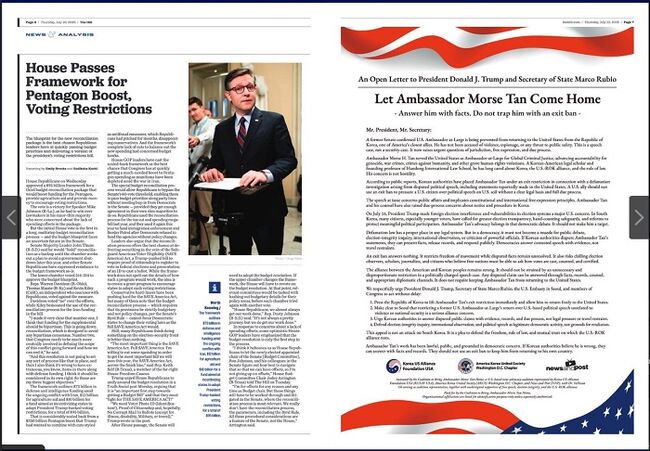 The open letter calling for the rescue of Ambassador Morse Tan appeared on page 7 (right) of the July 23rd edition of The Hill. On page 6 (left), news regarding U.S. Speaker of the House Mike Johnson was featured. [Capture of The Hill PDF edition]
An open letter urging the return of former U.S. Ambassador-at-Large for Global Criminal Justice Morse H. Tan (Korean name: Dan Hyun-myung) to the United States was published in the July 23rd edition (local time) of The Hill, a U.S. congressional newspaper.
The U.S.-based policy advocacy civic group, "The Coalition to Bring Ambassador Morse Tan Home" (represented by Oh In-hwan; hereinafter "the Coalition"), published the open letter on page 7 of The Hill, calling on U.S. President Donald Trump, Secretary of State Marco Rubio, the U.S. Embassy in Korea, and members of the U.S. Congress to intervene so that the South Korean government lifts the exit ban on Ambassador Tan and allows his safe return to the U.S.
The open letter was sponsored by key U.S.-based non-profit organizations, including the Korea-U.S. Alliance Foundation USA (KUSAF USA), the America-Korea United Society (AKUS) Washington D.C. Chapter, and News and Post (NNP).
The Coalition is headed by Oh In-hwan, Chairman of the AKUS Washington D.C. Chapter. The Korea-U.S. Alliance Foundation USA is a U.S.-based non-profit distinct from the Korea-U.S. Alliance Foundation in South Korea.
Indicted without detention on July 16… Exit ban extended until August 15
According to domestic media reports, this matter has moved beyond the investigative stage into legal proceedings. Reports on the 22nd (Korea time) revealed that the Seoul Central District Prosecutors' Office indicted Ambassador Tan without detention on the 16th on charges of defamation under the Information and Communications Network Act and the Criminal Act. The indictment was not immediately publicized and was only confirmed later through media reports.
Additionally, the existing exit ban, which was previously set to expire at the end of July, has been extended until August 15 following the indictment. Concerns over a further extension have become a reality.
As a result, the Coalition views this situation no longer as a temporary restriction on travel, but as a long-term issue tied to ongoing judicial proceedings.
The Coalition argues that if a U.S. citizen and former ambassador-level official is unable to return home for a prolonged period due to political statements, it will inevitably become a significant issue involving freedom of expression, due process, consular protection, and the credibility of the U.S.-ROK alliance.
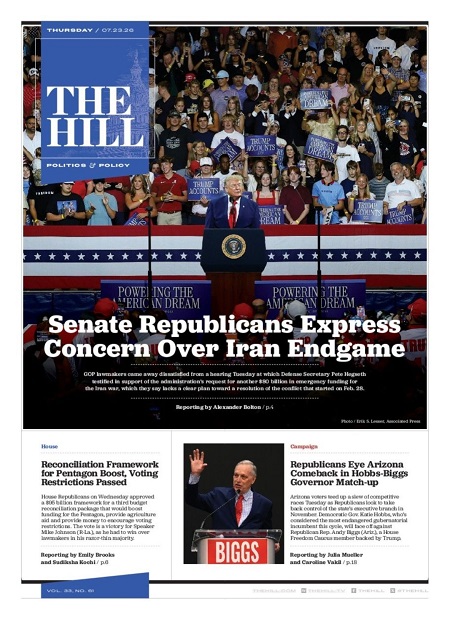 Front page of the July 23rd edition of The Hill.
Why Ambassador Morse Tan’s case is more than simple defamation
The Coalition believes this case cannot be viewed merely as a private defamation matter. Ambassador Tan is not an ordinary visitor who happened to become entangled in a legal dispute in Korea; he is a former U.S. State Department ambassador-level official who has publicly raised concerns regarding election integrity in Korea to U.S. political circles and the international community.
During the South Korean presidential election on June 3 of last year, Ambassador Tan visited Korea to lead the four-member International Election Monitoring Team (IEMT). Subsequently, he publicly reported and argued that the election was not fair and raised suspicions that Lee Jae-myung was elected through fraudulent means. He has continued activities to inform U.S. political circles and the international community of these issues through press conferences at the National Press Club and presentations at the U.S. Capitol.
In this process, Ambassador Tan made comments regarding suspicions about Lee Jae-myung’s youth, and it is understood that Korean authorities are using these comments as the basis for the defamation charges. The Coalition emphasized, "Rather than focusing on the specific facts of these statements, one must look at the correlation between his activities in raising election integrity issues to the international community and the subsequent exit ban and indictment."
Ambassador Tan also visited Korea during the 6/3 local election period to observe election fairness and stand with citizens demanding clarification on election fraud allegations. Viewed in this context, the Coalition worries that while the exit ban cites defamation as a surface-level justification, it could actually be interpreted as political pressure against a U.S. figure who has been a vocal critic of Korea’s election fairness.
Accordingly, the Coalition stated, "The focus of this open letter in The Hill is not to exacerbate the debate over the veracity of specific remarks, but to ask whether a measure that prevents the return of a former U.S. ambassador-level official based on his raising of election integrity issues and political expression is proportionate and lawful."
The core message of The Hill open letter
"Refute with facts, respond with due process. An exit ban is not the answer."
The open letter published in The Hill captures the core of its campaign with this statement.
It argues that if Korean authorities take issue with Ambassador Tan’s statements, they should respond with facts, records, public refutation, and due process rather than an exit ban.
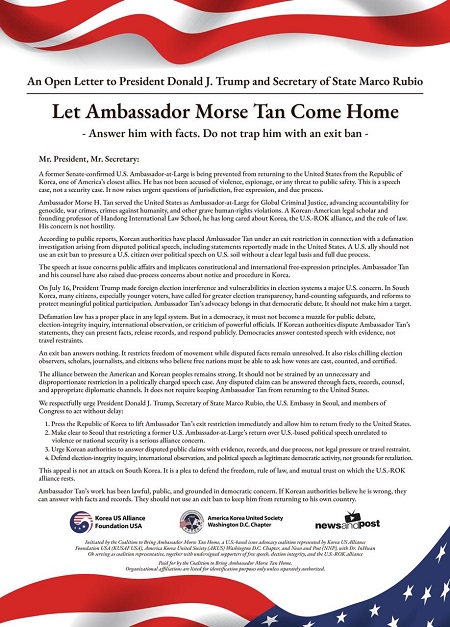 The English open letter published by the ‘Coalition to Bring Ambassador Morse Tan Home’ in The Hill.
The open letter emphasizes that Ambassador Tan is not someone who has committed violence, espionage, or posed a threat to public safety. This is not a security issue, but a matter of expression, while simultaneously raising serious concerns regarding jurisdiction, freedom of speech, and due process.
Ambassador Tan served as the U.S. State Department’s Ambassador-at-Large for Global Criminal Justice, working to hold perpetrators accountable for major human rights abuses such as genocide, war crimes, and crimes against humanity. As a Korean-American legal scholar and founding professor of Handong International Law School, he has also maintained deep ties with Korea.
In the open letter, the Coalition emphasized, "His background in raising issues regarding Korean election integrity, the possibility of foreign interference, and political freedom of expression stems from a sense of responsibility for Korean liberal democracy, the ROK-U.S. alliance, and the rule of law, not from hostility toward Korea." It stressed, "If Korean authorities have rebuttals, they should respond with facts, records, and public counter-arguments, not with an exit ban."
Furthermore, it stated, "Some of the problematic remarks were reportedly made by a U.S. citizen within the United States," and warned, "An ally should not restrict a U.S. citizen's return based on political speech made in the U.S. without clear legal grounds and full due process."
The Coalition requested four actions from the U.S. government and Congress in the letter.
First, it urged the U.S. to call on the South Korean government to immediately lift the exit ban on Ambassador Tan and allow him to return to the U.S. freely. Second, it demanded a clear communication to the Korean government that restricting the return of a former U.S. ambassador-level official based on political speech made in the U.S.—which is unrelated to violence or national security—is a serious alliance issue.
Third, it requested that the U.S. urge Korean authorities to respond to controversial public claims with evidence, records, and due process, rather than legal pressure or travel restrictions. Fourth, it asked for advocacy affirming that raising election integrity issues, international election monitoring, and political expression are legitimate democratic activities, not targets for retaliation.
Dr. Oh In-hwan: "They should refute with facts and records"
"A former U.S. Ambassador-at-Large, confirmed by the U.S. Senate, should not be prevented from returning to his home country due to politically sensitive remarks. If Korean authorities disagree with Ambassador Tan’s statements, they should refute them with facts and records. A U.S. citizen should not be pressured through an exit ban for political remarks reportedly made within the United States."
Dr. Oh In-hwan emphasized this, stating, "This appeal is not an attack on the Republic of Korea." He noted, "It is a request to uphold the foundations of the U.S.-ROK alliance: freedom, the rule of law, and mutual trust," adding that "The alliance between the peoples of the U.S. and Korea remains strong."
He further reiterated that "The credibility of the ROK-U.S. alliance should not be undermined by unnecessary and excessive exit bans regarding issues of politically sensitive expression."
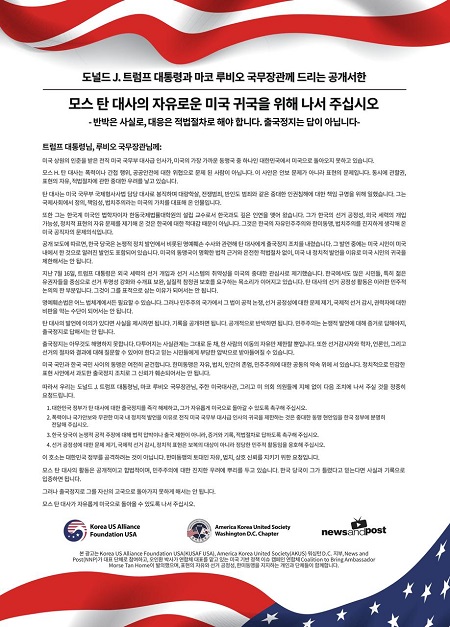 The Korean translation of the open letter published by the ‘Coalition to Bring Ambassador Morse Tan Home’ in The Hill.
Separate letter to be delivered directly to Secretary Rubio
In addition to the open letter in The Hill, the Coalition has prepared an official letter addressed to Secretary of State Marco Rubio, which will be delivered directly to the Secretary’s office.
The letter contains requests for Secretary Rubio to treat this matter as an urgent diplomatic and consular issue and for the State Department and the U.S. Embassy in Korea to take substantive action to ensure Ambassador Tan’s free return to the U.S.
The Coalition believes this case is fundamentally different from routine incidents where Americans abroad follow local legal procedures.
Because the legal proceedings surrounding his political speech and freedom of expression raise serious concerns regarding jurisdiction, due process, and substantive merits, and because the exit ban has reportedly been extended until August 15, the Coalition argues that U.S. government intervention can no longer be delayed.
The Coalition anticipates that a clear position or diplomatic message from the President, Vice President, or Secretary of State could play a vital role in resolving the situation.
The significance of the full-page ad in The Hill… Emergency measures following broken expectations
The Hill is a leading political and congressional media outlet that focuses on the U.S. Congress, the White House, the federal government, and election and policy issues, primarily in Washington D.C. Owned by Nexstar Media Group, one of the largest local television station owners in the U.S., it is widely read by Washington political circles, congressional staff, policymakers, and lobbyists.
The Coalition stated, "While a single newspaper advertisement does not immediately create policy decisions, the full-page open letter ad in The Hill is significant in that it is a public message aimed directly at the Washington policy community, the Congress, and the administration to raise the issue." It further explained, "This open letter demonstrates that Ambassador Tan’s exit ban is being elevated as an ROK-U.S. alliance issue that the U.S. political and policy community must pay attention to."
The Coalition emphasized, "Now is the time for the U.S. government and Congress to address this issue directly. Ambassador Tan’s case cannot be viewed merely as an individual legal dispute. It is a matter involving freedom of speech, election integrity, international election monitoring, the protection of U.S. citizens, and the credibility of the ROK-U.S. alliance."
☞ Announcement of the Open Letter for the Rescue of Morse Tan in The Hill (July 23) - NNP
Please act for the safe return of Ambassador Morse Tan to the United States Refute with facts, respond with due process. An exit ban is not the answer.
To President Trump and Secretary of State Rubio: A former U.S. State Department ambassador-level official, confirmed by the U.S. Senate, is unable to return to the United States from the Republic of Korea, one of our closest allies. Ambassador Morse H. Tan is not someone who has committed violence, espionage, or posed a threat to public safety. This is not a security issue, but a matter of expression. It simultaneously raises serious concerns regarding jurisdiction, freedom of speech, and due process. Ambassador Tan served as the U.S. State Department’s Ambassador-at-Large for Global Criminal Justice, working to hold perpetrators accountable for major human rights abuses such as genocide, war crimes, and crimes against humanity. He is a person who has represented American values of justice, accountability, and the rule of law in the international community. As a Korean-American legal scholar and founding professor of Handong International Law School, he has also maintained deep ties with Korea. His raising of issues regarding Korean election integrity, the possibility of foreign interference, and political freedom of expression does not stem from hostility toward Korea. It is the concern of an American public servant who has deeply considered the state of Korea’s liberal democracy, the ROK-U.S. alliance, and the rule of law. According to public reports, Korean authorities have placed an exit ban on Ambassador Tan in connection with a defamation investigation arising from controversial political statements. These statements include remarks reportedly made by a U.S. citizen within the United States. An ally should not restrict a U.S. citizen's return based on political speech made in the U.S. without clear legal grounds and full due process. On July 16, President Trump raised foreign election interference and the vulnerabilities of election systems as a matter of major U.S. concern. In Korea, many citizens, particularly young voters, are raising voices for enhanced election transparency, the supplementing of manual counting, and the substantial protection of voting rights. Ambassador Tan’s activities regarding election fairness are a part of this democratic discourse. They should not be the reason for targeting him. Defamation laws are necessary in any legal system. However, in a democratic country, those laws should not be used as a means to suppress public debate, questions regarding election fairness, international election monitoring, or criticism of those in power. If you disagree with Ambassador Tan's statements, present the facts. Release the records. Refute them publicly. Democracy requires responding to controversial statements with evidence, not with exit bans. An exit ban explains nothing. It restricts a person's freedom of movement while leaving the disputed facts unresolved. Furthermore, it can be perceived as unjust pressure on election monitors, scholars, journalists, and citizens who believe they should be able to question the processes and results of an election. The alliance between the peoples of the U.S. and Korea remains strong. The ROK-U.S. alliance stands on a shared commitment to freedom, the rule of law, human dignity, and democracy. That trust must not be undermined by excessive exit bans in matters of politically sensitive expression. Therefore, we respectfully request that President Donald J. Trump, Secretary of State Marco Rubio, the U.S. Embassy in Korea, and members of the U.S. Congress take the following actions without delay: 1. Call on the South Korean government to immediately lift the exit ban on Ambassador Tan and allow him to return to the U.S. freely. 2. Communicate clearly to the Korean government that restricting the return of a former U.S. ambassador-level official based on political speech made in the U.S.—which is unrelated to violence or national security—is a serious alliance issue. 3. Urge Korean authorities to respond to controversial public claims with evidence, records, and due process, rather than legal pressure or travel restrictions. 4. Advocate that raising election integrity issues, international election monitoring, and political expression are legitimate democratic activities, not targets for retaliation. This appeal is not an attack on the Republic of Korea. It is a request to uphold the foundations of the ROK-U.S. alliance: freedom, the rule of law, and mutual trust. Ambassador Morse Tan’s activities are public, legal, and rooted in a sincere concern for democracy. If Korean authorities believe he is wrong, they should prove it with facts and records. However, they must not prevent him from returning to his home country through an exit ban. Please act so that Ambassador Morse Tan may return to the United States freely. Korea-U.S. Alliance Foundation USA America-Korea United Society Washington D.C. Chapter News and Post |

 [Statement by the Seo-beo-kka Korea Military Academy Save-the-Nation Comrades Association] ㉛ Recount the Votes Publicly, as the Previous Recount Concealed Election Fraud
Tongyeong Mayoral Election Recount [Photo=Yonhap News]South Korea's liberal democracy is dying. The National Election Commission (NEC) and the judiciary, which have plummeted into criminal syndicates
[Statement by the Seo-beo-kka Korea Military Academy Save-the-Nation Comrades Association] ㉛ Recount the Votes Publicly, as the Previous Recount Concealed Election Fraud
Tongyeong Mayoral Election Recount [Photo=Yonhap News]South Korea's liberal democracy is dying. The National Election Commission (NEC) and the judiciary, which have plummeted into criminal syndicates
 Trump's nominee for new U.S. intelligence chief confirmed by U.S. Senate
U.S. Attorney for the Southern District of New York Jay Clayton, who has been confirmed by the Senate to lead the U.S. intelligence community [AP=Yonhap News File Photo]The U.S. Senate confirmed the n
Trump's nominee for new U.S. intelligence chief confirmed by U.S. Senate
U.S. Attorney for the Southern District of New York Jay Clayton, who has been confirmed by the Senate to lead the U.S. intelligence community [AP=Yonhap News File Photo]The U.S. Senate confirmed the n
 PPP on Speaker Woo's Remarks About 'Lee Jae-myung's Consecutive Term and Constitutional Amendment': "A True Act of Insurrection"
People Power Party Representative Jang Dong-hyeok holds a press conference at the National Assembly on the 28th to express his stance regarding National Assembly Speaker Cho Jeong-sik's remarks on a c
PPP on Speaker Woo's Remarks About 'Lee Jae-myung's Consecutive Term and Constitutional Amendment': "A True Act of Insurrection"
People Power Party Representative Jang Dong-hyeok holds a press conference at the National Assembly on the 28th to express his stance regarding National Assembly Speaker Cho Jeong-sik's remarks on a c
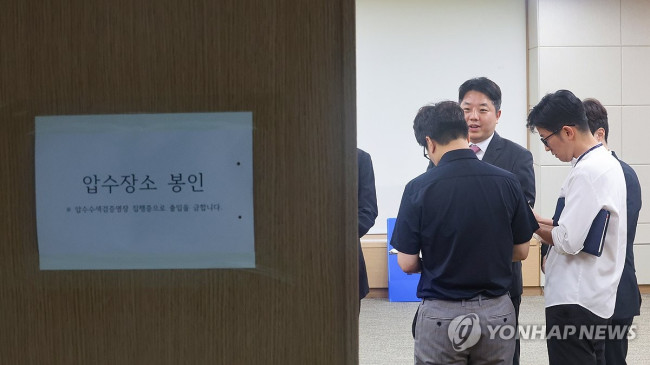 Prosecution Investigates Gyeonggi-do Election Commission Officials as Suspects in 'Statistical Manipulation' of Ballot Counting Records
'Circumstances of statistical manipulation following turnout errors': Joint Investigation Team conducts search and seizure at National Election Commission [Yonhap News file photo]The joint prosecution
Prosecution Investigates Gyeonggi-do Election Commission Officials as Suspects in 'Statistical Manipulation' of Ballot Counting Records
'Circumstances of statistical manipulation following turnout errors': Joint Investigation Team conducts search and seizure at National Election Commission [Yonhap News file photo]The joint prosecution
 SK Hynix Posts Record-High 76% Operating Margin… Outpacing TSMC for Three Consecutive Quarters
In the second quarter of this year, SK hynix [000660] maintained top-tier profitability in the semiconductor industry, recording an operating profit margin of 76%, which surpassed that of Taiwan’s T
SK Hynix Posts Record-High 76% Operating Margin… Outpacing TSMC for Three Consecutive Quarters
In the second quarter of this year, SK hynix [000660] maintained top-tier profitability in the semiconductor industry, recording an operating profit margin of 76%, which surpassed that of Taiwan’s T
 Shin Jin-seo: "AI is not the 'God of Go'… Human Go still holds its charm."
"I don't think AI is the 'God of Go.' I am confident that human Go, which involves making brilliant moves and high-stakes gambles depending on the situation, is still far more fascinating than AI, whi
Shin Jin-seo: "AI is not the 'God of Go'… Human Go still holds its charm."
"I don't think AI is the 'God of Go.' I am confident that human Go, which involves making brilliant moves and high-stakes gambles depending on the situation, is still far more fascinating than AI, whi
 [Park Pil-gyu's Security Column] If Carrying Out Orders Becomes a Crime, Neither the State Nor the Military Can Survive
"Can a military where following orders becomes a crime truly protect the nation and its people, contribute to maintaining the continuity of the state, and continue to survive and exist?" Soldiers stan
[Park Pil-gyu's Security Column] If Carrying Out Orders Becomes a Crime, Neither the State Nor the Military Can Survive
"Can a military where following orders becomes a crime truly protect the nation and its people, contribute to maintaining the continuity of the state, and continue to survive and exist?" Soldiers stan
 [Photo] Evidence of Election Fraud Flooding U.S. Media… Trump Had 2.7 Million Votes Stolen
 [Video] U.S. Semiquincentennial Air Show... 'Art in the Sky' streaks across New York
 [Editorial Cartoon] A Draconian Law That Undermines Freedom of Expression

 List
List