 Special Parliamentary Committee on the National Election Commission's ballot shortage scandal during the June 3 local elections [Photo: Yonhap News]
Controversies over private contracts at the National Election Commission (NEC) are escalating into a "400 million won bakery bill" scandal.
This is because it has been revealed that a specific bakery franchise store in Seo-gu, Incheon, secured 140 separate snack and midnight-meal contracts with 61 different NEC offices, despite the existence of the same franchises in every region across the country. The NEC maintains that there are no issues under the Public Contract Act, as each individual contract for goods or services was valued at under 20 million won, the threshold for private contracting.
However, the 20 million won limit is merely a formal requirement that allows for private contracts; it does not explain whether the business was artificially split or why a specific vendor was repeatedly selected.
□ Same election contracts repeatedly awarded to the same vendor
Rep. Joo Jin-woo of the People Power Party, after analyzing procurement data submitted by the Public Procurement Service, stated that the NEC had entered into 30 private contracts with six companies—totaling 940.67 million won—under circumstances that suggest identical or closely related projects were divided into multiple smaller contracts.
One company signed five contracts for the production of printed materials and manuals for the 21st Presidential Election over just six days (April 10–15, 2025), totaling 186.58 million won.
Another company was granted contracts for the rental of office equipment for the election situation room on the same day, split into two separate phases, and similar patterns were identified in contracts for large ballot boxes, locking mechanisms, and lids for mail-in ballot boxes.
The fact that there are multiple contracts does not automatically imply illegality. Separate contracts may be necessary if specifications, delivery deadlines, or budget items differ.
However, if items and services required for the same election are repeatedly contracted to the same vendor on the same day or within days of each other, one must verify when the total demand was identified and whether consolidated procurement was considered.
At this stage, the conclusion is not that "illegal splitting has been confirmed," but that "there are specific circumstances that raise suspicions of contract fragmentation to avoid competitive bidding."
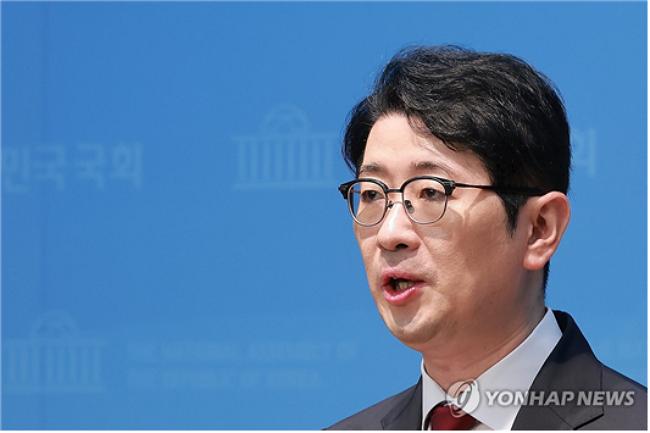 Rep. Joo Jin-woo of the People Power Party speaks at the National Assembly Communication Hall on the 19th, revealing that 82.1% of the NEC’s contracts over the past five years were private contracts. [Photo: Yonhap News]
□ 140 contracts with one Incheon store despite nationwide chain presence
According to private contract data from 2021 to 2026 submitted by the NEC to the office of Rep. Yoon Sang-hyun of the People Power Party, a single franchise bakery in Seo-gu, Incheon, signed 140 snack and midnight-meal contracts for vote-counting staff with 61 NEC offices across the country, totaling approximately 437.16 million won.
The volume of these contracts grew from 4 contracts worth 8.91 million won in 2021 to 36 contracts worth 160.97 million won in 2026, with NEC offices in Gangwon, South Jeolla, North Jeolla, and North Chungcheong also doing business with this specific store. The vendor explained that they received more business because they were "recommended by word of mouth" due to their good delivery record.
However, it was not disclosed who recommended the vendor, whether there was an official recommendation process, or whether price and delivery conditions were compared with local stores in each region. It has also not been confirmed whether the Incheon store merely held the contracts while local shops actually handled the deliveries.
While it cannot be deemed illegal without further proof, the reason for this concentration of contracts on a specific store, despite the availability of the same brand nationwide, must be clarified.
□ The trap in the NEC’s claim that private contracts are "permissible" and "not an issue"
The Public Contract Act establishes general competitive bidding as the principle and private contracts as the exception. An enforcement decree allows private contracts for the purchase, rental, or service of goods with an estimated price of 20 million won or less. Therefore, the NEC’s explanation that the private contract method was permissible for individual contracts below that threshold is difficult to dismiss as technically incorrect.
However, if the total demand was known to be 100 million won and was intentionally divided into several contracts of around 20 million won, the individual contract amounts are not a basis for immunity, but rather the starting point for determining whether competitive bidding was avoided.
The NEC’s defense—that each local office presumably assessed unit prices and the feasibility of stable procurement for the bakery contracts—is also hard to accept as an answer backed by comparative quotes and selection documentation for each contract.
According to the analysis by Rep. Joo’s office, 2,187 out of 2,665 NEC contracts (82.1%) over the past five years were private contracts.
While a high ratio does not in itself mean illegality, it diverges from the legal framework where competitive bidding is the rule and private contracting is the exception. It is necessary to examine the reasons for these contracts and the vendor selection process to determine if this "exception" has effectively hardened into a standard practice.
□ Local currency promotes local commerce, public procurement promotes out-of-region spending
The justification for the expansion of local currency and regional gift certificates by the Lee Jae-myung administration is to redirect consumption to local small business owners and neighborhood commercial districts to stimulate the local economy.
Yet, a state agency repeatedly contracted a specific store in Incheon for bread and snacks that could have been easily purchased in every local region. While the NEC is not part of the executive branch and is not legally obligated to use local vendors, public procurement must be grounded in economic efficiency, competitiveness, and transparency.
Large corporations’ "funneling" of work to affiliates and the inheritance of jobs by militant unions are criticized because specific networks block opportunities for outside competition.
If NEC contracts similarly concentrated opportunities on a specific vendor through internal referrals and repeated private contracting, they should be scrutinized using the same standard of fairness.
□ Verdict — NEC’s explanation is insufficient
The NEC’s claim that "there is no issue under the Contract Act because each contract is under 20 million won" only explains that the individual contracts qualify for private contracting.
It fails to address whether the same business was artificially divided, whether the selection process for the specific vendor was fair, and whether price and quality were properly compared.
To resolve the suspicions, the NEC must disclose the initial procurement plans, estimated price calculations, reasons for contract separation, comparative quotes, vendor recommendation paths, and delivery and inspection records.
Adhering to the legal monetary threshold does not equate to fairness. If projects are sliced thin and opportunities are funneled to specific vendors, the principles of public procurement collapse, regardless of whether the form appears lawful.
What the NEC contracts have revealed is not merely a "bakery bill" scandal, but a reversal of the principles of fairness—namely competition, local economic contribution, and transparent budget execution.
Editor’s Note: This article was written based on the data released by Rep. Joo Jin-woo’s office following an analysis of Public Procurement Service records, private contract data submitted by the NEC to Rep. Yoon Sang-hyun’s office, and current national contract laws and regulations. The legality of individual contracts must be determined through audits and investigations of original contracts and internal procurement documents.
|
※ This article was published in the 18th issue of the Weekly Hanmi Ilbo.

 Iranian Foreign Ministry: "Continuing Message Exchanges with the U.S. and Activities of Mediating Countries"
Esmaeil Baghaei, Spokesperson for the Iranian Ministry of Foreign Affairs [Xinhua, Yonhap News file photo]Esmaeil Baghaei, spokesperson for the Iranian Ministry of Foreign Affairs, stated on the 26th
Iranian Foreign Ministry: "Continuing Message Exchanges with the U.S. and Activities of Mediating Countries"
Esmaeil Baghaei, Spokesperson for the Iranian Ministry of Foreign Affairs [Xinhua, Yonhap News file photo]Esmaeil Baghaei, spokesperson for the Iranian Ministry of Foreign Affairs, stated on the 26th
 President Yoon: "Do You Think You Are Safe from the Special Counsel?"... Final Statement Video Released
President Yoon Suk Yeol rebuking the special prosecutor on the 24th. [Court video / @birds_justice X account subtitle GIF] A video of President Yoon Suk Yeol's closing statement at his trial rega
President Yoon: "Do You Think You Are Safe from the Special Counsel?"... Final Statement Video Released
President Yoon Suk Yeol rebuking the special prosecutor on the 24th. [Court video / @birds_justice X account subtitle GIF] A video of President Yoon Suk Yeol's closing statement at his trial rega
 President Yoon, regarding the first-instance ruling on the Public Official Election Act: “An excessive political verdict that distorts the facts… We will appeal immediately.”
The first-instance sentencing hearing for President Yoon Suk Yeol regarding violations of the Public Official Election Act is being broadcast live at Seoul Station on the 27th. [Photo=Yonhap News]Pres
President Yoon, regarding the first-instance ruling on the Public Official Election Act: “An excessive political verdict that distorts the facts… We will appeal immediately.”
The first-instance sentencing hearing for President Yoon Suk Yeol regarding violations of the Public Official Election Act is being broadcast live at Seoul Station on the 27th. [Photo=Yonhap News]Pres
 WSJ: "SK Hynix ADR Premium Is a Sign of AI Trading Overheat"
Advertisement for SK Hynix ADR listing in New York's Times Square [Reuters=Yonhap News file photo]The Wall Street Journal (WSJ) has pointed out that the price of SK Hynix’s American Depositary Recei
WSJ: "SK Hynix ADR Premium Is a Sign of AI Trading Overheat"
Advertisement for SK Hynix ADR listing in New York's Times Square [Reuters=Yonhap News file photo]The Wall Street Journal (WSJ) has pointed out that the price of SK Hynix’s American Depositary Recei
 'Godfather of Japanese Mystery Novels' Keigo Higashino Passes Away After Battle with Cancer at 68
Famous Japanese mystery novelist Keigo Higashino [AFP=Yonhap News]It has been belatedly reported that Keigo Higashino, the "godfather of Japanese mystery novels" and author of bestsellers such as "The
'Godfather of Japanese Mystery Novels' Keigo Higashino Passes Away After Battle with Cancer at 68
Famous Japanese mystery novelist Keigo Higashino [AFP=Yonhap News]It has been belatedly reported that Keigo Higashino, the "godfather of Japanese mystery novels" and author of bestsellers such as "The
 [Park Pil-kyu Security Column] To the Ignorant Trying to Clothe a Beast in Sheep's Clothing
Rep. Kim Byung-joo of the Democratic Party of Korea [Photo=Yonhap News]“The Air Force Academy doesn't teach you how to fly a plane!” “The Army, Navy, and Air Force academies are exactly the
[Park Pil-kyu Security Column] To the Ignorant Trying to Clothe a Beast in Sheep's Clothing
Rep. Kim Byung-joo of the Democratic Party of Korea [Photo=Yonhap News]“The Air Force Academy doesn't teach you how to fly a plane!” “The Army, Navy, and Air Force academies are exactly the
 [Issue Diagnosis] Two Effects of the Election Petition Review
 [Photo] Evidence of Election Fraud Flooding U.S. Media… Trump Had 2.7 Million Votes Stolen
 [Video] U.S. Semiquincentennial Air Show... 'Art in the Sky' streaks across New York
 [Editorial Cartoon] A Draconian Law That Undermines Freedom of Expression

 List
List










