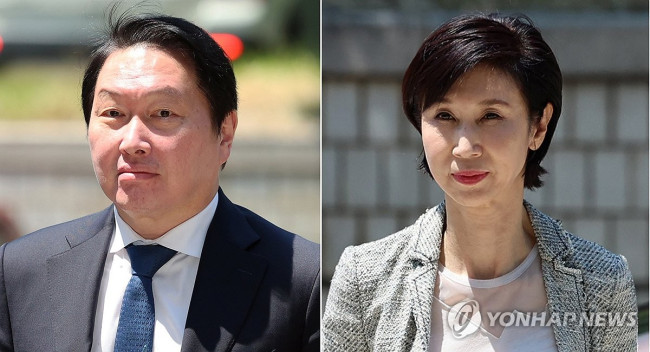
 On the 24th, the remand court for the property division lawsuit between SK Group Chairman Chey Tae-won and Art Center Nabi Director Roh Soh-yeong, held at the Seoul High Court in Seocho-gu, ruled that Chairman Chey must pay 944 billion KRW to Director Roh as a property division settlement. Pictured are Chairman Chey and Director Roh attending the second mediation session on the 15th of last month. [Yonhap News file photo]
A remand court has ruled that SK Group Chairman Chey Tae-won (65) must pay 944 billion KRW to Art Center Nabi Director Roh Soh-yeong (65) as a property division settlement.
The 1st Family Law Division of the Seoul High Court (Presiding Judge Lee Sang-joo) delivered this ruling during the remand hearing for the couple's property division lawsuit held at 2:00 PM on the 24th.
The court also ordered Chairman Chey to pay 5% annual interest on the amount from the day after the judgment becomes final until the payment is completed.
This amounts to 47.2 billion KRW per year, or approximately 130 million KRW per day.
The property division ratio was set at one-third for Director Roh and two-thirds for Chairman Chey.
The court determined that the SK shares held by Chairman Chey are subject to property division.
In doing so, it rejected the argument by Chairman Chey's side that the SK shares were "separate property" formed through inheritance and gifts, and thus not subject to division.
Instead, the court found that Director Roh had contributed to the formation, maintenance, and growth in value of these shares.
The court explained, "During the marriage, the value of the shares increased significantly due to Chairman Chey's management activities, and Director Roh's contribution through homemaking, child-rearing, and external activities for the SK Group played a role in this."
The reference date for calculating the value of the shares subject to division was set to April 16, 2024, the date on which the closing arguments for the factual hearing (appellate trial) of the divorce case took place.
This is in accordance with Supreme Court precedents, which dictate that when a property division claim is made after a court-ordered divorce has been finalized, the assets subject to division and their value should be determined based on the date of the closing of the factual trial in the divorce proceedings.
Director Roh's side had argued that the calculation should be based on the 26th of last month, the date of the closing arguments in the remand trial. The price of SK shares increased more than fivefold between these two dates.
The court noted, "Although the price of SK shares rose significantly between the closing of the appellate trial and the closing of the remand trial, it cannot be said that Chairman Chey's management contributions had no influence on this."
The court further observed, "Stock prices are highly volatile, and listed stocks are liquid assets that can be converted to cash at any time. It is difficult to conclude that failing to share the profits or losses from the disposal of shares after the divorce is finalized—when both parties are no longer in a marital relationship—would not lead to a result that significantly contradicts the purpose of the property division system, which is the fair settlement and distribution of marital property."
However, it explained that "the fact that the stock price rose significantly was considered in determining the property division ratio to ensure a fair distribution of marital property."
![[Graphic] Results of Chey Tae-won and Roh Soh-yeong's divorce and property division trial](/data/cheditor4/2607/GYH2026072400060004402_P2.jpg) [Graphic] Results of Chey Tae-won and Roh Soh-yeong's divorce and property division trial [Seoul=Yonhap News]
[Graphic] Results of Chey Tae-won and Roh Soh-yeong's divorce and property division trial [Seoul=Yonhap News]
Regarding the specific calculation of the property division ratio, the court explained, "We considered the assets held at the time of marriage, the circumstances under which the marital property was acquired, the extent of each party's contribution to the formation and maintenance of the joint property, and the duration of the marriage."
The court also took into account the fact that Chairman Chey's SK shares constitute a significant portion of the marital property and that his management contributions were a factor in the increase in share value.
However, in line with the Supreme Court's ruling from last October, the court held that even if the late former President Roh Tae-woo, Director Roh's father, had transferred 30 billion KRW in slush funds to SK, this could not be viewed as a contribution by Director Roh's side.
Furthermore, shares that Chairman Chey gifted to relatives to maintain management control and as part of his business activities prior to the breakdown of the marriage were excluded from the divisible assets.
The court ordered the property division settlement to be paid in cash.
The court explained, "Considering that the SK shares held by Chairman Chey serve as the basis for the company's management control or governance, and taking into account the title, nature, acquisition circumstances, and usage of the assets subject to division, we have determined that Chairman Chey should pay the shortfall in Director Roh's share under the division ratio in cash."
After the ruling, a representative for Chairman Chey told reporters, "The divorce was finalized by last year's Supreme Court ruling in the process of dissolving a nearly 20-year marriage, and today the remand court's ruling on property division was delivered. Chairman Chey apologizes for causing concern to many people throughout this process."
The representative added, "We will announce a specific position on the ruling after thoroughly reviewing the written judgment."
Director Roh's legal representative left the court without making any additional comments regarding the ruling.
If either party disagrees with today's ruling, they may file a re-appeal to the Supreme Court.
However, observers suggest that since the remand court's decision follows the intent of the existing Supreme Court ruling, it is unlikely that the final outcome will change in a re-appeal.
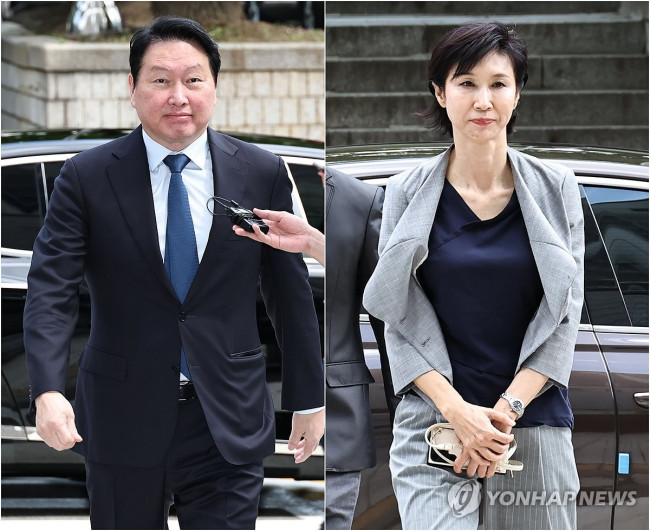 On the 24th, the remand court for the property division lawsuit between SK Group Chairman Chey Tae-won and Art Center Nabi Director Roh Soh-yeong, held at the Seoul High Court in Seocho-gu, ruled that Chairman Chey must pay 944 billion KRW to Director Roh as a property division settlement. Pictured are Chairman Chey and Director Roh attending the pleading session on the 26th of last month. [Yonhap News file photo]
Today's ruling comes nine years after the legal battle began in July 2017, when Chairman Chey filed for divorce mediation.
Chairman Chey and Director Roh married in September 1988 and had three children, but have been engaged in an arduous legal battle since Chairman Chey filed for divorce mediation in 2017.
The first-instance court in the divorce trial viewed the SK shares as Chairman Chey's separate property, ordering him to pay Director Roh 100 million KRW in alimony and 66.5 billion KRW in cash as property division.
In May 2024, the appellate court significantly increased the alimony to 2 billion KRW and the property division amount to 1.3808 trillion KRW.
The appellate court had judged that because former President Roh Tae-woo's "30 billion KRW slush fund" and Director Roh's contributions had helped the SK Group grow, the SK shares were also subject to property division.
However, last October, the Supreme Court sent the case back for retrial, ruling that the former President's slush fund was illicit money, and therefore could not be considered a contribution by Director Roh to the division of assets even if it had flowed into SK.
At that time, the appellate court's decision setting alimony at 2 billion KRW was finalized, leaving only the property division to be addressed in the remand trial.

 Iranian Foreign Ministry: "Continuing Message Exchanges with the U.S. and Activities of Mediating Countries"
Esmaeil Baghaei, Spokesperson for the Iranian Ministry of Foreign Affairs [Xinhua, Yonhap News file photo]Esmaeil Baghaei, spokesperson for the Iranian Ministry of Foreign Affairs, stated on the 26th
Iranian Foreign Ministry: "Continuing Message Exchanges with the U.S. and Activities of Mediating Countries"
Esmaeil Baghaei, Spokesperson for the Iranian Ministry of Foreign Affairs [Xinhua, Yonhap News file photo]Esmaeil Baghaei, spokesperson for the Iranian Ministry of Foreign Affairs, stated on the 26th
 President Yoon: "Do You Think You Are Safe from the Special Counsel?"... Final Statement Video Released
President Yoon Suk Yeol rebuking the special prosecutor on the 24th. [Court video / @birds_justice X account subtitle GIF] A video of President Yoon Suk Yeol's closing statement at his trial rega
President Yoon: "Do You Think You Are Safe from the Special Counsel?"... Final Statement Video Released
President Yoon Suk Yeol rebuking the special prosecutor on the 24th. [Court video / @birds_justice X account subtitle GIF] A video of President Yoon Suk Yeol's closing statement at his trial rega
 President Yoon, regarding the first-instance ruling on the Public Official Election Act: “An excessive political verdict that distorts the facts… We will appeal immediately.”
The first-instance sentencing hearing for President Yoon Suk Yeol regarding violations of the Public Official Election Act is being broadcast live at Seoul Station on the 27th. [Photo=Yonhap News]Pres
President Yoon, regarding the first-instance ruling on the Public Official Election Act: “An excessive political verdict that distorts the facts… We will appeal immediately.”
The first-instance sentencing hearing for President Yoon Suk Yeol regarding violations of the Public Official Election Act is being broadcast live at Seoul Station on the 27th. [Photo=Yonhap News]Pres
 WSJ: "SK Hynix ADR Premium Is a Sign of AI Trading Overheat"
Advertisement for SK Hynix ADR listing in New York's Times Square [Reuters=Yonhap News file photo]The Wall Street Journal (WSJ) has pointed out that the price of SK Hynix’s American Depositary Recei
WSJ: "SK Hynix ADR Premium Is a Sign of AI Trading Overheat"
Advertisement for SK Hynix ADR listing in New York's Times Square [Reuters=Yonhap News file photo]The Wall Street Journal (WSJ) has pointed out that the price of SK Hynix’s American Depositary Recei
 'Godfather of Japanese Mystery Novels' Keigo Higashino Passes Away After Battle with Cancer at 68
Famous Japanese mystery novelist Keigo Higashino [AFP=Yonhap News]It has been belatedly reported that Keigo Higashino, the "godfather of Japanese mystery novels" and author of bestsellers such as "The
'Godfather of Japanese Mystery Novels' Keigo Higashino Passes Away After Battle with Cancer at 68
Famous Japanese mystery novelist Keigo Higashino [AFP=Yonhap News]It has been belatedly reported that Keigo Higashino, the "godfather of Japanese mystery novels" and author of bestsellers such as "The
 [Park Pil-kyu Security Column] To the Ignorant Trying to Clothe a Beast in Sheep's Clothing
Rep. Kim Byung-joo of the Democratic Party of Korea [Photo=Yonhap News]“The Air Force Academy doesn't teach you how to fly a plane!” “The Army, Navy, and Air Force academies are exactly the
[Park Pil-kyu Security Column] To the Ignorant Trying to Clothe a Beast in Sheep's Clothing
Rep. Kim Byung-joo of the Democratic Party of Korea [Photo=Yonhap News]“The Air Force Academy doesn't teach you how to fly a plane!” “The Army, Navy, and Air Force academies are exactly the
 [Issue Diagnosis] Two Effects of the Election Petition Review
 [Photo] Evidence of Election Fraud Flooding U.S. Media… Trump Had 2.7 Million Votes Stolen
 [Video] U.S. Semiquincentennial Air Show... 'Art in the Sky' streaks across New York
 [Editorial Cartoon] A Draconian Law That Undermines Freedom of Expression

 List
List









