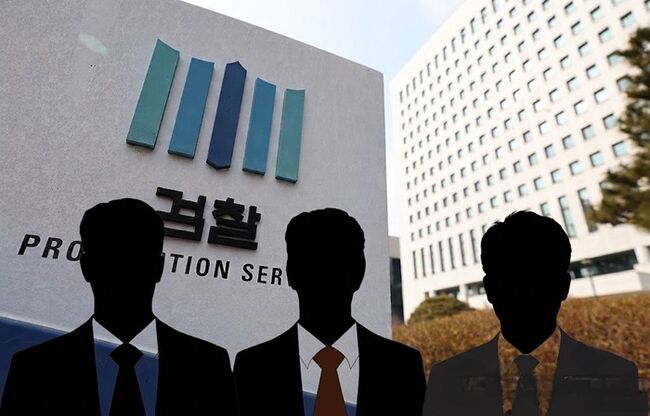
 "Is it truly reasonable from the perspective of the public to abolish prosecutors' supplementary investigation powers simply under the rhetoric of 'reforming the political prosecution'?"
There is fierce controversy over whether to abolish the supplementary investigation powers of prosecutors. The debate on adjusting investigative powers between the prosecution and the police, which has been ongoing for a considerable time, has culminated in the abolition of the prosecutors' office, and at its final stage, a battle is being waged over whether to strip away the prosecutors' supplementary investigation powers as well.
In the political sphere, the opposition party (People Power Party) has made opposition its official party platform. On the other hand, while there seems to be some caution regarding abolition among some members of the ruling party, they are pushing for it, claiming that "prosecutors have no need for supplementary investigation powers."
According to public opinion polls, the opposition to abolition seems to outweigh support by more than twice. If the majority of public opinion is against the abolition, why is the ruling party determined to carry it out? It is difficult to find any reasonable basis other than political motives.
Leaving aside the normative aspects, the separation of investigation and prosecution seems to have become a factual reality that is difficult to reverse. However, even if we assume this formal separation of investigation and prosecution, a complete severance—the total disconnection between the two—is both impossible and inappropriate.
From a teleological perspective, investigation and prosecution are structurally inseparable. Investigation is not an end in itself; its purpose is to initiate and maintain public prosecution.
Therefore, even if investigation and prosecution were strictly separated into distinct stages, it is logically inevitable for the prosecutor, as the authority responsible for prosecution, to examine the adequacy and completeness of an investigation when considering the purpose of prosecution.
In this regard, even if the police conduct and conclude investigations independently of the prosecutor, the investigation of a case is inevitably bound by the goal of prosecution (initiating and maintaining a public charge).
If so, the prosecuting authority must be able to intervene and participate in the police investigation to ensure the purpose of the investigation is achieved. Furthermore, it is necessary to legally and institutionally keep that path open to ensure that such objectives are properly met. This is why the prosecutor's supplementary investigation power must be recognized.
Therefore, recognizing supplementary investigation powers does not contradict the demand for the separation of investigation and prosecution; rather, it should be viewed as an essential measure to strengthen the power of prosecution—to preserve the significance of the investigation and ensure the effective maintenance of public charges.
The issue becomes even clearer when we consider the situations and consequences that would arise if the prosecutor's supplementary investigation powers were removed. First, serious concerns are expected from the perspective of crime prevention (criminal policy).
While the police have gained investigative authority over all crimes following the adjustment of investigative powers, public trust in their ability to appropriately exercise such immense power is not high. While their institutional authority is vast, the corresponding capability and responsibility they possess are not at a commensurate level.
This is well demonstrated in the reality of specific investigations. For instance, questions regarding the investigative capabilities and reliability of the police in cases of property crimes under the Criminal Act—such as embezzlement, breach of trust, and fraud—have been consistently raised since the adjustment of investigative powers, yet there have been no reports of meaningful changes thus far.
Furthermore, the shocking behavior shown by the police in the recent case of a high school girl murdered by an active-duty police officer is an empirical example demonstrating why supplementary investigation powers are necessary to prevent the suppression or burying of such cases.
Moreover, it is especially concerning to see the weakened response capability regarding power-related crimes. Crimes involving political power and those colluding with it are of a nature that cannot be easily uncovered.
It is highly uncertain whether the investigative capabilities and trends of the police, whose credibility has been undermined in many respects, will be able to properly respond to the abuses of power, corruption, and systemic graft (so-called "great evils") currently rampant in our society.
The issue of an appropriate response to crime is not something that ends with the concentration of investigative power in a specific agency. It is a critical social issue that forms the foundation of the stability of citizens' lives and the sustainable development of the nation.
Considering the public's complaints and suspicions regarding the police—such as allegations of political collusion or biased investigations to protect certain factions—there appears to be a high risk that these negative aspects will continue to surface.
Ultimately, it is the public who suffers in this chaotic web of issues and side effects. Do those in power not always keep a loophole for themselves? Politicians who recklessly push for this under the guise of "prosecution reform" should search their own hearts and think again.
Ask yourselves if your claim that the abolition of supplementary investigation powers is a sincere appeal for the public's interest, rather than mere conjecture! The same applies to those who have been endlessly expanding the scope of "victim protection" under the banner of victim-centrism. Why do you choose to ignore that the general public could be driven to become victims of crime in this issue?
In short, the abolition of supplementary investigation powers is a risky measure that currently does much more harm than good. Even without citing public opinion poll results, it is highly likely to be a counterproductive move that weakens the foundations of the public’s expectations and livelihood, leading to greater instability.
If they still insist on carrying this out through the sheer force of the powerful, they will find it difficult to escape the criticism that this is a ruthless attempt to prioritize their own party interests while casting aside the stability and welfare of the people's daily lives.
Currently, the country’s situation is deeply unsettled and chaotic. Honestly, it is no exaggeration to say that expecting the political sphere to carefully identify the people's pain and provide appropriate solutions has become a luxury.
Reasonable discussion and debate between responsible parties seem to have long since disappeared from both the National Assembly and the public sphere as a whole. While they always talk about the "livelihood of the people," most citizens are well aware that they have no real interest in the sighs, lamentations, pain, and outcries of the people that erupt daily from the grassroots.
In this harsh reality, it is highly doubtful whether the move to abolish the prosecutor's supplementary investigation powers simply under the rhetoric of "reforming the political prosecution" can be seen as reasonable from the eyes of the public.

◆ Professor Byun Jong-pil
Professor at Dongguk University College of Law, former member of the National Examination Committee, former President of the Korean Association for Comparative Criminal Law, and current member of the Central Executive Committee of the Association for the Advancement of University Professors (Jagyomo)

 Iranian Foreign Ministry: "Continuing Message Exchanges with the U.S. and Activities of Mediating Countries"
Esmaeil Baghaei, Spokesperson for the Iranian Ministry of Foreign Affairs [Xinhua, Yonhap News file photo]Esmaeil Baghaei, spokesperson for the Iranian Ministry of Foreign Affairs, stated on the 26th
Iranian Foreign Ministry: "Continuing Message Exchanges with the U.S. and Activities of Mediating Countries"
Esmaeil Baghaei, Spokesperson for the Iranian Ministry of Foreign Affairs [Xinhua, Yonhap News file photo]Esmaeil Baghaei, spokesperson for the Iranian Ministry of Foreign Affairs, stated on the 26th
 President Yoon: "Do You Think You Are Safe from the Special Counsel?"... Final Statement Video Released
President Yoon Suk Yeol rebuking the special prosecutor on the 24th. [Court video / @birds_justice X account subtitle GIF] A video of President Yoon Suk Yeol's closing statement at his trial rega
President Yoon: "Do You Think You Are Safe from the Special Counsel?"... Final Statement Video Released
President Yoon Suk Yeol rebuking the special prosecutor on the 24th. [Court video / @birds_justice X account subtitle GIF] A video of President Yoon Suk Yeol's closing statement at his trial rega
 President Yoon, regarding the first-instance ruling on the Public Official Election Act: “An excessive political verdict that distorts the facts… We will appeal immediately.”
The first-instance sentencing hearing for President Yoon Suk Yeol regarding violations of the Public Official Election Act is being broadcast live at Seoul Station on the 27th. [Photo=Yonhap News]Pres
President Yoon, regarding the first-instance ruling on the Public Official Election Act: “An excessive political verdict that distorts the facts… We will appeal immediately.”
The first-instance sentencing hearing for President Yoon Suk Yeol regarding violations of the Public Official Election Act is being broadcast live at Seoul Station on the 27th. [Photo=Yonhap News]Pres
 WSJ: "SK Hynix ADR Premium Is a Sign of AI Trading Overheat"
Advertisement for SK Hynix ADR listing in New York's Times Square [Reuters=Yonhap News file photo]The Wall Street Journal (WSJ) has pointed out that the price of SK Hynix’s American Depositary Recei
WSJ: "SK Hynix ADR Premium Is a Sign of AI Trading Overheat"
Advertisement for SK Hynix ADR listing in New York's Times Square [Reuters=Yonhap News file photo]The Wall Street Journal (WSJ) has pointed out that the price of SK Hynix’s American Depositary Recei
 'Godfather of Japanese Mystery Novels' Keigo Higashino Passes Away After Battle with Cancer at 68
Famous Japanese mystery novelist Keigo Higashino [AFP=Yonhap News]It has been belatedly reported that Keigo Higashino, the "godfather of Japanese mystery novels" and author of bestsellers such as "The
'Godfather of Japanese Mystery Novels' Keigo Higashino Passes Away After Battle with Cancer at 68
Famous Japanese mystery novelist Keigo Higashino [AFP=Yonhap News]It has been belatedly reported that Keigo Higashino, the "godfather of Japanese mystery novels" and author of bestsellers such as "The
 [Park Pil-kyu Security Column] To the Ignorant Trying to Clothe a Beast in Sheep's Clothing
Rep. Kim Byung-joo of the Democratic Party of Korea [Photo=Yonhap News]“The Air Force Academy doesn't teach you how to fly a plane!” “The Army, Navy, and Air Force academies are exactly the
[Park Pil-kyu Security Column] To the Ignorant Trying to Clothe a Beast in Sheep's Clothing
Rep. Kim Byung-joo of the Democratic Party of Korea [Photo=Yonhap News]“The Air Force Academy doesn't teach you how to fly a plane!” “The Army, Navy, and Air Force academies are exactly the
 [Issue Diagnosis] Two Effects of the Election Petition Review
 [Photo] Evidence of Election Fraud Flooding U.S. Media… Trump Had 2.7 Million Votes Stolen
 [Video] U.S. Semiquincentennial Air Show... 'Art in the Sky' streaks across New York
 [Editorial Cartoon] A Draconian Law That Undermines Freedom of Expression

 List
List









