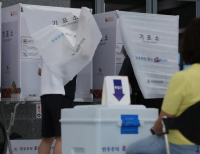
A trader works on the floor of the New York Stock Exchange on the 23rd (local time), as the market contends with surging international oil prices, rising long-term U.S. interest rates, and the burden of AI capital expenditures. The Nasdaq index fell 2.15% on this day. [Photo = Reuters & Yonhap News] Will the AI correction spread to the broader market?
Two risk thresholds that the market was monitoring last week were breached simultaneously this week. Brent crude surged past $100 per barrel, and the 10-year U.S. Treasury yield climbed as high as 4.71% during intraday trading.
While corporate earnings have not deteriorated across the board, the rise in oil prices and long-term interest rates has increased the discount rate applied to future earnings, triggering a price re-evaluation centered on artificial intelligence (AI) and semiconductor stocks.
Brent crude soared to $102 per barrel on the 23rd before closing at $96.78 on the 24th, a 3.9% decline. Although it finished the day back below the $100 mark, its breach of the $100 level during the week signals that the market has begun to factor in concerns that Middle Eastern maritime transport risks could lead to actual supply disruptions.
The bond market's reaction was different from last week.
Last week, the 10-year U.S. Treasury yield remained in the 4.5% range despite the spike in oil prices. This week, however, it rose to an 18-month high of 4.71% during the session. The rise in long-term rates reflects concerns that the spike in oil prices is not just a temporary "war premium," but could actually alter inflation trends and the Federal Reserve's interest rate trajectory.
In the market, the 4.75% and 5% levels have begun to be cited as critical risk thresholds that could further pressure equity valuations.
U.S. stock markets showed weakness, particularly among tech stocks. On the 24th, the S&P 500 closed at 7,411.98, the Dow Jones Industrial Average at 51,947.25, and the Nasdaq Composite at 24,975.82. For the week, the S&P 500 fell 0.6%, the Dow dropped 0.4%, and the Nasdaq declined 2.1%.
The issue was not that earnings themselves were poor. The problem was how much more companies would need to invest in the future, and what interest rate should be applied to convert those future profits into present value.
When the 10-year U.S. Treasury yield rises, the present value of future earnings decreases. AI and semiconductor stocks—which reflect expectations for growth years down the road more heavily than current earnings—are particularly sensitive to increases in discount rates. When combined with rising oil prices, the resulting increases in electricity, logistics, and raw material costs also pressure corporate earnings forecasts.
The shock was even more pronounced in the Korean stock market.
The KOSPI plummeted 5.72% on the 24th to close at 6,690.62. Foreigners net sold 3.2828 trillion won and institutions net sold 1.9513 trillion won, while individual investors net bought 5.1783 trillion won. Selling was concentrated on top-market-cap semiconductor stocks, including Samsung Electronics and SK Hynix.
It is difficult to immediately define this correction as a collapse of an "AI bubble." What has been confirmed so far is a re-valuation of assets due to rising oil prices and interest rates, rather than a withdrawal of AI investment.
Even if AI growth prospects remain intact, a rise in long-term interest rates can lower the price-to-earnings ratio (PER) that the market is willing to accept. This week, the market began to re-examine not just "how much a company earned," but "how much of a premium it is worth paying for those earnings."
Results of Last Week's Checkpoints
• Will international oil prices hold above $80? : Breached
Beyond holding above the $80 level, Brent crude surged past $100 during the week.
• Will the U.S. 10-year yield exceed 4.6%? : Breached
It rose to as high as 4.71% during the session, surpassing the risk threshold set last week.
• Will the semiconductor correction spread to the entire market? : Partially confirmed
While the Nasdaq saw the largest decline, both the S&P 500 and the Dow also fell for the week. However, this did not escalate into a full-scale sell-off in the U.S. market.
Next Week's Checkpoints
• Will Brent crude rise back above $100 and stabilize?
• Will the U.S. 10-year yield exceed 4.75% and rise further?
• Will the FOMC view the oil price hike as a temporary supply shock or a factor for raising interest rates?
• Will the U.S. Q2 GDP and Personal Consumption Expenditures (PCE) price index show a combination of high growth and high inflation?
• Will big tech earnings provide the revenue and cash flow necessary to offset increased AI investment costs?
The FOMC meeting will be held on the 28th–29th, and the preliminary U.S. Q2 GDP and June PCE price index will be released on the 30th.
Points to Avoid Over-Concluding
There is still insufficient evidence to conclude that this week's correction marks the bursting of an AI bubble or the beginning of a long-term bear market. The fact established so far is not the disappearance of AI demand, but that the market has begun to recalculate the fair price of AI companies in line with rising oil prices and interest rates.
※ This article analyzes financial markets and industry trends based on public market data and does not recommend the buying or selling of any specific financial investment products or stocks. Investment decisions and the associated risks remain the responsibility of the investor.

 [Statement by the Seo-beo-kka Korea Military Academy Save-the-Nation Comrades Association] ㉛ Recount the Votes Publicly, as the Previous Recount Concealed Election Fraud
Tongyeong Mayoral Election Recount [Photo=Yonhap News]South Korea's liberal democracy is dying. The National Election Commission (NEC) and the judiciary, which have plummeted into criminal syndicates
[Statement by the Seo-beo-kka Korea Military Academy Save-the-Nation Comrades Association] ㉛ Recount the Votes Publicly, as the Previous Recount Concealed Election Fraud
Tongyeong Mayoral Election Recount [Photo=Yonhap News]South Korea's liberal democracy is dying. The National Election Commission (NEC) and the judiciary, which have plummeted into criminal syndicates
 Trump's nominee for new U.S. intelligence chief confirmed by U.S. Senate
U.S. Attorney for the Southern District of New York Jay Clayton, who has been confirmed by the Senate to lead the U.S. intelligence community [AP=Yonhap News File Photo]The U.S. Senate confirmed the n
Trump's nominee for new U.S. intelligence chief confirmed by U.S. Senate
U.S. Attorney for the Southern District of New York Jay Clayton, who has been confirmed by the Senate to lead the U.S. intelligence community [AP=Yonhap News File Photo]The U.S. Senate confirmed the n
 PPP on Speaker Woo's Remarks About 'Lee Jae-myung's Consecutive Term and Constitutional Amendment': "A True Act of Insurrection"
People Power Party Representative Jang Dong-hyeok holds a press conference at the National Assembly on the 28th to express his stance regarding National Assembly Speaker Cho Jeong-sik's remarks on a c
PPP on Speaker Woo's Remarks About 'Lee Jae-myung's Consecutive Term and Constitutional Amendment': "A True Act of Insurrection"
People Power Party Representative Jang Dong-hyeok holds a press conference at the National Assembly on the 28th to express his stance regarding National Assembly Speaker Cho Jeong-sik's remarks on a c
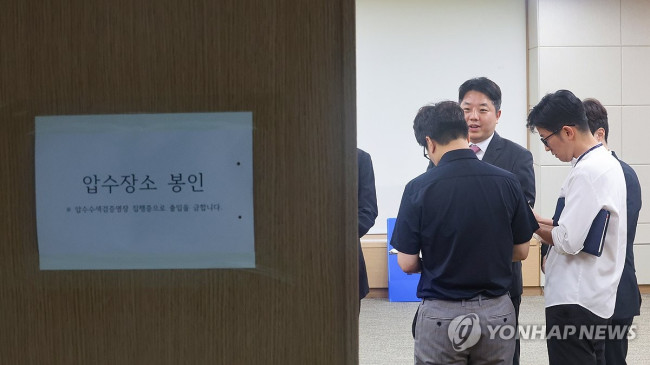 Prosecution Investigates Gyeonggi-do Election Commission Officials as Suspects in 'Statistical Manipulation' of Ballot Counting Records
'Circumstances of statistical manipulation following turnout errors': Joint Investigation Team conducts search and seizure at National Election Commission [Yonhap News file photo]The joint prosecution
Prosecution Investigates Gyeonggi-do Election Commission Officials as Suspects in 'Statistical Manipulation' of Ballot Counting Records
'Circumstances of statistical manipulation following turnout errors': Joint Investigation Team conducts search and seizure at National Election Commission [Yonhap News file photo]The joint prosecution
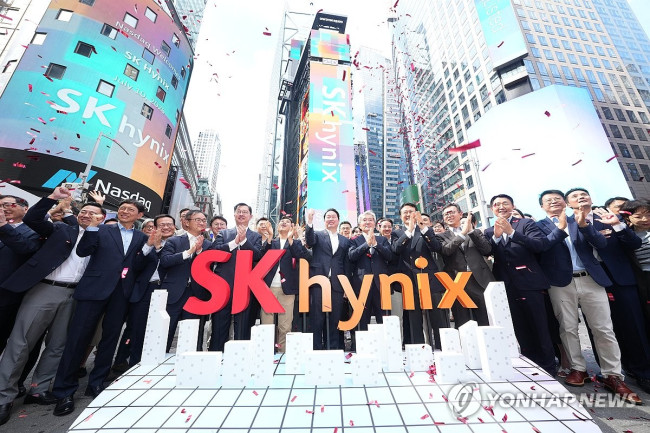 SK Hynix Posts Record-High 76% Operating Margin… Outpacing TSMC for Three Consecutive Quarters
In the second quarter of this year, SK hynix [000660] maintained top-tier profitability in the semiconductor industry, recording an operating profit margin of 76%, which surpassed that of Taiwan’s T
SK Hynix Posts Record-High 76% Operating Margin… Outpacing TSMC for Three Consecutive Quarters
In the second quarter of this year, SK hynix [000660] maintained top-tier profitability in the semiconductor industry, recording an operating profit margin of 76%, which surpassed that of Taiwan’s T
 Shin Jin-seo: "AI is not the 'God of Go'… Human Go still holds its charm."
"I don't think AI is the 'God of Go.' I am confident that human Go, which involves making brilliant moves and high-stakes gambles depending on the situation, is still far more fascinating than AI, whi
Shin Jin-seo: "AI is not the 'God of Go'… Human Go still holds its charm."
"I don't think AI is the 'God of Go.' I am confident that human Go, which involves making brilliant moves and high-stakes gambles depending on the situation, is still far more fascinating than AI, whi
 [Park Pil-gyu's Security Column] If Carrying Out Orders Becomes a Crime, Neither the State Nor the Military Can Survive
"Can a military where following orders becomes a crime truly protect the nation and its people, contribute to maintaining the continuity of the state, and continue to survive and exist?" Soldiers stan
[Park Pil-gyu's Security Column] If Carrying Out Orders Becomes a Crime, Neither the State Nor the Military Can Survive
"Can a military where following orders becomes a crime truly protect the nation and its people, contribute to maintaining the continuity of the state, and continue to survive and exist?" Soldiers stan
 [Photo] Evidence of Election Fraud Flooding U.S. Media… Trump Had 2.7 Million Votes Stolen
 [Video] U.S. Semiquincentennial Air Show... 'Art in the Sky' streaks across New York
 [Editorial Cartoon] A Draconian Law That Undermines Freedom of Expression

 List
List