 A flag waving in front of the Central District Prosecutors' Office [Yonhap News file photo]
The prosecution is showing signs of instability due to "internal strife and external threats," just about two months ahead of its transition into a Public Prosecution Office, which will focus exclusively on maintaining public prosecutions.
As the Democratic Party of Korea has officially adopted the abolition of supplementary investigation rights as its party platform and is expected to pass the relevant amendment to the Criminal Procedure Act at the plenary session of the National Assembly on the 30th, there are growing concerns over a leadership vacuum. This follows the repeated and firm resignation expressed by Minister of Justice Jung Sung-ho and the potential departure of Acting Prosecutor General Koo Ja-hyun.
According to the legal community on the 26th, Minister Jung has conveyed his intention to resign to President Lee Jae-myung several times in the past through his aides.
It is reported that he has been contemplating his position since early this year, when opinions were divided within the ruling party regarding the bills to establish the Public Prosecution Office and the Major Crime Investigation Agency (MCIA).
However, the general consensus within and outside the legal community is that his determination to resign has strengthened over the past month, after President Lee deferred the matter to the National Assembly, urging for thorough deliberation regarding the survival of supplementary investigation rights.
Some analysts suggest that the Democratic Party's push to abolish supplementary investigation rights as a party platform, despite concerns from civic society, has also had an impact.
It is said that Minister Jung expressed his intent to step down once more during a Ministry of Justice executive meeting just before the abolition of supplementary investigation rights was finalized as the Democratic Party's platform.
Throughout the prosecution reform process, Minister Jung has consistently emphasized the importance of the prosecution's supplementary investigations and the necessity of referring all cases (full referral), arguing that no innocent victims should emerge from the reform.
However, as the Democratic Party has shown no signs of yielding on its demand for the complete abolition of the prosecution's supplementary investigation rights, interpretations suggest that he has concluded his role is more needed in the National Assembly than as Minister of Justice.
The amendment to the Criminal Procedure Act is scheduled to be discussed by a subcommittee of the National Assembly Legislation and Judiciary Committee on the 27th and may be processed as early as the 30th at the plenary session.
It is expected that Minister Jung will formally submit his resignation as the amendment to the Criminal Procedure Act clears the National Assembly and undergoes the promulgation process following a cabinet meeting.
There are also predictions that Acting Prosecutor General Koo Ja-hyun will decide on his future during the process of the Criminal Procedure Act's passage.
There is significant concern that if both the Minister of Justice and the Prosecutor General positions remain vacant, there will be no one to oversee the follow-up measures for the amendment to the Criminal Procedure Act ahead of the abolition of the current Prosecutors' Office in October.
With prosecutors unable to conduct investigations directly starting in just two months, a series of follow-up procedures—such as amending enforcement decrees, organizational restructuring, personnel appointments, and the transfer of cases—remain, all of which will lack leadership to manage them.
A prosecution official stated, "During the past adjustment of investigative powers between the prosecution and the police, we had enough time to create internal manuals, but now we have to determine everything within two months," adding, "Since there is no one to keep the system running, the burden on successors will be just as great."
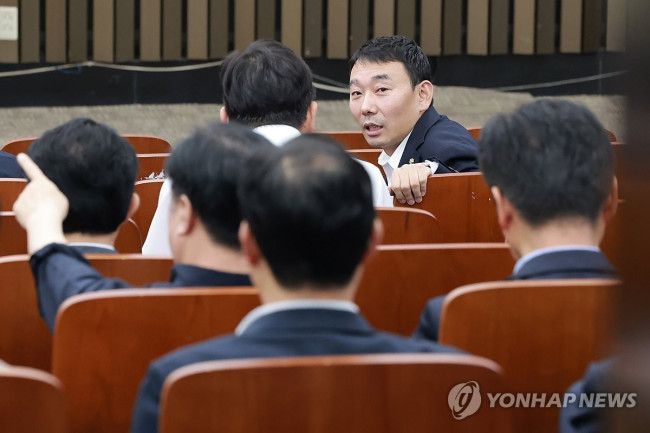 Democratic Party lawmaker Kim Yong-min attends a closed-door general meeting of lawmakers at the National Assembly on the 24th to discuss the amendment to the Criminal Procedure Act, which includes the abolition of the prosecution's supplementary investigation rights. [Yonhap News]
Although the Democratic Party has allowed for full referral and supplementary investigations for seven major crimes, concerns remain in the legal community that there is no way to provide relief for crimes not covered by this, such as murder cases like the Jang Yoon-ki case, voice phishing, or stock manipulation, which often affect ordinary citizens.
There is also a belief that there is a lack of mechanisms to ensure the effectiveness of supplementary investigation requests.
At a general meeting of lawmakers on the 24th, the Democratic Party confirmed the amendment to the Criminal Procedure Act as its party platform, deciding that for only seven major crimes—child abuse, domestic violence, sex crimes, child sex crimes, stalking, disability abuse, and elderly abuse—all cases will be "fully referred" to the prosecution, and supplementary investigations will be entrusted to a dedicated department within the MCIA.
However, these details will not be reflected in the Criminal Procedure Act itself; the establishment of the dedicated MCIA department will be handled through an amendment to the MCIA Act, and the full referral will also be made possible through amendments to individual laws.
The limitation remains that if full referral and MCIA supplementary investigations are restricted to only these seven categories, it cannot be applied if socially vulnerable groups—such as children, the disabled, or the elderly—are victims of crimes other than abuse.
Lawyer Kim Ye-won, head of the Disability Rights Law Center, expressed concern on Facebook, stating, "It is a problem if the police initially determine a case as simple assault, fraud, or embezzlement rather than disability or elderly abuse," adding that "full referral for seven major crimes" cannot guarantee the protection of the socially vulnerable.
Regarding the plan to entrust supplementary investigations to the MCIA, lawyer Kim pointed out, "The MCIA is not an agency created to constantly control police investigations, and it hasn't even established its central organization in a stable manner," adding, "Instead of investigative control, they've just added another agency for cases to be ping-ponged between."
Lawyer Yang Hong-seok, who served as an advisory committee member for the Prosecution Reform Promotion Group, also noted, "We have traditionally tasked prosecutors with the role of concluding investigations, and through that 'after-sales service' (post-investigation management), we have received a somewhat consistent level of criminal justice service. Now, if a prosecutor requests 'after-sales service' in writing, the same judicial police officer who caused the issue in the first place will be the one handling it," adding, "Unnecessary indictments will increase, and investigations after the filing of public charges will inevitably increase as well."

 Iranian Foreign Ministry: "Continuing Message Exchanges with the U.S. and Activities of Mediating Countries"
Esmaeil Baghaei, Spokesperson for the Iranian Ministry of Foreign Affairs [Xinhua, Yonhap News file photo]Esmaeil Baghaei, spokesperson for the Iranian Ministry of Foreign Affairs, stated on the 26th
Iranian Foreign Ministry: "Continuing Message Exchanges with the U.S. and Activities of Mediating Countries"
Esmaeil Baghaei, Spokesperson for the Iranian Ministry of Foreign Affairs [Xinhua, Yonhap News file photo]Esmaeil Baghaei, spokesperson for the Iranian Ministry of Foreign Affairs, stated on the 26th
 President Yoon: "Do You Think You Are Safe from the Special Counsel?"... Final Statement Video Released
President Yoon Suk Yeol rebuking the special prosecutor on the 24th. [Court video / @birds_justice X account subtitle GIF] A video of President Yoon Suk Yeol's closing statement at his trial rega
President Yoon: "Do You Think You Are Safe from the Special Counsel?"... Final Statement Video Released
President Yoon Suk Yeol rebuking the special prosecutor on the 24th. [Court video / @birds_justice X account subtitle GIF] A video of President Yoon Suk Yeol's closing statement at his trial rega
 President Yoon, regarding the first-instance ruling on the Public Official Election Act: “An excessive political verdict that distorts the facts… We will appeal immediately.”
The first-instance sentencing hearing for President Yoon Suk Yeol regarding violations of the Public Official Election Act is being broadcast live at Seoul Station on the 27th. [Photo=Yonhap News]Pres
President Yoon, regarding the first-instance ruling on the Public Official Election Act: “An excessive political verdict that distorts the facts… We will appeal immediately.”
The first-instance sentencing hearing for President Yoon Suk Yeol regarding violations of the Public Official Election Act is being broadcast live at Seoul Station on the 27th. [Photo=Yonhap News]Pres
 WSJ: "SK Hynix ADR Premium Is a Sign of AI Trading Overheat"
Advertisement for SK Hynix ADR listing in New York's Times Square [Reuters=Yonhap News file photo]The Wall Street Journal (WSJ) has pointed out that the price of SK Hynix’s American Depositary Recei
WSJ: "SK Hynix ADR Premium Is a Sign of AI Trading Overheat"
Advertisement for SK Hynix ADR listing in New York's Times Square [Reuters=Yonhap News file photo]The Wall Street Journal (WSJ) has pointed out that the price of SK Hynix’s American Depositary Recei
 'Godfather of Japanese Mystery Novels' Keigo Higashino Passes Away After Battle with Cancer at 68
Famous Japanese mystery novelist Keigo Higashino [AFP=Yonhap News]It has been belatedly reported that Keigo Higashino, the "godfather of Japanese mystery novels" and author of bestsellers such as "The
'Godfather of Japanese Mystery Novels' Keigo Higashino Passes Away After Battle with Cancer at 68
Famous Japanese mystery novelist Keigo Higashino [AFP=Yonhap News]It has been belatedly reported that Keigo Higashino, the "godfather of Japanese mystery novels" and author of bestsellers such as "The
 [Park Pil-kyu Security Column] To the Ignorant Trying to Clothe a Beast in Sheep's Clothing
Rep. Kim Byung-joo of the Democratic Party of Korea [Photo=Yonhap News]“The Air Force Academy doesn't teach you how to fly a plane!” “The Army, Navy, and Air Force academies are exactly the
[Park Pil-kyu Security Column] To the Ignorant Trying to Clothe a Beast in Sheep's Clothing
Rep. Kim Byung-joo of the Democratic Party of Korea [Photo=Yonhap News]“The Air Force Academy doesn't teach you how to fly a plane!” “The Army, Navy, and Air Force academies are exactly the
 [Issue Diagnosis] Two Effects of the Election Petition Review
 [Photo] Evidence of Election Fraud Flooding U.S. Media… Trump Had 2.7 Million Votes Stolen
 [Video] U.S. Semiquincentennial Air Show... 'Art in the Sky' streaks across New York
 [Editorial Cartoon] A Draconian Law That Undermines Freedom of Expression

 List
List









