 An official from the People Power Party submits an election appeal to an official at the National Election Commission (NEC) in Gwacheon, Gyeonggi Province, on June 17, 2026, regarding the ballot shortage during the June 3 local elections. An election appeal is a required legal procedure before the validity of a local election can be contested in court. [Photo=Yonhap News]
[The National Election Commission (NEC) held its first formal hearing on the 27th regarding election appeals filed in relation to the June 3 local elections.
People Power Party Representative Jang Dong-hyeok personally presented oral arguments, raising issues regarding the shortage of ballots, voting suspensions, and the modification of computerized figures, asserting that if the NEC fails to clarify these suspicions, a re-election must be held.
However, limiting the significance of an election appeal solely to the possibility of invalidating an election and holding a re-election would fail to capture the true essence of the process.
Election appeal reviews generally have two major effects.
First, it serves as a legal mechanism that allows the validity of an election to be contested in the Supreme Court or a High Court.
Second, it has a political and institutional effect by creating an official record of what facts the NEC investigated and what materials it failed to verify.
Today, we will examine why election appeals are a necessary gateway for judicial proceedings, what political implications remain even if they are dismissed, and the inherent limitations of a structure where the NEC—the body under scrutiny—is responsible for its own evidence investigation and validity assessment.
Hello. This is the Hanmi Ilbo Issue Diagnosis.
Today, we will discuss the two effects of election appeal reviews with our editor, Kim Young. Editor Kim, hello.]
Yes, hello.
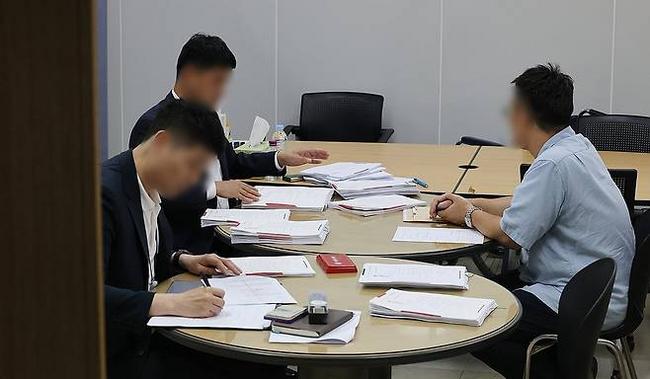 Officials from the National Election Commission review the June 3 local election appeal submitted by the People Power Party on the 17th of last month. The NEC must reach a decision on appeals regarding local government head and proportional representative councilor elections within 60 days of the filing date. [Photo=Yonhap News]
[First, what is the specific nature of the procedure the People Power Party has requested through this election appeal?]
Looking at the publicly disclosed grounds for the appeal, it is not merely a procedure to challenge the eligibility of a specific elected official or the determination of a winner.
They are asking for a judgment on whether the election itself can be considered valid, given the illegalities in the administrative process, such as ballot shortages, voting interruptions, and omissions in the electoral register.
The Public Official Election Act distinguishes between the 'validity of an election' and the 'validity of an election victory' in local elections.
An appeal regarding election validity contests whether the election procedures themselves—such as voting, ballot counting, and tallying—were conducted legally. An appeal regarding victory validity argues that while the election itself may be valid, there were issues with a specific winner’s eligibility or the process by which they were declared the winner.
On June 17, the People Power Party filed appeals under the name of its central party for elections in Seoul, Gyeonggi, Incheon, Ulsan, Busan, Gwangju, South Jeolla, and North Chungcheong, while separate appeals were filed in the names of candidates for Daejeon, South Chungcheong, Sejong, and North Jeolla.
However, since the original texts of the appeal documents have not been made public, it is difficult to confirm from public materials alone whether they have requested the invalidation of the entire election or only of specific voting districts where issues occurred.
[What conditions must be met for an election to be declared invalid?]
Two conditions must be met simultaneously.
First, there must be a violation of regulations or a significant flaw in the management of the election, such as in voting, counting, or tallying.
Second, it must be recognized that this violation had an impact on the election results.
Therefore, an election does not automatically become invalid just because ballots were in short supply or voting was suspended.
One must determine whether there were actual voters who were unable to exercise their right to vote, the scale of such voters, and whether, considering the vote margin between candidates, there was a possibility that the outcome could have been different.
The same applies to the modification of computerized figures.
If statistics on the number of voters or voter turnout were modified without following normal procedures, that is a significant management issue. However, whether that modification was merely a statistical correction or if it actually impacted the number of votes per candidate or the election results must be verified separately through original source data and change logs.
[Then, based on the facts currently disclosed, isn't it highly likely that the appeal will be dismissed?]
It is difficult to conclude that.
It is true that based only on the data released so far, proving an impact on election results seems difficult.
However, most of the core data is held by the NEC.
It is difficult for an ordinary appellant to secure records of ballot printing, distribution, and additional shipments, voting suspension incident reports, voter turnout by time of day, initial computerized input values, pre- and post-modification data, and access and change logs by account.
Demanding that the appellant fully prove changes in votes per candidate or organizational instructions before sufficient investigation and evidence gathering have taken place is an virtually impossible order.
The election appeal process follows administrative litigation procedures, including the right to demand document submission, evidence investigation, and ex officio examination. Therefore, if specific abnormalities have been raised, the adjudicating body must demand relevant data and verify the facts.
[But if the NEC itself conducts that evidence investigation, isn't that like 'letting the cat guard the fish'?]
That is precisely the greatest structural limitation of these appeals.
Formally, a higher-level NEC reviews the administrative actions of a regional NEC. The Central NEC judges appeals for local government heads and proportional representative councilors, while the municipal or provincial NECs judge appeals for local council members and lower-level government heads.
However, in reality, it is all the same NEC organization.
The agency that managed the election is the NEC; the agency that holds the original data and servers is the NEC; and the agency that decides what data to investigate and makes the primary determination on the validity of the election is also the NEC.
If the suspicions go beyond simple mistakes by specific polling station staff and point toward the Central NEC’s operational guidelines, computer systems, or command and oversight responsibilities, it is inevitable that the Central NEC will be criticized for being unable to be seen as an independent third-party adjudicator.
Even if the committee members judge independently, the issue of the independence of the evidence investigation remains if the NEC secretariat is the one selecting and submitting the server originals, logs, internal documents, and staff testimony that serve as the basis for the judgment.
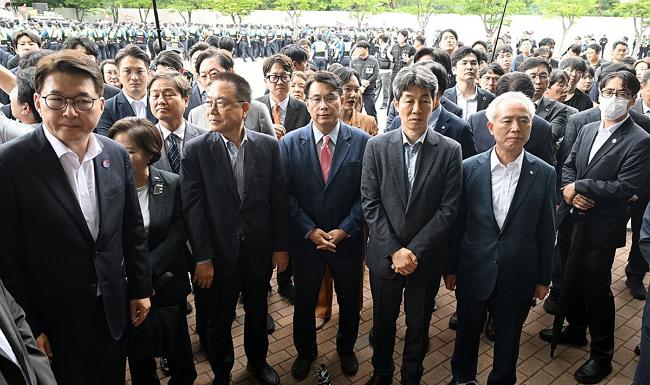 Members of the National Assembly's Special Committee on the Fact-Finding Investigation of the Infringement of Suffrage during the June 3 Local Elections attempt to enter a ballot counting station at Olympic Park in Songpa-gu, Seoul, on the 2nd for an on-site investigation. If key materials are not sufficiently investigated during the election appeal, calls for external investigations may increase. [Photo=Yonhap News][The NEC that received the appeal must make a decision within 60 days. Can they properly uncover the facts within this period?]
In reality, it is not easy to uncover the full extent of the computer-related suspicions.
The Public Official Election Act stipulates that the Central NEC or the municipal/provincial NEC that receives an appeal must make a decision within 60 days from the date of filing.
However, it is difficult to finish server forensics, comparison of original and backup data, analysis of modification logs by account, confirmation of internal instruction chains, and a full investigation into whether the same methods were repeated in other regions within 60 days.
Moreover, the evidence-gathering authority for election appeals does not include compulsory investigative powers such as search and seizure.
If NEC staff refuse to submit data, or if one needs to confirm recovered deleted files, staff-to-staff messenger and email exchanges, and organizational collusion, the compulsory investigation by law enforcement agencies may be necessary.
Ultimately, 60 days is less of a period to finally uncover the truth behind all suspicions and more of a procedural deadline to complete the primary administrative review of election validity before moving to the court stage.
[Then what is the first effect of the election appeal review?]
It opens a legal gateway to contest the validity of the election in the Supreme Court or a High Court.
For local councilor and local government head elections, one cannot immediately file an election invalidation lawsuit in court; one must first go through the election appeal process.
If an appeal is dismissed or rejected, an election lawsuit can be filed within 10 days from the date of receiving the decision letter.
If the NEC does not reach a decision within 60 days from the filing date, one can also proceed to court within 10 days after that period ends.
The Supreme Court handles elections for local government heads and proportional representatives, while the competent High Court handles elections for local council members and lower-level government heads.
Therefore, just because this appeal is dismissed by the Central NEC does not mean the legal process is over.
On the contrary, as the decision document documents what the Central NEC recognized as fact, which arguments were dismissed, and what data was or was not investigated, the issues to be contested in court become more concrete.
The first effect of an appeal is that it is a mandatory gateway to reaching the court.
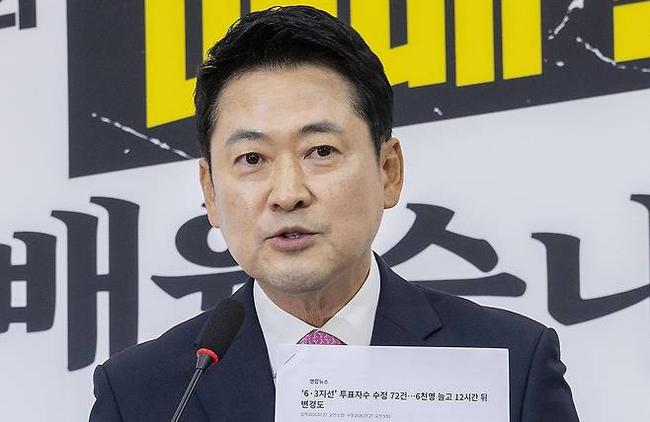 People Power Party Representative Jang Dong-hyeok explains the contents to be addressed in the election appeal at the National Assembly on the 27th, holding up an article regarding the NEC's modification of voter counts. Representative Jang asserted that if the NEC cannot clarify the suspicions of modifying computerized figures, a re-election must be held. [Photo=Yonhap News][Is the second effect a political one?]
Yes, that is correct.
Suspicions raised at press conferences or rallies can be dismissed as mere political rhetoric.
However, when an appeal is filed, the NEC must hold a hearing and issue a decision according to the law. It must deliver the original decision to the parties involved and also announce the gist of the decision.
The focus also shifts from vague 'election fraud controversy' to specific issues of institutional responsibility.
They must officially respond to how long voting was suspended at which polling stations, whether there were actual voters who gave up voting, how additional ballots were supplied, who had the authority to modify computerized figures, and whether they checked the originals before modification and the change logs.
If the NEC sufficiently investigates the core data and presents objective verification results, it becomes a basis for clearing up suspicions.
Conversely, if they conclude that "there is no evidence that it affected the election results" without checking the original data and modification logs, the political repercussions could grow even larger.
This is because it creates a circular structure where the agency with the data does not disclose it, the appellant cannot prove their case because they lack the data, and the adjudicating body dismisses the case on the grounds of insufficient proof.
[Aren't there reports that regional NECs have already submitted opinions for dismissal?]
Some regional NECs, such as Busan and Daegu, have submitted written responses to the Central NEC with the intent that the appeal should be dismissed.
However, this is merely the opinion of the responding side, not the final dismissal decision made by the Central NEC.
The Seoul Metropolitan Election Commission did not provide a definitive dismissal opinion but instead submitted a response asking the Central NEC to judge carefully in accordance with parallel procedures and legal reviews.
The fact that the regional responses are inconsistent itself shows that it is difficult to handle the ballot shortage situation simply as a blanket on-site mistake.
The Central NEC must judge case-by-case what actually happened in each region.
[Are you saying that even if an appeal is dismissed, a political significance remains?]
Yes, on the condition that it is handled properly.
If the People Power Party demands specific data submission and evidence investigation, and the decision document records exactly what the NEC investigated, a dismissal can serve as a starting point for the next phase.
In court proceedings, one can again demand the submission and verification of data that the Central NEC failed to investigate.
If the NEC refuses to check core data or reaches a conclusion based only on its own investigation, the political argument for a parliamentary investigation or an independent special counsel will gain traction.
Conversely, if the People Power Party only puts forward the political slogan of a re-election but fails to apply for specific evidence gathering regarding original data, modification logs, and voting suspension records during the appeal process, the appeal may end up being merely a political performance.
The political effect of an appeal is not something that occurs automatically.
What the appellant demanded and what the NEC investigated must be made public.
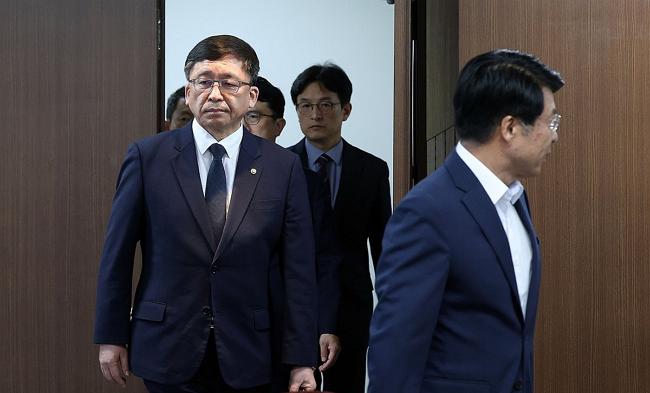 Kang Dong-wan, Deputy Secretary-General of the National Election Commission, and other NEC officials visited Songpa-gu Office, Seoul, on the 24th to apologize for the ballot shortage that occurred during the June 3 local elections. While management responsibility and election invalidity are distinct, the appeal review must assess both the scope of management illegality and its impact on the election results. [Photo=Yonhap News]
[Ultimately, how should the success or failure of this election appeal be judged?]
It should not be judged solely by whether it was accepted or dismissed.
First, one must look at whether issues and evidence have been formalized so that the validity of the election can continue to be contested in court.
Second, one must verify to what extent the NEC investigated the original data and computerized records it holds.
Third, one must examine whether the items not investigated and the reasons why are specifically included in the decision document.
The first effect of an election appeal review is the legal effect of connecting election disputes to the Supreme Court and High Courts.
The second effect is holding the agency accountable politically and institutionally by leaving a record of what the NEC investigated and what it ignored.
If the NEC dismisses the appeal without sufficient evidence investigation, this question remains:
“Was it dismissed because there was no evidence, or was there no evidence because it wasn't investigated?”
Ultimately, the true meaning of this election appeal does not lie solely in getting a re-election immediately.
It lies in opening the path to re-contest election validity in court and leaving the NEC's investigation and judgment as an official record before the public.
[Thank you for your thoughts today.]
Thank you.
[So far, we have discussed the significance of the election appeal case with our editor, Kim Young.]

 Iranian Foreign Ministry: "Continuing Message Exchanges with the U.S. and Activities of Mediating Countries"
Esmaeil Baghaei, Spokesperson for the Iranian Ministry of Foreign Affairs [Xinhua, Yonhap News file photo]Esmaeil Baghaei, spokesperson for the Iranian Ministry of Foreign Affairs, stated on the 26th
Iranian Foreign Ministry: "Continuing Message Exchanges with the U.S. and Activities of Mediating Countries"
Esmaeil Baghaei, Spokesperson for the Iranian Ministry of Foreign Affairs [Xinhua, Yonhap News file photo]Esmaeil Baghaei, spokesperson for the Iranian Ministry of Foreign Affairs, stated on the 26th
 President Yoon: "Do You Think You Are Safe from the Special Counsel?"... Final Statement Video Released
President Yoon Suk Yeol rebuking the special prosecutor on the 24th. [Court video / @birds_justice X account subtitle GIF] A video of President Yoon Suk Yeol's closing statement at his trial rega
President Yoon: "Do You Think You Are Safe from the Special Counsel?"... Final Statement Video Released
President Yoon Suk Yeol rebuking the special prosecutor on the 24th. [Court video / @birds_justice X account subtitle GIF] A video of President Yoon Suk Yeol's closing statement at his trial rega
 President Yoon, regarding the first-instance ruling on the Public Official Election Act: “An excessive political verdict that distorts the facts… We will appeal immediately.”
The first-instance sentencing hearing for President Yoon Suk Yeol regarding violations of the Public Official Election Act is being broadcast live at Seoul Station on the 27th. [Photo=Yonhap News]Pres
President Yoon, regarding the first-instance ruling on the Public Official Election Act: “An excessive political verdict that distorts the facts… We will appeal immediately.”
The first-instance sentencing hearing for President Yoon Suk Yeol regarding violations of the Public Official Election Act is being broadcast live at Seoul Station on the 27th. [Photo=Yonhap News]Pres
 WSJ: "SK Hynix ADR Premium Is a Sign of AI Trading Overheat"
Advertisement for SK Hynix ADR listing in New York's Times Square [Reuters=Yonhap News file photo]The Wall Street Journal (WSJ) has pointed out that the price of SK Hynix’s American Depositary Recei
WSJ: "SK Hynix ADR Premium Is a Sign of AI Trading Overheat"
Advertisement for SK Hynix ADR listing in New York's Times Square [Reuters=Yonhap News file photo]The Wall Street Journal (WSJ) has pointed out that the price of SK Hynix’s American Depositary Recei
 'Godfather of Japanese Mystery Novels' Keigo Higashino Passes Away After Battle with Cancer at 68
Famous Japanese mystery novelist Keigo Higashino [AFP=Yonhap News]It has been belatedly reported that Keigo Higashino, the "godfather of Japanese mystery novels" and author of bestsellers such as "The
'Godfather of Japanese Mystery Novels' Keigo Higashino Passes Away After Battle with Cancer at 68
Famous Japanese mystery novelist Keigo Higashino [AFP=Yonhap News]It has been belatedly reported that Keigo Higashino, the "godfather of Japanese mystery novels" and author of bestsellers such as "The
 [Park Pil-kyu Security Column] To the Ignorant Trying to Clothe a Beast in Sheep's Clothing
Rep. Kim Byung-joo of the Democratic Party of Korea [Photo=Yonhap News]“The Air Force Academy doesn't teach you how to fly a plane!” “The Army, Navy, and Air Force academies are exactly the
[Park Pil-kyu Security Column] To the Ignorant Trying to Clothe a Beast in Sheep's Clothing
Rep. Kim Byung-joo of the Democratic Party of Korea [Photo=Yonhap News]“The Air Force Academy doesn't teach you how to fly a plane!” “The Army, Navy, and Air Force academies are exactly the
 [Photo] Evidence of Election Fraud Flooding U.S. Media… Trump Had 2.7 Million Votes Stolen
 [Video] U.S. Semiquincentennial Air Show... 'Art in the Sky' streaks across New York
 [Editorial Cartoon] A Draconian Law That Undermines Freedom of Expression

 List
List









