U.S. Representative Michael Baumgartner (R-WA) has drawn attention for introducing the "No Racketeers on Our Shores Act" (H.R. 9834).
In a press release issued on Thursday the 23rd, Rep. Baumgartner stated, "Foreign public officials who abuse their government authority to discriminate against U.S. companies may be denied entry into the United States."
Rep. Baumgartner remarked, "U.S. businesses should compete in foreign markets based on the merits and competitiveness of their products, rather than having to fight against foreign bureaucrats intent on undermining a level playing field." He added, "There is a concerning global trend where foreign governments are imposing selective investigations, punitive fines, discriminatory taxes, and regulatory burdens that overwhelmingly target U.S.-owned companies."
The bill is designed to address this spreading global trend—identified by the House Judiciary Committee—in which foreign governments use coercive state power to target successful American-owned firms while protecting favored domestic competitors.
Rep. Baumgartner cited South Korea as a key example, noting, "In South Korea, authorities subjected the U.S.-based company Coupang to dozens of investigations and thousands of requests for documents, and imposed a record-breaking fine of approximately $410 million."
In Europe, regulators have imposed fines exceeding $1 billion on Google under the Digital Markets Act (DMA) concerning the company's display of its own services in search results and its operation of the Play Store. This is part of a regulatory regime that allows for fines of up to 10% of global annual turnover, or up to 20% for repeat offenses.
In Brazil, authorities are pursuing DMA-style legislation that would impose special restrictions on overwhelmingly large technology platforms headquartered in the U.S.
Baumgartner added, "While congressional oversight, diplomatic directives, and bilateral cooperation remain important tools, they are often insufficient. Conversely, formal investigations by the Office of the U.S. Trade Representative (USTR) or the renegotiation of trade agreements are significant measures with broad economic and diplomatic implications." He continued, "This bill adds a new step to the tiered sanctions framework. Foreign public officials who personally abuse their government power to discriminate against Americans should not expect the privilege of visiting or staying in the United States."
The key provisions of the bill are as follows;
- Amend the ‘Immigration and Nationality Act’ to designate foreign government officials who engage in economic discrimination against Americans as inadmissible to the U.S. and subject to deportation if present in the country;
- Focus on discriminatory government actions while exempting legitimate and fair regulations;
- Impose targeted diplomatic sanctions on individual decision-makers.
However, the bill, which was introduced to the House Judiciary Committee on Wednesday the 22nd, currently has no co-sponsors, and its chances of passing within this legislative session appear slim.
The U.S. Congress has recently become increasingly vocal in criticizing the South Korean government’s excessive measures and discriminatory actions against American companies.
In a letter sent to South Korean Ambassador to the U.S. Cho Hyun-dong last April, 54 Republican lawmakers argued that "the South Korean government is taking discriminatory and politically motivated measures against U.S. companies." In the letter, the representatives cited the consideration of a business suspension for Coupang, the raid on its Seoul office, fines, and tax audits as examples of discriminatory regulation against the company.
Furthermore, an interim report released by the House Judiciary Committee recently described the Coupang case as an instance of the South Korean government abusing law enforcement to discriminate against U.S. companies and American citizens.
The South Korean government has pushed back against these congressional criticisms, claiming they are unfounded and represent an acceptance of only Coupang’s one-sided arguments.
Rep. Baumgartner is known for leading the Republican pushback against the South Korean government regarding the Coupang issue. The fact that he is one of only two Republican representatives who serve on both the House Foreign Affairs Committee and the House Judiciary Committee suggests that his introduction of this bill is not a coincidence. The other representative is Darrell Issa (R-CA), who led the collective letter in April.
Meanwhile, it was reported via LegiStorm on the 23rd that Jake Parker, who previously served as senior advisor for tax and trade policy to Senator Bill Cassidy (R-LA), has transitioned to the role of Director of Global Government Affairs at Coupang.
Parker led Senator Cassidy’s work on trade, tariff modernization, tax policy, and economic security, and specifically supported the Senator’s priority issues on the Senate Finance Committee. Previously, he served for over two years as a senior professional staff member on the House Select Committee on the CCP, focusing on U.S.-China economic competition, trade, and critical mineral, battery, and magnet supply chains.
He joined Senator Cassidy’s office in 2022 after completing a Congressional Tech Fellowship. Prior to his work in Congress, he spent nine years at the U.S.-China Business Council.
In addition to Parker, Coupang’s government affairs team includes lobbyist Ari M. Zimmerman, who worked as a congressional aide and on the House Armed Services Committee from 2011 to 2019; William B. Anaya, who has been active as a lobbyist since 2001; and Jason Park, who served for many years in both the House and the Senate.
Coupang’s congressional lobbying records show they began in 2021, with lobbying expenditures peaking at $2.75 million in 2024, dropping significantly to $1.13 million in 2025, and totaling $710,000 as of the second quarter of 2026.
The scope of their lobbying has been diverse; in the second quarter of this year, reports indicate engagement with the National Security Council (NSC), the U.S. Trade Representative (USTR), the Department of Agriculture, the Department of Commerce, the Department of State, the Department of the Treasury, the House, the Senate, and the Small Business Administration. In the first quarter, they reported lobbying the USTR and the Executive Office of the President.
U.S. NNP = Representative Journalist Sung Ku Hong / Special Correspondent NNP info@newsandpost.com

 [Statement by the Seo-beo-kka Korea Military Academy Save-the-Nation Comrades Association] ㉛ Recount the Votes Publicly, as the Previous Recount Concealed Election Fraud
Tongyeong Mayoral Election Recount [Photo=Yonhap News]South Korea's liberal democracy is dying. The National Election Commission (NEC) and the judiciary, which have plummeted into criminal syndicates
[Statement by the Seo-beo-kka Korea Military Academy Save-the-Nation Comrades Association] ㉛ Recount the Votes Publicly, as the Previous Recount Concealed Election Fraud
Tongyeong Mayoral Election Recount [Photo=Yonhap News]South Korea's liberal democracy is dying. The National Election Commission (NEC) and the judiciary, which have plummeted into criminal syndicates
 Trump's nominee for new U.S. intelligence chief confirmed by U.S. Senate
U.S. Attorney for the Southern District of New York Jay Clayton, who has been confirmed by the Senate to lead the U.S. intelligence community [AP=Yonhap News File Photo]The U.S. Senate confirmed the n
Trump's nominee for new U.S. intelligence chief confirmed by U.S. Senate
U.S. Attorney for the Southern District of New York Jay Clayton, who has been confirmed by the Senate to lead the U.S. intelligence community [AP=Yonhap News File Photo]The U.S. Senate confirmed the n
 PPP on Speaker Woo's Remarks About 'Lee Jae-myung's Consecutive Term and Constitutional Amendment': "A True Act of Insurrection"
People Power Party Representative Jang Dong-hyeok holds a press conference at the National Assembly on the 28th to express his stance regarding National Assembly Speaker Cho Jeong-sik's remarks on a c
PPP on Speaker Woo's Remarks About 'Lee Jae-myung's Consecutive Term and Constitutional Amendment': "A True Act of Insurrection"
People Power Party Representative Jang Dong-hyeok holds a press conference at the National Assembly on the 28th to express his stance regarding National Assembly Speaker Cho Jeong-sik's remarks on a c
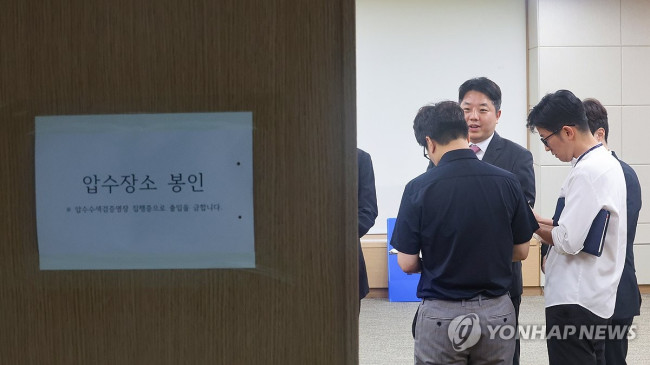 Prosecution Investigates Gyeonggi-do Election Commission Officials as Suspects in 'Statistical Manipulation' of Ballot Counting Records
'Circumstances of statistical manipulation following turnout errors': Joint Investigation Team conducts search and seizure at National Election Commission [Yonhap News file photo]The joint prosecution
Prosecution Investigates Gyeonggi-do Election Commission Officials as Suspects in 'Statistical Manipulation' of Ballot Counting Records
'Circumstances of statistical manipulation following turnout errors': Joint Investigation Team conducts search and seizure at National Election Commission [Yonhap News file photo]The joint prosecution
 SK Hynix Posts Record-High 76% Operating Margin… Outpacing TSMC for Three Consecutive Quarters
In the second quarter of this year, SK hynix [000660] maintained top-tier profitability in the semiconductor industry, recording an operating profit margin of 76%, which surpassed that of Taiwan’s T
SK Hynix Posts Record-High 76% Operating Margin… Outpacing TSMC for Three Consecutive Quarters
In the second quarter of this year, SK hynix [000660] maintained top-tier profitability in the semiconductor industry, recording an operating profit margin of 76%, which surpassed that of Taiwan’s T
 Shin Jin-seo: "AI is not the 'God of Go'… Human Go still holds its charm."
"I don't think AI is the 'God of Go.' I am confident that human Go, which involves making brilliant moves and high-stakes gambles depending on the situation, is still far more fascinating than AI, whi
Shin Jin-seo: "AI is not the 'God of Go'… Human Go still holds its charm."
"I don't think AI is the 'God of Go.' I am confident that human Go, which involves making brilliant moves and high-stakes gambles depending on the situation, is still far more fascinating than AI, whi
 [Park Pil-gyu's Security Column] If Carrying Out Orders Becomes a Crime, Neither the State Nor the Military Can Survive
"Can a military where following orders becomes a crime truly protect the nation and its people, contribute to maintaining the continuity of the state, and continue to survive and exist?" Soldiers stan
[Park Pil-gyu's Security Column] If Carrying Out Orders Becomes a Crime, Neither the State Nor the Military Can Survive
"Can a military where following orders becomes a crime truly protect the nation and its people, contribute to maintaining the continuity of the state, and continue to survive and exist?" Soldiers stan
 [Photo] Evidence of Election Fraud Flooding U.S. Media… Trump Had 2.7 Million Votes Stolen
 [Video] U.S. Semiquincentennial Air Show... 'Art in the Sky' streaks across New York
 [Editorial Cartoon] A Draconian Law That Undermines Freedom of Expression

 List
List