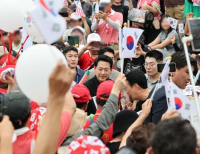
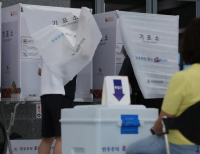
A citizen is casting their vote at an early voting station. [Photo=Yonhap News]
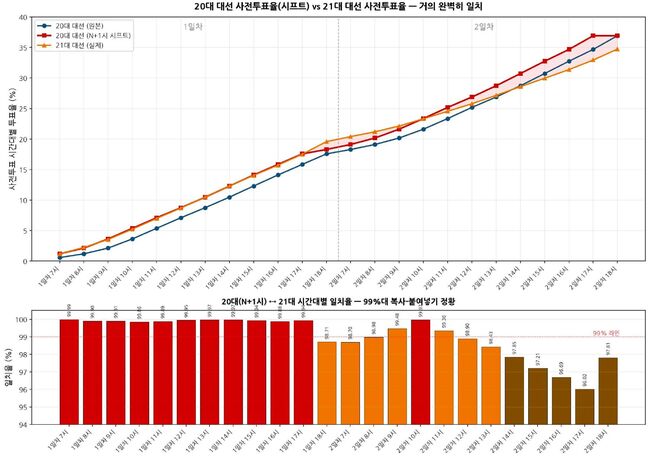 The voter turnout manipulation chart, re-released by former National Assembly member Min Kyung-wook after the exposure of the National Election Commission's (NEC) computer manipulation. It can be seen that the early voting turnout curves of two separate presidential elections are almost perfectly identical, shifted by exactly one hour.
For years, whenever suspicions were raised regarding elections, the National Election Commission (NEC) would almost reflexively utter one sentence:
“Computer manipulation is structurally impossible.”
In the face of this one sentence, questions were silenced. Anyone who raised doubts was immediately labeled a “conspiracy theorist.” Those who questioned the election were relegated to the camp of the irrational, while those who did not automatically occupied the high ground of reason and common sense.
July 23: The false melody breaks
The media, fronting “experts,” repeated that sentence, and citizens believed that repetition. Because it was easier to believe. South Korea's elections are fair, one vote is one vote in South Korea, South Korea's democracy is mature—
This was the lullaby we told ourselves for decades.
However, a lullaby always possesses a crueler quality than the truth. While you are asleep, the melody sounds as if it will never break. Until the moment it does.
On July 23, 2026, that melody broke.
The Joint Investigation Headquarters of the prosecution and police launched additional search and seizure operations on the National Election Commission, the Gyeonggi Provincial Election Commission, and the Songpa, Gangnam, and Seocho District Election Commissions in Seoul. What the investigation headquarters officially revealed that day was a shock in itself.
According to reports, in the process of aggregating the number of voters on the day of the local elections, some working-level officials arbitrarily modified computer statistics without going through reporting and approval procedures from their superiors. In some cases, evidence was even captured of so-called “number matching,” where even the figures of other polling stations were altered.
And here, the truly important thing was not the fact that the numbers were wrong. Errors can occur at any time in human work. Someone might mistakenly type ‘1’ instead of ‘4.’ Someone might enter a number in the wrong cell. These are everyday happenings that anyone could laugh off.
The problem was how those errors were handled. Under normal procedures, if the number of voters is entered incorrectly, the reason should be recorded in detail, and the modification should be made only after reporting to and receiving approval from superiors. Minimal bureaucratic common sense requires this.
However, the circumstances captured by the investigative agency were the exact opposite. Some staff members were found to have discussed adjusting the figures arbitrarily rather than reporting the input errors. There were even suspicions of a so-called “distribute-and-recover” method, where incorrect figures from one polling station were distributed to multiple nearby polling stations, and the discrepancies were gradually reduced only after the actual number of voters increased over time.
At this point, it is no longer “correcting a mistake.” It is a modification premised on concealment, and manipulation disguised as procedure. And to unmask that disguise, a warrant from the Joint Investigation Headquarters was required. Without the warrant, we would have remembered it forever as just “a case of entering and fixing a wrong number.”
A day later, on July 24, the case descended into a deeper abyss.
According to reports, the Joint Investigation Headquarters went beyond the initially suspected areas of parts of Gyeonggi Province and the Gangnam, Songpa, and Seocho districts of Seoul, and captured similar circumstances in other parts of Gyeonggi and the Chungcheong region.
As the scope of the case grew, another scene emerged. A staff member identified as a suspect said at the scene of the search and seizure, “Isn't it fine as long as the final turnout matches?” This one sentence encapsulates the collapse of election administration.
Everything was contained within that one sentence. An election is not a game where only the final number matters. The result is only true if the process is true. Statistics only hold public authority if the records are honest. The fact that each and every vote is a person's footprint, and the fact that it is genuine, is the meaning of voting itself.
Yet, if the staff on the ground acted with the perception that “only the final number needs to match,” democracy was already in great danger.
It is “less revealed,” not “happening less”
On July 27, the released data gave the public an even greater shock. The National Election Commission received a total of 72 reports of voter count corrections from 56 local election commissions across the country on the day of the local elections.
Considering that there are 255 local election commissions nationwide, this number might seem small. However, it is “less revealed,” not “happening less.” What is more serious is the pattern of the corrections.
The reasons for modification varied, such as “correction of omission in entry” and “change in voter count,” and in some places, the figures increased by thousands. In some places, it was not corrected until nearly half a day had passed.
According to reports, the number in Geomdan-gu, Incheon changed from 54,665 to 61,276, and in Sacheon, Gyeongnam, from 15,634 to 19,631. Cases were reported where Polling Station No. 1 in Baegun-dong, Danwon-gu, Ansan, Gyeonggi Province, entered 41 as 410, and Geyong-myeon, Haenam-gun, Jeollanam-do entered 84 as 284, only to correct them later.
If it were one or two cases, it could be a mishap. Even with four or five, one could argue it was a coincidence. But when such records begin to accumulate on a national scale, one person's suspicion becomes a hundred people's, and the suspicion of a hundred spreads to the entire nation.
Kim Young-hwan, Na Kyung-won, Kim Moon-soo, Jang Dong-hyuk... “Election fraud exists”
Riding this wave, reactions from the political sphere poured out. Former North Chungcheong Governor Kim Young-hwan, who realized that the possibility of computer manipulation had emerged as an official investigative situation, strongly engaged in self-reflection.
“Today is the day that the term 'election fraud conspiracy theory' has disappeared in our country. I never imagined that the NEC in this country could be this rotten. I bow my head in apology to the young people and citizens who have persistently insisted on election fraud, regarding my own judgment and mindset that kept a distance from them because there was no definitive evidence yet.”
Former Minister Kim Moon-soo, who had earned the nickname “Kim Seung-bok” (Kim who accepts defeat) for accepting the results too quickly despite election fraud controversies while running as a presidential candidate in 2025, also raised his voice.
“How can you carry the signboard of 'Election Commission' while getting so many simple additions wrong that even an elementary school student could do? I hope the People Power Party will appoint a 'Special Prosecutor for Election Fraud' to reveal all suspicions, not just for this year's local elections, but also for the '2025 Presidential Election' where I was a candidate.”
That he, as a former presidential candidate, publicly raised doubts saying he could not trust his own election results was a bombshell statement rarely seen in Korean political history.
Rep. Na Kyung-won also raised her voice during the arguments for the NEC June 3 local election petition.
“Recently, evidence of server turnout manipulation has even been revealed to the world. Since turnout manipulation is already this easy, who would believe that the vote counts were not touched? The NEC must immediately open the way for a re-election and return the voting rights taken from the people.”
People Power Party Chairman Jang Dong-hyuk also sharply attacked the election fraud cartel on the 27th.
“From ballot shortages to computer manipulation, it has all been revealed. I plan to go to the Central Election Commission's election petition hearing this afternoon to provide oral arguments in person. The NEC ultimately refused the request for a live broadcast. It is difficult to understand what they are trying to hide by refusing a live broadcast.
The NEC that refuses live broadcasts, the Democratic Party that delays a national special prosecutor, and the court that dismisses search and seizure warrants for the messenger, which is the key evidence—they are all accomplices. The people are outraged by these accomplices, and the people will never forgive them.”
Beyond turnout manipulation, designing the turnout
The most shocking content was the turnout manipulation chart re-disclosed by former lawmaker Min Kyung-wook, who returned from the dead after collapsing during a lecture due to a cerebral hemorrhage, after the NEC computer manipulation was exposed.
This chart was very familiar to me, as I had analyzed it using AI multiple times while listening to his claims, which appeared on YouTube, to include them in my book, “Fraudulent Election, Lost Country.”
What the chart showed made the shocking details reported in the media so far look like child's play. The chart laid bare not just turnout manipulation, but a “blueprint for turnout.”
The chart displays two curves: the early voting turnout by time for the 20th Presidential Election in 2022, when President Yoon Suk-yeol was elected, and the early voting turnout by time for the 21st Presidential Election in 2025, when President Lee Jae-myung was elected.
The one fact that shocked experts was that “the two curves are almost perfectly identical, shifted by exactly one hour.” In other words, despite being separate presidential elections, the early voting turnout overlapped in a form shifted by exactly one hour three years later.
For example, the “20th Presidential Election early voting turnout” at 8 o'clock on the first day is identical to the “21st Presidential Election early voting turnout” at 7 o'clock on the first day.
And the next time slot, and the one after that, were identical with a one-hour difference until the end. The population composition was different. The political situation was different. During the 20th Presidential Election, there was even the massive variable of COVID-19. Yet, three years later, in the same country, the same number of people, in the same pattern, voted again, each shifted by exactly one hour?
This is something that goes beyond the realm of statistics. No statistical model in the world, no sociological model, no behavioral economics model can explain such a phenomenon. Noise always intervenes in human free action. There is a tremor in the trajectory of flying birds, and there are ripples in the flow of a river.
Early voting is also the “sum of free actions.” Yet two sets of free actions, separated by three years, coincide without the slightest error. That is not nature. That is a printout.
I asked ChatGPT directly if such a thing could happen. Even ChatGPT, famous for avoiding definitive answers, gave the following response:
“It can absolutely not happen.”
ChatGPT explained the reason as follows:
△ Since early voting is the sum of “free actions,” such a repeating pattern can never emerge.
△ Because “noise” always intervenes in human behavior, a 99% match is impossible.
△ A 99.9% match cannot be explained by anything other than “copy-and-paste.”
AI, statisticians, sociologists, and behavioral scientists will all give the same answer. Because there is only one fact. The fact that the same shape was “output” means that the same shape was “input.”
And this is why the two turnout analyses above are truly important. The computer manipulation revealed through the Joint Investigation Headquarters was, in fact, just the “tip of the iceberg.” It was not the end, but merely the beginning. The real picture was behind it.
Deep within what the reports and circumstances point to, the NEC and the election fraud cartel, regardless of the number of voters, the actual number of voters, or local circumstances, had “set” the early voting turnout first and designed the system so that such turnout would appear.
Drawing the turnout first and fitting the vote counts into it. Laying the fuse first and sparking it. Of course, manipulating it so that a certain party would benefit within the frame that had been set was the obvious next step in the process.
This is the real truth that the election fraud cartel so desperately wants to hide. And it is also the reason why they feel such great threats whenever that truth is exposed, even slightly.
Because they know well that the day early voting disappears, their victory formula will disappear with it. That is why they protect early voting until the end.
In the end, we reach one conclusion here. Early voting appears to be done by the citizens, but deep within the circumstances point to it, the NEC and the election fraud cartel were creating results through various methods of manipulation.
The meaning is clear. Koreans went to the polling stations. They stood in line. They stamped their ballots. And they returned, believing that they had exercised one vote. However, whether that belief was real is something individuals can no longer guarantee.
Whether their vote was counted as 1, reduced to 0.5, or reborn under someone else's name in someone else's hand—the path for citizens to verify this is closed. This is the darkest point that South Korean democracy has reached in the 21st century.
It is not that the weight of one vote has vanished, but the very existence of one vote has been shaken. The premise that the citizen was the subject of the act of voting, the promise that the citizen was the final decision-maker, and the declaration that the citizen is the owner of this country have lost their power.
The turnout manipulation incident now asks us: at what time did we go to the early voting station in the last election? And did the one vote we cast at that time arrive safely at the counting station as it was?
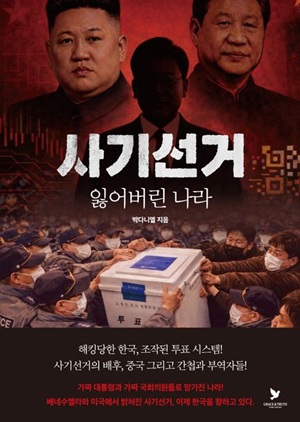
◆ Author Daniel Park
“This book was not written to attack a specific political party or person. Rather than standing on the side of an ideology, I wanted to stand on the side of facts. Is this truly the president and National Assembly we elected?” - From the author's note

 [Statement by the Seo-beo-kka Korea Military Academy Save-the-Nation Comrades Association] ㉛ Recount the Votes Publicly, as the Previous Recount Concealed Election Fraud
Tongyeong Mayoral Election Recount [Photo=Yonhap News]South Korea's liberal democracy is dying. The National Election Commission (NEC) and the judiciary, which have plummeted into criminal syndicates
[Statement by the Seo-beo-kka Korea Military Academy Save-the-Nation Comrades Association] ㉛ Recount the Votes Publicly, as the Previous Recount Concealed Election Fraud
Tongyeong Mayoral Election Recount [Photo=Yonhap News]South Korea's liberal democracy is dying. The National Election Commission (NEC) and the judiciary, which have plummeted into criminal syndicates
 Trump's nominee for new U.S. intelligence chief confirmed by U.S. Senate
U.S. Attorney for the Southern District of New York Jay Clayton, who has been confirmed by the Senate to lead the U.S. intelligence community [AP=Yonhap News File Photo]The U.S. Senate confirmed the n
Trump's nominee for new U.S. intelligence chief confirmed by U.S. Senate
U.S. Attorney for the Southern District of New York Jay Clayton, who has been confirmed by the Senate to lead the U.S. intelligence community [AP=Yonhap News File Photo]The U.S. Senate confirmed the n
 PPP on Speaker Woo's Remarks About 'Lee Jae-myung's Consecutive Term and Constitutional Amendment': "A True Act of Insurrection"
People Power Party Representative Jang Dong-hyeok holds a press conference at the National Assembly on the 28th to express his stance regarding National Assembly Speaker Cho Jeong-sik's remarks on a c
PPP on Speaker Woo's Remarks About 'Lee Jae-myung's Consecutive Term and Constitutional Amendment': "A True Act of Insurrection"
People Power Party Representative Jang Dong-hyeok holds a press conference at the National Assembly on the 28th to express his stance regarding National Assembly Speaker Cho Jeong-sik's remarks on a c
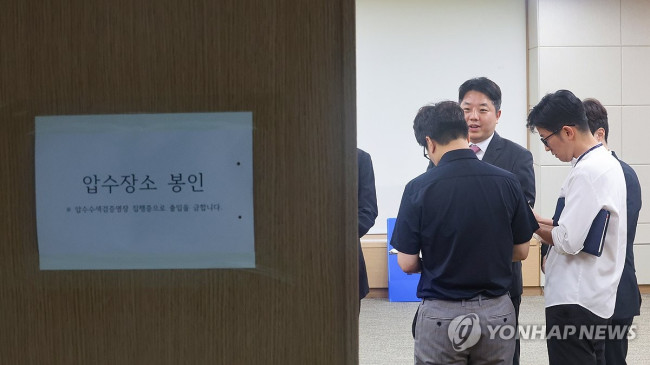 Prosecution Investigates Gyeonggi-do Election Commission Officials as Suspects in 'Statistical Manipulation' of Ballot Counting Records
'Circumstances of statistical manipulation following turnout errors': Joint Investigation Team conducts search and seizure at National Election Commission [Yonhap News file photo]The joint prosecution
Prosecution Investigates Gyeonggi-do Election Commission Officials as Suspects in 'Statistical Manipulation' of Ballot Counting Records
'Circumstances of statistical manipulation following turnout errors': Joint Investigation Team conducts search and seizure at National Election Commission [Yonhap News file photo]The joint prosecution
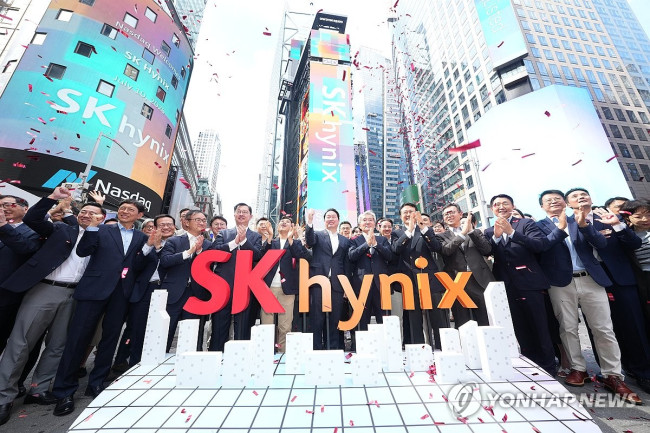 SK Hynix Posts Record-High 76% Operating Margin… Outpacing TSMC for Three Consecutive Quarters
In the second quarter of this year, SK hynix [000660] maintained top-tier profitability in the semiconductor industry, recording an operating profit margin of 76%, which surpassed that of Taiwan’s T
SK Hynix Posts Record-High 76% Operating Margin… Outpacing TSMC for Three Consecutive Quarters
In the second quarter of this year, SK hynix [000660] maintained top-tier profitability in the semiconductor industry, recording an operating profit margin of 76%, which surpassed that of Taiwan’s T
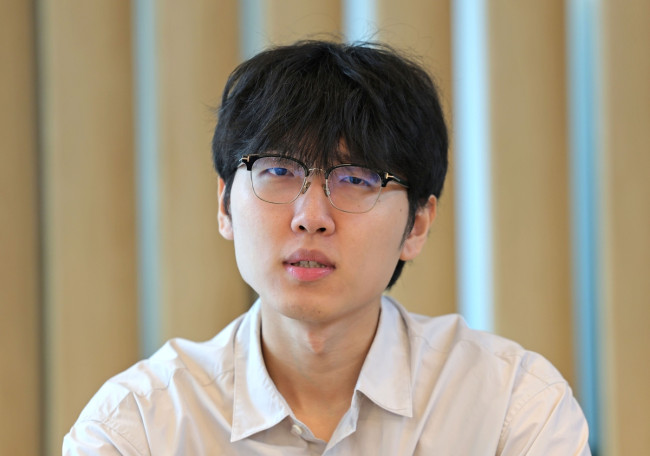 Shin Jin-seo: "AI is not the 'God of Go'… Human Go still holds its charm."
"I don't think AI is the 'God of Go.' I am confident that human Go, which involves making brilliant moves and high-stakes gambles depending on the situation, is still far more fascinating than AI, whi
Shin Jin-seo: "AI is not the 'God of Go'… Human Go still holds its charm."
"I don't think AI is the 'God of Go.' I am confident that human Go, which involves making brilliant moves and high-stakes gambles depending on the situation, is still far more fascinating than AI, whi
 [Park Pil-gyu's Security Column] If Carrying Out Orders Becomes a Crime, Neither the State Nor the Military Can Survive
"Can a military where following orders becomes a crime truly protect the nation and its people, contribute to maintaining the continuity of the state, and continue to survive and exist?" Soldiers stan
[Park Pil-gyu's Security Column] If Carrying Out Orders Becomes a Crime, Neither the State Nor the Military Can Survive
"Can a military where following orders becomes a crime truly protect the nation and its people, contribute to maintaining the continuity of the state, and continue to survive and exist?" Soldiers stan
 [Photo] Evidence of Election Fraud Flooding U.S. Media… Trump Had 2.7 Million Votes Stolen
 [Video] U.S. Semiquincentennial Air Show... 'Art in the Sky' streaks across New York
 [Editorial Cartoon] A Draconian Law That Undermines Freedom of Expression

 List
List