 "The Divine Comedy" is an epic poem that the Italian author Dante Alighieri began writing in 1308 and completed in 1321. It is divided into Inferno (Hell), Purgatorio (Purgatory), and Paradiso (Paradise), with the Inferno being the most well-known. In the 21st century, humanity is facing greater spiritual and political chaos than at any other time in history. Forces of evil that harm the order and well-being of humanity are rampant across the globe: regimes that deprive citizens of freedom and trample on human rights; situations where permanent members of the UN Security Council invade neighboring countries; regimes that use oil—a gift from God in barren deserts—as a weapon to blockade international waterways and threaten their own people and the world with religious dogma; and regimes that erode the constitutional foundations of liberal democracy while intimidating their citizens.
The Reality and Horror of Evil in History and Thought
Anything that harms humanity and the world and strips away God-given human rights is evil. Evil is not a mere abstract concept; it is an existential destructive force that has claimed countless lives and inflicted suffering throughout human history. When human selfishness and the lust for power combine with misguided ideologies, evil explodes in its most brutal form.
The Essence of Evil Viewed Through Thought and Literature
The Bible describes human history as a continuous confrontation between good and evil. The Bible as a whole, including the Book of Revelation, portrays Satan (Evil) as attempting to destroy God's order (Good) through deceit and violence, aiming for destruction and division; however, it also promises an eschatological victory where good eventually triumphs.
In Goethe's "Faust," Mephistopheles, who tempts Dr. Faust, is the embodiment of negation, declaring, "Everything that exists deserves to perish." He demonstrates the cunning nature of evil, which burrows into human desire to consume the soul.
The phrase "wishing for many good people in the world" (所願善人多) reflects the beautiful teachings of Confucianism—from Zhu Xi to Toegye and down to their modern descendants—which emphasize the "respect for humanity and the restoration of morality."
Historical Examples of Evil That Stained Humanity with Blood
The greatest evil of the Pharisees in the time of Jesus was "the spiritual pride of using religion as a means to monopolize God, while condemning and exploiting others to protect their own vested interests." Jesus criticized this, calling them "whitewashed tombs" (looking clean on the outside but full of rotting bones within).
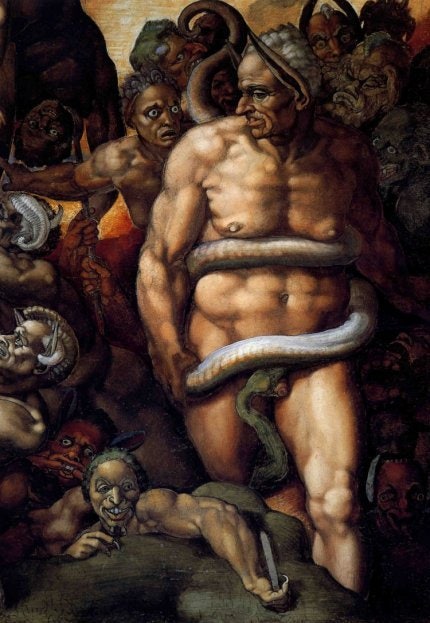 Cardinal Biagio, whom Michelangelo depicted as the "King of Hell" in "The Last Judgment." Despite the pressure from the Pope and high-ranking officials who held absolute power, Michelangelo used his wit and genius artistry to brilliantly mock the harsh censorship of his era. The face of Biagio, who had criticized "The Last Judgment" painted in the Sistine Chapel, remains on the chapel wall as the King of Hell to this day, 500 years later.
The witch hunts driven by the madness of the medieval church represent a tragedy in which approximately 40,000 to 60,000 innocent people were sacrificed across Europe. Because of this history, "witch hunt" today refers to "the act of scapegoating and destroying a specific individual or the weak without cause to resolve collective anxiety or contradictions."
The massacre of Koreans during the 1923 Great Kanto Earthquake serves as a historical warning of how rumors based on discrimination and prejudice, when combined with state negligence and public power, can lead to horrific genocidal massacres.
The Nazi Holocaust—the systematic extermination of over 6 million Jews by forces filled with the madness of extreme nationalism and racism after seizing state power—was the greatest tragedy in human history, demonstrating just how cruel humans can become.
Stalin's Great Purge was the height of power-based evil, where, to maintain a communist dictatorship, he branded even his comrades as enemies, purging tens of millions and sending them to forced labor camps.
In China, the reckless economic policies of Mao Zedong (the Great Leap Forward) and the madness of the Red Guards used to maintain his power (the Cultural Revolution) led to the sacrifice of tens of millions of innocent lives.
The 21st-Century War Between Good and Evil: The Liberal Bloc vs. The Totalitarian Bloc
If the evil of the past is history, the evil of today has arrived before our eyes with even more precise and massive organization. A recent politician cried out, "If an ignorant, unlearned, and incompetent leader is arrogant, we must fight against that wicked devil ruler and satanic regime!"
Currently, the world stands on a massive battlefield between the liberal democratic camp, which seeks to protect human rights and legitimacy, and the axis of evil—totalitarianism and fanaticism—which uses "unconditional equality" as a front to destroy these values. The CCP has perfected "digital totalitarianism," using artificial intelligence and cutting-edge technology to monitor its people, and seeks to reshape the global order using its economic power.
North Korea and Iran are holding the entire world hostage through nuclear development, trampling on the human rights of their citizens, and forming an alliance of terror-sponsoring states. These axis-of-evil nations are either exporting fraudulent elections to the world or becoming accomplices in usurping sovereignty and undermining the foundations of liberal democracy.
The greater problem is the enemy within. Terrorism like Antifa in the U.S., anarchism that denies civilization, "Deep State" forces—consisting of bureaucrats and media elites who form massive cartels by colluding with foreign powers—as well as anti-Semitism, Islamic fundamentalism, and communism are eroding the foundations of free society.
Examples are endless: businesses built through a lifetime of effort going bankrupt due to excessive inheritance taxes, or clergy and churches colluding with power that denies religion, essentially surrendering their religious freedom.
Even within South Korea, forces that trample on common sense and morality are on the rise. There are so many individuals who have contributed to the Republic of Korea across fields like industrialization, modernization, democratization, national defense, and security, yet only the "merit holders of democratization" receive massive compensation, and their list remains undisclosed—which is incomprehensible.
In particular, Dante's "Divine Comedy" and Goethe's "Faust" vividly depict the judgment awaiting those who serve the forces of evil.
The Eighth Circle of Hell in The Divine Comedy (Malebolge - Fraud and Deceit)
Sycophants and Corrupt Officials: Those who praised the evil deeds of rulers and shared in the spoils of power are punished by being eternally submerged in filth (feces). This is because the sweet talk and corruption they practiced on earth are viewed as excrement that polluted the community.
Could this include judges who, while wearing the robes of justice, trade with power and undermine the rule of law, or election commissions that hinder the political neutrality of civil servants, collude with power, and threaten the integrity of elections to dismantle the foundations of liberal democracy?
Those Who Perpetrated Division and Sowing Discord: Those who split religious, political, and social communities and served evil are punished by having their bodies ripped apart by swords; just as their wounds heal, the devil's blade tears them apart again, repeating the agony for eternity. This also includes ideologically biased media outlets that spew countless fake news stories across the globe, blinding and deafening the public.
The Ninth Circle of Hell in The Divine Comedy (Cocytus - Betrayal)
The ninth and lowest circle of Hell is not fire, but a massive frozen lake where everything is encased in ice.
Those Who Betrayed Their Fatherland and Fellow Citizens: Those who sold out their country or served a dictator, driving their own people into life-and-death situations, are trapped in ice up to their necks, suffering the agony of tears freezing over. This category includes forces that disparage and deny the ROK-U.S. alliance, which has saved South Korea from numerous crises and served as the cornerstone of its freedom and prosperity over the past 70 years.
Those Who Betrayed Benefactors and Served Absolute Evil: At the very center of Hell, three figures are forever chewed in the mouths of Satan: Judas, who betrayed Jesus Christ; and Brutus and Cassius, who betrayed Caesar, the founder of the Roman Empire's foundations, and plunged the republic into crisis.
There are countless people who trade with the devil for personal glory and profit, regardless of what happens to the country. There are many untrustworthy political dividers who betrayed their own party's president and brought down the government themselves. Can politicians and scholars who distort historical facts to defy the truth based on ideological biases ever be forgiven?
Goethe's Faust
Faust lives his life as a servant of the devil, enjoying power, wealth, and pleasure, but he gains enlightenment in his old age. Instead of relying on the supernatural magic provided by the devil, he decides to dedicate himself to a public-interest task: using his own strength to reclaim land from the sea and build a "land of freedom" where countless people can work and live.
Ways to Defeat the Forces of Evil and Save the World
First, Restoration of Moral Clarity: Absolute Distinction Between Good and Evil
First and foremost, we must break down the distorted values that relativize good and evil. We must not tolerate human rights abuses, ethnic cleansing, religious persecution, or state-sponsored terrorism under the excuses of "cultural differences" or "historical specificity." To this end, we must build global moral solidarity.
Second, Peace Through Strength: Powerful Physical Deterrence
Evil exploits the goodwill of the good as a weakness. Just as the policy of appeasement that ceded territory to the Nazis eventually led to the catastrophe of World War II, half-hearted compromises with evil invite greater ruin. We must deter our main enemy with overwhelming military power so they dare not even contemplate using nuclear weapons, and we must continue strong economic sanctions to cut off the funding for evil regimes.
Third, Internal Collapse of Evil Through the Influx of Truth and Information
Totalitarian and fanatical regimes survive on lies and the blockade of information. We must maximize the inflow of outside information and continue to dismantle the "information walls" that hide corruption and historical errors. There is no stronger method of eradication than helping those within realize the truth so they reject the evil regime themselves.
Fourth, Inner Courtesy (Li) and Spiritual Awakening
As Xunzi emphasized, we must strengthen the rule of law and moral education that can control the evil nature within humans. We must reinforce education on proper values and the dignity of human rights in homes and schools. Through religious and spiritual awakening, we must overcome the idolatry of worshiping humans as gods, as well as materialism and selfishness, and rebuild the spiritual foundation that cherishes the lives of others.
Our Mission for the Victory of Good
Humanity may never be able to end the war between good and evil until the end of the world. This is because, as long as human greed and the lust for power exist, evil will constantly change its form and reappear. When we remain silent and watch with a relativistic view of good and evil, evil consumes the world. A firm rejection of evil and powerful retribution are the only ways to protect human civilization and save the world in this era of crisis.

◆ Dr. Shin Dong-chun
Ph.D. in Public Administration, Representative of the Alliance for Liberal Unification. After passing the 21st Public Administration Examination and serving in the public sector, he has been actively engaged as a corporate CEO, university professor, media contributor, author, and President of the Global Aerospace Industry Society.

 [Statement by the Seo-beo-kka Korea Military Academy Save-the-Nation Comrades Association] ㉛ Recount the Votes Publicly, as the Previous Recount Concealed Election Fraud
Tongyeong Mayoral Election Recount [Photo=Yonhap News]South Korea's liberal democracy is dying. The National Election Commission (NEC) and the judiciary, which have plummeted into criminal syndicates
[Statement by the Seo-beo-kka Korea Military Academy Save-the-Nation Comrades Association] ㉛ Recount the Votes Publicly, as the Previous Recount Concealed Election Fraud
Tongyeong Mayoral Election Recount [Photo=Yonhap News]South Korea's liberal democracy is dying. The National Election Commission (NEC) and the judiciary, which have plummeted into criminal syndicates
 Trump's nominee for new U.S. intelligence chief confirmed by U.S. Senate
U.S. Attorney for the Southern District of New York Jay Clayton, who has been confirmed by the Senate to lead the U.S. intelligence community [AP=Yonhap News File Photo]The U.S. Senate confirmed the n
Trump's nominee for new U.S. intelligence chief confirmed by U.S. Senate
U.S. Attorney for the Southern District of New York Jay Clayton, who has been confirmed by the Senate to lead the U.S. intelligence community [AP=Yonhap News File Photo]The U.S. Senate confirmed the n
 PPP on Speaker Woo's Remarks About 'Lee Jae-myung's Consecutive Term and Constitutional Amendment': "A True Act of Insurrection"
People Power Party Representative Jang Dong-hyeok holds a press conference at the National Assembly on the 28th to express his stance regarding National Assembly Speaker Cho Jeong-sik's remarks on a c
PPP on Speaker Woo's Remarks About 'Lee Jae-myung's Consecutive Term and Constitutional Amendment': "A True Act of Insurrection"
People Power Party Representative Jang Dong-hyeok holds a press conference at the National Assembly on the 28th to express his stance regarding National Assembly Speaker Cho Jeong-sik's remarks on a c
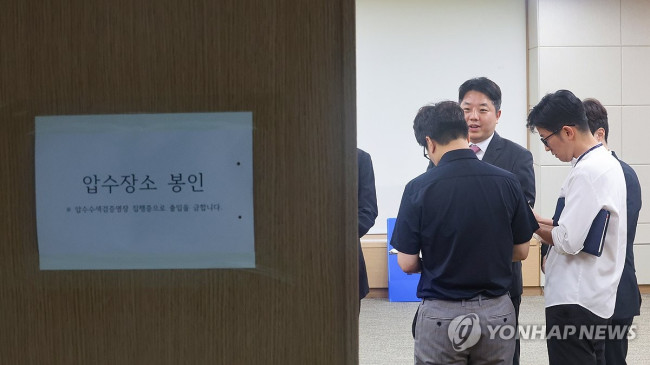 Prosecution Investigates Gyeonggi-do Election Commission Officials as Suspects in 'Statistical Manipulation' of Ballot Counting Records
'Circumstances of statistical manipulation following turnout errors': Joint Investigation Team conducts search and seizure at National Election Commission [Yonhap News file photo]The joint prosecution
Prosecution Investigates Gyeonggi-do Election Commission Officials as Suspects in 'Statistical Manipulation' of Ballot Counting Records
'Circumstances of statistical manipulation following turnout errors': Joint Investigation Team conducts search and seizure at National Election Commission [Yonhap News file photo]The joint prosecution
 SK Hynix Posts Record-High 76% Operating Margin… Outpacing TSMC for Three Consecutive Quarters
In the second quarter of this year, SK hynix [000660] maintained top-tier profitability in the semiconductor industry, recording an operating profit margin of 76%, which surpassed that of Taiwan’s T
SK Hynix Posts Record-High 76% Operating Margin… Outpacing TSMC for Three Consecutive Quarters
In the second quarter of this year, SK hynix [000660] maintained top-tier profitability in the semiconductor industry, recording an operating profit margin of 76%, which surpassed that of Taiwan’s T
 Shin Jin-seo: "AI is not the 'God of Go'… Human Go still holds its charm."
"I don't think AI is the 'God of Go.' I am confident that human Go, which involves making brilliant moves and high-stakes gambles depending on the situation, is still far more fascinating than AI, whi
Shin Jin-seo: "AI is not the 'God of Go'… Human Go still holds its charm."
"I don't think AI is the 'God of Go.' I am confident that human Go, which involves making brilliant moves and high-stakes gambles depending on the situation, is still far more fascinating than AI, whi
 [Park Pil-gyu's Security Column] If Carrying Out Orders Becomes a Crime, Neither the State Nor the Military Can Survive
"Can a military where following orders becomes a crime truly protect the nation and its people, contribute to maintaining the continuity of the state, and continue to survive and exist?" Soldiers stan
[Park Pil-gyu's Security Column] If Carrying Out Orders Becomes a Crime, Neither the State Nor the Military Can Survive
"Can a military where following orders becomes a crime truly protect the nation and its people, contribute to maintaining the continuity of the state, and continue to survive and exist?" Soldiers stan
 [Photo] Evidence of Election Fraud Flooding U.S. Media… Trump Had 2.7 Million Votes Stolen
 [Video] U.S. Semiquincentennial Air Show... 'Art in the Sky' streaks across New York
 [Editorial Cartoon] A Draconian Law That Undermines Freedom of Expression

 List
List