Trump Administration Proposes "Korea Build Nuclear Power Plants in the US" (Comprehensive)
Discussions underway for KHNP-Westinghouse joint venture... tensions over leadership
Nuclear cooperation expected to be discussed at Lee-Trump summit... KHNP and KEPCO presidents to visit the US
 President Trump signs executive order expanding nuclear power [EPA=Yonhap News Agency Data Photo]
The Donald Trump administration in the United States has reportedly conveyed to the South Korean government its hope for active participation from Korea, which has strengths in construction capabilities, for the expansion of nuclear power in the US.
According to trade sources on the 21st, during contacts between US and South Korean energy authorities following the launch of the second Trump administration, high-ranking US officials introduced their country's plans to expand nuclear power and expressed expectations for active roles from Korean companies.
The US side assessed that the intellectual property dispute between Korean and US companies was resolved in January, and a consensus on nuclear power cooperation has been established between the two governments based on strict adherence to export control principles, creating favorable conditions for collaboration. They reportedly mentioned their hope for Korea to build nuclear power plants in the US, where the need to resolve nuclear power expansion issues is more urgent than in third-country markets.
A source stated, "The two countries have proposed to discuss this issue seriously, and I understand a plan has been made for the public and private sectors to gather and have detailed discussions."
President Donald Trump is pursuing a significant expansion of nuclear power alongside the revival of the fossil fuel economy.
He has set a goal to expand nuclear power capacity from the current approximately 100 GW (gigawatts) to 400 GW by 2050. The additional 300 GW that the US plans to build is equivalent to about 300 nuclear power plants based on a 1 GW standard.
A goal has been set to commence construction of 10 nuclear power plants by 2030. The industry views even this ambitious target as an unprecedented volume, and significant challenges are anticipated in the realization process, from operator selection to financing and actual construction.
The Trump administration's de facto request for assistance stems from the collapse of the domestic supply chain for new nuclear power plant construction, which has been effectively dormant since the 1979 Three Mile Island accident, despite the US being a leader in core technologies like design.
This situation is similar to the shipbuilding industry, where the US is relying on absolute assistance from Korea due to the collapse of its domestic supply chain. Consequently, there is speculation that if the Korean nuclear power industry can make a full-fledged entry into the US based on US demand, it could hold strategic significance similar to the MASGA (Maritime and Shipbuilding Cooperation Agreement between the US and Korea) project for cooperation in the shipbuilding sector.
Against this backdrop, KHNP and Westinghouse are in discussions to establish a joint venture for joint entry into major nuclear power markets, including the US. Hwang Joo-ho, president of KHNP, stated at the National Assembly on the 19th, "We concluded that we should target the US market, rather than continuing to exert efforts in the European market."
The two companies are engaged in detailed discussions regarding the scale and ratio of contributions and target projects. However, it is reported that the talks have not yet reached a conclusive stage.
Recently, news reports revealed the agreement to resolve the intellectual property dispute between the two companies, confirming that KHNP and KEPCO would give up pursuing projects in regions like the European Union (EU), which sparked controversy over unfair practices.
This situation corresponds to the scenario where each company pursues independent orders, as they did when in conflict. It is understood that joint projects through a joint venture are not subject to regional order restrictions.
Within the nuclear power industry, there is anticipation that if a path to the US market, which Korea has not even been able to attempt, opens up through a joint venture, it could create unprecedented new opportunities for Korean nuclear power companies in construction, equipment, and other areas.
A source commented, "The US offers the highest prices and does not require approval for third-country exports, making it a dream solution for our nuclear power industry if we can enter. If the US market opens up, there would be no reason to go to Europe, fighting with EDF."
However, even if the indirect entry through the establishment of a joint venture is successful, concerns remain that the issue of a "second humiliating negotiation" could arise if leadership is ceded to Westinghouse in terms of share ratios. In fact, KHNP and Westinghouse are reportedly still at odds over details such as business leadership.
An official from a public energy company pointed out, "While we can expect opportunities to enter a massive market, there are concerns about potentially receiving unfavorable conditions regarding share ratios, so we are monitoring the situation."
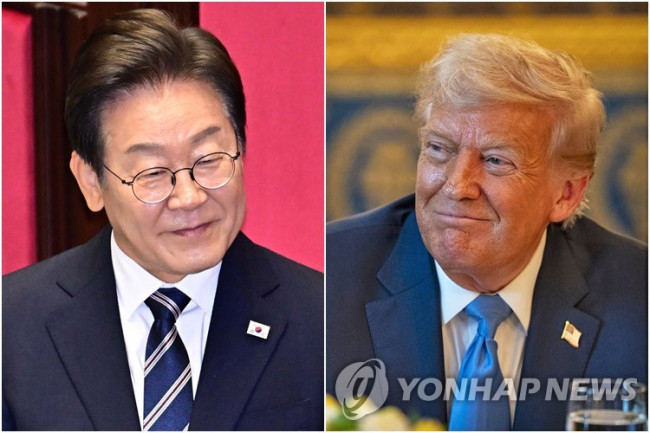 President Lee Jae-myung (left) and US President Trump [EPA=Yonhap News Agency and Yonhap News Agency Data Photo. Redistribution and DB prohibited.]
Meanwhile, amidst the Trump administration's expectations for Korea's role in achieving its nuclear power expansion goals, there is speculation that nuclear cooperation measures could be on the agenda at the summit between President Lee Jae-myung and President Trump on the 25th.
As part of the tariff negotiation resolution process, the two countries agreed to establish an investment support package worth $200 billion, including the nuclear power sector. Consequently, it is speculated that discussions to materialize nuclear cooperation could naturally occur during discussions on cooperation in the power industry, including semiconductors, secondary batteries, and shipbuilding.
The industry also speculates that the decision for President Hwang Joo-ho to depart for the US on the 23rd, prior to the presidential visit, might be related to government-level nuclear cooperation discussions. President Hwang is reportedly pursuing a meeting with a senior official from Westinghouse during his visit to the US.
Similarly, Kim Dong-cheol, president of Korea Electric Power Corporation (KEPCO), who is responsible for South Korea's nuclear power export projects alongside KHNP, is scheduled to depart on the 21st, coinciding with the presidential visit, and plans to hold separate meetings with senior Westinghouse officials.
While KHNP is currently leading discussions for the establishment of a joint venture with Westinghouse, it is speculated that KEPCO could also participate in the discussions as they approach a resolution. According to existing internal discussions between KEPCO and KHNP, the US is considered a target region for KEPCO's nuclear power projects.
An official from the Ministry of Trade, Industry and Energy stated, "The discussions between KHNP and Westinghouse are discussions between companies, and nothing that would lead to specific agreements at the summit has been prepared. However, it is true that we are preparing for various discussion topics that may arise depending on the US's interests." Yonhap News Agency

 Iranian Foreign Ministry: "Continuing Message Exchanges with the U.S. and Activities of Mediating Countries"
Esmaeil Baghaei, Spokesperson for the Iranian Ministry of Foreign Affairs [Xinhua, Yonhap News file photo]Esmaeil Baghaei, spokesperson for the Iranian Ministry of Foreign Affairs, stated on the 26th
Iranian Foreign Ministry: "Continuing Message Exchanges with the U.S. and Activities of Mediating Countries"
Esmaeil Baghaei, Spokesperson for the Iranian Ministry of Foreign Affairs [Xinhua, Yonhap News file photo]Esmaeil Baghaei, spokesperson for the Iranian Ministry of Foreign Affairs, stated on the 26th
 President Yoon: "Do You Think You Are Safe from the Special Counsel?"... Final Statement Video Released
President Yoon Suk Yeol rebuking the special prosecutor on the 24th. [Court video / @birds_justice X account subtitle GIF] A video of President Yoon Suk Yeol's closing statement at his trial rega
President Yoon: "Do You Think You Are Safe from the Special Counsel?"... Final Statement Video Released
President Yoon Suk Yeol rebuking the special prosecutor on the 24th. [Court video / @birds_justice X account subtitle GIF] A video of President Yoon Suk Yeol's closing statement at his trial rega
 President Yoon, regarding the first-instance ruling on the Public Official Election Act: “An excessive political verdict that distorts the facts… We will appeal immediately.”
The first-instance sentencing hearing for President Yoon Suk Yeol regarding violations of the Public Official Election Act is being broadcast live at Seoul Station on the 27th. [Photo=Yonhap News]Pres
President Yoon, regarding the first-instance ruling on the Public Official Election Act: “An excessive political verdict that distorts the facts… We will appeal immediately.”
The first-instance sentencing hearing for President Yoon Suk Yeol regarding violations of the Public Official Election Act is being broadcast live at Seoul Station on the 27th. [Photo=Yonhap News]Pres
 WSJ: "SK Hynix ADR Premium Is a Sign of AI Trading Overheat"
Advertisement for SK Hynix ADR listing in New York's Times Square [Reuters=Yonhap News file photo]The Wall Street Journal (WSJ) has pointed out that the price of SK Hynix’s American Depositary Recei
WSJ: "SK Hynix ADR Premium Is a Sign of AI Trading Overheat"
Advertisement for SK Hynix ADR listing in New York's Times Square [Reuters=Yonhap News file photo]The Wall Street Journal (WSJ) has pointed out that the price of SK Hynix’s American Depositary Recei
 'Godfather of Japanese Mystery Novels' Keigo Higashino Passes Away After Battle with Cancer at 68
Famous Japanese mystery novelist Keigo Higashino [AFP=Yonhap News]It has been belatedly reported that Keigo Higashino, the "godfather of Japanese mystery novels" and author of bestsellers such as "The
'Godfather of Japanese Mystery Novels' Keigo Higashino Passes Away After Battle with Cancer at 68
Famous Japanese mystery novelist Keigo Higashino [AFP=Yonhap News]It has been belatedly reported that Keigo Higashino, the "godfather of Japanese mystery novels" and author of bestsellers such as "The
 [Park Pil-kyu Security Column] To the Ignorant Trying to Clothe a Beast in Sheep's Clothing
Rep. Kim Byung-joo of the Democratic Party of Korea [Photo=Yonhap News]“The Air Force Academy doesn't teach you how to fly a plane!” “The Army, Navy, and Air Force academies are exactly the
[Park Pil-kyu Security Column] To the Ignorant Trying to Clothe a Beast in Sheep's Clothing
Rep. Kim Byung-joo of the Democratic Party of Korea [Photo=Yonhap News]“The Air Force Academy doesn't teach you how to fly a plane!” “The Army, Navy, and Air Force academies are exactly the
 [Issue Diagnosis] Two Effects of the Election Petition Review
 [Photo] Evidence of Election Fraud Flooding U.S. Media… Trump Had 2.7 Million Votes Stolen
 [Video] U.S. Semiquincentennial Air Show... 'Art in the Sky' streaks across New York
 [Editorial Cartoon] A Draconian Law That Undermines Freedom of Expression

 List
List









