Business Community Expresses Strong Regret Over Passage of "Yellow Envelope Bill"..."Companies Will Leave Korea"
Six Economic Organizations Call for "Follow-up Legislation"..."We Face Legal Disputes with All Subcontractors"
Significant Impact on Auto, Shipbuilding, and Construction Sectors...Concerns Over Exodus of Domestic and Foreign Investors
 The 'Yellow Envelope Bill' Passes the National Assembly Plenary Session Under the Ruling Party's Lead [Yonhap News Photo]
The business community on the 24th expressed strong regret over the passage of the amendments to Articles 2 and 3 of the Labor Union and Labor Relations Adjustment Act, known as the "Yellow Envelope Bill," through the National Assembly's plenary session, led by the Democratic Party of Korea.
The business community stated that the Yellow Envelope Bill would severely impact corporate management and Korea's industrial competitiveness, urging immediate revisions through follow-up legislation.
Individual companies also expressed dismay over the bill's passage despite multiple requests for reconsideration and voiced concerns about an "exodus" of domestic and foreign investors.
The six economic organizations, including the Korea Employers Federation, the Korea Chamber of Commerce and Industry, the Korea Economic Federation, the Korea International Trade Association, the Korea Federation of Small and Medium Business, and the Korea Association of Manufacturing Companies, distributed a joint statement immediately after the bill's passage in the National Assembly, stating, "We express our regret over the passage of the Yellow Envelope Bill, which expands the scope of employers and the definition of labor disputes, and limits liability for damages in cases of illegal disputes."
They further warned, "While the scope of employers and the definition of labor disputes have been expanded by the bill's passage, it remains unclear who qualifies as an employer under the law and the extent of management decisions that constitute labor disputes. This will inevitably lead to legal disputes between labor and management in the future."
The six economic organizations urged that complementary legislation must follow to minimize the repercussions of the Yellow Envelope Bill.
These organizations emphasized, "The National Assembly needs to clarify the scope of employers and the definition of labor disputes through follow-up legislation to minimize confusion in industrial sites," and added, "The government should also diligently prepare complementary measures through close communication with the business community during the grace period."
They further requested, "We hope that the balance in labor-management relations will be achieved by legislating the employer's right to defense, which is guaranteed in major developed countries, such as allowing substitute workers, in accordance with global standards."
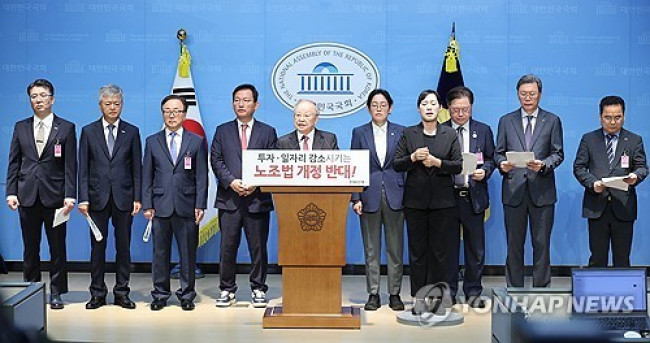 Economic Organizations Oppose the Yellow Envelope Bill [Yonhap News Photo]
Individual companies also appealed that the Yellow Envelope Bill would lead to a contraction of corporate management activities and a decline in domestic business competitiveness.
Companies expressed their greatest concern that the expansion of the labor dispute definition would encompass management judgments such as investment decisions, business relocation, and restructuring, thus infringing upon the essential aspects of management rights.
An executive from a major conglomerate stated, "It is rare for management decisions not to affect working conditions, so in effect, all areas have become subject to dispute activities. This restricts the inherent rights of employers guaranteed by the Constitution."
Concerns were also raised that the Yellow Envelope Bill would severely impact Korea's leading industries, such as automobiles, shipbuilding, and steel.
These companies explained that due to the involvement of hundreds of subcontractors in their manufacturing processes, they would face legal disputes with all subcontractors involved in the manufacturing process, and with damage claims for illegal acts by unions being limited, the companies would have to bear the full cost.
An official from an economic organization said, "In industries structured with multi-tiered collaboration systems like automobiles, shipbuilding, and construction, the passage of the Yellow Envelope Bill will lead to constant dispute activities against main contractors, causing the industrial ecosystem to collapse." He added, "If companies cannot accept union demands, they will inevitably end up in court, making it difficult for them to focus on business management due to labor-management conflicts."
Another executive from a major construction company commented, "Even now, the two major labor unions frequently clash over control of the sites. With the Yellow Envelope Bill in effect, on-site labor-management conflicts are expected to intensify, and disputes are likely to become prolonged. We are seriously concerned about the cascading negative effects such as delays in project timelines and increased construction costs."
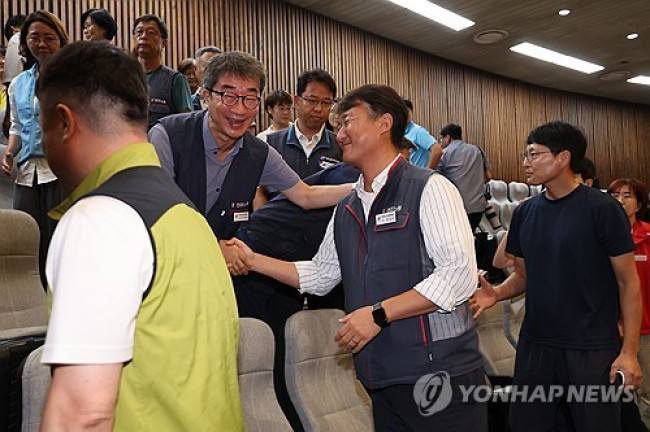 Unions Celebrate the Passage of the Yellow Envelope Bill [Yonhap News Photo]
Forecasts also emerged regarding an "exodus" of foreign investors due to the passage of the Yellow Envelope Bill.
Global companies consider stability in corporate management as a key investment condition, and concerns were raised that the Yellow Envelope Bill would undermine this, reducing Korea's attractiveness for investment.
The U.S. Chamber of Commerce recently pointed out, "The Yellow Envelope Bill could lead to excessive burden transfer onto prime contractors and an increase in legal uncertainty."
GM Korea, one of Korea's largest foreign-invested companies, reportedly requested reconsideration of the bill during a meeting organized by the Ministry of Employment and Labor to hear opinions from the business community on the Yellow Envelope Bill, stating, "There may be a re-evaluation of the business site by headquarters."
A representative from the business community said, "The most frightening aspect is that companies will quietly leave Korea. In the future, if cases of worsening corporate performance emerge following the passage of the Yellow Envelope Bill, foreign and domestic companies will have no choice but to prepare countermeasures to reduce uncertainty."
He added, "Korea, with its high labor union risks, will be gradually excluded from supply chains."
Companies also requested that the six-month grace period be extended to at least one year, given that the bill has already passed.
An executive from a major conglomerate stated, "The Yellow Envelope Bill's impact is by no means small compared to past labor-related legislation. To minimize social disruption, it should be implemented after a sufficient preparation period of at least one year." (Yonhap News)

 Iranian Foreign Ministry: "Continuing Message Exchanges with the U.S. and Activities of Mediating Countries"
Esmaeil Baghaei, Spokesperson for the Iranian Ministry of Foreign Affairs [Xinhua, Yonhap News file photo]Esmaeil Baghaei, spokesperson for the Iranian Ministry of Foreign Affairs, stated on the 26th
Iranian Foreign Ministry: "Continuing Message Exchanges with the U.S. and Activities of Mediating Countries"
Esmaeil Baghaei, Spokesperson for the Iranian Ministry of Foreign Affairs [Xinhua, Yonhap News file photo]Esmaeil Baghaei, spokesperson for the Iranian Ministry of Foreign Affairs, stated on the 26th
 President Yoon: "Do You Think You Are Safe from the Special Counsel?"... Final Statement Video Released
President Yoon Suk Yeol rebuking the special prosecutor on the 24th. [Court video / @birds_justice X account subtitle GIF] A video of President Yoon Suk Yeol's closing statement at his trial rega
President Yoon: "Do You Think You Are Safe from the Special Counsel?"... Final Statement Video Released
President Yoon Suk Yeol rebuking the special prosecutor on the 24th. [Court video / @birds_justice X account subtitle GIF] A video of President Yoon Suk Yeol's closing statement at his trial rega
 President Yoon, regarding the first-instance ruling on the Public Official Election Act: “An excessive political verdict that distorts the facts… We will appeal immediately.”
The first-instance sentencing hearing for President Yoon Suk Yeol regarding violations of the Public Official Election Act is being broadcast live at Seoul Station on the 27th. [Photo=Yonhap News]Pres
President Yoon, regarding the first-instance ruling on the Public Official Election Act: “An excessive political verdict that distorts the facts… We will appeal immediately.”
The first-instance sentencing hearing for President Yoon Suk Yeol regarding violations of the Public Official Election Act is being broadcast live at Seoul Station on the 27th. [Photo=Yonhap News]Pres
 WSJ: "SK Hynix ADR Premium Is a Sign of AI Trading Overheat"
Advertisement for SK Hynix ADR listing in New York's Times Square [Reuters=Yonhap News file photo]The Wall Street Journal (WSJ) has pointed out that the price of SK Hynix’s American Depositary Recei
WSJ: "SK Hynix ADR Premium Is a Sign of AI Trading Overheat"
Advertisement for SK Hynix ADR listing in New York's Times Square [Reuters=Yonhap News file photo]The Wall Street Journal (WSJ) has pointed out that the price of SK Hynix’s American Depositary Recei
 'Godfather of Japanese Mystery Novels' Keigo Higashino Passes Away After Battle with Cancer at 68
Famous Japanese mystery novelist Keigo Higashino [AFP=Yonhap News]It has been belatedly reported that Keigo Higashino, the "godfather of Japanese mystery novels" and author of bestsellers such as "The
'Godfather of Japanese Mystery Novels' Keigo Higashino Passes Away After Battle with Cancer at 68
Famous Japanese mystery novelist Keigo Higashino [AFP=Yonhap News]It has been belatedly reported that Keigo Higashino, the "godfather of Japanese mystery novels" and author of bestsellers such as "The
 [Park Pil-kyu Security Column] To the Ignorant Trying to Clothe a Beast in Sheep's Clothing
Rep. Kim Byung-joo of the Democratic Party of Korea [Photo=Yonhap News]“The Air Force Academy doesn't teach you how to fly a plane!” “The Army, Navy, and Air Force academies are exactly the
[Park Pil-kyu Security Column] To the Ignorant Trying to Clothe a Beast in Sheep's Clothing
Rep. Kim Byung-joo of the Democratic Party of Korea [Photo=Yonhap News]“The Air Force Academy doesn't teach you how to fly a plane!” “The Army, Navy, and Air Force academies are exactly the
 [Issue Diagnosis] Two Effects of the Election Petition Review
 [Photo] Evidence of Election Fraud Flooding U.S. Media… Trump Had 2.7 Million Votes Stolen
 [Video] U.S. Semiquincentennial Air Show... 'Art in the Sky' streaks across New York
 [Editorial Cartoon] A Draconian Law That Undermines Freedom of Expression

 List
List









