 Former Prime Minister Han Duck-soo, accused of aiding and abetting the former President Yoon Suk-yeol's rebellion, is seen leaving the Seoul Central District Court in Seocho-gu, Seoul, on the 27th, to be taken to the Seoul Detention Center after his pre-arrest warrant review (warrant examination). Yonhap News.
The special prosecutor's team, investigating the rebellion and foreign exchange case related to the 12.12 martial law situation, failed to secure former Prime Minister Han Duck-soo on the 27th, making further investigations targeting cabinet members inevitably challenging.
The special prosecutor's team applied six charges against former Prime Minister Han, including aiding and abetting the ringleader of the rebellion. They argued that as the "primary state organ" and the vice chairman of the State Council, he was responsible for failing to prevent former President Yoon Suk-yeol's illegal declaration of martial law, but the court did not accept this argument.
The court's reason for dismissing the warrant was that "there is room for dispute regarding the legal assessment of important factual relationships and the suspect's series of actions."
The key issue was whether former Prime Minister Han, as an accomplice aiding and abetting a serious crime like rebellion, qualified as a co-conspirator.
Accomplices include instigators and abettors, and more broadly, joint principals.
In the case of former Prime Minister Han, who acted as an accessory by abetting the crime, the core question was whether he supported or assisted the principal, former President Yoon, in carrying out his illegal actions. To determine this, it was crucial to ascertain whether he engaged in supporting/assisting acts (objective requirement) and whether he had the intention to do so (subjective requirement).
In other words, both the act of supporting/assisting the illegal martial law and the intent to support/assist it must be present.
The court appears to have given more weight to former Prime Minister Han's explanation that his actions were not in support of the illegal martial law but were measures to dissuade it, rather than the special prosecutor's team's assertion that his various actions supported former President Yoon's illegal conduct and that he acted with the intent to assist (help) while knowing it was illegal.
The court summarized this as "room for dispute regarding the legal assessment."
Furthermore, it seems the court also considered that he could not be seen as a co-conspirator deeply involved in planning the martial law and carrying out subsequent measures, unlike former Defense Minister Kim Yong-hyun, who planned the martial law, or former Minister of the Interior and Safety Lee Sang-min, who actively implemented follow-up measures. This interpretation suggests that the court differentiated the qualitative assessment from the other two individuals, concluding that former Prime Minister Han, as a person of "real power," could not be seen as actively conspiring.
The special prosecutor's team's view is entirely different.
They argued that former Prime Minister Han actively abetted the martial law by proposing the convening of the State Council to provide a veneer of legality to former President Yoon's martial law declaration and by selectively contacting some ministers.
The special prosecutor's team's perspective was that the Prime Minister has a duty to check the President's abuse of power, citing the point made by former Minister of Legislation Yoo Jin-oh, who drafted the initial constitution, that "the Prime Minister was appointed with parliamentary approval to prevent the President's sole dictatorship."
However, the court seems to have concluded that there was insufficient evidence to suggest that former Prime Minister Han had the intention to abet rebellion through his actions.
Questions have also been raised within legal circles about whether the Prime Minister possesses sufficient authority to prevent the President from declaring martial law, and to what extent he should have dissuaded the declaration.
As a result, with the rejection of the arrest warrant for former Prime Minister Han, there is a possibility that criticisms will arise suggesting that the special prosecutor's team interpreted the Prime Minister's duty to check the President, which is not explicitly stipulated in the Constitution, too broadly.
However, from the special prosecutor's team's standpoint, they decided it was necessary to seek an arrest warrant and have it judged by the court despite these limitations, and it is therefore expected that they will further meticulously review the reasons for the warrant's dismissal.
A presiding judge at the Central District Court stated, "It was an unreasonable application of charges to consider the Prime Minister's suggestion to convene the State Council as aiding and abetting rebellion," adding, "The logic was that it would be a problem whether the Prime Minister suggested convening the State Council or not."
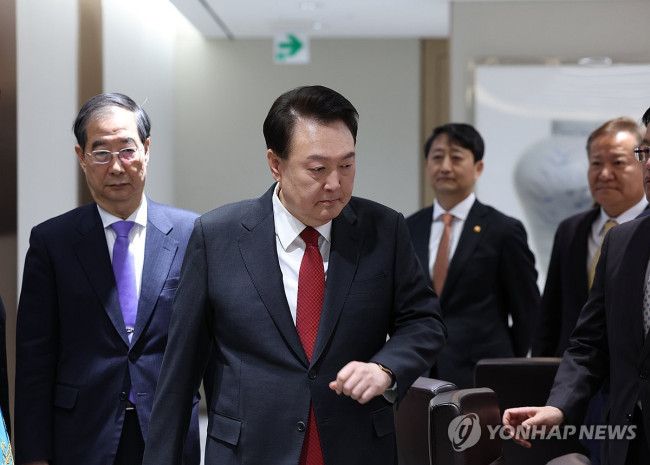 President Yoon Suk-yeol enters a State Council meeting held at the Yongsan Presidential Office building in Seoul on the 19th. Yonhap News.
With the failure to secure former Prime Minister Han, who bears relatively heavy responsibility as the "nation's second-in-command," the special prosecutor's team is expected to face increased deliberation in applying charges of rebellion and abetting rebellion to the remaining cabinet members.
This is the first time the court has made a judgment on the charge of abetting rebellion for a cabinet member. Previously, former Defense Minister Kim Yong-hyun and former Minister of the Interior and Safety Lee Sang-min were charged with carrying out important duties related to martial law.
If the arrest warrant for former Prime Minister Han had been issued on charges of abetting rebellion, the investigation could have expanded to include other cabinet members who attended the State Council meeting before the martial law declaration, applying charges of abetting rebellion to them as well.
The day after requesting the arrest warrant for former Prime Minister Han, the special prosecutor's team initiated compulsory investigation by applying charges of carrying out important duties related to rebellion to former Minister of Justice Park Sung-jae.
Former National Intelligence Service Director Cho Tae-yong was booked on charges of dereliction of duty, and former Deputy Prime Minister for Economy and Minister of Economy and Finance Choi Sang-mok is also under investigation for suspicions of receiving a note regarding an emergency legislative body during the martial law period.
However, with the rejection of the arrest warrant for former Prime Minister Han, it is anticipated that further corroboration will be required for the charges against other cabinet members.
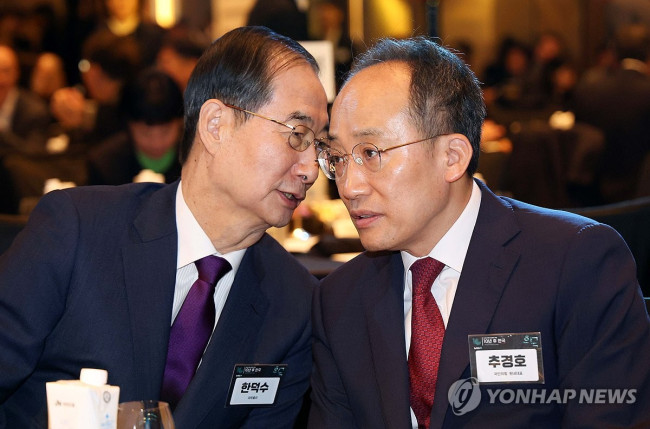 Prime Minister Han Duck-soo (left) and People Power Party Floor Leader Choo Kyung-ho are seen conversing at the "2024 Newsis Forum: Korea in 10 Years" held at the Four Seasons Hotel in Gwanghwamun, Seoul, on the 24th. Yonhap News.
This is also expected to affect the investigation into allegations of obstruction of the National Assembly's resolution to lift martial law, involving People Power Party lawmaker Choo Kyung-ho and others.
The special prosecutor's team suspects the possibility of discussing the ruling party's role during the martial law period, citing the fact that former Prime Minister Han and then-Floor Leader Choo had a phone conversation for about seven minutes shortly after the martial law declaration.
Choo had changed the venue for the party's general meetings multiple times between the National Assembly and the party headquarters, leading to suspicions that this was to prevent lawmakers from participating in the vote to lift martial law at the request of former President Yoon. However, Choo maintains that he called former Prime Minister Han first to understand the situation and did not discuss matters related to the National Assembly.
While there were expectations that the special prosecutor's team would soon proceed with searches and summons investigations following the completion of the People Power Party's national convention, it is now anticipated that this may be somewhat delayed due to the failure to secure former Prime Minister Han.
Yonhap News

 Iranian Foreign Ministry: "Continuing Message Exchanges with the U.S. and Activities of Mediating Countries"
Esmaeil Baghaei, Spokesperson for the Iranian Ministry of Foreign Affairs [Xinhua, Yonhap News file photo]Esmaeil Baghaei, spokesperson for the Iranian Ministry of Foreign Affairs, stated on the 26th
Iranian Foreign Ministry: "Continuing Message Exchanges with the U.S. and Activities of Mediating Countries"
Esmaeil Baghaei, Spokesperson for the Iranian Ministry of Foreign Affairs [Xinhua, Yonhap News file photo]Esmaeil Baghaei, spokesperson for the Iranian Ministry of Foreign Affairs, stated on the 26th
 President Yoon: "Do You Think You Are Safe from the Special Counsel?"... Final Statement Video Released
President Yoon Suk Yeol rebuking the special prosecutor on the 24th. [Court video / @birds_justice X account subtitle GIF] A video of President Yoon Suk Yeol's closing statement at his trial rega
President Yoon: "Do You Think You Are Safe from the Special Counsel?"... Final Statement Video Released
President Yoon Suk Yeol rebuking the special prosecutor on the 24th. [Court video / @birds_justice X account subtitle GIF] A video of President Yoon Suk Yeol's closing statement at his trial rega
 President Yoon, regarding the first-instance ruling on the Public Official Election Act: “An excessive political verdict that distorts the facts… We will appeal immediately.”
The first-instance sentencing hearing for President Yoon Suk Yeol regarding violations of the Public Official Election Act is being broadcast live at Seoul Station on the 27th. [Photo=Yonhap News]Pres
President Yoon, regarding the first-instance ruling on the Public Official Election Act: “An excessive political verdict that distorts the facts… We will appeal immediately.”
The first-instance sentencing hearing for President Yoon Suk Yeol regarding violations of the Public Official Election Act is being broadcast live at Seoul Station on the 27th. [Photo=Yonhap News]Pres
 WSJ: "SK Hynix ADR Premium Is a Sign of AI Trading Overheat"
Advertisement for SK Hynix ADR listing in New York's Times Square [Reuters=Yonhap News file photo]The Wall Street Journal (WSJ) has pointed out that the price of SK Hynix’s American Depositary Recei
WSJ: "SK Hynix ADR Premium Is a Sign of AI Trading Overheat"
Advertisement for SK Hynix ADR listing in New York's Times Square [Reuters=Yonhap News file photo]The Wall Street Journal (WSJ) has pointed out that the price of SK Hynix’s American Depositary Recei
 'Godfather of Japanese Mystery Novels' Keigo Higashino Passes Away After Battle with Cancer at 68
Famous Japanese mystery novelist Keigo Higashino [AFP=Yonhap News]It has been belatedly reported that Keigo Higashino, the "godfather of Japanese mystery novels" and author of bestsellers such as "The
'Godfather of Japanese Mystery Novels' Keigo Higashino Passes Away After Battle with Cancer at 68
Famous Japanese mystery novelist Keigo Higashino [AFP=Yonhap News]It has been belatedly reported that Keigo Higashino, the "godfather of Japanese mystery novels" and author of bestsellers such as "The
 [Park Pil-kyu Security Column] To the Ignorant Trying to Clothe a Beast in Sheep's Clothing
Rep. Kim Byung-joo of the Democratic Party of Korea [Photo=Yonhap News]“The Air Force Academy doesn't teach you how to fly a plane!” “The Army, Navy, and Air Force academies are exactly the
[Park Pil-kyu Security Column] To the Ignorant Trying to Clothe a Beast in Sheep's Clothing
Rep. Kim Byung-joo of the Democratic Party of Korea [Photo=Yonhap News]“The Air Force Academy doesn't teach you how to fly a plane!” “The Army, Navy, and Air Force academies are exactly the
 [Issue Diagnosis] Two Effects of the Election Petition Review
 [Photo] Evidence of Election Fraud Flooding U.S. Media… Trump Had 2.7 Million Votes Stolen
 [Video] U.S. Semiquincentennial Air Show... 'Art in the Sky' streaks across New York
 [Editorial Cartoon] A Draconian Law That Undermines Freedom of Expression

 List
List










