TV Broadcasting & Internet News Maintain Strong Influence on Public Opinion... Combined Share 84.6%
Social Media Shows Growth Trend... Printed Newspapers & Radio at Lowest Levels
'2022-2024 Public Opinion Concentration Survey'... "Top Influential Media Must Enhance Public Duty"
 Trend of Weighted Values (Share) of Public Opinion Influence by Media Sector (2021-2024) [Provided by the Ministry of Culture, Sports and Tourism. Reproduction and database prohibited]
Television broadcasting and internet news continue to demonstrate powerful influence on public opinion in the media market.
According to the results of the '2022-2024 Public Opinion Concentration Survey' released on the 29th by the Public Opinion Concentration Survey Committee of the Ministry of Culture, Sports and Tourism, the weighted values (shares) of public opinion influence by media sector last year were analyzed as: television broadcasting 45.3%, internet news 39.3%, social media 8.4%, printed newspapers 4.5%, and radio broadcasting 3.0%.
The weighted value of public opinion influence is a statistical figure calculated annually through the 'Media Users Survey' conducted by the Korea Press Foundation, indicating the relative size of influence each medium holds in the public opinion formation process.
While television broadcasting and internet news saw a slight decrease compared to the previous '2019-2021 Public Opinion Concentration Survey', their combined weighted value reached 84.6%, indicating their continued strong influence on public opinion.
The Public Opinion Concentration Survey Committee analyzed, "Both television broadcasting and internet news have consistently maintained the highest influence on public opinion," adding that "they continue to function as core media sectors for public opinion formation."
Social media, though still having a marginal influence, shows a notable growth trend. The weighted value of social media's influence on public opinion, which was only 5.5% in the previous survey, rose to 8.4% in 2024, strengthening its presence as a channel for news and current affairs information distribution. The committee attributed this to the emergence of YouTube and Facebook as primary news consumption paths.
The influence of printed newspapers and radio broadcasting saw a slight increase compared to the previous survey but remained at the lowest levels. The committee assessed that these media are perceived as relatively less important in the public opinion formation process compared to other sectors.
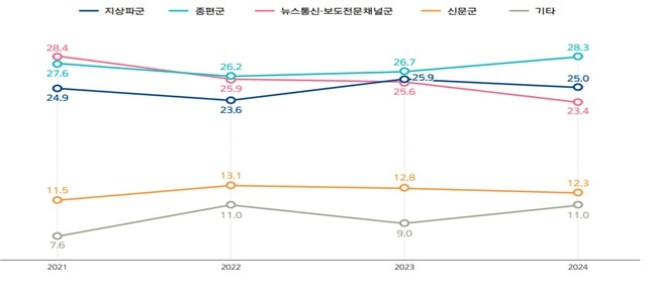 Trend of Combined Public Opinion Influence Share by Media Group (2021-2024) [Provided by the Ministry of Culture, Sports and Tourism. Reproduction and database prohibited]
In terms of influence share by media group, which aggregates various media outlets that are technically and institutionally similar to understand their influence on public opinion, general programming channels (종편) showed the highest influence.
The survey results were: general programming channels 28.3%, terrestrial broadcasters 25.0%, news agencies/specialized news channels 23.4%, and newspapers 12.3%.
The committee analyzed that the influence of general programming channels, which comprehensively own and operate various media such as printed newspapers, television broadcasting, and internet news, has increased.
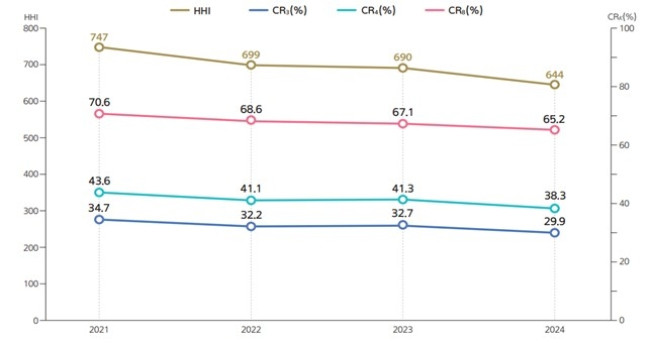 Trend of Combined Public Opinion Influence Concentration (2021-2024) [Provided by the Ministry of Culture, Sports and Tourism. Reproduction and database prohibited]
Furthermore, the Herfindahl-Hirschman Index (HHI), calculated as an indicator of public opinion influence concentration, recorded 644 last year, a decrease from 747 in 2021, showing a trend of easing concentration of influence. A higher concentration of public opinion influence indicates that influence is concentrated among a small number of specific media companies.
This survey calculated the utilization share and concentration of news, current affairs, and reporting across five major media sectors: printed newspapers, television broadcasting, radio broadcasting, internet news, and social media, and based on this, it computed the combined public opinion influence concentration.
The Survey Committee stated, "There is a need to enhance the public duty and transparency of top media companies where public opinion influence is concentrated, and institutional support is required for the quality improvement of new media companies and to enhance public accessibility."

 Iranian Foreign Ministry: "Continuing Message Exchanges with the U.S. and Activities of Mediating Countries"
Esmaeil Baghaei, Spokesperson for the Iranian Ministry of Foreign Affairs [Xinhua, Yonhap News file photo]Esmaeil Baghaei, spokesperson for the Iranian Ministry of Foreign Affairs, stated on the 26th
Iranian Foreign Ministry: "Continuing Message Exchanges with the U.S. and Activities of Mediating Countries"
Esmaeil Baghaei, Spokesperson for the Iranian Ministry of Foreign Affairs [Xinhua, Yonhap News file photo]Esmaeil Baghaei, spokesperson for the Iranian Ministry of Foreign Affairs, stated on the 26th
 President Yoon: "Do You Think You Are Safe from the Special Counsel?"... Final Statement Video Released
President Yoon Suk Yeol rebuking the special prosecutor on the 24th. [Court video / @birds_justice X account subtitle GIF] A video of President Yoon Suk Yeol's closing statement at his trial rega
President Yoon: "Do You Think You Are Safe from the Special Counsel?"... Final Statement Video Released
President Yoon Suk Yeol rebuking the special prosecutor on the 24th. [Court video / @birds_justice X account subtitle GIF] A video of President Yoon Suk Yeol's closing statement at his trial rega
 President Yoon, regarding the first-instance ruling on the Public Official Election Act: “An excessive political verdict that distorts the facts… We will appeal immediately.”
The first-instance sentencing hearing for President Yoon Suk Yeol regarding violations of the Public Official Election Act is being broadcast live at Seoul Station on the 27th. [Photo=Yonhap News]Pres
President Yoon, regarding the first-instance ruling on the Public Official Election Act: “An excessive political verdict that distorts the facts… We will appeal immediately.”
The first-instance sentencing hearing for President Yoon Suk Yeol regarding violations of the Public Official Election Act is being broadcast live at Seoul Station on the 27th. [Photo=Yonhap News]Pres
 WSJ: "SK Hynix ADR Premium Is a Sign of AI Trading Overheat"
Advertisement for SK Hynix ADR listing in New York's Times Square [Reuters=Yonhap News file photo]The Wall Street Journal (WSJ) has pointed out that the price of SK Hynix’s American Depositary Recei
WSJ: "SK Hynix ADR Premium Is a Sign of AI Trading Overheat"
Advertisement for SK Hynix ADR listing in New York's Times Square [Reuters=Yonhap News file photo]The Wall Street Journal (WSJ) has pointed out that the price of SK Hynix’s American Depositary Recei
 'Godfather of Japanese Mystery Novels' Keigo Higashino Passes Away After Battle with Cancer at 68
Famous Japanese mystery novelist Keigo Higashino [AFP=Yonhap News]It has been belatedly reported that Keigo Higashino, the "godfather of Japanese mystery novels" and author of bestsellers such as "The
'Godfather of Japanese Mystery Novels' Keigo Higashino Passes Away After Battle with Cancer at 68
Famous Japanese mystery novelist Keigo Higashino [AFP=Yonhap News]It has been belatedly reported that Keigo Higashino, the "godfather of Japanese mystery novels" and author of bestsellers such as "The
 [Park Pil-kyu Security Column] To the Ignorant Trying to Clothe a Beast in Sheep's Clothing
Rep. Kim Byung-joo of the Democratic Party of Korea [Photo=Yonhap News]“The Air Force Academy doesn't teach you how to fly a plane!” “The Army, Navy, and Air Force academies are exactly the
[Park Pil-kyu Security Column] To the Ignorant Trying to Clothe a Beast in Sheep's Clothing
Rep. Kim Byung-joo of the Democratic Party of Korea [Photo=Yonhap News]“The Air Force Academy doesn't teach you how to fly a plane!” “The Army, Navy, and Air Force academies are exactly the
 [Issue Diagnosis] Two Effects of the Election Petition Review
 [Photo] Evidence of Election Fraud Flooding U.S. Media… Trump Had 2.7 Million Votes Stolen
 [Video] U.S. Semiquincentennial Air Show... 'Art in the Sky' streaks across New York
 [Editorial Cartoon] A Draconian Law That Undermines Freedom of Expression

 List
List









