Unfinished Tariff Negotiations... Will the U.S. Continue to Use 'Automobiles as Hostages' for Pressure?
Diverging Views on Implementing the $350 Billion Investment Package... Apples and the Online Platform Law Also 'Hidden Pitfalls'
"South Korea, Japan, and the EU Enter a New Competition to Secure Automotive Tariff Exemptions First"
 President Lee Jae-myung shaking hands in President Trump's office (Washington=Yonhap News) Reporter Han Sang-gyun = President Lee Jae-myung smiles while shaking hands with U.S. President Donald Trump after a Korea-U.S. summit held at the White House Oval Office in Washington D.C. on the 25th (local time). 2025.8.26 [Joint Press Corps]
xyz@yna.co.kr
(End)
The South Korea-U.S. summit on the 25th (local time) is being assessed as having established a foundation for trade stabilization, as both leaders approved the broad framework of the tariff negotiation deal and agreed to move forward with discussions on the specifics.
However, there remains a gap in perception between the two countries regarding the roadmap for the total $350 billion (approximately 486 trillion won) investment package for the U.S., which is the key issue.
It is understood that the U.S. position is that South Korea must first fulfill its commitments before the U.S. can proceed with reducing automotive tariffs, leading to observations that U.S. trade pressure on Korea, with automobiles as a lever, may persist for a considerable time.
◇ No Promised Date for U.S. Auto Tariff Cuts... Continued Burden on Exports to the U.S.
Previously, South Korea secured promises for tariff reductions by offering a $350 billion investment package—comprising a $150 billion investment dedicated to the shipbuilding industry and a $200 billion general-purpose investment package that can be used flexibly across various strategic industries—along with a $100 billion energy purchase plan.
According to government and trade sources on the 31st, the tariff cuts promised by the U.S. to South Korea broadly fall into three categories: 'reciprocal tariffs' on South Korea, automotive tariffs, and expected future tariffs on semiconductors and pharmaceuticals.
First, immediately after the tariff deal was reached, the U.S. lowered the reciprocal tariff on South Korea from the initially announced 25% to 15%, effective as of August.
Reciprocal tariffs apply to general goods excluding steel, automobiles, and items like semiconductors and IT products for which specific tariffs are already imposed or planned.
Additionally, the U.S. agreed to lower the 25% automotive tariff, which has been applied to all countries since April, to 15%.
However, the U.S. has never clarified when it will begin reducing tariffs on South Korean automobiles.
Although the U.S. stated it would provide 'most-favored-nation treatment' for semiconductors and pharmaceuticals, it has not provided a written commitment to apply the 'maximum 15%' rate recently finalized for the European Union (EU) to South Korea.
Consequently, even though a month has passed since the tariff negotiations were concluded on July 30, high tariffs of 25% are still being applied to South Korean automobiles exported to the U.S.
This situation is not unique to South Korea. While the U.S. agreed to lower automotive tariffs to 15% for the EU and Japan as well, it has not provided a concrete implementation plan for them either.
The activation of these tariff barriers is significantly impacting South Korea's automobile exports to the U.S.
According to the Korea International Trade Association, automobile exports to the U.S. from January to July this year totaled $18.2 billion, a 15.1% decrease compared to the same period last year.
In the international community, analysis suggests that the U.S. government is continuing to use automotive tariffs as a lever to pressure its partners even after tariff deals are reached.
Indeed, when the U.S. announced its first trade agreement with the EU in a joint statement, it explicitly stated that it would reduce automotive tariffs only after the other side took prior measures.
In response, the EU announced legislative plans on the 28th (local time) to fully abolish tariffs on U.S. industrial goods and increase Tariff-Rate Quota (TRQ) volumes for U.S. seafood and non-sensitive agricultural products to grant preferential market access, thereby rushing follow-up measures to actually receive the promised automotive tariff cuts.
However, it is unclear whether the U.S. will immediately reciprocate such measures from the EU.
Therefore, concerns are raised that the U.S. may seek to use automotive tariffs as a lever against South Korea as well to resolve issues related to the implementation of the investment package and non-tariff barriers, such as in the agricultural sector.
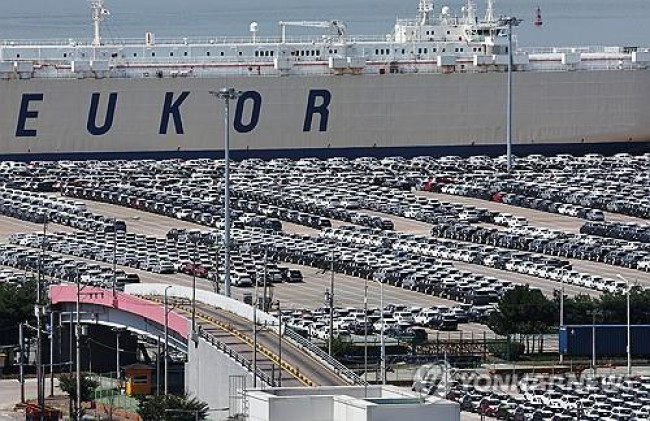 Cars waiting for export (Pyeongtaek=Yonhap News) Reporter Hong Ki-won = Export vehicles are lined up at Pyeongtaek Port in Gyeonggi Province on the 24th.
xanadu@yna.co.kr
(End)
◇ A Hurdle Cleared in U.S. Negotiations... A 'Mountain' of Difficulties Ranging from Investment Packages to Apples and Google Maps
It is reported that during the consultations leading up to this summit, South Korea and the U.S. exposed differences in opinion regarding issues such as the composition of the package, including the proportion of direct investment, investment decision-making, and the attribution of profits. There is also talk in diplomatic circles that this is why a joint statement was not released after the summit.
Furthermore, in the sensitive agricultural sector, there is a possibility that the U.S. will demand that South Korea take 'prior action' and call for the removal of 'non-tariff barriers'.
During the recent tariff negotiations, South Korea officially promised the U.S. to 'strengthen bilateral cooperation on fruit and vegetable import hygiene'.
The government emphasizes that rice and beef were excluded from this agreement and that there will be no additional opening of the agricultural market, as the quarantine system's existing framework remains unchanged.
However, if the process for quarantine of U.S. agricultural products, which had been effectively at a standstill, accelerates through this 'strengthened Korea-U.S. cooperation', it could lead to faster import schedules for U.S. fruits such as apples, pears, and peaches, effectively resulting in a de facto additional opening of the market for U.S. fruits and vegetables.
The U.S. is reportedly expressing strong dissatisfaction that the apple quarantine application, submitted in 1993, has remained in the second stage of 'initiating import risk analysis' out of eight stages for over 20 years, and is demanding that South Korea provide a concrete 'timetable'.
Beyond this, issues in the digital sector, such as the introduction of an online platform law and the request by Google and Apple for the export of high-precision map data, are highly volatile matters that the U.S. could link to the issue of automotive tariff reductions.
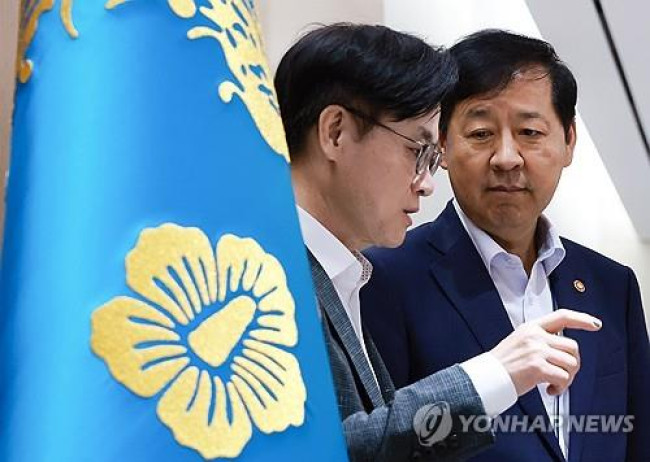 Deputy Prime Minister for Economy Koo Yun-cheol and Minister of Industry Kim Jung-gwan in discussion (Seoul=Yonhap News) Reporter Hong Hae-in = Deputy Prime Minister for Economy and Minister of Economy and Finance Koo Yun-cheol (right) and Minister of Trade, Industry and Energy Kim Jung-gwan attend and discuss at an extraordinary Cabinet meeting presided over by President Lee Jae-myung at the Yongsan Presidential Office in Seoul on the 29th. 2025.8.29
hihong@yna.co.kr
(End)
A trade authority official stated, "Externally, the U.S. has concluded tariff negotiations with major countries, but a situation has newly emerged where South Korea, the EU, and Japan are competing to see who gets their automotive tariffs exempted first," adding, "We are mindful of this situation and are continuing relevant discussions."
Deputy Prime Minister for Economy and Minister of Economy and Finance Koo Yun-cheol appeared on an SBS program on the 29th and, regarding 'when the 15% automotive tariff will be applied', said, "We are in the midst of working-level consultations to reduce them as quickly as possible," and added, "We will do our best to ensure they are reduced to 15% as originally planned."

 Trump pressures for rate cut again ahead of FOMC... "Should be the lowest in the world"
U.S. President Donald Trump. [Photo = The White House] U.S. President Donald Trump once again pressured the Federal Reserve, the U.S. central bank, to lower interest rates on the 27th (local time
Trump pressures for rate cut again ahead of FOMC... "Should be the lowest in the world"
U.S. President Donald Trump. [Photo = The White House] U.S. President Donald Trump once again pressured the Federal Reserve, the U.S. central bank, to lower interest rates on the 27th (local time
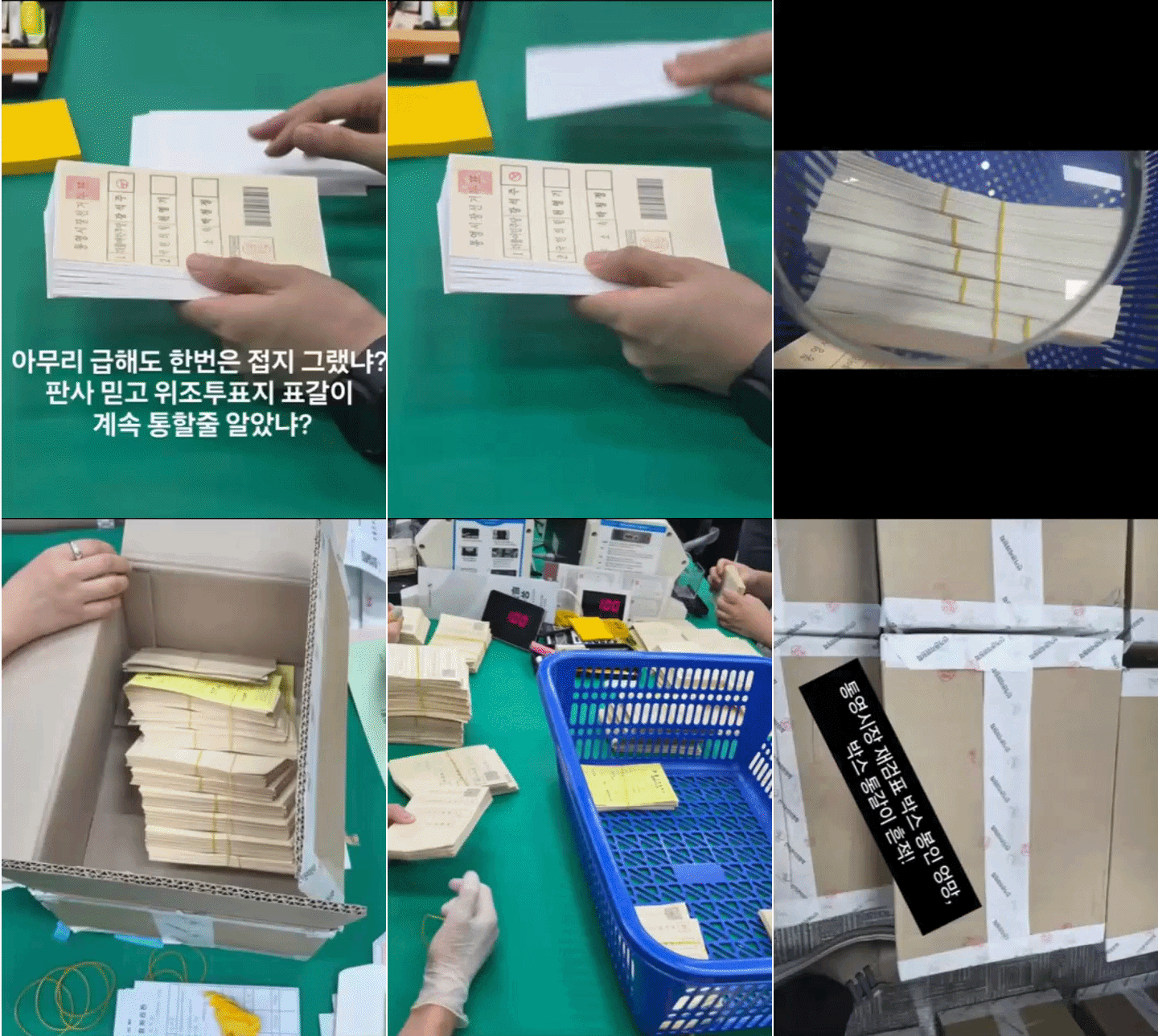 “Ignoring crisp ballots and damaged seals”… Tongyeong mayoral recount concludes with ‘no change in outcome,’ leaving suspicions and public outrage behind
Suspected counterfeit ballots discovered in Tongyeong [GIF from social media of Representative Hwang Kyo-ahn / Attorney Park Joo-hyun]During a recount of the Tongyeong mayoral election in South Gyeong
“Ignoring crisp ballots and damaged seals”… Tongyeong mayoral recount concludes with ‘no change in outcome,’ leaving suspicions and public outrage behind
Suspected counterfeit ballots discovered in Tongyeong [GIF from social media of Representative Hwang Kyo-ahn / Attorney Park Joo-hyun]During a recount of the Tongyeong mayoral election in South Gyeong
 President Yoon, regarding the first-instance ruling on the Public Official Election Act: “An excessive political verdict that distorts the facts… We will appeal immediately.”
The first-instance sentencing hearing for President Yoon Suk Yeol regarding violations of the Public Official Election Act is being broadcast live at Seoul Station on the 27th. [Photo=Yonhap News]Pres
President Yoon, regarding the first-instance ruling on the Public Official Election Act: “An excessive political verdict that distorts the facts… We will appeal immediately.”
The first-instance sentencing hearing for President Yoon Suk Yeol regarding violations of the Public Official Election Act is being broadcast live at Seoul Station on the 27th. [Photo=Yonhap News]Pres
 WSJ: "SK Hynix ADR Premium Is a Sign of AI Trading Overheat"
Advertisement for SK Hynix ADR listing in New York's Times Square [Reuters=Yonhap News file photo]The Wall Street Journal (WSJ) has pointed out that the price of SK Hynix’s American Depositary Recei
WSJ: "SK Hynix ADR Premium Is a Sign of AI Trading Overheat"
Advertisement for SK Hynix ADR listing in New York's Times Square [Reuters=Yonhap News file photo]The Wall Street Journal (WSJ) has pointed out that the price of SK Hynix’s American Depositary Recei
 'Godfather of Japanese Mystery Novels' Keigo Higashino Passes Away After Battle with Cancer at 68
Famous Japanese mystery novelist Keigo Higashino [AFP=Yonhap News]It has been belatedly reported that Keigo Higashino, the "godfather of Japanese mystery novels" and author of bestsellers such as "The
'Godfather of Japanese Mystery Novels' Keigo Higashino Passes Away After Battle with Cancer at 68
Famous Japanese mystery novelist Keigo Higashino [AFP=Yonhap News]It has been belatedly reported that Keigo Higashino, the "godfather of Japanese mystery novels" and author of bestsellers such as "The
 [Park Pil-kyu Security Column] To the Ignorant Trying to Clothe a Beast in Sheep's Clothing
Rep. Kim Byung-joo of the Democratic Party of Korea [Photo=Yonhap News]“The Air Force Academy doesn't teach you how to fly a plane!” “The Army, Navy, and Air Force academies are exactly the
[Park Pil-kyu Security Column] To the Ignorant Trying to Clothe a Beast in Sheep's Clothing
Rep. Kim Byung-joo of the Democratic Party of Korea [Photo=Yonhap News]“The Air Force Academy doesn't teach you how to fly a plane!” “The Army, Navy, and Air Force academies are exactly the
 [Issue Diagnosis] Two Effects of the Election Petition Review
 [Photo] Evidence of Election Fraud Flooding U.S. Media… Trump Had 2.7 Million Votes Stolen
 [Video] U.S. Semiquincentennial Air Show... 'Art in the Sky' streaks across New York
 [Editorial Cartoon] A Draconian Law That Undermines Freedom of Expression

 List
List