US Supreme Court Precedent That Hampered Obama's Policies, Will It Also Undermine Trump's Tariffs?
Established in 2022 the 'Major Questions Doctrine' prohibiting infringement on legislative functions
 The U.S. Supreme Court [Photo courtesy of Reuters-Yonhap News]
The U.S. Supreme Court has once again found itself in a position to determine the fate of key executive branch policies.
The Wall Street Journal (WSJ) reported on the 31st (local time) that the fate of former President Donald Trump's reciprocal tariff policy hinges on the outcome of the Supreme Court's appellate review.
Previously, on the 29th, the U.S. Court of Appeals for the D.C. Circuit ruled that the International Emergency Economic Powers Act (IEEPA), which served as the basis for the executive order imposing reciprocal tariffs, does not grant the authority to impose tariffs through an executive order.
Regarding presidential authority, there is a legal doctrine established by the Supreme Court in 2022 during the administration of President Joe Biden, known as the 'Major Questions Doctrine'.
At that time, Chief Justice John Roberts set the limits of executive orders, stating, "The President cannot unilaterally implement policies of significant economic or political consequence unless Congress has clearly delegated such authority."
The principle is that it is unconstitutional for the president to pursue broad policies that encroach upon the functions of the legislative branch.
Consequently, former President Barack Obama's greenhouse gas emission reduction policy was effectively repealed.
Additionally, various policies introduced by the Democratic administration, such as student loan forgiveness, workplace vaccination mandates, and eviction moratoriums, were overturned.
The 'Major Questions Doctrine' could also be applied to President Trump's reciprocal tariff policy.
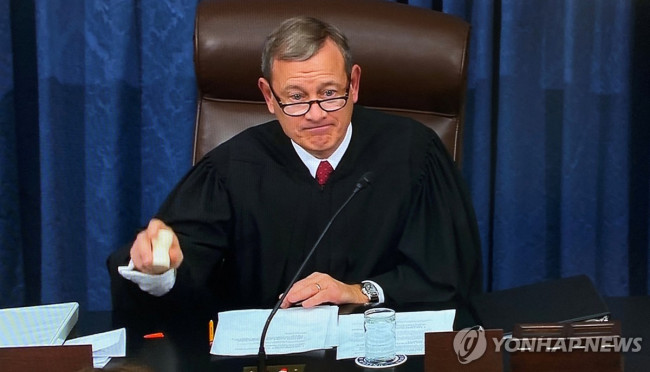 U.S. Chief Justice John Roberts [Photo courtesy of Reuters-Yonhap News / U.S. Senate TV]
Experts suggest that the Supreme Court may adopt a critical stance towards the Trump administration in this case.
The argument is that the IEEPA, which President Trump cited as the basis for imposing tariffs, does not grant the president the authority to adjust tariffs to address chronic issues such as drug trafficking or trade imbalances.
Mark Graber, a professor at the University of Maryland Law School, explained, "If President Trump ignored a clear stance from Congress, the Supreme Court stepped in to put a stop to it."
Conversely, there is also an analysis that the Supreme Court might rule in favor of the Trump administration because there is no precedent on the specific issue of presidential authority to impose tariffs.
Indeed, even within the U.S. Court of Appeals for the D.C. Circuit, which ruled that reciprocal tariffs are illegal, a dissenting opinion argued, "The IEEPA was intended to allow for a variety of regulatory tools, and the interpretation that tariffs cannot be used is unconvincing."
Peter Navarro, White House Trade and Manufacturing Policy Advisor under Trump, expressed his optimism regarding this dissenting opinion, stating, "This provides very clear guidance that the Supreme Court can rule in our favor."
The composition of the Supreme Court, with a 6-3 majority of conservative justices, could also influence the outcome of the appellate review.
Since the Trump administration took office, the Supreme Court has made conservative rulings on actions such as the dismissal of federal employees, deportation of undocumented immigrants, and suspension of federal funding, despite opposition from liberal justices.
Oral arguments for the appellate case concerning tariffs are expected to begin this winter or early next spring.
The Supreme Court's decision could be released weeks or months after the commencement of oral arguments.
The Trump administration's reciprocal tariffs remain in effect until the conclusion of the appellate review.
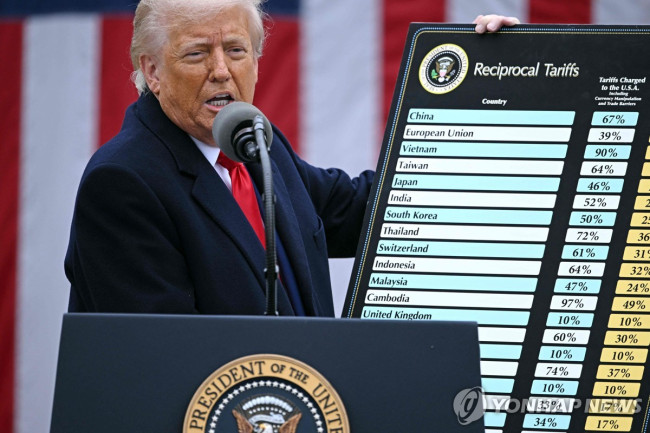 Former U.S. President Donald Trump [Photo courtesy of AFP-Yonhap News]

 Iranian Foreign Ministry: "Continuing Message Exchanges with the U.S. and Activities of Mediating Countries"
Esmaeil Baghaei, Spokesperson for the Iranian Ministry of Foreign Affairs [Xinhua, Yonhap News file photo]Esmaeil Baghaei, spokesperson for the Iranian Ministry of Foreign Affairs, stated on the 26th
Iranian Foreign Ministry: "Continuing Message Exchanges with the U.S. and Activities of Mediating Countries"
Esmaeil Baghaei, Spokesperson for the Iranian Ministry of Foreign Affairs [Xinhua, Yonhap News file photo]Esmaeil Baghaei, spokesperson for the Iranian Ministry of Foreign Affairs, stated on the 26th
 President Yoon: "Do You Think You Are Safe from the Special Counsel?"... Final Statement Video Released
President Yoon Suk Yeol rebuking the special prosecutor on the 24th. [Court video / @birds_justice X account subtitle GIF] A video of President Yoon Suk Yeol's closing statement at his trial rega
President Yoon: "Do You Think You Are Safe from the Special Counsel?"... Final Statement Video Released
President Yoon Suk Yeol rebuking the special prosecutor on the 24th. [Court video / @birds_justice X account subtitle GIF] A video of President Yoon Suk Yeol's closing statement at his trial rega
 President Yoon, regarding the first-instance ruling on the Public Official Election Act: “An excessive political verdict that distorts the facts… We will appeal immediately.”
The first-instance sentencing hearing for President Yoon Suk Yeol regarding violations of the Public Official Election Act is being broadcast live at Seoul Station on the 27th. [Photo=Yonhap News]Pres
President Yoon, regarding the first-instance ruling on the Public Official Election Act: “An excessive political verdict that distorts the facts… We will appeal immediately.”
The first-instance sentencing hearing for President Yoon Suk Yeol regarding violations of the Public Official Election Act is being broadcast live at Seoul Station on the 27th. [Photo=Yonhap News]Pres
 WSJ: "SK Hynix ADR Premium Is a Sign of AI Trading Overheat"
Advertisement for SK Hynix ADR listing in New York's Times Square [Reuters=Yonhap News file photo]The Wall Street Journal (WSJ) has pointed out that the price of SK Hynix’s American Depositary Recei
WSJ: "SK Hynix ADR Premium Is a Sign of AI Trading Overheat"
Advertisement for SK Hynix ADR listing in New York's Times Square [Reuters=Yonhap News file photo]The Wall Street Journal (WSJ) has pointed out that the price of SK Hynix’s American Depositary Recei
 'Godfather of Japanese Mystery Novels' Keigo Higashino Passes Away After Battle with Cancer at 68
Famous Japanese mystery novelist Keigo Higashino [AFP=Yonhap News]It has been belatedly reported that Keigo Higashino, the "godfather of Japanese mystery novels" and author of bestsellers such as "The
'Godfather of Japanese Mystery Novels' Keigo Higashino Passes Away After Battle with Cancer at 68
Famous Japanese mystery novelist Keigo Higashino [AFP=Yonhap News]It has been belatedly reported that Keigo Higashino, the "godfather of Japanese mystery novels" and author of bestsellers such as "The
 [Park Pil-kyu Security Column] To the Ignorant Trying to Clothe a Beast in Sheep's Clothing
Rep. Kim Byung-joo of the Democratic Party of Korea [Photo=Yonhap News]“The Air Force Academy doesn't teach you how to fly a plane!” “The Army, Navy, and Air Force academies are exactly the
[Park Pil-kyu Security Column] To the Ignorant Trying to Clothe a Beast in Sheep's Clothing
Rep. Kim Byung-joo of the Democratic Party of Korea [Photo=Yonhap News]“The Air Force Academy doesn't teach you how to fly a plane!” “The Army, Navy, and Air Force academies are exactly the
 [Issue Diagnosis] Two Effects of the Election Petition Review
 [Photo] Evidence of Election Fraud Flooding U.S. Media… Trump Had 2.7 Million Votes Stolen
 [Video] U.S. Semiquincentennial Air Show... 'Art in the Sky' streaks across New York
 [Editorial Cartoon] A Draconian Law That Undermines Freedom of Expression

 List
List









