 Google logo. Yonhap News.
A U.S. court ruled on the 2nd (local time) that Google's request to sell off its browser Chrome and operating system Android as a remedy for its illegal monopoly in the online search market was not accepted, thereby helping Google avoid the worst-case scenario of a company breakup.
The measures ordered by U.S. District Judge Amit Mehta on this day to resolve Google's illegal monopoly in the online search market include that selling Chrome and Android is unnecessary, sharing search data with competitors, and prohibiting monopolistic contracts with smartphone manufacturers.
The U.S. Department of Justice has been demanding the sale of Chrome, data sharing, and prohibition of monopolistic contracts since the court ruled in August last year that Google's dominance in the search market constituted an illegal monopoly.
Although the U.S. Department of Justice initially proposed the sale of Android, they stepped back and did not include it in the remedy plan submitted to the court, but its possibility was still discussed in the market.
The sale of Chrome and Android was considered an "extreme measure" for Google. Google holds over 90% of the global online search market share, and it solidifies this foundation through Android and Chrome.
Android, along with Apple's iOS, divides the operating system market for devices worldwide, and Chrome's market share is close to 70%.
In particular, Chrome acts as a gateway to Google Search, so the weakening of Google's market dominance was inevitable if Chrome were to be sold.
Approximately 70% of Google's total revenue comes from advertising, such as search, with total ad revenue reaching $71.34 billion (approximately 100 trillion won) in the second quarter.
With such immense influence, several companies were "coveting" Chrome during the trial.
OpenAI, the developer of ChatGPT, stated its willingness to acquire Chrome if a sale order was issued, and Yahoo also announced its intention to bid. AI startup Perplexity even proposed a specific acquisition price of $34.5 billion for Chrome.
However, with the exclusion of Chrome's sale from the current decision, Google can breathe a sigh of relief, while companies expecting to acquire Chrome are disappointed.
As indicated by the 8% surge in Google's stock price in after-hours trading on the New York Stock Exchange, the market is also showing signs of relief as the most feared scenario was omitted from the court's ruling.
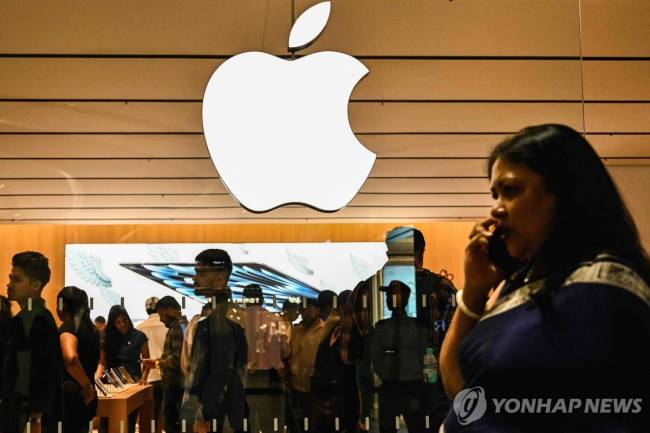 Apple logo. Yonhap News.
The Wall Street Journal (WSJ) commented that "Judge Mehta's decision in effect largely accepted Google's position."
Google is not the only one relieved by this verdict. Apple's stock price also rose by 3% in after-hours trading.
Google has paid tens of billions of dollars annually to companies like Apple and Samsung for featuring its search engine on their smartphones. The majority of this amount has been paid to Apple, with $20 billion paid in 2022 alone.
This substantial payment was essentially a measure to solidify Google's monopolistic position, and the market had predicted that the court would order a halt to these payments.
The search partnership between Apple and Google was a key issue in the antitrust lawsuit filed by the U.S. Department of Justice.
If Google were ordered to stop payments, Apple would inevitably face a corresponding decrease in profits. However, the court deemed this cessation of payments unnecessary, effectively allowing them to continue.
Nevertheless, the court drew a line by prohibiting exclusive contracts that only feature Google Search, meaning these costs are not simply for distribution but are no longer paid as consideration for exclusive agreements.
Consequently, Apple is expected to maintain a significant portion of its previous revenue, even if not the full amount received under the exclusive contract.
Although Google can breathe a sigh of relief with this ruling, some impact is unavoidable regarding the court's order to share search data with competitors.
Google uses vast amounts of user search history and click pattern data to improve its search algorithms for greater accuracy and for ad targeting.
Advertisers rely on targeted ads based on search queries and user behavior data. If Google shares its search data, competitors can also improve their search quality.
In such a scenario, advertisers would have less reason to use Google Search, potentially leading to a significant decrease in advertising revenue.
Google has argued that sharing data is akin to selling its intellectual property (IP) and that it would allow competitors to replicate its technology.
Furthermore, with exclusive contracts with device manufacturers such as smartphone makers prohibited, Google's market share could decline if these companies decide to feature other search engines.
This adds another unfavorable factor, the prohibition of exclusive contracts, to a situation where Google is already concerned about declining search market share due to the popularity of AI chatbots like ChatGPT.
Yonhap News

 Iranian Foreign Ministry: "Continuing Message Exchanges with the U.S. and Activities of Mediating Countries"
Esmaeil Baghaei, Spokesperson for the Iranian Ministry of Foreign Affairs [Xinhua, Yonhap News file photo]Esmaeil Baghaei, spokesperson for the Iranian Ministry of Foreign Affairs, stated on the 26th
Iranian Foreign Ministry: "Continuing Message Exchanges with the U.S. and Activities of Mediating Countries"
Esmaeil Baghaei, Spokesperson for the Iranian Ministry of Foreign Affairs [Xinhua, Yonhap News file photo]Esmaeil Baghaei, spokesperson for the Iranian Ministry of Foreign Affairs, stated on the 26th
 President Yoon: "Do You Think You Are Safe from the Special Counsel?"... Final Statement Video Released
President Yoon Suk Yeol rebuking the special prosecutor on the 24th. [Court video / @birds_justice X account subtitle GIF] A video of President Yoon Suk Yeol's closing statement at his trial rega
President Yoon: "Do You Think You Are Safe from the Special Counsel?"... Final Statement Video Released
President Yoon Suk Yeol rebuking the special prosecutor on the 24th. [Court video / @birds_justice X account subtitle GIF] A video of President Yoon Suk Yeol's closing statement at his trial rega
 President Yoon, regarding the first-instance ruling on the Public Official Election Act: “An excessive political verdict that distorts the facts… We will appeal immediately.”
The first-instance sentencing hearing for President Yoon Suk Yeol regarding violations of the Public Official Election Act is being broadcast live at Seoul Station on the 27th. [Photo=Yonhap News]Pres
President Yoon, regarding the first-instance ruling on the Public Official Election Act: “An excessive political verdict that distorts the facts… We will appeal immediately.”
The first-instance sentencing hearing for President Yoon Suk Yeol regarding violations of the Public Official Election Act is being broadcast live at Seoul Station on the 27th. [Photo=Yonhap News]Pres
 WSJ: "SK Hynix ADR Premium Is a Sign of AI Trading Overheat"
Advertisement for SK Hynix ADR listing in New York's Times Square [Reuters=Yonhap News file photo]The Wall Street Journal (WSJ) has pointed out that the price of SK Hynix’s American Depositary Recei
WSJ: "SK Hynix ADR Premium Is a Sign of AI Trading Overheat"
Advertisement for SK Hynix ADR listing in New York's Times Square [Reuters=Yonhap News file photo]The Wall Street Journal (WSJ) has pointed out that the price of SK Hynix’s American Depositary Recei
 'Godfather of Japanese Mystery Novels' Keigo Higashino Passes Away After Battle with Cancer at 68
Famous Japanese mystery novelist Keigo Higashino [AFP=Yonhap News]It has been belatedly reported that Keigo Higashino, the "godfather of Japanese mystery novels" and author of bestsellers such as "The
'Godfather of Japanese Mystery Novels' Keigo Higashino Passes Away After Battle with Cancer at 68
Famous Japanese mystery novelist Keigo Higashino [AFP=Yonhap News]It has been belatedly reported that Keigo Higashino, the "godfather of Japanese mystery novels" and author of bestsellers such as "The
 [Park Pil-kyu Security Column] To the Ignorant Trying to Clothe a Beast in Sheep's Clothing
Rep. Kim Byung-joo of the Democratic Party of Korea [Photo=Yonhap News]“The Air Force Academy doesn't teach you how to fly a plane!” “The Army, Navy, and Air Force academies are exactly the
[Park Pil-kyu Security Column] To the Ignorant Trying to Clothe a Beast in Sheep's Clothing
Rep. Kim Byung-joo of the Democratic Party of Korea [Photo=Yonhap News]“The Air Force Academy doesn't teach you how to fly a plane!” “The Army, Navy, and Air Force academies are exactly the
 [Issue Diagnosis] Two Effects of the Election Petition Review
 [Photo] Evidence of Election Fraud Flooding U.S. Media… Trump Had 2.7 Million Votes Stolen
 [Video] U.S. Semiquincentennial Air Show... 'Art in the Sky' streaks across New York
 [Editorial Cartoon] A Draconian Law That Undermines Freedom of Expression

 List
List









