The Belt and Road Initiative (BRI), China's ambitious infrastructure and development project connecting China, Central Asia, and Europe, is facing a test due to political instability caused by anti-government protests in South Asia, including Nepal, according to a report by the Hong Kong-based South China Morning Post (SCMP) on the 11th.
The report indicates that China is viewing the recent protests in Nepal, following similar events in Bangladesh and Indonesia, with concern.
This apprehension stems from the fact that all these countries are participants in the BRI, and China fears that social unrest and political upheaval caused by the protests could negatively impact the initiative.
China is particularly closely monitoring the situation in Nepal.
 Protesters attempting to burn a photo of Nepalese Prime Minister Sharma Oli. SCMP capture.
The protests, triggered by unbearable levels of corruption and poverty, are spreading nationwide, and China is concerned about them escalating to a level beyond the authorities' control, with incidents such as arson of government buildings and indiscriminate assaults on high-ranking officials, including ministers.
China is also concerned that the anti-government protests in Nepal could spill over into anti-China sentiment within the country.
This is because the anti-government protesters in Nepal do not hold a particularly favorable view of China, given that the left-wing coalition government, led by the Communist Party of Nepal (Unified Marxist-Leninist) and the Nepali Congress, has maintained friendly relations with China.
Despite the ongoing protests, Prime Minister Sharma Oli, who led the left-wing coalition government, attended the Shanghai Cooperation Organization (SCO) summit in Tianjin from August 31 to September 1, and then observed the 80th-anniversary military parade celebrating victory in the Chinese Civil War in Beijing on September 3. This led to intensified backlash from anti-government protesters in Nepal.
Upon his return to Nepal, Oli resigned on September 9 as the protests grew more violent and led to large-scale bloodshed.
"Given Oli's relatively close relationship with China, his fate has garnered significant attention from China," commented Professor Lin Minwang of Fudan University's Institute of International Studies.
The Chinese Foreign Ministry emphasized the previous day through a briefing by spokesperson Lin Jian, stating, "China hopes that all sectors in Nepal will properly handle their domestic affairs and restore social order and national stability as soon as possible."
China had been working to strengthen its relations with Nepal, seeing the emergence of a left-wing coalition government as an opportunity to counter its "arch-rival" India, which exerts significant political, economic, and cultural influence over Nepal.
The Nepalese government, which joined the BRI in 2017, has been pursuing the construction of the Rasuwagadhi-Kathmandu railway line connecting Kerung in southern Tibet to Kathmandu with Chinese support. However, this project is expected to face disruptions due to the current situation.
China is also closely watching the situation in Indonesia.
In Indonesia, protests against parliamentary privileges last month spread nationwide, forcing President Prabowo Subianto to cancel his planned attendance at the SCO summit in Tianjin. The protests subsided, and he was only able to depart from Jakarta on September 2, attending the 80th-anniversary military parade in Beijing on September 3.
China is Indonesia's largest trading partner and a major investor in infrastructure projects under the BRI, such as the Jakarta-Bandung High-Speed Railway, as well as in the raw materials industry, including nickel, a key component for batteries.
Previously, Bangladesh also experienced anti-government protests in August last year, leading to the resignation of Prime Minister Sheikh Hasina and her subsequent flight to India. In Sri Lanka, former President Gotabaya Rajapaksa fled to the United States in December 2022, pursued by anti-government protesters, and both countries continue to suffer from political instability.
Both Bangladesh and Sri Lanka are also deeply involved in China's BRI. In this context, the international community has pointed out that the two countries, which received substantial infrastructure investment from China, have fallen into an unsustainable "debt trap."
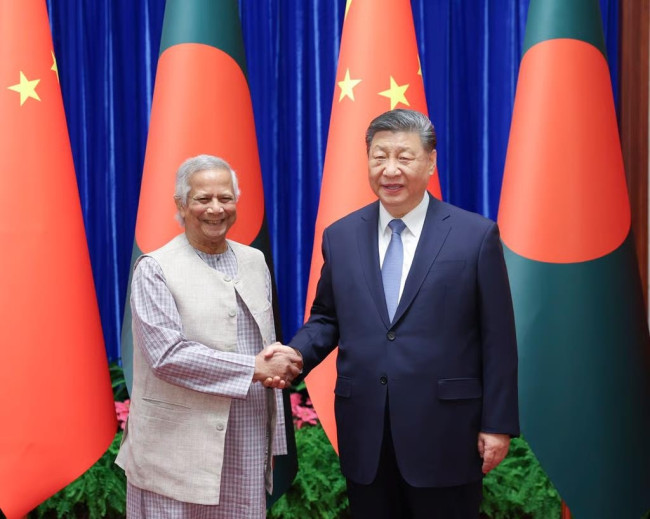 Chinese President Xi Jinping meeting with interim government chief advisor Muhammad Yunus of Bangladesh. SCMP capture.
Liu Zhongyi, a senior researcher at the Center for South Asian Studies affiliated with the Shanghai Institutes for International Studies, noted, "The unstable situations in Sri Lanka, Bangladesh, Indonesia, and Nepal could affect the BRI."
Zhang Jiadong, director of the Center for South Asian Studies at Fudan University, commented, "The social unrest in Nepal is part of a new order in South Asia. Public awakening, economic difficulties, and the growth of social media are driving political change in Nepal and could also influence China (associated with the Nepalese left-wing coalition government), so attention must be paid."
Amit Ranjan, a researcher at the Institute of South Asian Studies at the National University of Singapore, emphasized, "Chinese authorities must actively communicate with any country undergoing change, with its new government and leaders; there is no other option."
Yonhap News

 Iranian Foreign Ministry: "Continuing Message Exchanges with the U.S. and Activities of Mediating Countries"
Esmaeil Baghaei, Spokesperson for the Iranian Ministry of Foreign Affairs [Xinhua, Yonhap News file photo]Esmaeil Baghaei, spokesperson for the Iranian Ministry of Foreign Affairs, stated on the 26th
Iranian Foreign Ministry: "Continuing Message Exchanges with the U.S. and Activities of Mediating Countries"
Esmaeil Baghaei, Spokesperson for the Iranian Ministry of Foreign Affairs [Xinhua, Yonhap News file photo]Esmaeil Baghaei, spokesperson for the Iranian Ministry of Foreign Affairs, stated on the 26th
 President Yoon: "Do You Think You Are Safe from the Special Counsel?"... Final Statement Video Released
President Yoon Suk Yeol rebuking the special prosecutor on the 24th. [Court video / @birds_justice X account subtitle GIF] A video of President Yoon Suk Yeol's closing statement at his trial rega
President Yoon: "Do You Think You Are Safe from the Special Counsel?"... Final Statement Video Released
President Yoon Suk Yeol rebuking the special prosecutor on the 24th. [Court video / @birds_justice X account subtitle GIF] A video of President Yoon Suk Yeol's closing statement at his trial rega
 President Yoon, regarding the first-instance ruling on the Public Official Election Act: “An excessive political verdict that distorts the facts… We will appeal immediately.”
The first-instance sentencing hearing for President Yoon Suk Yeol regarding violations of the Public Official Election Act is being broadcast live at Seoul Station on the 27th. [Photo=Yonhap News]Pres
President Yoon, regarding the first-instance ruling on the Public Official Election Act: “An excessive political verdict that distorts the facts… We will appeal immediately.”
The first-instance sentencing hearing for President Yoon Suk Yeol regarding violations of the Public Official Election Act is being broadcast live at Seoul Station on the 27th. [Photo=Yonhap News]Pres
 WSJ: "SK Hynix ADR Premium Is a Sign of AI Trading Overheat"
Advertisement for SK Hynix ADR listing in New York's Times Square [Reuters=Yonhap News file photo]The Wall Street Journal (WSJ) has pointed out that the price of SK Hynix’s American Depositary Recei
WSJ: "SK Hynix ADR Premium Is a Sign of AI Trading Overheat"
Advertisement for SK Hynix ADR listing in New York's Times Square [Reuters=Yonhap News file photo]The Wall Street Journal (WSJ) has pointed out that the price of SK Hynix’s American Depositary Recei
 'Godfather of Japanese Mystery Novels' Keigo Higashino Passes Away After Battle with Cancer at 68
Famous Japanese mystery novelist Keigo Higashino [AFP=Yonhap News]It has been belatedly reported that Keigo Higashino, the "godfather of Japanese mystery novels" and author of bestsellers such as "The
'Godfather of Japanese Mystery Novels' Keigo Higashino Passes Away After Battle with Cancer at 68
Famous Japanese mystery novelist Keigo Higashino [AFP=Yonhap News]It has been belatedly reported that Keigo Higashino, the "godfather of Japanese mystery novels" and author of bestsellers such as "The
 [Park Pil-kyu Security Column] To the Ignorant Trying to Clothe a Beast in Sheep's Clothing
Rep. Kim Byung-joo of the Democratic Party of Korea [Photo=Yonhap News]“The Air Force Academy doesn't teach you how to fly a plane!” “The Army, Navy, and Air Force academies are exactly the
[Park Pil-kyu Security Column] To the Ignorant Trying to Clothe a Beast in Sheep's Clothing
Rep. Kim Byung-joo of the Democratic Party of Korea [Photo=Yonhap News]“The Air Force Academy doesn't teach you how to fly a plane!” “The Army, Navy, and Air Force academies are exactly the
 [Issue Diagnosis] Two Effects of the Election Petition Review
 [Photo] Evidence of Election Fraud Flooding U.S. Media… Trump Had 2.7 Million Votes Stolen
 [Video] U.S. Semiquincentennial Air Show... 'Art in the Sky' streaks across New York
 [Editorial Cartoon] A Draconian Law That Undermines Freedom of Expression

 List
List









