Major Shareholder Threshold Kept at 5 Billion Won... Securities Industry Welcomes "Favorable Environment for the Stock Market"
"Already Priced In," Analysts Say... "Next Momentum is Separate Taxation on Dividend Income... Year-End Target of 3,750 Possible"
 Deputy Prime Minister and Minister of Economy and Finance Koo Yun-cheol announcing livelihood stability measures (Seoul=Yonhap News) Reporter Kim Joo-sung = Deputy Prime Minister and Minister of Economy and Finance Koo Yun-cheol announces measures, including the criteria for "major shareholders" subject to stock transfer tax, during the 'Consultative Meeting on Chuseok Livelihood Stability' held at the National Assembly in Yeouido, Seoul, on the 15th. 2025.9.15 utzza@yna.co.kr
As the government has finalized its decision to maintain the current 5 billion won threshold for major shareholders subject to stock transfer tax, the securities industry is expressing relief that the stock market's biggest source of uncertainty has been resolved.
While some forecast that the stock market will gain real momentum through the end of the year as concerns over year-end sell-offs—which were feared if the threshold had been lowered—have eased, others argue that this development is already priced into the market and is unlikely to serve as a catalyst for further gains.
Deputy Prime Minister and Minister of Economy and Finance Koo Yun-cheol announced at the 'Consultative Meeting on Chuseok Livelihood Stability' held at the National Assembly on the 15th that the government has decided to keep the major shareholder threshold for stock transfer tax at the current 5 billion won level.
Previously, in July, the Ministry of Economy and Finance had proposed a tax reform plan that included tightening the threshold for stock holdings per company from 5 billion won to 1 billion won.
Concerns grew that this measure would trigger massive year-end sell-offs by "big-hand" investors, leading the KOSPI to plummet by more than 3.8% on the first day of last month, immediately following the announcement of the tax reform plan.
However, pressure to maintain the current threshold mounted, particularly from political circles. Following President Lee Jae-myung’s hint at a potential policy pivot during his 100-day press conference on the 10th—where he stated, "I do not necessarily believe that we must lower the threshold from 5 billion won to 1 billion won if it causes actual disruption to the stock market"—the decision to maintain the status quo was announced today.
The securities industry is welcoming the decision, as the risk of a "bomb" of year-end sell-offs has been removed, fostering expectations for an improvement in short-term supply and demand.
Lim Hee-yeon, a researcher at Shinhan Securities, assessed, "The risk associated with the tax reform plan has entered a resolution phase," adding, "A favorable environment for the stock market and brokerage industry has been created."
Lee Kyung-soo, a researcher at Hana Securities, said in a phone call with Yonhap News, "The market is enjoying a relief rally following the announcement to maintain the threshold," noting, "As the government continues to demonstrate its active management of the stock market, foreign capital inflow remains positive."
In fact, as of 10:27 a.m. today, foreign investors were net buyers of 217.1 billion won worth of stocks on the KOSPI market. This marks their sixth consecutive day of net buying since the 8th.
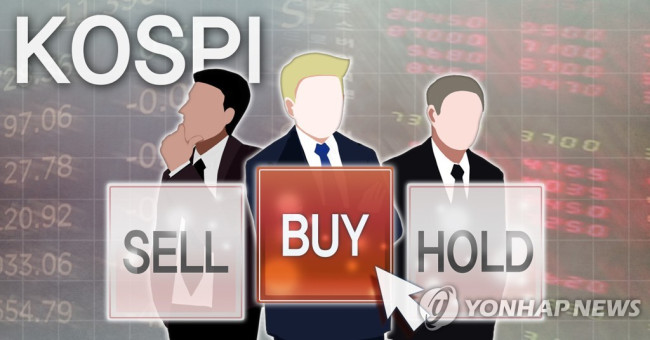 KOSPI Foreigner 'Buy Korea' (PG) [Produced by Jung Yeon-joo] Illustration
However, some analysts argue that because the impact of this measure was already priced in, its effect on the market will be limited. Furthermore, concerns remain that this decision does not address the fundamental structural issues of companies, such as their financial performance.
Lee Kyung-min, a researcher at Daishin Securities, noted, "The decision to maintain the threshold was largely priced in during the KOSPI’s upward climb, so it is difficult for this to act as a stronger catalyst for further gains," adding, "Also, this decision does not improve corporate earnings."
Lee Woong-chan, a researcher at iM Securities, also assessed, "The decision to maintain the major shareholder threshold was already priced into the market, and the additional upward momentum for the stock market resulting from this decision is limited."
The market's attention is now shifting to "separate taxation on dividend income," another pillar of the tax reform plan.
The government initially revealed a plan to set the maximum tax rate for separate taxation on dividend income at 35%, but there are growing arguments within political circles that it should be lowered to the 20% range. Observers suggest that if the government’s final position—such as a reduction in the tax rate for separate dividend taxation—meets market expectations, it could serve as a new catalyst for further market growth.
Researcher Lee Kyung-soo stated, "The next momentum for the stock market is now the separate taxation of dividend income. If the current maximum tax rate of 35% is lowered to 25%, there is sufficient room for the stock market to rise further," and projected the KOSPI’s upper limit at 3,750 by the end of the year. Yonhap News

 Iranian Foreign Ministry: "Continuing Message Exchanges with the U.S. and Activities of Mediating Countries"
Esmaeil Baghaei, Spokesperson for the Iranian Ministry of Foreign Affairs [Xinhua, Yonhap News file photo]Esmaeil Baghaei, spokesperson for the Iranian Ministry of Foreign Affairs, stated on the 26th
Iranian Foreign Ministry: "Continuing Message Exchanges with the U.S. and Activities of Mediating Countries"
Esmaeil Baghaei, Spokesperson for the Iranian Ministry of Foreign Affairs [Xinhua, Yonhap News file photo]Esmaeil Baghaei, spokesperson for the Iranian Ministry of Foreign Affairs, stated on the 26th
 President Yoon: "Do You Think You Are Safe from the Special Counsel?"... Final Statement Video Released
President Yoon Suk Yeol rebuking the special prosecutor on the 24th. [Court video / @birds_justice X account subtitle GIF] A video of President Yoon Suk Yeol's closing statement at his trial rega
President Yoon: "Do You Think You Are Safe from the Special Counsel?"... Final Statement Video Released
President Yoon Suk Yeol rebuking the special prosecutor on the 24th. [Court video / @birds_justice X account subtitle GIF] A video of President Yoon Suk Yeol's closing statement at his trial rega
 President Yoon, regarding the first-instance ruling on the Public Official Election Act: “An excessive political verdict that distorts the facts… We will appeal immediately.”
The first-instance sentencing hearing for President Yoon Suk Yeol regarding violations of the Public Official Election Act is being broadcast live at Seoul Station on the 27th. [Photo=Yonhap News]Pres
President Yoon, regarding the first-instance ruling on the Public Official Election Act: “An excessive political verdict that distorts the facts… We will appeal immediately.”
The first-instance sentencing hearing for President Yoon Suk Yeol regarding violations of the Public Official Election Act is being broadcast live at Seoul Station on the 27th. [Photo=Yonhap News]Pres
 WSJ: "SK Hynix ADR Premium Is a Sign of AI Trading Overheat"
Advertisement for SK Hynix ADR listing in New York's Times Square [Reuters=Yonhap News file photo]The Wall Street Journal (WSJ) has pointed out that the price of SK Hynix’s American Depositary Recei
WSJ: "SK Hynix ADR Premium Is a Sign of AI Trading Overheat"
Advertisement for SK Hynix ADR listing in New York's Times Square [Reuters=Yonhap News file photo]The Wall Street Journal (WSJ) has pointed out that the price of SK Hynix’s American Depositary Recei
 'Godfather of Japanese Mystery Novels' Keigo Higashino Passes Away After Battle with Cancer at 68
Famous Japanese mystery novelist Keigo Higashino [AFP=Yonhap News]It has been belatedly reported that Keigo Higashino, the "godfather of Japanese mystery novels" and author of bestsellers such as "The
'Godfather of Japanese Mystery Novels' Keigo Higashino Passes Away After Battle with Cancer at 68
Famous Japanese mystery novelist Keigo Higashino [AFP=Yonhap News]It has been belatedly reported that Keigo Higashino, the "godfather of Japanese mystery novels" and author of bestsellers such as "The
 [Park Pil-kyu Security Column] To the Ignorant Trying to Clothe a Beast in Sheep's Clothing
Rep. Kim Byung-joo of the Democratic Party of Korea [Photo=Yonhap News]“The Air Force Academy doesn't teach you how to fly a plane!” “The Army, Navy, and Air Force academies are exactly the
[Park Pil-kyu Security Column] To the Ignorant Trying to Clothe a Beast in Sheep's Clothing
Rep. Kim Byung-joo of the Democratic Party of Korea [Photo=Yonhap News]“The Air Force Academy doesn't teach you how to fly a plane!” “The Army, Navy, and Air Force academies are exactly the
 [Issue Diagnosis] Two Effects of the Election Petition Review
 [Photo] Evidence of Election Fraud Flooding U.S. Media… Trump Had 2.7 Million Votes Stolen
 [Video] U.S. Semiquincentennial Air Show... 'Art in the Sky' streaks across New York
 [Editorial Cartoon] A Draconian Law That Undermines Freedom of Expression

 List
List









