'Full Demolition' of Seosomun Overpass Begins with Full Closure on the 21st at Midnight... Buses to Reroute
Demolition to be completed by May of next year, with a new overpass to be constructed by February 2028.
Limited straight and left turns at the intersection under the overpass... Detours will be in operation.
 Start of Seosomun Overpass Demolition (Seoul=Yonhap News) Reporter Lee Jin-wook = The Seosomun Overpass, which began demolition on the 17th. The Seosomun Overpass is a 335m long and 14.9m wide road composed of 18 piers connecting Chungjeongno Station and City Hall Station. Currently, more than 40,000 vehicles pass through it daily. 2025.8.17 cityboy@yna.co.kr
The Seoul Metropolitan Government announced on the 15th that it will fully close the Seosomun Overpass starting at midnight on the 21st and commence full-scale demolition work.
The Seosomun Overpass is a 335m long and 14.9m wide road composed of 18 piers connecting Chungjeongno Station and City Hall Station. Currently, more than 40,000 vehicles pass through it daily.
Demolition was decided for safety reasons, as the overpass, which received a 'D grade' in a precise safety diagnosis, has reached its limits with simple repair work.
Demolition work has been carried out in phases by reducing lanes since midnight on the 17th of last month, and full closure will be implemented from midnight on the 21st.
Demolition is expected to take approximately 8 months, with completion targeted for May of next year. Following this, construction of the new overpass will commence, with completion scheduled for February 2028.
During the construction period, to prevent accidents at the Gyeongui-Jungang Line railway crossing located beneath the overpass, straight turns at the intersection from City Hall towards Chungjeongno will be prohibited. Vehicles must detour via surrounding roads such as Tongil-ro, Saemunan-ro, and Chilpae-ro.
Additionally, a left turn from Seosomun-ro to Cheongpa-ro will be prohibited in front of the Arisu Headquarters under the Seosomun Overpass. To enter Cheongpa-ro, drivers must proceed straight a bit further and make a U-turn at the crosswalk ahead.
For citizens using public transportation, a roadside bus-only lane will be newly established and operated full-time on the 380m section from Seosomun-ro City Hall Station Intersection to the Seosomun Overpass direction.
Buses will also be rerouted in stages. Following the rerouting of 20 routes for Gyeonggi and Incheon intercity buses starting on the 17th of last month, 11 routes for Seoul city and night buses will also operate via Chungjeong-ro, Sejong-daero, and Tongil-ro starting on the 21st.
Five routes that used to travel back and forth on the existing Seosomun Overpass, such as routes 172 and 472, will have their routes changed to Chungjeong-ro ~ Tongil-ro ~ Sejong-daero. For one-way routes that passed through the Seosomun Overpass, such as routes 600 and 602, their routes will be changed to Sejong-daero ~ Tongil-ro ~ Chungjeong-ro.
Detailed detour routes can be found on the Seoul Metropolitan Government website, Topis, at bus stop information signs, and on notices posted inside buses.
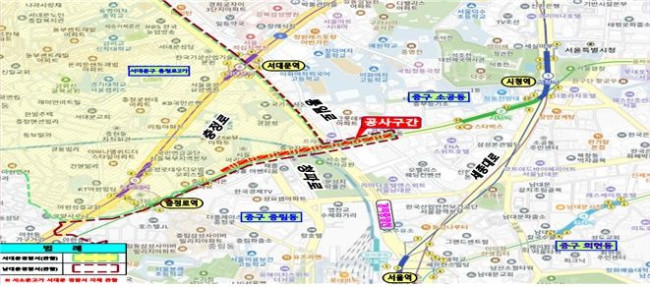 Map of Seosomun Overpass Demolition Site [Provided by Seoul Metropolitan Government. Republication and database prohibited]
General vehicles should avoid Seosomun-ro as much as possible and use nearby roads.
When entering the city center from the outskirts of Seoul, drivers can use Seongsan-ro and Sajik-ro, or proceed towards Sejong-daero via Malire-ro and Cheongpa-ro from Mapo-daero.
When exiting the city center from the outskirts of Seoul, drivers can detour to Sajik-ro from Sejong-daero, or travel via Saemunan-ro, Chungjeong-ro, Cheongpa-ro, and Malire-ro.
The city plans to minimize traffic congestion by continuously monitoring the construction zone in cooperation with the National Police Agency, autonomous districts, and traffic experts.
Approximately 30 guidance personnel, including volunteer drivers and pedestrian safety assistants, will be flexibly deployed at major intersections to manage vehicle flow and pedestrian safety.
Real-time traffic information will also be provided through various media, including Variable Message Signs (VMS), bus stop displays, social media, and navigation apps.
An Dae-hee, Head of the Seoul Metropolitan Government's Urban Infrastructure Headquarters, said, "As traffic congestion is expected due to the full closure, we urge citizens to refrain from using private cars as much as possible and to actively use public transportation," adding, "We will complete the construction as soon as possible by minimizing inconvenience to citizens and prioritizing safety." Yonhap News

 Trump pressures for rate cut again ahead of FOMC... "Should be the lowest in the world"
U.S. President Donald Trump. [Photo = The White House] U.S. President Donald Trump once again pressured the Federal Reserve, the U.S. central bank, to lower interest rates on the 27th (local time
Trump pressures for rate cut again ahead of FOMC... "Should be the lowest in the world"
U.S. President Donald Trump. [Photo = The White House] U.S. President Donald Trump once again pressured the Federal Reserve, the U.S. central bank, to lower interest rates on the 27th (local time
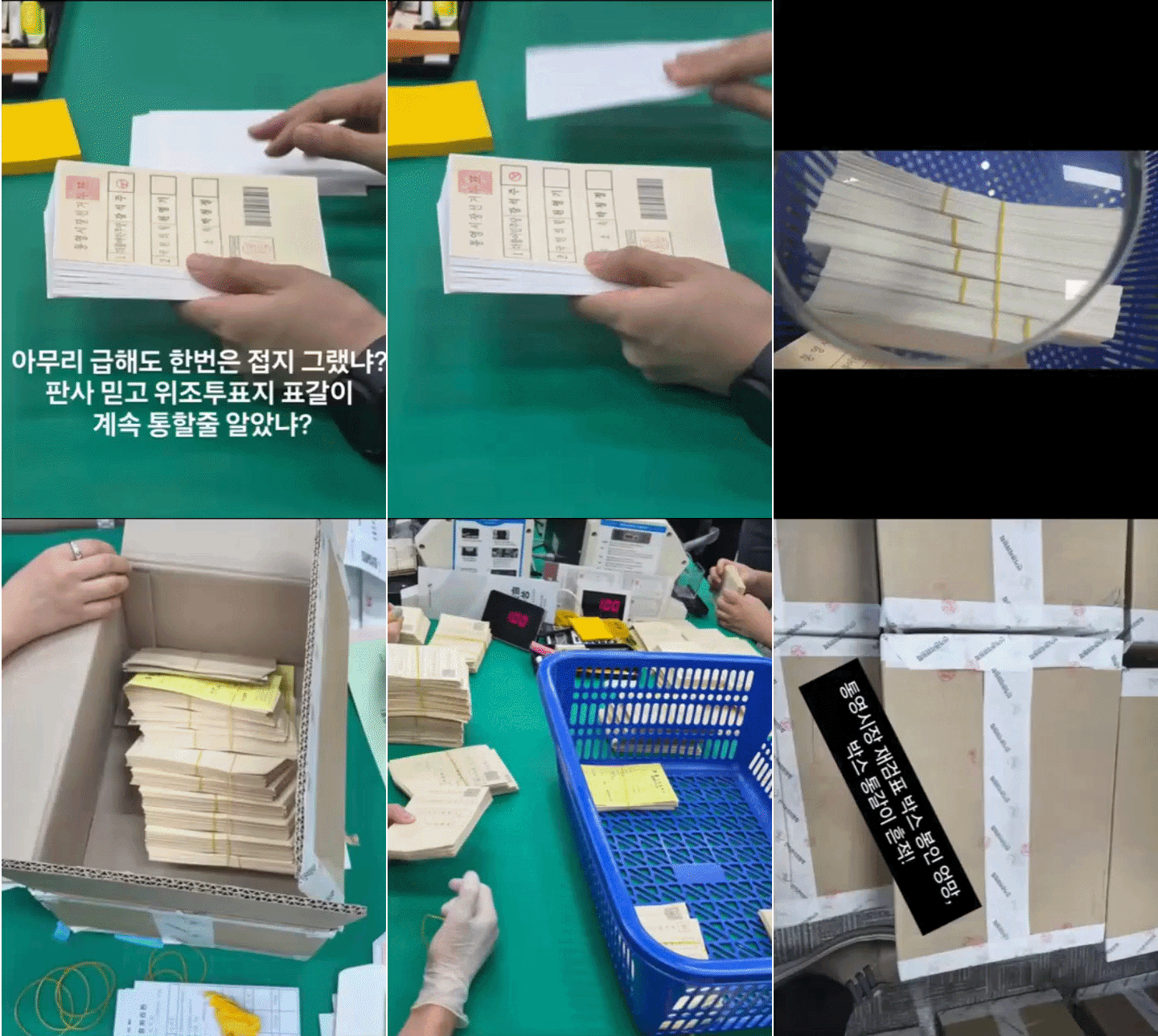 “Ignoring crisp ballots and damaged seals”… Tongyeong mayoral recount concludes with ‘no change in outcome,’ leaving suspicions and public outrage behind
Suspected counterfeit ballots discovered in Tongyeong [GIF from social media of Representative Hwang Kyo-ahn / Attorney Park Joo-hyun]During a recount of the Tongyeong mayoral election in South Gyeong
“Ignoring crisp ballots and damaged seals”… Tongyeong mayoral recount concludes with ‘no change in outcome,’ leaving suspicions and public outrage behind
Suspected counterfeit ballots discovered in Tongyeong [GIF from social media of Representative Hwang Kyo-ahn / Attorney Park Joo-hyun]During a recount of the Tongyeong mayoral election in South Gyeong
 President Yoon, regarding the first-instance ruling on the Public Official Election Act: “An excessive political verdict that distorts the facts… We will appeal immediately.”
The first-instance sentencing hearing for President Yoon Suk Yeol regarding violations of the Public Official Election Act is being broadcast live at Seoul Station on the 27th. [Photo=Yonhap News]Pres
President Yoon, regarding the first-instance ruling on the Public Official Election Act: “An excessive political verdict that distorts the facts… We will appeal immediately.”
The first-instance sentencing hearing for President Yoon Suk Yeol regarding violations of the Public Official Election Act is being broadcast live at Seoul Station on the 27th. [Photo=Yonhap News]Pres
 WSJ: "SK Hynix ADR Premium Is a Sign of AI Trading Overheat"
Advertisement for SK Hynix ADR listing in New York's Times Square [Reuters=Yonhap News file photo]The Wall Street Journal (WSJ) has pointed out that the price of SK Hynix’s American Depositary Recei
WSJ: "SK Hynix ADR Premium Is a Sign of AI Trading Overheat"
Advertisement for SK Hynix ADR listing in New York's Times Square [Reuters=Yonhap News file photo]The Wall Street Journal (WSJ) has pointed out that the price of SK Hynix’s American Depositary Recei
 'Godfather of Japanese Mystery Novels' Keigo Higashino Passes Away After Battle with Cancer at 68
Famous Japanese mystery novelist Keigo Higashino [AFP=Yonhap News]It has been belatedly reported that Keigo Higashino, the "godfather of Japanese mystery novels" and author of bestsellers such as "The
'Godfather of Japanese Mystery Novels' Keigo Higashino Passes Away After Battle with Cancer at 68
Famous Japanese mystery novelist Keigo Higashino [AFP=Yonhap News]It has been belatedly reported that Keigo Higashino, the "godfather of Japanese mystery novels" and author of bestsellers such as "The
 [Park Pil-kyu Security Column] To the Ignorant Trying to Clothe a Beast in Sheep's Clothing
Rep. Kim Byung-joo of the Democratic Party of Korea [Photo=Yonhap News]“The Air Force Academy doesn't teach you how to fly a plane!” “The Army, Navy, and Air Force academies are exactly the
[Park Pil-kyu Security Column] To the Ignorant Trying to Clothe a Beast in Sheep's Clothing
Rep. Kim Byung-joo of the Democratic Party of Korea [Photo=Yonhap News]“The Air Force Academy doesn't teach you how to fly a plane!” “The Army, Navy, and Air Force academies are exactly the
 [Issue Diagnosis] Two Effects of the Election Petition Review
 [Photo] Evidence of Election Fraud Flooding U.S. Media… Trump Had 2.7 Million Votes Stolen
 [Video] U.S. Semiquincentennial Air Show... 'Art in the Sky' streaks across New York
 [Editorial Cartoon] A Draconian Law That Undermines Freedom of Expression

 List
List









