표현의 자유는 민주주의의 근간입니다. 그러나 최근 보앤인 김문희 대표의 현수막 사건과 일반 국민의 카톡 공유 사건에서 보듯, 선거법과 경찰의 인지 수사가 결합하며 국민의 비판과 의견 표명이 수사 대상이 되고 있습니다. 이번 기사는 수사 형평성 논란과 더불어, 검찰 개혁 이후 강화되는 경찰 권한이 공안통치로 변질될 위험을 짚고자 합니다. <편집자 주>
 Kim Moon-hee, head of the Institute for Health Studies and Human Rights (Bonae-in)
From Banners to KakaoTalk Messages… Concerns Grow Over Precursors to Public Security Rule
Criticism is mounting that the police investigation into violations of the Public Official Election Act surrounding the June 3 presidential election is excessive.
The controversy over the infringement of freedom of expression is spreading, following the search and seizure of Kim Moon-hee, head of the Institute for Health Studies and Human Rights (Bonae-in), on charges of posting banners, and a summons issued to an ordinary citizen solely for sharing a message in a KakaoTalk chatroom.
With both cases reportedly initiated by the police themselves, some are expressing concern that the concentration of power in the hands of the police, under the guise of prosecutorial reform, could be a step towards "Chinese-style public security rule."
During the June 3 presidential election, Ms. Kim posted approximately 120 banners near high schools in Seoul with messages such as "KakaoTalk Instagram censorship, don't silence my words" and "The choice of a third-year high school student can protect freedom of expression." The police, considering that some banners were installed within 100 meters of polling stations and that the messages could be reminiscent of a specific political party and influence the election, searched her home on August 14. She was subsequently summoned and investigated twice, on August 29 and September 4.
However, Ms. Kim fully denied the charges, stating, "Banners within 100 meters of polling stations were extremely few, and I received opinions from the election commission that there were no issues both before and after." She argued, "My intention was to protect freedom of expression, and I did not support or criticize any specific political party," adding, "The disproportionate investigation is evident as the Democratic Party's illegal banners related to the presidential election are not even being investigated." She further filed a complaint regarding the Democratic Party's banners.
Ms. Kim expressed her frustration, saying, "The banners were installed in the early morning of June 2, meaning the posting period was only one day, until Election Day, June 3." She added, "The police have issued multiple summonses to those who installed the banners."
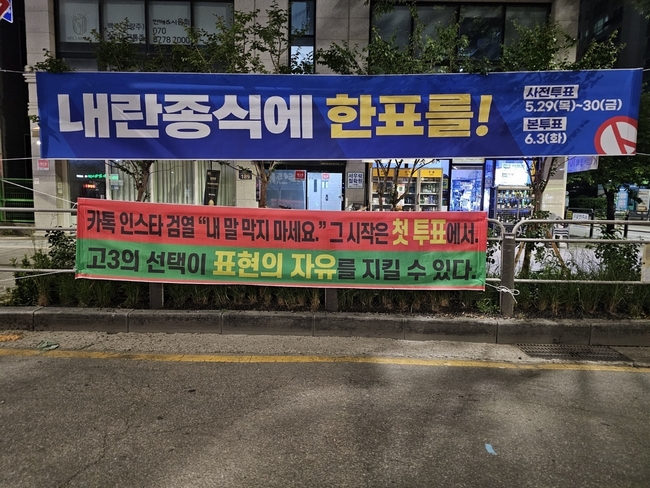 Banners by the Democratic Party (top) and by Bonae-in's Kim Moon-hee (bottom)In another case, an ordinary citizen received a summons from the police on charges of "violation of the Public Official Election Act due to dissemination of false information" for sharing a critical post in a chatroom regarding the "hotel no-show" controversy involving presidential candidate Lee Jae-myung (then a presidential candidate).
The fact that a simple act of sharing a post became the subject of an investigation, without even revealing the identity of the complainant, was shocking. Rep. Joo Jin-woo of the People Power Party, who received a petition regarding this matter, expressed strong anger, asserting, "It is 100 percent not guilty."
The fact that both cases were reportedly initiated by the police themselves is fueling the controversy. This is because if a state agency arbitrarily cracks down on freedom of expression without clear grounds for a complaint, it can transcend law enforcement and take on the character of political control.
Some legal circles and civic groups point out, "The prosecutorial reform, being pursued under the pretext of separating investigation and prosecution, is ultimately leading to the concentration of police power." They add, "The moment politically unfavorable expressions are defined as 'false information,' it could become a precursor to Chinese-style public security rule."
The Constitution defines freedom of expression as the foundation of democracy. However, if everyday activities like posting banners and sending KakaoTalk messages are consecutively targeted for investigation, and if only opposition-leaning individuals or citizens are questioned while ruling party banners are not investigated, the fairness of law enforcement will inevitably be severely undermined.
Experts warned, "We need to reaffirm the spirit of the Constitution and establish safeguards to control the abuse of power." They further cautioned, "Democracy is hollowed out the moment the eyes, ears, and mouths of the people are silenced."
#FreedomOfExpression #PublicOfficialElectionAct #KimMoonHee #BonaeIn #KakaoTalkInvestigation #PoliceInitiatedInvestigation #PublicSecurityRuleConcerns #ConstitutionalSpirit #Democracy #InvestigationFairness

 Iranian Foreign Ministry: "Continuing Message Exchanges with the U.S. and Activities of Mediating Countries"
Esmaeil Baghaei, Spokesperson for the Iranian Ministry of Foreign Affairs [Xinhua, Yonhap News file photo]Esmaeil Baghaei, spokesperson for the Iranian Ministry of Foreign Affairs, stated on the 26th
Iranian Foreign Ministry: "Continuing Message Exchanges with the U.S. and Activities of Mediating Countries"
Esmaeil Baghaei, Spokesperson for the Iranian Ministry of Foreign Affairs [Xinhua, Yonhap News file photo]Esmaeil Baghaei, spokesperson for the Iranian Ministry of Foreign Affairs, stated on the 26th
 President Yoon: "Do You Think You Are Safe from the Special Counsel?"... Final Statement Video Released
President Yoon Suk Yeol rebuking the special prosecutor on the 24th. [Court video / @birds_justice X account subtitle GIF] A video of President Yoon Suk Yeol's closing statement at his trial rega
President Yoon: "Do You Think You Are Safe from the Special Counsel?"... Final Statement Video Released
President Yoon Suk Yeol rebuking the special prosecutor on the 24th. [Court video / @birds_justice X account subtitle GIF] A video of President Yoon Suk Yeol's closing statement at his trial rega
 President Yoon, regarding the first-instance ruling on the Public Official Election Act: “An excessive political verdict that distorts the facts… We will appeal immediately.”
The first-instance sentencing hearing for President Yoon Suk Yeol regarding violations of the Public Official Election Act is being broadcast live at Seoul Station on the 27th. [Photo=Yonhap News]Pres
President Yoon, regarding the first-instance ruling on the Public Official Election Act: “An excessive political verdict that distorts the facts… We will appeal immediately.”
The first-instance sentencing hearing for President Yoon Suk Yeol regarding violations of the Public Official Election Act is being broadcast live at Seoul Station on the 27th. [Photo=Yonhap News]Pres
 WSJ: "SK Hynix ADR Premium Is a Sign of AI Trading Overheat"
Advertisement for SK Hynix ADR listing in New York's Times Square [Reuters=Yonhap News file photo]The Wall Street Journal (WSJ) has pointed out that the price of SK Hynix’s American Depositary Recei
WSJ: "SK Hynix ADR Premium Is a Sign of AI Trading Overheat"
Advertisement for SK Hynix ADR listing in New York's Times Square [Reuters=Yonhap News file photo]The Wall Street Journal (WSJ) has pointed out that the price of SK Hynix’s American Depositary Recei
 'Godfather of Japanese Mystery Novels' Keigo Higashino Passes Away After Battle with Cancer at 68
Famous Japanese mystery novelist Keigo Higashino [AFP=Yonhap News]It has been belatedly reported that Keigo Higashino, the "godfather of Japanese mystery novels" and author of bestsellers such as "The
'Godfather of Japanese Mystery Novels' Keigo Higashino Passes Away After Battle with Cancer at 68
Famous Japanese mystery novelist Keigo Higashino [AFP=Yonhap News]It has been belatedly reported that Keigo Higashino, the "godfather of Japanese mystery novels" and author of bestsellers such as "The
 [Park Pil-kyu Security Column] To the Ignorant Trying to Clothe a Beast in Sheep's Clothing
Rep. Kim Byung-joo of the Democratic Party of Korea [Photo=Yonhap News]“The Air Force Academy doesn't teach you how to fly a plane!” “The Army, Navy, and Air Force academies are exactly the
[Park Pil-kyu Security Column] To the Ignorant Trying to Clothe a Beast in Sheep's Clothing
Rep. Kim Byung-joo of the Democratic Party of Korea [Photo=Yonhap News]“The Air Force Academy doesn't teach you how to fly a plane!” “The Army, Navy, and Air Force academies are exactly the
 [Issue Diagnosis] Two Effects of the Election Petition Review
 [Photo] Evidence of Election Fraud Flooding U.S. Media… Trump Had 2.7 Million Votes Stolen
 [Video] U.S. Semiquincentennial Air Show... 'Art in the Sky' streaks across New York
 [Editorial Cartoon] A Draconian Law That Undermines Freedom of Expression

 List
List










