
Negotiations on the follow-up to the South Korea-U.S. tariff agreement face potential long-term delays as disagreements persist over investment structures and other key terms.
While the U.S. is reportedly pressuring South Korea to adopt the same framework it established with Japan, Seoul remains firm in its stance to seek a rational agreement that serves its national interests, suggesting that significant time will be needed to bridge the gap.
According to trade authorities on the 17th, South Korean and U.S. officials have been engaged in continuous consultations to finalize and document the details of the tariff deal since it was reached in late July.
Previously, the two nations agreed on a framework in which the 25% reciprocal tariff the U.S. intended to impose on South Korea would be lowered to 15%, in exchange for South Korea making $350 billion (approximately 486 trillion won) in investments in the U.S.
Trade officials held working-level meetings in Washington D.C. on the 8th to address follow-up measures, and Minister of Trade, Industry and Energy Kim Jung-gwan met with U.S. Secretary of Commerce Howard Lutnick in New York on the 12th; however, these meetings reportedly yielded no clear breakthroughs.
Consequently, Yeo Han-koo, Minister for Trade at the Ministry of Trade, Industry and Energy, departed for Washington D.C. immediately after Minister Kim's return to continue high-level discussions with U.S. Trade Representative (USTR) Jamieson Greer.
Amid these developments, growing domestic concern has emerged following Japan’s signing of a memorandum of understanding (MOU) regarding investments in the U.S., which led to a reduction in tariffs on Japanese cars from 25% to 15%.
As the tariff on South Korean cars—a major export to the U.S. alongside Japanese vehicles—remains at 25% while Japanese cars benefit from the 15% rate, there are rising concerns about a decline in the price competitiveness of South Korean automobiles.
While Hyundai Motor and Kia are attempting to mitigate the tariff impact by increasing local production in the U.S., responses in sectors like batteries are being delayed due to incidents such as the detention of South Korean workers at the Hyundai-LG Energy Solution joint battery plant.
In the case of Japan, it pledged $550 billion in U.S. investment and signed an MOU that grants the U.S. leadership in investment decisions and includes terms to transfer 90% of investment profits (50% before full recovery of the investment) to the U.S.
While critics within Japan argue that the deal is overly skewed toward U.S. interests, others view it as a strategic choice that secures a competitive advantage in the American market by immediately lowering auto tariffs to 15%, even if the $550 billion investment is not provided all at once.
With reports that the U.S. is pressuring South Korea to accept the same investment model as Japan, some have even suggested that "it would be better to pay the 25% tariff than to hand over $350 billion."
However, the South Korean government maintains its position that it cannot accept excessive demands from the U.S. that conflict with national interests.
On the 15th, Kang Yu-jung, spokesperson for the Presidential Office, addressed criticisms regarding the delayed conclusion of the tariff negotiations, stating, "Our priority is to ensure that national interests are not compromised. There is no change in our principle of negotiating with the goal of 'preserving national interests' if unreasonable demands are made."
The government also maintains that the negotiations are still in progress, dismissing concerns that the talks have reached a complete stalemate.
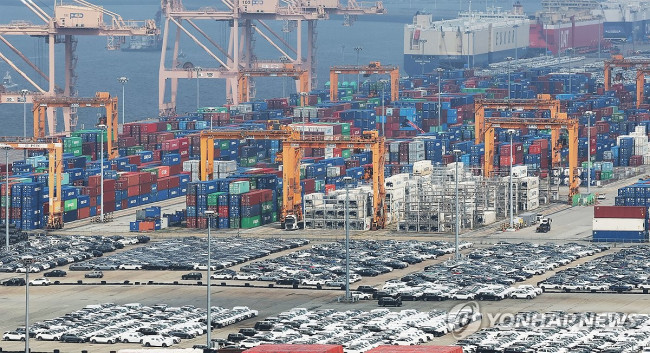 Pyeongtaek Port container terminal [Yonhap News file photo]
Minister of Trade, Industry and Energy Kim Jung-gwan remarked during a press conference the previous day that "the fact that we are still negotiating is not a bad sign."
It is understood that the government is meticulously coordinating details—such as requesting an unlimited currency swap—due to concerns that a large-scale cash investment of $350 billion could destabilize the foreign exchange market.
Minister Kim added, "The negotiations are in a push-and-pull phase. I have been firm at the table, raising my voice to ensure our position is heard. These processes are recurring to achieve a 'win-win' outcome for both sides."
Experts have largely advised against rushing to sign an agreement, suggesting that it is better to conclude the negotiations cautiously, even if it takes more time.
Jang Sang-sik, head of the International Trade and Trade Research Institute at the Korea International Trade Association, noted, "The stalemate seems likely to persist for a while. It may take two to three months to find common ground. We need to persuade the U.S. by offering cooperation in areas where South Korea has strengths and the U.S. lacks, such as shipbuilding, nuclear power, and semiconductors."
Hur Yoon, a professor at Sogang University’s Graduate School of International Studies, added, "While cars are important, we must negotiate by considering the overall impact on the national economy. I believe it is possible to expand our bargaining power by leveraging assets like the 'MARS' (Mutual Arrangement for Reciprocal Support) or other cards."
While there are hopes that the negotiations could gain momentum during President Lee Jae-myung’s visit to New York for the UN General Assembly next week, the likelihood appears low.
This is because there is insufficient time to resolve complex issues, including a U.S.-Korea currency swap and visa concerns for South Korean employees.
Diplomatic circles are leaning toward the possibility that the documentation of the U.S.-Korea tariff agreement will be finalized during the Asia-Pacific Economic Cooperation (APEC) summit in Gyeongju at the end of October, given the high probability of President Trump’s attendance.
Yonhap News

 Iranian Foreign Ministry: "Continuing Message Exchanges with the U.S. and Activities of Mediating Countries"
Esmaeil Baghaei, Spokesperson for the Iranian Ministry of Foreign Affairs [Xinhua, Yonhap News file photo]Esmaeil Baghaei, spokesperson for the Iranian Ministry of Foreign Affairs, stated on the 26th
Iranian Foreign Ministry: "Continuing Message Exchanges with the U.S. and Activities of Mediating Countries"
Esmaeil Baghaei, Spokesperson for the Iranian Ministry of Foreign Affairs [Xinhua, Yonhap News file photo]Esmaeil Baghaei, spokesperson for the Iranian Ministry of Foreign Affairs, stated on the 26th
 President Yoon: "Do You Think You Are Safe from the Special Counsel?"... Final Statement Video Released
President Yoon Suk Yeol rebuking the special prosecutor on the 24th. [Court video / @birds_justice X account subtitle GIF] A video of President Yoon Suk Yeol's closing statement at his trial rega
President Yoon: "Do You Think You Are Safe from the Special Counsel?"... Final Statement Video Released
President Yoon Suk Yeol rebuking the special prosecutor on the 24th. [Court video / @birds_justice X account subtitle GIF] A video of President Yoon Suk Yeol's closing statement at his trial rega
 President Yoon, regarding the first-instance ruling on the Public Official Election Act: “An excessive political verdict that distorts the facts… We will appeal immediately.”
The first-instance sentencing hearing for President Yoon Suk Yeol regarding violations of the Public Official Election Act is being broadcast live at Seoul Station on the 27th. [Photo=Yonhap News]Pres
President Yoon, regarding the first-instance ruling on the Public Official Election Act: “An excessive political verdict that distorts the facts… We will appeal immediately.”
The first-instance sentencing hearing for President Yoon Suk Yeol regarding violations of the Public Official Election Act is being broadcast live at Seoul Station on the 27th. [Photo=Yonhap News]Pres
 WSJ: "SK Hynix ADR Premium Is a Sign of AI Trading Overheat"
Advertisement for SK Hynix ADR listing in New York's Times Square [Reuters=Yonhap News file photo]The Wall Street Journal (WSJ) has pointed out that the price of SK Hynix’s American Depositary Recei
WSJ: "SK Hynix ADR Premium Is a Sign of AI Trading Overheat"
Advertisement for SK Hynix ADR listing in New York's Times Square [Reuters=Yonhap News file photo]The Wall Street Journal (WSJ) has pointed out that the price of SK Hynix’s American Depositary Recei
 'Godfather of Japanese Mystery Novels' Keigo Higashino Passes Away After Battle with Cancer at 68
Famous Japanese mystery novelist Keigo Higashino [AFP=Yonhap News]It has been belatedly reported that Keigo Higashino, the "godfather of Japanese mystery novels" and author of bestsellers such as "The
'Godfather of Japanese Mystery Novels' Keigo Higashino Passes Away After Battle with Cancer at 68
Famous Japanese mystery novelist Keigo Higashino [AFP=Yonhap News]It has been belatedly reported that Keigo Higashino, the "godfather of Japanese mystery novels" and author of bestsellers such as "The
 [Park Pil-kyu Security Column] To the Ignorant Trying to Clothe a Beast in Sheep's Clothing
Rep. Kim Byung-joo of the Democratic Party of Korea [Photo=Yonhap News]“The Air Force Academy doesn't teach you how to fly a plane!” “The Army, Navy, and Air Force academies are exactly the
[Park Pil-kyu Security Column] To the Ignorant Trying to Clothe a Beast in Sheep's Clothing
Rep. Kim Byung-joo of the Democratic Party of Korea [Photo=Yonhap News]“The Air Force Academy doesn't teach you how to fly a plane!” “The Army, Navy, and Air Force academies are exactly the
 [Issue Diagnosis] Two Effects of the Election Petition Review
 [Photo] Evidence of Election Fraud Flooding U.S. Media… Trump Had 2.7 Million Votes Stolen
 [Video] U.S. Semiquincentennial Air Show... 'Art in the Sky' streaks across New York
 [Editorial Cartoon] A Draconian Law That Undermines Freedom of Expression

 List
List









