 The Supreme Court of the United States. Reuters Yonhap News.
A case challenging the legality of "reciprocal tariffs" imposed by U.S. President Donald Trump on various countries, including South Korea, will have its first hearing at the Supreme Court on November 5 (local time).
The Supreme Court designated November 5 as the date for oral arguments in its hearing schedule released on the 18th.
The Supreme Court has decided to expedite this case as requested by the Trump administration, and U.S. media predict that a ruling may be possible within the year.
The lawsuit's central issue is whether President Trump has the authority to impose broad tariffs based on the International Emergency Economic Powers Act (IEEPA), enacted in 1977.
President Trump imposed so-called "reciprocal tariffs" on countries worldwide through IEEPA. However, lower courts (first and second instances) ruled that the import regulation authority granted to the president by IEEPA does not include the power to impose tariffs.
The U.S. Constitution grants Congress the authority to levy taxes, including tariffs.
Therefore, if the Supreme Court upholds the lower courts' rulings, the 15% reciprocal tariff imposed by President Trump on South Korean products could be invalidated.
Tariffs imposed on China, Canada, and Mexico for their alleged failure to prevent drug smuggling into the United States also fall under this category.
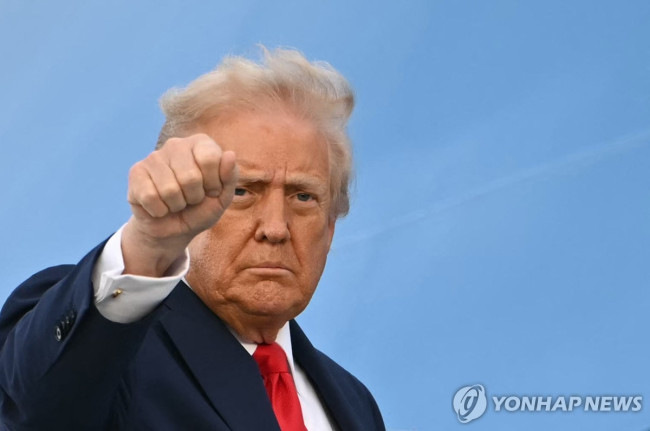 U.S. President Trump. AFP Yonhap News.
In addition to the interpretation of IEEPA, there is also interest in whether the Supreme Court will apply the "Major Questions Doctrine" in this case.
This doctrine posits that the executive branch should not unilaterally make policies that have significant economic or political implications for the nation by flexibly interpreting statutes, unless Congress has explicitly delegated such authority to the executive branch.
The Supreme Court applied this doctrine when it blocked several Democratic policies, including former President Joe Biden's student loan forgiveness plan.
However, the current conservative composition of the Supreme Court is cited as a variable.
The Supreme Court, composed of nine justices, has six conservative justices, including three appointed by President Trump during his first term.
In recent years, the Supreme Court has shown a tendency to rule favorably for the conservative bloc, such as in July of last year when it granted broad presidential immunity for official acts during a former president's tenure, thereby halting criminal proceedings related to President Trump.
President Trump has expressed confidence that the Supreme Court will side with the executive branch.
President Trump and senior administration officials have argued that if they lose the tariff lawsuit, trade agreements with countries like South Korea could be invalidated, leading to the ruin of the United States.
However, even if the Supreme Court rules that the tariffs based on IEEPA are illegal, President Trump has various other means to impose tariffs.
Furthermore, the item-specific tariffs imposed on automobiles and steel, based on Section 232 of the Trade Expansion Act, are unrelated to this lawsuit.
Other provisions such as Section 301 and Section 122 of the Trade Act, and Section 338 of the Tariff Act, are also mentioned as means for imposing tariffs.
Hanmi Daily, Yonhap News

 Iranian Foreign Ministry: "Continuing Message Exchanges with the U.S. and Activities of Mediating Countries"
Esmaeil Baghaei, Spokesperson for the Iranian Ministry of Foreign Affairs [Xinhua, Yonhap News file photo]Esmaeil Baghaei, spokesperson for the Iranian Ministry of Foreign Affairs, stated on the 26th
Iranian Foreign Ministry: "Continuing Message Exchanges with the U.S. and Activities of Mediating Countries"
Esmaeil Baghaei, Spokesperson for the Iranian Ministry of Foreign Affairs [Xinhua, Yonhap News file photo]Esmaeil Baghaei, spokesperson for the Iranian Ministry of Foreign Affairs, stated on the 26th
 President Yoon: "Do You Think You Are Safe from the Special Counsel?"... Final Statement Video Released
President Yoon Suk Yeol rebuking the special prosecutor on the 24th. [Court video / @birds_justice X account subtitle GIF] A video of President Yoon Suk Yeol's closing statement at his trial rega
President Yoon: "Do You Think You Are Safe from the Special Counsel?"... Final Statement Video Released
President Yoon Suk Yeol rebuking the special prosecutor on the 24th. [Court video / @birds_justice X account subtitle GIF] A video of President Yoon Suk Yeol's closing statement at his trial rega
 President Yoon, regarding the first-instance ruling on the Public Official Election Act: “An excessive political verdict that distorts the facts… We will appeal immediately.”
The first-instance sentencing hearing for President Yoon Suk Yeol regarding violations of the Public Official Election Act is being broadcast live at Seoul Station on the 27th. [Photo=Yonhap News]Pres
President Yoon, regarding the first-instance ruling on the Public Official Election Act: “An excessive political verdict that distorts the facts… We will appeal immediately.”
The first-instance sentencing hearing for President Yoon Suk Yeol regarding violations of the Public Official Election Act is being broadcast live at Seoul Station on the 27th. [Photo=Yonhap News]Pres
 WSJ: "SK Hynix ADR Premium Is a Sign of AI Trading Overheat"
Advertisement for SK Hynix ADR listing in New York's Times Square [Reuters=Yonhap News file photo]The Wall Street Journal (WSJ) has pointed out that the price of SK Hynix’s American Depositary Recei
WSJ: "SK Hynix ADR Premium Is a Sign of AI Trading Overheat"
Advertisement for SK Hynix ADR listing in New York's Times Square [Reuters=Yonhap News file photo]The Wall Street Journal (WSJ) has pointed out that the price of SK Hynix’s American Depositary Recei
 'Godfather of Japanese Mystery Novels' Keigo Higashino Passes Away After Battle with Cancer at 68
Famous Japanese mystery novelist Keigo Higashino [AFP=Yonhap News]It has been belatedly reported that Keigo Higashino, the "godfather of Japanese mystery novels" and author of bestsellers such as "The
'Godfather of Japanese Mystery Novels' Keigo Higashino Passes Away After Battle with Cancer at 68
Famous Japanese mystery novelist Keigo Higashino [AFP=Yonhap News]It has been belatedly reported that Keigo Higashino, the "godfather of Japanese mystery novels" and author of bestsellers such as "The
 [Park Pil-kyu Security Column] To the Ignorant Trying to Clothe a Beast in Sheep's Clothing
Rep. Kim Byung-joo of the Democratic Party of Korea [Photo=Yonhap News]“The Air Force Academy doesn't teach you how to fly a plane!” “The Army, Navy, and Air Force academies are exactly the
[Park Pil-kyu Security Column] To the Ignorant Trying to Clothe a Beast in Sheep's Clothing
Rep. Kim Byung-joo of the Democratic Party of Korea [Photo=Yonhap News]“The Air Force Academy doesn't teach you how to fly a plane!” “The Army, Navy, and Air Force academies are exactly the
 [Issue Diagnosis] Two Effects of the Election Petition Review
 [Photo] Evidence of Election Fraud Flooding U.S. Media… Trump Had 2.7 Million Votes Stolen
 [Video] U.S. Semiquincentennial Air Show... 'Art in the Sky' streaks across New York
 [Editorial Cartoon] A Draconian Law That Undermines Freedom of Expression

 List
List









