 A Japanese daily reported on the 23rd that the U.S. is considering a Northeast Asian defense perimeter that excludes South Korea and Taiwan. / Captured from Nihon Keizai Shimbun.
Japan's Nikkei: "U.S. Department of War Reviews New Far East Defense Perimeter Excluding South Korea"
Citing the 'Weighty Lessons of the Past' regarding the Korean War, it adds, "Trump's Words and Actions Cause Anxiety"
A Closer Look at the Reasons Cited by the Japanese Paper: Part of a U.S.-led 'Reorganization of the New Cold War Order against China'
The U.S. Department of War (formerly the Department of Defense) is reportedly considering a new "National Defense Strategy"—expected to be announced next month—that would include only Japan in its defense perimeter while excluding South Korea and Taiwan, reported Japan’s Nihon Keizai (Nikkei) Shimbun on the 23rd.
According to the Nikkei, this worst-case scenario is included among the four patterns of defense perimeters the U.S. is considering. The report expresses concern that if this plan is realized, North Korea and China would become more aggressive, increasing the risk of conflict in Northeast Asia.
Specifically, the newspaper noted that the four patterns under consideration for the new Asian defense perimeter are: (1) including Japan but excluding South Korea and Taiwan, (2) including South Korea, Japan, and Taiwan, (3) including Japan and Taiwan but excluding South Korea, and (4) including South Korea and Japan but excluding Taiwan.
The report added, "For regional stability in Northeast Asia, a line that includes South Korea, Japan, and Taiwan is the best option," noting that the U.S. has fundamentally maintained this line until now.
However, the paper stated that if the U.S. decides to exclude South Korea alone, or South Korea along with Taiwan, it would evoke the "extremely heavy lessons of the past."
This refers to the "Acheson Line," established by U.S. Secretary of State Dean Acheson during the Harry Truman administration in 1950.
At the time, the U.S. unilaterally drew a Far East defense line that excluded South Korea, which led to the perception among communist adversaries like North Korea that the U.S. would not intervene if a war broke out on the peninsula, ultimately resulting in the Korean War.
According to the report, the U.S. is currently in the process of establishing this National Defense Strategy while deeply engaged in secret intelligence gathering.
The National Defense Strategy is a key document through which the U.S. government sets the parameters for U.S. military participation or involvement approximately every four years. The 2018 National Defense Strategy, during the first Trump administration, defined China and Russia as significant challengers to the U.S.-led security order and set its defense perimeter based on a policy of winning the competition against these nations.
The U.S. Department of War reportedly completed a draft of the new National Defense Strategy by the end of last month, and it is currently being circulated within the administration.
According to the left-leaning U.S. political news outlet Politico, cited in the article, a draft has been prepared that prioritizes the defense of the U.S. mainland by revising the 2018 policy centered on countering China and Russia. The Nikkei expressed alarm, stating, "If this happens, the global impact will be significant. As the U.S. military turns 'inward' (prioritizing domestic security), there is concern about negative ripple effects on Europe or the Indo-Pacific region, including South Korea and Japan."
The newspaper predicted that while there may be minor adjustments until the final version is decided, the overall framework is unlikely to change, expecting the current draft to be finalized. However, it did not specify which scenario is considered the most probable.
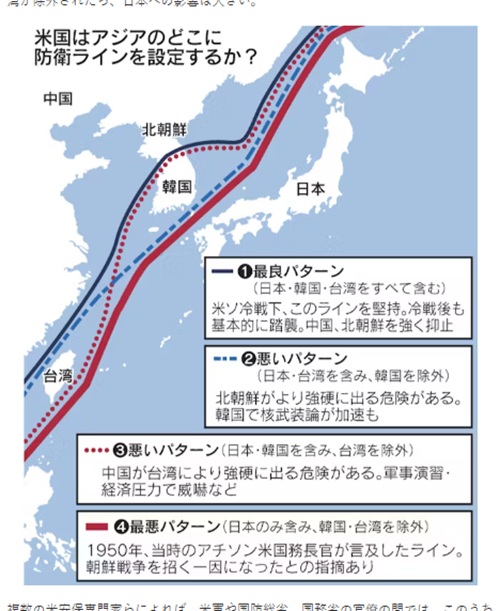 Northeast Asian defense perimeters reportedly under consideration by the U.S. / Captured from Nikkei online.
In this regard, the report noted that President Donald Trump has strengthened his stance on prioritizing the defense of the U.S. mainland since last month and has taken the lead in conceptualizing the new strategy. The paper interprets this as a strategic move to emphasize "U.S. Mainland Defense Firstism," moving beyond mere "America First."
The newspaper listed as evidence that the U.S. has: sent troops to the Caribbean to block drug trafficking; killed 11 people in an attack on a Venezuelan vessel suspected of illegal drug transport; and announced its intention to reduce military support for the three Baltic states, which are NATO members bordering Russia.
Consequently, while a sense of resignation permeates Europe that a reduction in U.S. military support is inevitable, the newspaper observed that Asian allies of the U.S. had hoped for increased U.S. military involvement in Asia as part of a strategy to counter China.
At the same time, it added the concern that if the Trump administration adheres to "U.S. Mainland Defense Firstism," there is room for a reduction in U.S. military involvement in Asia as well.
The report also stated that the Trump administration does not yet appear to have settled on where in Asia it should set its "defense line"—the line that must be defended even at great cost—while considering U.S. national interests.
According to multiple U.S. security experts, the consensus among U.S. military, War Department, and State Department officials is to support the best-case pattern (including South Korea, Japan, and Taiwan), but the paper claims that figures like Vice President JD Vance, who are cautious about overseas military intervention, are skeptical about how deeply the U.S. should be involved in defending South Korea and Taiwan.
As a result, the Nikkei predicted that a plan discussed secretly—and previously shelved—within some parts of the administration to reduce U.S. military defense of South Korea in exchange for recognizing South Korea's nuclear armament as a countermeasure against North Korea, could potentially re-emerge.
Furthermore, the newspaper assessed that Vice President Vance also lacks the will to defend Taiwan. This perspective contrasts with the prevailing view among U.S. military and congressional circles, where China hawks argue that Taiwan must be defended.
Ultimately, the newspaper concluded that the U.S. military's new Asian defense perimeter is a matter that depends on President Trump’s judgment, adding, "Given President Trump's past words and actions, one cannot help but feel uneasy."
However, the author of the article, Hiroyuki Akita, cited as evidence for these "words and actions" the fact that while President Trump is very angry with China over trade deficits, he lacks the willingness to curb the expansion of the Chinese military through deep U.S. involvement in ensuring Asian security.
The author also presented his own argument that Trump lacks a geopolitical mindset that views the world map as a chessboard and is prepared to compete for power against China.
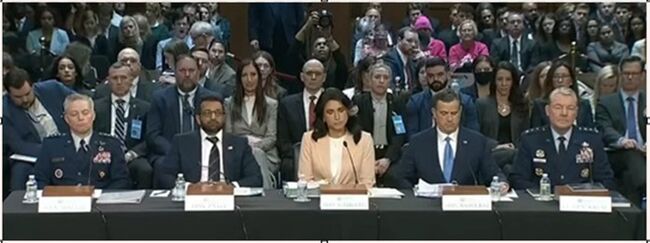 Director of National Intelligence (DNI) Tulsi Gabbard (center), FBI Director Kash Patel (second from left), and CIA Director John Ratcliffe (second from right) attend a joint hearing of the Senate and House Intelligence Committees on Capitol Hill in Washington, D.C., on March 26. / Captured from FOX News.
This seems to be far from the general perception of the American conservative base. Supporters of the "MAGA" (Make America Great Again) movement, who form President Trump’s core support, identify China as the "primary adversary" and believe the Trump administration is employing a diplomatic strategy to control China’s expanding military power and dismantle the Chinese Communist Party (CCP).
In particular, the newspaper quoted a former U.S. government official who knows Trump well as asserting, "President Trump lacks the sense that the U.S. and China are currently in a strategic standoff involving their total national power."
The perspective of the Japanese reporter also differs significantly from the general MAGA observation that the U.S.-China hegemony struggle currently determines the world's political dynamics. The viewpoint that President Trump is overlooking military confrontation while dealing with the primary adversary can be seen as an error stemming from reliance on left-leaning U.S. media sources.
Earlier, immediately after the start of the second Trump administration, the heads of intelligence, security, and investigative agencies unanimously identified the CCP as the "primary adversary." During a joint hearing of the U.S. Senate and House Intelligence Committees held in Washington D.C. in March, Director of National Intelligence Tulsi Gabbard essentially solidified the concept of the primary adversary, stating, "China under the Xi Jinping regime, which is aiming for global hegemony, is evaluated as the 'most capable strategic competitor' among our adversaries."
CIA Director John Ratcliffe also stated, "The CCP is exploiting U.S. vulnerabilities through asymmetric attacks," and FBI Director Kash Patel emphasized, "I agree with Director Gabbard's point that U.S. adversaries like China, North Korea, and Russia are cooperating at a higher level," adding that "The CCP is also harming critical U.S. infrastructure," and that intelligence agencies are focusing their cooperative capabilities on stopping them.
House Intelligence Committee Chairman Rick Crawford (R-AR) noted, "The threat from the CCP, which is expanding its powerful military and espionage capabilities, is spreading beyond the Pacific to the West and across the globe," adding, "We are even facing a reality where aggressiveness is constantly increasing to the brink of armed conflict." Senator Michael Bennet (D-CO) also called for a response from U.S. intelligence agencies regarding China’s infiltration methods, which directly affect U.S. security and the prosperity of the American people.
These remarks show a stark difference in perception from the comments of the former U.S. official cited by the Nikkei Shimbun.
Reporter Heo Gyeom

 Trump pressures for rate cut again ahead of FOMC... "Should be the lowest in the world"
U.S. President Donald Trump. [Photo = The White House] U.S. President Donald Trump once again pressured the Federal Reserve, the U.S. central bank, to lower interest rates on the 27th (local time
Trump pressures for rate cut again ahead of FOMC... "Should be the lowest in the world"
U.S. President Donald Trump. [Photo = The White House] U.S. President Donald Trump once again pressured the Federal Reserve, the U.S. central bank, to lower interest rates on the 27th (local time
 “Ignoring crisp ballots and damaged seals”… Tongyeong mayoral recount concludes with ‘no change in outcome,’ leaving suspicions and public outrage behind
Suspected counterfeit ballots discovered in Tongyeong [GIF from social media of Representative Hwang Kyo-ahn / Attorney Park Joo-hyun]During a recount of the Tongyeong mayoral election in South Gyeong
“Ignoring crisp ballots and damaged seals”… Tongyeong mayoral recount concludes with ‘no change in outcome,’ leaving suspicions and public outrage behind
Suspected counterfeit ballots discovered in Tongyeong [GIF from social media of Representative Hwang Kyo-ahn / Attorney Park Joo-hyun]During a recount of the Tongyeong mayoral election in South Gyeong
 President Yoon, regarding the first-instance ruling on the Public Official Election Act: “An excessive political verdict that distorts the facts… We will appeal immediately.”
The first-instance sentencing hearing for President Yoon Suk Yeol regarding violations of the Public Official Election Act is being broadcast live at Seoul Station on the 27th. [Photo=Yonhap News]Pres
President Yoon, regarding the first-instance ruling on the Public Official Election Act: “An excessive political verdict that distorts the facts… We will appeal immediately.”
The first-instance sentencing hearing for President Yoon Suk Yeol regarding violations of the Public Official Election Act is being broadcast live at Seoul Station on the 27th. [Photo=Yonhap News]Pres
 WSJ: "SK Hynix ADR Premium Is a Sign of AI Trading Overheat"
Advertisement for SK Hynix ADR listing in New York's Times Square [Reuters=Yonhap News file photo]The Wall Street Journal (WSJ) has pointed out that the price of SK Hynix’s American Depositary Recei
WSJ: "SK Hynix ADR Premium Is a Sign of AI Trading Overheat"
Advertisement for SK Hynix ADR listing in New York's Times Square [Reuters=Yonhap News file photo]The Wall Street Journal (WSJ) has pointed out that the price of SK Hynix’s American Depositary Recei
 'Godfather of Japanese Mystery Novels' Keigo Higashino Passes Away After Battle with Cancer at 68
Famous Japanese mystery novelist Keigo Higashino [AFP=Yonhap News]It has been belatedly reported that Keigo Higashino, the "godfather of Japanese mystery novels" and author of bestsellers such as "The
'Godfather of Japanese Mystery Novels' Keigo Higashino Passes Away After Battle with Cancer at 68
Famous Japanese mystery novelist Keigo Higashino [AFP=Yonhap News]It has been belatedly reported that Keigo Higashino, the "godfather of Japanese mystery novels" and author of bestsellers such as "The
 [Park Pil-kyu Security Column] To the Ignorant Trying to Clothe a Beast in Sheep's Clothing
Rep. Kim Byung-joo of the Democratic Party of Korea [Photo=Yonhap News]“The Air Force Academy doesn't teach you how to fly a plane!” “The Army, Navy, and Air Force academies are exactly the
[Park Pil-kyu Security Column] To the Ignorant Trying to Clothe a Beast in Sheep's Clothing
Rep. Kim Byung-joo of the Democratic Party of Korea [Photo=Yonhap News]“The Air Force Academy doesn't teach you how to fly a plane!” “The Army, Navy, and Air Force academies are exactly the
 [Issue Diagnosis] Two Effects of the Election Petition Review
 [Photo] Evidence of Election Fraud Flooding U.S. Media… Trump Had 2.7 Million Votes Stolen
 [Video] U.S. Semiquincentennial Air Show... 'Art in the Sky' streaks across New York
 [Editorial Cartoon] A Draconian Law That Undermines Freedom of Expression

 List
List









