Presidential Office: "Currency Swap Isn't the End-All... No Sacrificing Principles Due to Deadlines"
"Currency Swap is a Necessary Condition... EXIM Bank Act Revision and Parliamentary Consent May Be Required; Commercial Rationality Must Be Met"
"Negotiating for U.S.-Demanded 'Cash Flow' to Closely Resemble Loans... Principles of Sustainability, National Interest, and Mutual Benefit Must Be Upheld"
"Non-Tariff Areas Such as Rice and Beef Off the Table... Negotiations Keeping the Gyeongju APEC Summit in Mind as the Next Milestone"
 Policy Chief Kim Yong-beom briefing. (New York=Yonhap News) Han Sang-gyun = Kim Yong-beom, Chief of Policy for the Presidential Office, gives a briefing on the 24th (local time) at the UN Headquarters in New York regarding the meeting between President Lee Jae-myung and U.S. Treasury Secretary Scott Bessent. 2025.9.25 xyz@yna.co.kr
Kim Yong-beom, Chief of Policy for the Presidential Office, stated on the 24th (local time) regarding the "South Korea-U.S. currency swap," which has emerged as a key issue in tariff negotiations, that "simply securing an unlimited currency swap does not automatically mean all (negotiations) are resolved."
Chief Kim, who is accompanying President Lee Jae-myung on his visit to New York for the UN General Assembly, said during a briefing that day, "To use a high school math analogy, an unlimited currency swap is a necessary condition."
This means that since a currency swap is merely a minimum safety net, there are additional stages that must be discussed even if one is signed.
Referring to President Lee’s recent foreign media interview where he mentioned the possibility of a "foreign exchange crisis" to emphasize the need for a swap, Kim explained, "If that doesn't happen, the shock would be too severe. It is a necessary condition that must be met to proceed to the next step."
However, he clarified, "Meeting that condition does not automatically lead to the $350 billion investment in the form of 'equity' (cash investment) that the U.S. is demanding. Sufficient conditions must also be met."
He added, "(The investment scale) must be within the scope permitted by our current laws. If necessary, we may need to amend the Export-Import Bank of Korea Act, or if it represents a significant burden, we would also need to obtain the National Assembly's consent for the guarantee."
He stated that meeting the "commercial rationality" emphasized by President Lee is also one of the sufficient conditions.
Kim emphasized, "We mentioned the currency swap because we need at least that answer from the U.S. to move to the next stage, and only when all sufficient conditions are met can we discuss which projects to invest in and how much."
Regarding the process that led the government to request a currency swap from the U.S., he stated, "After the July 31 tariff agreement, there was a discrepancy in the contents of the Memorandum of Understanding (MOU) sent by the U.S."
The Korean side had assumed that the initial $350 billion investment agreement would consist mostly of loans or guarantees and had even noted this in a memorandum, but the U.S. had a different understanding.
He said, "The U.S. used the term 'cash flow,' but when we examined it, we realized they were pushing for something very close to equity. We recognized the potential shock it could have on our foreign exchange market and are currently pointing this out to the U.S."
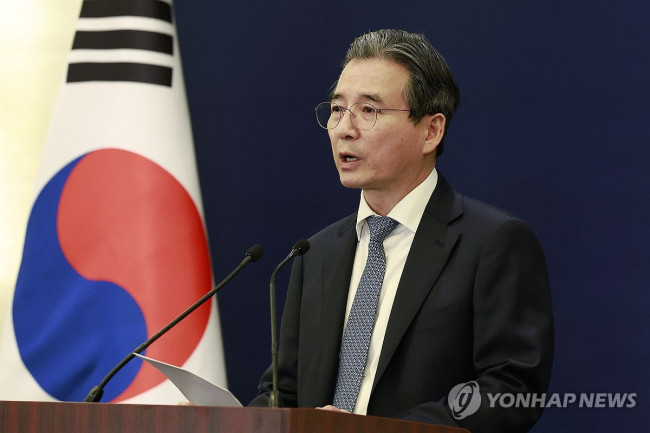 Policy Chief Kim Yong-beom briefing. (New York=Yonhap News) Han Sang-gyun = Kim Yong-beom, Chief of Policy for the Presidential Office, gives a briefing on the 24th (local time) at the UN Headquarters in New York regarding the meeting between President Lee Jae-myung and U.S. Treasury Secretary Scott Bessent. 2025.9.25 xyz@yna.co.kr
Regarding the current state of negotiations, he explained, "We are urging the U.S. to define the cash flow using our terminology—loans, guarantees, and investments—but they have not yet agreed. We are currently negotiating the language to ensure the cash flow takes on a nature as close to a loan as possible."
He also mentioned that South Korea had proposed terms that align with the national interest, such as splitting future profits 9 to 1 between Korea and the U.S. before returns are realized.
Kim emphasized, "We are negotiating based on the principle that the outcome must meet commercial rationality, be sustainable for us, serve the national interest, and be mutually beneficial. We will not sacrifice those principles simply because of a deadline."
He also stated, "We are making it clear that issues like rice and beef cannot be discussed. Our premise is that non-tariff areas are strictly excluded. We are conducting substantive discussions in the remaining areas."
Regarding President Lee's meeting with U.S. Treasury Secretary Scott Bessent earlier that day, Kim said, "It was a positive meeting, and both countries will do their best to ensure it leads to concrete results."
On the outlook for future negotiations, he noted, "The next important milestone is the Gyeongju APEC Summit, and we are keeping that in mind during our negotiations." Yonhap News

 Iranian Foreign Ministry: "Continuing Message Exchanges with the U.S. and Activities of Mediating Countries"
Esmaeil Baghaei, Spokesperson for the Iranian Ministry of Foreign Affairs [Xinhua, Yonhap News file photo]Esmaeil Baghaei, spokesperson for the Iranian Ministry of Foreign Affairs, stated on the 26th
Iranian Foreign Ministry: "Continuing Message Exchanges with the U.S. and Activities of Mediating Countries"
Esmaeil Baghaei, Spokesperson for the Iranian Ministry of Foreign Affairs [Xinhua, Yonhap News file photo]Esmaeil Baghaei, spokesperson for the Iranian Ministry of Foreign Affairs, stated on the 26th
 President Yoon: "Do You Think You Are Safe from the Special Counsel?"... Final Statement Video Released
President Yoon Suk Yeol rebuking the special prosecutor on the 24th. [Court video / @birds_justice X account subtitle GIF] A video of President Yoon Suk Yeol's closing statement at his trial rega
President Yoon: "Do You Think You Are Safe from the Special Counsel?"... Final Statement Video Released
President Yoon Suk Yeol rebuking the special prosecutor on the 24th. [Court video / @birds_justice X account subtitle GIF] A video of President Yoon Suk Yeol's closing statement at his trial rega
 President Yoon, regarding the first-instance ruling on the Public Official Election Act: “An excessive political verdict that distorts the facts… We will appeal immediately.”
The first-instance sentencing hearing for President Yoon Suk Yeol regarding violations of the Public Official Election Act is being broadcast live at Seoul Station on the 27th. [Photo=Yonhap News]Pres
President Yoon, regarding the first-instance ruling on the Public Official Election Act: “An excessive political verdict that distorts the facts… We will appeal immediately.”
The first-instance sentencing hearing for President Yoon Suk Yeol regarding violations of the Public Official Election Act is being broadcast live at Seoul Station on the 27th. [Photo=Yonhap News]Pres
 WSJ: "SK Hynix ADR Premium Is a Sign of AI Trading Overheat"
Advertisement for SK Hynix ADR listing in New York's Times Square [Reuters=Yonhap News file photo]The Wall Street Journal (WSJ) has pointed out that the price of SK Hynix’s American Depositary Recei
WSJ: "SK Hynix ADR Premium Is a Sign of AI Trading Overheat"
Advertisement for SK Hynix ADR listing in New York's Times Square [Reuters=Yonhap News file photo]The Wall Street Journal (WSJ) has pointed out that the price of SK Hynix’s American Depositary Recei
 'Godfather of Japanese Mystery Novels' Keigo Higashino Passes Away After Battle with Cancer at 68
Famous Japanese mystery novelist Keigo Higashino [AFP=Yonhap News]It has been belatedly reported that Keigo Higashino, the "godfather of Japanese mystery novels" and author of bestsellers such as "The
'Godfather of Japanese Mystery Novels' Keigo Higashino Passes Away After Battle with Cancer at 68
Famous Japanese mystery novelist Keigo Higashino [AFP=Yonhap News]It has been belatedly reported that Keigo Higashino, the "godfather of Japanese mystery novels" and author of bestsellers such as "The
 [Park Pil-kyu Security Column] To the Ignorant Trying to Clothe a Beast in Sheep's Clothing
Rep. Kim Byung-joo of the Democratic Party of Korea [Photo=Yonhap News]“The Air Force Academy doesn't teach you how to fly a plane!” “The Army, Navy, and Air Force academies are exactly the
[Park Pil-kyu Security Column] To the Ignorant Trying to Clothe a Beast in Sheep's Clothing
Rep. Kim Byung-joo of the Democratic Party of Korea [Photo=Yonhap News]“The Air Force Academy doesn't teach you how to fly a plane!” “The Army, Navy, and Air Force academies are exactly the
 [Issue Diagnosis] Two Effects of the Election Petition Review
 [Photo] Evidence of Election Fraud Flooding U.S. Media… Trump Had 2.7 Million Votes Stolen
 [Video] U.S. Semiquincentennial Air Show... 'Art in the Sky' streaks across New York
 [Editorial Cartoon] A Draconian Law That Undermines Freedom of Expression

 List
List









