Manufacturing Outlook Declines Amid Tariff Shock... Auto, Steel, and Pharmaceuticals 'Shaken'
Only Semiconductors and Food Show Resilience... AI Demand and K-Food Exports Act as Buffers
 Car Exports [Yonhap News Archive Photo]
The manufacturing sector's perceived economic conditions are contracting as the impact of U.S. tariffs begins to take full effect.
According to a survey of 2,275 manufacturing companies nationwide conducted by the Korea Chamber of Commerce and Industry (KCCI), the Business Survey Index (BSI) for the fourth quarter stood at 74.
This represents a 7-point decrease from the third quarter and an 11-point drop from the fourth quarter of last year. Following two consecutive quarters of increases this year, the index has turned downward again.
A BSI above 100 indicates that more companies have a positive outlook on the quarter's economy compared to the previous one, while a BSI below 100 signifies the opposite. The index has remained below the benchmark for 17 consecutive quarters since the fourth quarter of 2021 (91).
The outlook for export-oriented companies (-13 points) showed a sharper decline than that of domestic-oriented companies (-5 points), as tariffs have already been implemented or high tariffs are anticipated for sectors such as automobiles, steel, and pharmaceuticals.
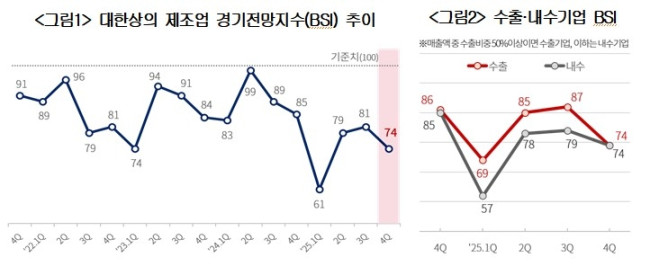 KCCI Manufacturing Business Survey Index (BSI) Results [Provided by the Korea Chamber of Commerce and Industry. Reproduction and Database Prohibited]
By industry, in the fourth quarter, the outlook for all sectors fell short of the benchmark of 100 due to the impact of tariffs.
The automotive sector's outlook was 60, a 16-point decrease from the previous quarter, placing it in an unfavorable position with higher tariff rates applied from September compared to Japan and the European Union (EU).
The prolonged downturn in the construction industry, a key downstream sector, led to outlooks below 70 for non-metallic minerals (56), steel (63), and petrochemicals (63).
The steel industry faces amplified difficulties due to a 50% tariff on exports to the U.S., while the petrochemical sector is struggling with oversupply from China and the Middle East.
The outlook for cosmetics and pharmaceuticals/biologics, which had surpassed the benchmark at 113 and 109 respectively in the second quarter, also dropped below 100.
Cosmetics (69), whose export growth has slowed, experienced the largest decline (-44 points) in its outlook, with the abolition of duty-free benefits for small parcel shipments to the U.S. acting as a contributing factor.
The pharmaceuticals/biologics sector (87) saw its outlook turn negative with the U.S. announcing its intention to impose high tariffs on imported medicines.
The sectors that showed the most resilience were semiconductors (98) and food (98).
Semiconductors approached the benchmark, driven by demand for Artificial Intelligence (AI) despite tariff uncertainties, while food benefited from the holiday season and robust K-food exports.
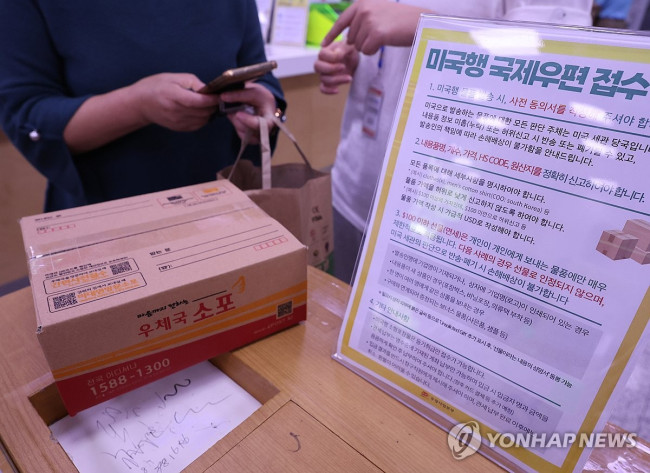 Notice for International Mail to the U.S. [Yonhap News Archive Photo]
The BSI for metropolitan cities and provinces also fell below the benchmark in all regions.
Specifically, Daegu (60), which is concentrated in the automotive parts and textile industries, Gyeongbuk (68), with a high proportion of steel and electronics sectors, and Busan (66), with a significant presence of metal and machinery industries, recorded indices below 70 due to the impact of tariffs.
Jeonnam (60), Chungnam (71), and Ulsan (74), home to the three major petrochemical complexes, also saw their indices decline from the previous quarter, as profitability worsened due to slowing demand for their main products and global oversupply.
Kim Hyun-soo, Head of the Economic Policy Team at the KCCI, stated, "To prevent the weakening of manufacturing competitiveness, the government needs to expand support measures, including emergency liquidity supply, deregulation, and enhanced investment incentives, to act as a breakwater that can withstand external shocks." Yonhap News

 Iranian Foreign Ministry: "Continuing Message Exchanges with the U.S. and Activities of Mediating Countries"
Esmaeil Baghaei, Spokesperson for the Iranian Ministry of Foreign Affairs [Xinhua, Yonhap News file photo]Esmaeil Baghaei, spokesperson for the Iranian Ministry of Foreign Affairs, stated on the 26th
Iranian Foreign Ministry: "Continuing Message Exchanges with the U.S. and Activities of Mediating Countries"
Esmaeil Baghaei, Spokesperson for the Iranian Ministry of Foreign Affairs [Xinhua, Yonhap News file photo]Esmaeil Baghaei, spokesperson for the Iranian Ministry of Foreign Affairs, stated on the 26th
 President Yoon: "Do You Think You Are Safe from the Special Counsel?"... Final Statement Video Released
President Yoon Suk Yeol rebuking the special prosecutor on the 24th. [Court video / @birds_justice X account subtitle GIF] A video of President Yoon Suk Yeol's closing statement at his trial rega
President Yoon: "Do You Think You Are Safe from the Special Counsel?"... Final Statement Video Released
President Yoon Suk Yeol rebuking the special prosecutor on the 24th. [Court video / @birds_justice X account subtitle GIF] A video of President Yoon Suk Yeol's closing statement at his trial rega
 President Yoon, regarding the first-instance ruling on the Public Official Election Act: “An excessive political verdict that distorts the facts… We will appeal immediately.”
The first-instance sentencing hearing for President Yoon Suk Yeol regarding violations of the Public Official Election Act is being broadcast live at Seoul Station on the 27th. [Photo=Yonhap News]Pres
President Yoon, regarding the first-instance ruling on the Public Official Election Act: “An excessive political verdict that distorts the facts… We will appeal immediately.”
The first-instance sentencing hearing for President Yoon Suk Yeol regarding violations of the Public Official Election Act is being broadcast live at Seoul Station on the 27th. [Photo=Yonhap News]Pres
 WSJ: "SK Hynix ADR Premium Is a Sign of AI Trading Overheat"
Advertisement for SK Hynix ADR listing in New York's Times Square [Reuters=Yonhap News file photo]The Wall Street Journal (WSJ) has pointed out that the price of SK Hynix’s American Depositary Recei
WSJ: "SK Hynix ADR Premium Is a Sign of AI Trading Overheat"
Advertisement for SK Hynix ADR listing in New York's Times Square [Reuters=Yonhap News file photo]The Wall Street Journal (WSJ) has pointed out that the price of SK Hynix’s American Depositary Recei
 'Godfather of Japanese Mystery Novels' Keigo Higashino Passes Away After Battle with Cancer at 68
Famous Japanese mystery novelist Keigo Higashino [AFP=Yonhap News]It has been belatedly reported that Keigo Higashino, the "godfather of Japanese mystery novels" and author of bestsellers such as "The
'Godfather of Japanese Mystery Novels' Keigo Higashino Passes Away After Battle with Cancer at 68
Famous Japanese mystery novelist Keigo Higashino [AFP=Yonhap News]It has been belatedly reported that Keigo Higashino, the "godfather of Japanese mystery novels" and author of bestsellers such as "The
 [Park Pil-kyu Security Column] To the Ignorant Trying to Clothe a Beast in Sheep's Clothing
Rep. Kim Byung-joo of the Democratic Party of Korea [Photo=Yonhap News]“The Air Force Academy doesn't teach you how to fly a plane!” “The Army, Navy, and Air Force academies are exactly the
[Park Pil-kyu Security Column] To the Ignorant Trying to Clothe a Beast in Sheep's Clothing
Rep. Kim Byung-joo of the Democratic Party of Korea [Photo=Yonhap News]“The Air Force Academy doesn't teach you how to fly a plane!” “The Army, Navy, and Air Force academies are exactly the
 [Issue Diagnosis] Two Effects of the Election Petition Review
 [Photo] Evidence of Election Fraud Flooding U.S. Media… Trump Had 2.7 Million Votes Stolen
 [Video] U.S. Semiquincentennial Air Show... 'Art in the Sky' streaks across New York
 [Editorial Cartoon] A Draconian Law That Undermines Freedom of Expression

 List
List









