 Laszlo Krasznahorkai, winner of the Nobel Prize in Literature. EPA=Yonhap News.
On Hangul Day, the 9th, Laszlo Krasznahorkai, winner of the Nobel Prize in Literature, is a novelist who primarily deals with the stories of people bound to tragic situations 'involuntarily,' focusing not on various events or characters but on the bleak landscapes of life.
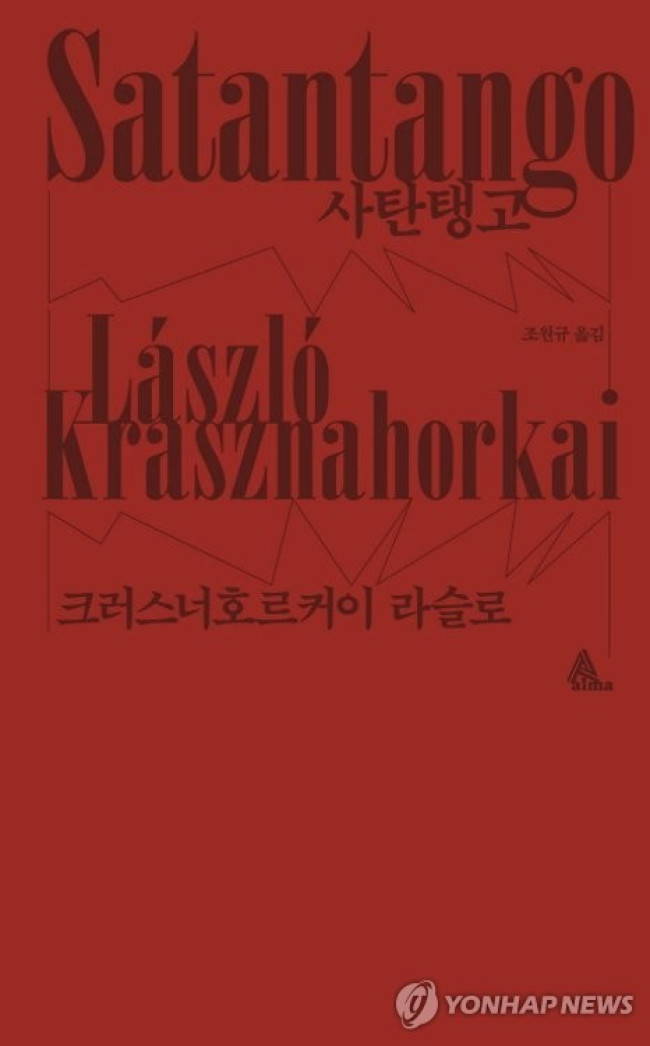
Through his major four-part series, including 'Satan's Tango,' 'The Melancholy of Resistance,' 'War and War,' and 'The Baron Wenckheim's Homecoming,' he has explored themes of despair, suffering, corruption, bondage, war, and repetition that life presents. His literature borders on apocalyptic tragedy in that while his characters await a messiah to save their lives, they are unable to escape their harsh reality in the slightest.
 Courtesy of Alma.
His representative work known in Korea is 'Satan's Tango.'
It is a long novel, better known for being adapted into a film by the acclaimed Hungarian director Bela Tarr. Much like the slow film, shot in long takes with extreme economy of scenes for over seven hours, Krasznahorkai's original novel bizarrely depicts the despair within sticky everyday life.
Hungary in the 1980s, as communism was collapsing. Amidst those remaining in a village of a disbanded collective farm, mired in poverty and distrust, living listless lives, a rumor begins to circulate. It was said that Irimiás, who was known to have died a year and a half ago, was returning to the village.
Upon hearing of his return, with his overwhelming charisma, coinciding with the start of the autumn monsoon, the villagers are filled with the sweet dream of escaping their desperate lives, while simultaneously suffering from an unknown fear and anxiety. The tolling of bells without a clapper and invisible spiderwebs woven by unseen spiders fuel the terror of the world's collapse.
"He will ultimately face a merciless, summary judgment and be handed over to those who meticulously skin him, laughing, along with the corpse washers, without being assigned any class marker. At that moment, he will irrevocably realize the scale of life's affairs. The outcome of stepping into a game with swindlers has long been decided, and in the end, he will even lose the hope of returning once more to a state of rest, the last weapon he possessed." (From 'Satan's Tango')
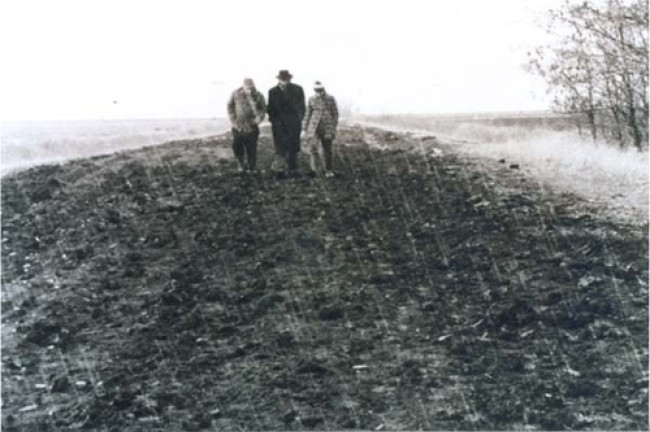 A scene from 'Satan's Tango'
'Satan's Tango' is not a novel featuring diverse events and intersecting, thrilling narratives. It depicts the crushing of dreams in the daily lives of people gripped by despair, who, like waiting for a savior, live through days and nights in a desolate landscape.
All the villagers' efforts to escape the cycle of their ruined lives ultimately end in failure. It is, in essence, an apocalypse of despair, depicting an eternal cycle of suffering, much like Nietzsche's eternal recurrence.
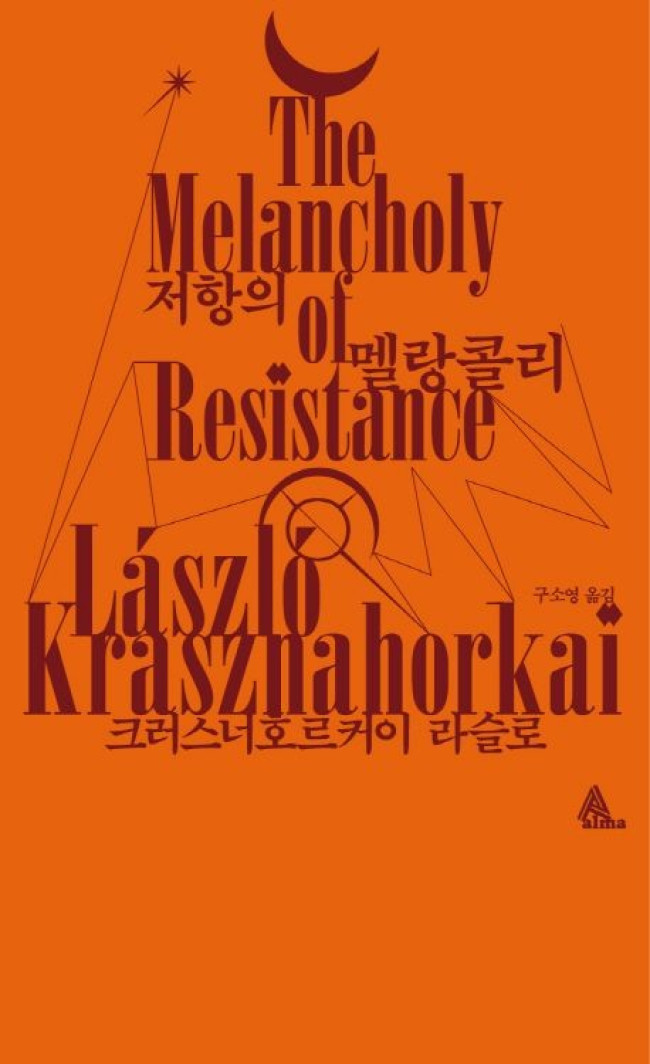
His other masterpiece, 'The Melancholy of Resistance,' shares a similar vein with 'Satan's Tango.'
In a small Hungarian village. Bitterly cold weather persists, streetlights inexplicably fail to turn on, a giant tree is uprooted overnight, and the church clock, stopped for decades, begins to move. At the same time, a traveling circus arrives in town, advertising 'The Largest Whale in the World,' and rumors and paranoia begin to spread throughout the village.
The unique aspect of this novel is that a menacing truck transporting this whale, without causing any direct harm to the village, drives the entire community into madness simply by being quietly parked in the middle of the town square.
Professor Han Kyung-min of the Department of Hungarian Studies at Hankuk University of Foreign Studies interpreted, "The characters' actions in the novel are bizarre, which has similarities to modern people. This is because modern people believe they live very rationally and logically, but in reality, they live lives swayed by rumors."
 Courtesy of Alma.
'War and War' is a story that explores how humans lose their sense of self and conflict in a world destroyed by war. The protagonist, Ibrahim, depicts the continuity of war and humanity's meaningless struggles, portraying him as a character caught in what seems like an endless mechanism of war. His inner world is constantly chaotic and powerless, with external war and internal conflict intertwined, revealing his struggles. The novel strongly poses existential questions about human existence and ethical dilemmas, deeply conveying human anxiety and suffering.
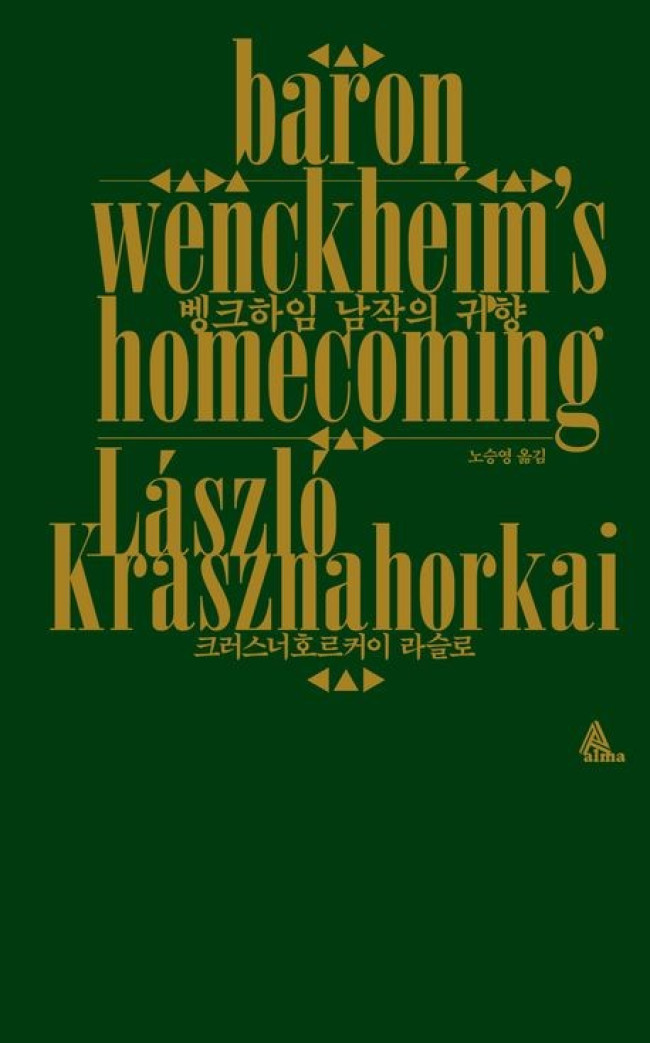
The concluding work of the four-part series, 'The Baron Wenckheim's Homecoming,' is set in a small Hungarian village and tells the story of Baron Wenckheim's return. The Baron, after living abroad for a long time, returns to his hometown, but the villagers harbor doubts about his reasons for returning and his past.
The novel deals with themes of horror, corruption, and power, with the story unfolding around the protagonist Baron's complex psychology and the social reality he faces. Krasznahorkai unsparingly depicts social corruption, political decay, and the distortion of collective memory.
 Courtesy of Alma.
Krasznahorkai also collaborated with Hungarian director Bela Tarr. He wrote the screenplays for five of Tarr's films, including the acclaimed 'Satan's Tango' and 'The Turin Horse.' 'The Turin Horse,' like 'Satan's Tango,' is a black-and-white film where a single scene, lasting over ten minutes, is shot in almost one continuous take. The story, which unfolds when someone (in this film, Gypsies) arrives in the village, is similar to his previous works.
After the Gypsies visit and touch the well, it suddenly dries up. Lacking drinking water, a father and daughter prepare to leave with their horse and cart. However, despair mingled with the biting wind crushes their futile hope. The relentlessly howling wind forces them to turn back, and the father and daughter are once again trapped in a house without a drop of water.
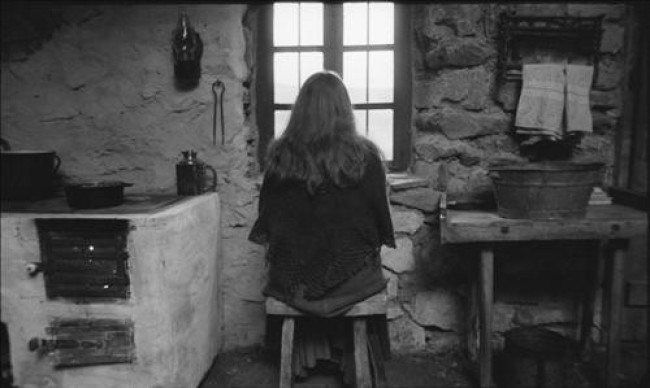 A scene from the film 'The Turin Horse'
Pessimism about life, death, and distrust in humanity are deeply imbued in the film. This is characteristic of most of Krasznahorkai's works. His novels and screenplays do not focus on the grand meaning of history but rather constantly question the fragility of life, the immensity of the world, and the place of humanity within such a world.
Above all, his works offer a unique aesthetic, characterized by the perfect choice of words, precise metaphors, the power of imagination and narrative, the accumulation of sentences, and beautifully crafted prose that paradoxically blooms from the despair of life. His long, flowing sentences, often described as his trademark, seem to symbolize unending despair, stretching on and on.
Noh Seung-young, the translator of 'The Baron Wenckheim's Homecoming' and 'The Arrival of Queen Sheba,' commented, "The preface alone for 'The Baron Wenckheim's Homecoming' is over seven pages long and is written as a single sentence. It's a section where the author uses musical orchestration to express his artistic and literary philosophy because the events come later, and you can see how that single, lengthy sentence maintains unity and a consistent thematic consciousness."
Ahn Ji-mi, CEO of Alma Publishing, which has released six of his books, explained, "While the plot might seem simple if explained, there are many details, and aeschatological worldview underpins all his works. However, they also contain a touch of humor, so it's not purely bleak content."
Ahn is preparing for the publication of his novel 'Hershitt 07769.' His works are known for being challenging to translate, so the book is expected to be released around next year.
Yonhap News

 Iranian Foreign Ministry: "Continuing Message Exchanges with the U.S. and Activities of Mediating Countries"
Esmaeil Baghaei, Spokesperson for the Iranian Ministry of Foreign Affairs [Xinhua, Yonhap News file photo]Esmaeil Baghaei, spokesperson for the Iranian Ministry of Foreign Affairs, stated on the 26th
Iranian Foreign Ministry: "Continuing Message Exchanges with the U.S. and Activities of Mediating Countries"
Esmaeil Baghaei, Spokesperson for the Iranian Ministry of Foreign Affairs [Xinhua, Yonhap News file photo]Esmaeil Baghaei, spokesperson for the Iranian Ministry of Foreign Affairs, stated on the 26th
 President Yoon: "Do You Think You Are Safe from the Special Counsel?"... Final Statement Video Released
President Yoon Suk Yeol rebuking the special prosecutor on the 24th. [Court video / @birds_justice X account subtitle GIF] A video of President Yoon Suk Yeol's closing statement at his trial rega
President Yoon: "Do You Think You Are Safe from the Special Counsel?"... Final Statement Video Released
President Yoon Suk Yeol rebuking the special prosecutor on the 24th. [Court video / @birds_justice X account subtitle GIF] A video of President Yoon Suk Yeol's closing statement at his trial rega
 President Yoon, regarding the first-instance ruling on the Public Official Election Act: “An excessive political verdict that distorts the facts… We will appeal immediately.”
The first-instance sentencing hearing for President Yoon Suk Yeol regarding violations of the Public Official Election Act is being broadcast live at Seoul Station on the 27th. [Photo=Yonhap News]Pres
President Yoon, regarding the first-instance ruling on the Public Official Election Act: “An excessive political verdict that distorts the facts… We will appeal immediately.”
The first-instance sentencing hearing for President Yoon Suk Yeol regarding violations of the Public Official Election Act is being broadcast live at Seoul Station on the 27th. [Photo=Yonhap News]Pres
 WSJ: "SK Hynix ADR Premium Is a Sign of AI Trading Overheat"
Advertisement for SK Hynix ADR listing in New York's Times Square [Reuters=Yonhap News file photo]The Wall Street Journal (WSJ) has pointed out that the price of SK Hynix’s American Depositary Recei
WSJ: "SK Hynix ADR Premium Is a Sign of AI Trading Overheat"
Advertisement for SK Hynix ADR listing in New York's Times Square [Reuters=Yonhap News file photo]The Wall Street Journal (WSJ) has pointed out that the price of SK Hynix’s American Depositary Recei
 'Godfather of Japanese Mystery Novels' Keigo Higashino Passes Away After Battle with Cancer at 68
Famous Japanese mystery novelist Keigo Higashino [AFP=Yonhap News]It has been belatedly reported that Keigo Higashino, the "godfather of Japanese mystery novels" and author of bestsellers such as "The
'Godfather of Japanese Mystery Novels' Keigo Higashino Passes Away After Battle with Cancer at 68
Famous Japanese mystery novelist Keigo Higashino [AFP=Yonhap News]It has been belatedly reported that Keigo Higashino, the "godfather of Japanese mystery novels" and author of bestsellers such as "The
 [Park Pil-kyu Security Column] To the Ignorant Trying to Clothe a Beast in Sheep's Clothing
Rep. Kim Byung-joo of the Democratic Party of Korea [Photo=Yonhap News]“The Air Force Academy doesn't teach you how to fly a plane!” “The Army, Navy, and Air Force academies are exactly the
[Park Pil-kyu Security Column] To the Ignorant Trying to Clothe a Beast in Sheep's Clothing
Rep. Kim Byung-joo of the Democratic Party of Korea [Photo=Yonhap News]“The Air Force Academy doesn't teach you how to fly a plane!” “The Army, Navy, and Air Force academies are exactly the
 [Issue Diagnosis] Two Effects of the Election Petition Review
 [Photo] Evidence of Election Fraud Flooding U.S. Media… Trump Had 2.7 Million Votes Stolen
 [Video] U.S. Semiquincentennial Air Show... 'Art in the Sky' streaks across New York
 [Editorial Cartoon] A Draconian Law That Undermines Freedom of Expression

 List
List









