Will US Semiconductor Strategy Bear Fruit... Domestic Industry 'Tense' Over Intel's Advanced Process Announcement
Rapid Management Normalization Amid Technological Achievements... Orders & Verification Remain Challenges
With the US government fostering growth, NVIDIA, Apple, and AMD also offer support.
Intel, which was on the verge of becoming a failing company, has announced the mass production of the world's first 2nm-class advanced semiconductor process under the US government's semiconductor industry promotion policy, causing significant tension in the domestic industry.
This achievement, surpassing South Korea's Samsung Electronics and Taiwan's TSMC, which have boasted superiority in semiconductor manufacturing capabilities, is expected to intensify the global semiconductor hegemony competition.
 Intel Logo [Yonhap News Agency Photo. Re-distribution and DB prohibited]
According to foreign media and industry sources on the 10th, the 18A process announced by Intel is analyzed to be 2nm-class, although specific circuit linewidths have not been disclosed.
While Samsung Electronics and TSMC are also preparing for 2nm mass production within the year, Intel, which faced rumors of withdrawing from the foundry business due to severe financial difficulties, has taken a step ahead by initiating mass production of an advanced process.
The domestic industry's sentiment is that it needs to observe further to determine if this announcement poses an immediate threat, as what is important in the foundry business is not being the first to develop a process, but proving technological prowess through actual orders.
An industry official stated, "It is unlikely that Intel's market share will surge immediately due to the 2nm process," adding, "We need to see how Intel secures customers and builds trust through the volume it actually supplies in the future."
There is a clear sense of caution regarding Intel's rapid management normalization, as it has outpaced competitors with an advanced process in just a few months, despite undergoing restructuring of personnel and businesses until the first half of this year.
An industry official commented, "As Intel could re-emerge as a competitor, we must prepare for changes in the competitive landscape from various angles."
Moreover, there are projections that the market landscape could be shaken in the medium to long term, as this trend is unfolding not only through Intel's own efforts but also through policy support from the US government and its cooperation with domestic big tech companies.
The Fab 52 facility in Arizona, where Intel has begun mass-producing 2nm semiconductors, is the facility for which US President Joe Biden promised subsidies under the CHIPS Act in March last year.
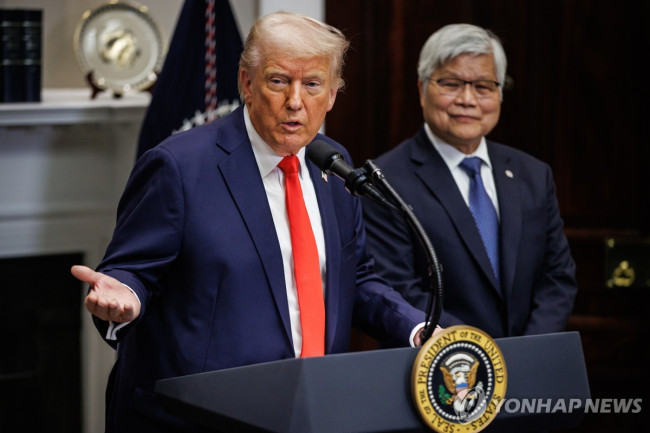 US President Trump meets with TSMC Chairman Wei Zhejia [EPA Yonhap News Agency Photo. Re-distribution and DB prohibited]
Since the Trump administration took office, the US's reshoring policy for its semiconductor industry has accelerated.
Following a commitment from TSMC Chairman Wei Zhejia for nearly 150 trillion won in investment in the US in March, then-US President Donald Trump emphasized at a press conference, "The most powerful artificial intelligence (AI) semiconductors in the world will be made in the US," stating, "This is a matter of economic security as well as national security."
Subsequently, the Trump administration announced a 100% tariff on semiconductors not produced domestically, and in return for its semiconductor subsidies, it converted the investment into equity, securing a 10% stake and thus becoming Intel's largest shareholder.
Under the US government's "Save Intel" initiative, domestic big tech companies are also joining as allies one after another.
Last month, Jensen Huang, CEO of NVIDIA, announced his company would invest approximately 7 trillion won in Intel and jointly develop chips for PCs and data centers, stating, "We will become a very large customer for Intel's central processing units (CPUs)."
Intel has recently requested investment from Apple and exchanged opinions on cooperation, and it is also known that discussions are underway for Intel Foundry to manufacture AMD chips.
With the full support of the US government and big tech, Intel's stock price has risen by more than 50% in about two months since August.
An industry official remarked, "From the US perspective, Intel is a symbol of America's semiconductor resurgence, so comprehensive support for Intel will continue," adding, "In a climate of strengthening American centrism and protectionism, competition between our companies and Intel, an American company, could become even fiercer." Yonhap News

 Iranian Foreign Ministry: "Continuing Message Exchanges with the U.S. and Activities of Mediating Countries"
Esmaeil Baghaei, Spokesperson for the Iranian Ministry of Foreign Affairs [Xinhua, Yonhap News file photo]Esmaeil Baghaei, spokesperson for the Iranian Ministry of Foreign Affairs, stated on the 26th
Iranian Foreign Ministry: "Continuing Message Exchanges with the U.S. and Activities of Mediating Countries"
Esmaeil Baghaei, Spokesperson for the Iranian Ministry of Foreign Affairs [Xinhua, Yonhap News file photo]Esmaeil Baghaei, spokesperson for the Iranian Ministry of Foreign Affairs, stated on the 26th
 President Yoon: "Do You Think You Are Safe from the Special Counsel?"... Final Statement Video Released
President Yoon Suk Yeol rebuking the special prosecutor on the 24th. [Court video / @birds_justice X account subtitle GIF] A video of President Yoon Suk Yeol's closing statement at his trial rega
President Yoon: "Do You Think You Are Safe from the Special Counsel?"... Final Statement Video Released
President Yoon Suk Yeol rebuking the special prosecutor on the 24th. [Court video / @birds_justice X account subtitle GIF] A video of President Yoon Suk Yeol's closing statement at his trial rega
 President Yoon, regarding the first-instance ruling on the Public Official Election Act: “An excessive political verdict that distorts the facts… We will appeal immediately.”
The first-instance sentencing hearing for President Yoon Suk Yeol regarding violations of the Public Official Election Act is being broadcast live at Seoul Station on the 27th. [Photo=Yonhap News]Pres
President Yoon, regarding the first-instance ruling on the Public Official Election Act: “An excessive political verdict that distorts the facts… We will appeal immediately.”
The first-instance sentencing hearing for President Yoon Suk Yeol regarding violations of the Public Official Election Act is being broadcast live at Seoul Station on the 27th. [Photo=Yonhap News]Pres
 WSJ: "SK Hynix ADR Premium Is a Sign of AI Trading Overheat"
Advertisement for SK Hynix ADR listing in New York's Times Square [Reuters=Yonhap News file photo]The Wall Street Journal (WSJ) has pointed out that the price of SK Hynix’s American Depositary Recei
WSJ: "SK Hynix ADR Premium Is a Sign of AI Trading Overheat"
Advertisement for SK Hynix ADR listing in New York's Times Square [Reuters=Yonhap News file photo]The Wall Street Journal (WSJ) has pointed out that the price of SK Hynix’s American Depositary Recei
 'Godfather of Japanese Mystery Novels' Keigo Higashino Passes Away After Battle with Cancer at 68
Famous Japanese mystery novelist Keigo Higashino [AFP=Yonhap News]It has been belatedly reported that Keigo Higashino, the "godfather of Japanese mystery novels" and author of bestsellers such as "The
'Godfather of Japanese Mystery Novels' Keigo Higashino Passes Away After Battle with Cancer at 68
Famous Japanese mystery novelist Keigo Higashino [AFP=Yonhap News]It has been belatedly reported that Keigo Higashino, the "godfather of Japanese mystery novels" and author of bestsellers such as "The
 [Park Pil-kyu Security Column] To the Ignorant Trying to Clothe a Beast in Sheep's Clothing
Rep. Kim Byung-joo of the Democratic Party of Korea [Photo=Yonhap News]“The Air Force Academy doesn't teach you how to fly a plane!” “The Army, Navy, and Air Force academies are exactly the
[Park Pil-kyu Security Column] To the Ignorant Trying to Clothe a Beast in Sheep's Clothing
Rep. Kim Byung-joo of the Democratic Party of Korea [Photo=Yonhap News]“The Air Force Academy doesn't teach you how to fly a plane!” “The Army, Navy, and Air Force academies are exactly the
 [Issue Diagnosis] Two Effects of the Election Petition Review
 [Photo] Evidence of Election Fraud Flooding U.S. Media… Trump Had 2.7 Million Votes Stolen
 [Video] U.S. Semiquincentennial Air Show... 'Art in the Sky' streaks across New York
 [Editorial Cartoon] A Draconian Law That Undermines Freedom of Expression

 List
List









