Representative of the National Union for Free Unification & Doctor of Public Administration Our country has experienced four major economic crises: the oil shock in the 1970s, the IMF foreign exchange crisis in 1998, the global financial crisis in 2008, and the recent pandemic. Since 2019, government spending has significantly increased compared to tax revenue, and with declining economic growth projected at 1.8% in 2023 and 0.9% in 2025, national debt is rapidly rising. Compounded by the current stalemate in tariff negotiations with the United States and the won-dollar exchange rate exceeding 1,400 won, a second IMF foreign exchange crisis is gradually becoming a reality.
National debt refers to the debt that the government is legally obligated to repay, with clearly defined repayment times and amounts, such as through the issuance of government bonds. National liabilities encompass a broader concept, including national debt plus debts of public enterprises, pension liabilities, and other potential future debts for which the government may not have direct repayment obligations.
If not properly managed, national debt can lead to national crisis and collapse. Excessive government spending on social welfare, infrastructure, and military expenditures accumulates debt and increases interest burdens. When debt exceeds 100% of GDP, the country's credit rating declines, and investors demand higher interest rates. A default on debt can block access to international financial markets, leading to IMF bailout loans and the imposition of strict austerity measures (reduced spending, increased taxes). Austerity measures lead to decreased consumption and investment, causing economic recession, and rising unemployment and poverty. Attempts to finance debt by printing money trigger runaway inflation and currency collapse.
National debt can trigger or worsen foreign exchange crises. If a significant portion of national debt is denominated in foreign currencies such as dollars or euros, the repayment burden increases as the domestic currency depreciates (exchange rate spikes). Excessive national debt erodes government credibility and can lead foreign investors to withdraw capital, putting pressure on the foreign exchange market. A high volume of short-term foreign currency borrowing can increase repayment pressure at maturity and lead to a shortage of foreign exchange reserves.
Why is National Debt Soaring?
Global public debt stands at approximately 93% of GDP, with an average of 110% in developed countries. Major developed nations like Japan (235%), the United States (123%), and Italy (137%) have high debt levels, indicating sustained fiscal pressure. South Korea's debt-to-GDP ratio is rapidly increasing: 32.7% in 2000, 44.9% in 2020, and projected at 48.9% in 2025, with further increases to 51.6% in 2026 and 58% in 2029. During the five years of the Moon administration, national debt increased by a staggering 440 trillion won, or 70.2%, from 627 trillion won to 1,067 trillion won.
The total debt, including government, corporate, and household debt, was 232.3% in 2015, 263.7% in 2020, and 248.2% in 2024. Government spending is also projected to increase by an average of 3-8% annually from 2024 to 2026, widening the fiscal deficit. The debt ratio during IMF bailouts has averaged around 100%, often exceeding the unsustainable threshold of 60-90%.
One-party dictatorial regimes, lacking checks and balances, can arbitrarily decide expenditures without reflecting the will of the people, resulting in significantly lower economic growth and efficiency. Modern democratic politics has been corrupted by populism in many countries, facing crises. Politicians beg for votes with sweet promises of money in exchange for power. Citizens lacking a sense of national community demand reciprocal benefits from politicians, creating a vicious cycle. The phenomenon of politicians suffering from fiscal addiction, stealing precious national funds, is rampant.
Politicians, judging that the lower and middle-income populace has more votes than the wealthy, expand welfare and wasteful fiscal expenditures by increasing taxes on the rich, ultimately leading national finances to the brink of collapse.
As society ages and the demographic cliff looms, national debt borne by future generations is snowballing. This includes expanding welfare costs (pensions, health insurance), enormous fixed budgets allocated to civic groups, indiscriminate infrastructure costs built based on regional self-interest, and subsidies to financially depleted local governments. Education budgets remain unchanged despite declining student numbers. Airports in areas with no demand are built with national funds, and operating deficits are also covered by national funds. These fixed expenditures are increasing, leading to severe fiscal inflexibility.
Sustainability means not sacrificing our children and future generations to satisfy the needs of the current generation. For the continuous survival of the national community, selfish desires of individuals, groups, and regions must be restrained.
The Dangerous Level of National Debt
The national debt of major countries is primarily assessed by the Debt-to-GDP ratio, a metric comparing a nation's economic size with its debt repayment capacity. Asian countries that received IMF bailouts after 1997 had relatively low debt ratios (20-60%), with foreign exchange and banking crises as the main causes. However, in the Eurozone crisis (2010~) and recent cases (Argentina, Sri Lanka), high debt ratios exceeding 80% were the primary cause. While the debt ratio is important, rapid increases are highlighted as a major problem. Nations must not manipulate statistics; they must publish accurate data so that everyone can heed the warnings of crisis.
※ IMF Bailouts (Examples): United Kingdom (1976), France (1958, 1969), Italy (1974, 1977), South Korea (1998), Greece (2010), Portugal (2011), Spain (2012), Venezuela (2014~), Argentina (2018)
Recent Economic Situation in Korea
The Korean economy has entered a phase of severe slowdown due to a combination of factors including political instability, global trade tensions, and sluggish domestic demand. With a loss of growth momentum, growth is projected at 1.8% in 2023 and 0.9% in 2025. Political instability has further dampened investment sentiment, and entering an aged society in 2025, coupled with structural issues stemming from low birth rates, is further weakening long-term growth potential. The global industrial economy and trade order operate on capitalist, market economy systems. It is impossible to achieve both growth and welfare through socialist or communist approaches driven by state intervention and control. Due to various sanctions imposed by the U.S. on China, trade volume between Korea and China has significantly decreased, resulting in a deficit. However, the U.S. has once again become Korea's largest trading partner, and Korea maintains a trade surplus with the U.S.
Aggressive unions, focused on confrontation, are at the forefront of creating an anti-business environment. Laws like the "Yellow Envelope Act" and the Serious Accidents Punishment Act, along with commercial law and tax regulations, are frustrating corporate initiative. The "Yellow Envelope Act" expands the collective bargaining rights of subcontracted workers and limits claims for damages from strikes. This could expand labor disputes to corporate restructuring, M&A, and personnel transfers, hindering investment attraction, and foreign business groups have warned of "investment exclusion." Overseas relocation of large corporations is expected to accelerate due to the interaction of domestic policy "push" and overseas, particularly U.S., "pull" factors.
Regional industrial complexes are collapsing in a domino effect. Due to the influx of low-priced Chinese products, the Yeosu petrochemical complex and Pohang's steel industry have lost competitiveness. Crises are emerging with GM's withdrawal decisions in Gunsan and Bupyeong, and the relocation of Kumho Tire's factory in Gwangju overseas. The construction industry is expected to shrink by 9.1% in 2025. Continuous decline in regional population has reduced demand, and ineffective regional balanced development policies (business attraction, innovation cities, corporate cities, etc.) have failed to revive demand. The real estate market is in a downturn, and in some areas, financial institutions have closed or withdrawn operations.
Possibility of Foreign Exchange Crisis
In July 2025, Korea promised investments totaling $350 billion (approximately 500 trillion won) in the U.S. (semiconductors, AI, energy, etc.) in exchange for a 15% tariff rate in tariff negotiations with the U.S. However, the negotiations have reached a stalemate as the Trump administration demanded "upfront cash payments" and control over fund management. Uncertainty has grown, pushing the won-dollar exchange rate past 1,400 won. This is identified as the reason why the Korean won is uniquely weakening despite a global dollar downturn. Foreign investment is massively flowing out of the country. Experts warn that large-scale capital outflows during this process could pressure foreign exchange reserves, pushing the exchange rate to 1,500-1,600 won, and raising the possibility of a recurrence of fiscal and foreign exchange crises.
In the Korea-U.S. tariff negotiations, we are by no means in a strong position. Inciting anti-American sentiment in some quarters will only worsen the situation. With China's economy rapidly collapsing, the only way to solve this problem is to face reality, restore trust between Korea and the U.S., and strengthen the Korea-U.S. alliance. We must minimize country risk and adhere to "Anmi-gyeongmi" (peace through the U.S., economy through the U.S.).
Conclusion
The issue of national debt extends beyond macroeconomics to directly impact citizens' lives; a fiscal crisis inevitably leads to a livelihood crisis. Crises are unpredictable but inevitable, and maintaining fiscal soundness is the best preventive measure. Comprehensive reforms are needed, including the enactment of fiscal rules (legalizing limits on national debt ratio and fiscal deficit, as adopted by OECD countries except Korea and Turkey, and operated by 105 other countries), management of mandatory expenditures such as basic pensions and health insurance, and expansion of revenue streams, as a minimal safety net to protect fiscal soundness from populist spending.
Political power must not tolerate populism, prioritizing the nation's sustainability, and must prevent the autocratic governance of dictatorial parties. Responsible fiscal management that considers future generations, beyond popularity-driven spending, is imperative. Fiscal policy is not merely numbers; it is the power that determines the nation's future.
Especially in the current uncertain external economic climate, Korea, not being a reserve currency nation, must expand its foreign exchange reserves and resolve the tariff negotiations with the United States with utmost urgency.
Shin Dong-chun, Representative of the National Union for Free Unification & Doctor of Public Administration

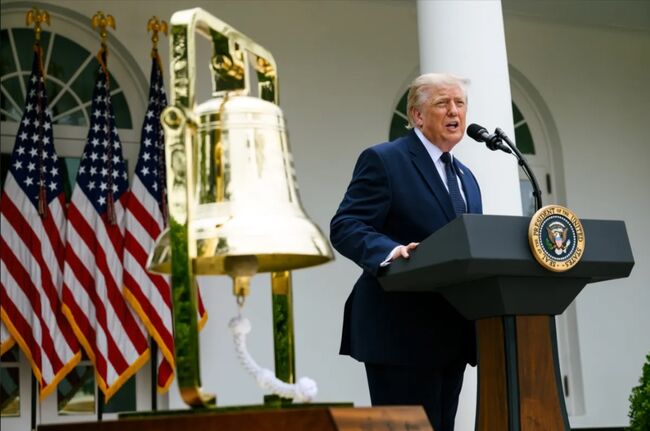 Trump pressures for rate cut again ahead of FOMC... "Should be the lowest in the world"
U.S. President Donald Trump. [Photo = The White House] U.S. President Donald Trump once again pressured the Federal Reserve, the U.S. central bank, to lower interest rates on the 27th (local time
Trump pressures for rate cut again ahead of FOMC... "Should be the lowest in the world"
U.S. President Donald Trump. [Photo = The White House] U.S. President Donald Trump once again pressured the Federal Reserve, the U.S. central bank, to lower interest rates on the 27th (local time
 “Ignoring crisp ballots and damaged seals”… Tongyeong mayoral recount concludes with ‘no change in outcome,’ leaving suspicions and public outrage behind
Suspected counterfeit ballots discovered in Tongyeong [GIF from social media of Representative Hwang Kyo-ahn / Attorney Park Joo-hyun]During a recount of the Tongyeong mayoral election in South Gyeong
“Ignoring crisp ballots and damaged seals”… Tongyeong mayoral recount concludes with ‘no change in outcome,’ leaving suspicions and public outrage behind
Suspected counterfeit ballots discovered in Tongyeong [GIF from social media of Representative Hwang Kyo-ahn / Attorney Park Joo-hyun]During a recount of the Tongyeong mayoral election in South Gyeong
 President Yoon, regarding the first-instance ruling on the Public Official Election Act: “An excessive political verdict that distorts the facts… We will appeal immediately.”
The first-instance sentencing hearing for President Yoon Suk Yeol regarding violations of the Public Official Election Act is being broadcast live at Seoul Station on the 27th. [Photo=Yonhap News]Pres
President Yoon, regarding the first-instance ruling on the Public Official Election Act: “An excessive political verdict that distorts the facts… We will appeal immediately.”
The first-instance sentencing hearing for President Yoon Suk Yeol regarding violations of the Public Official Election Act is being broadcast live at Seoul Station on the 27th. [Photo=Yonhap News]Pres
 WSJ: "SK Hynix ADR Premium Is a Sign of AI Trading Overheat"
Advertisement for SK Hynix ADR listing in New York's Times Square [Reuters=Yonhap News file photo]The Wall Street Journal (WSJ) has pointed out that the price of SK Hynix’s American Depositary Recei
WSJ: "SK Hynix ADR Premium Is a Sign of AI Trading Overheat"
Advertisement for SK Hynix ADR listing in New York's Times Square [Reuters=Yonhap News file photo]The Wall Street Journal (WSJ) has pointed out that the price of SK Hynix’s American Depositary Recei
 'Godfather of Japanese Mystery Novels' Keigo Higashino Passes Away After Battle with Cancer at 68
Famous Japanese mystery novelist Keigo Higashino [AFP=Yonhap News]It has been belatedly reported that Keigo Higashino, the "godfather of Japanese mystery novels" and author of bestsellers such as "The
'Godfather of Japanese Mystery Novels' Keigo Higashino Passes Away After Battle with Cancer at 68
Famous Japanese mystery novelist Keigo Higashino [AFP=Yonhap News]It has been belatedly reported that Keigo Higashino, the "godfather of Japanese mystery novels" and author of bestsellers such as "The
 [Park Pil-kyu Security Column] To the Ignorant Trying to Clothe a Beast in Sheep's Clothing
Rep. Kim Byung-joo of the Democratic Party of Korea [Photo=Yonhap News]“The Air Force Academy doesn't teach you how to fly a plane!” “The Army, Navy, and Air Force academies are exactly the
[Park Pil-kyu Security Column] To the Ignorant Trying to Clothe a Beast in Sheep's Clothing
Rep. Kim Byung-joo of the Democratic Party of Korea [Photo=Yonhap News]“The Air Force Academy doesn't teach you how to fly a plane!” “The Army, Navy, and Air Force academies are exactly the
 [Issue Diagnosis] Two Effects of the Election Petition Review
 [Photo] Evidence of Election Fraud Flooding U.S. Media… Trump Had 2.7 Million Votes Stolen
 [Video] U.S. Semiquincentennial Air Show... 'Art in the Sky' streaks across New York
 [Editorial Cartoon] A Draconian Law That Undermines Freedom of Expression

 List
List