[10·15 Real Estate Measures] 27 Locations in Seoul and Gyeonggi Province Subject to 'Triple Regulations'... Aiming to Curb Balloon Effect (Summary)
Entirety of Seoul, Plus 12 Areas Including Bundang, Yongin, and Suwon, Bundled Under Adjustment Areas, Speculative Zones, and Land Transaction Permit Zones
Full Revival of Regulations After 2 Years and 9 Months... Tightening Loans, Taxes, and Subscription Rules to Block Gap Investment
Adjustment and Speculative Zones Effective from the 16th, Land Transaction Permit Zones from the 20th... "Market Turmoil and Transaction Slump Inevitable"
The Lee Jae-myung administration has unveiled its third set of real estate measures just four months after taking office, following the June 27 loan regulations and the September 7 supply plan.
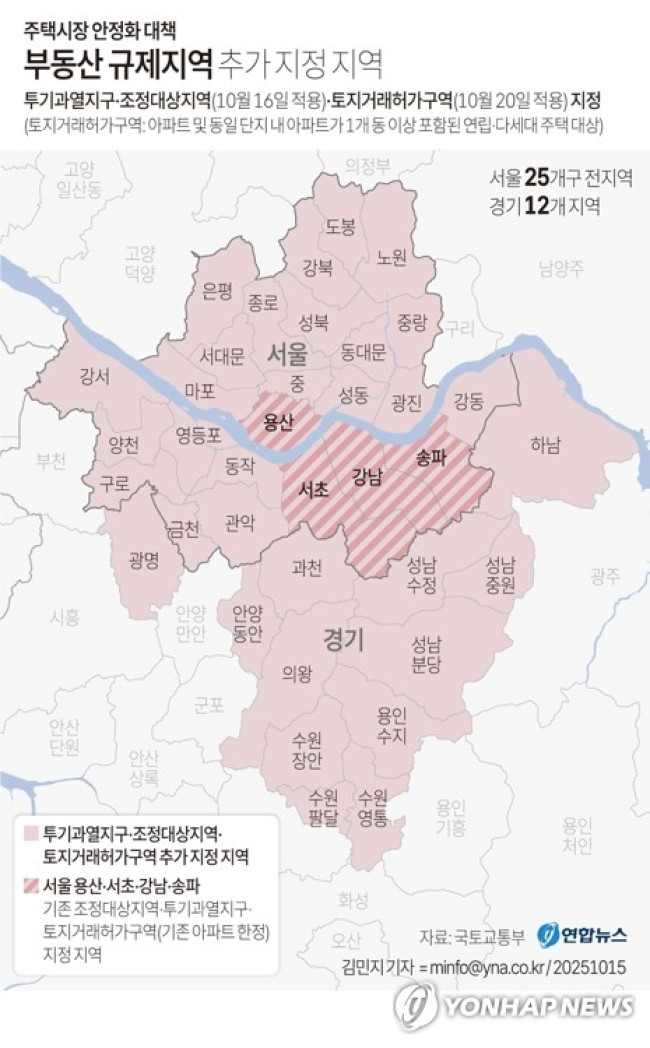
This is a super-strong set of measures that bundles a total of 27 locations—including all 25 districts of Seoul (including the existing regulated areas of the three Gangnam districts and Yongsan-gu) and 12 locations in Gyeonggi Province south of the Han River—under a "triple regulatory" framework consisting of adjustment target areas, speculative districts, and land transaction permit zones, while simultaneously tightening financial regulations.
While Seoul, the metropolitan area, and parts of provincial metropolitan cities have previously been designated as adjustment target areas and speculative districts simultaneously, this is the first time that entire cities—rather than specific districts—such as the three Gangnam districts and Yongsan-gu, have been extensively designated as land transaction permit zones.
This is interpreted as a strong determination to preemptively block the "balloon effect," where price hikes spread from the currently overheated "Han River Belt" and select metropolitan areas like Bundang and Gwacheon to neighboring regions.
Experts anticipate that these measures will lead to a continued slump, including a sharp decline in transactions in the outskirts of Seoul and metropolitan areas where demand from actual residents is not strong.
 View of apartment and housing complexes in Seoul [Yonhap News File Photo]
◇ Full Revival of Regulated Areas After 2 Years and 9 Months... Loan Reductions and Blocked Gap Investments in 27 Metropolitan Locations
In the 10·15 measures, the government maintained existing regulations on the four areas of the three Gangnam districts and Yongsan-gu, while newly designating 12 Gyeonggi regions as adjustment target areas and speculative districts: the remaining 21 districts in Seoul, Gwacheon, Gwangmyeong, Seongnam (Bundang, Sujeong, and Jungwon-gu), Suwon (Yeongtong, Jangan, and Paldal-gu), Anyang (Dongan-gu), Yongin (Suji-gu), Uiwang, and Hanam.
For the entirety of Seoul and four Gyeonggi regions (Gwacheon, Seongnam's Bundang/Sujeong, Hanam, and Gwangmyeong), this marks a redesignation after being lifted from adjustment and speculative status approximately 2 years and 9 months ago in January 2023.
Regions such as Suwon, Anyang, and Yongin were returned to regulatory status 2 years and 11 months after being lifted in November 2022.
The government explained that Seoul, as well as the Gyeonggi regions, met all quantitative criteria including housing price growth rates and inflation rates over the past three months.
While the government expanded speculative districts, it did not bundle them into areas subject to the price ceiling on new apartment sales (bundled-price system).
Kim Gyu-cheol, Director of the Housing and Land Office at the Ministry of Land, Infrastructure and Transport, explained, "The current market issue stems from the rise in housing transaction prices rather than new supply pricing, so we excluded the price ceiling system for now," adding, "We will decide on the price ceiling later by monitoring the situation." Currently, the price ceiling system is applied only to the three Gangnam districts and Yongsan-gu.
Furthermore, the government designated all these regulated areas as land transaction permit zones until December 31 of next year. Thus, 27 locations in Seoul and Gyeonggi have become "triple regulated" areas, subject to adjustment/speculative restrictions as well as land transaction permits.
In land transaction permit zones, the permit requirement now includes not only apartments but also row houses and multi-family housing complexes that contain at least one building within the same complex.
This measure was taken to address the issue of row houses being excluded from land transaction permits in some complexes, such as Nine One Hannam in Yongsan-gu, where both apartments and row houses of four stories or less coexist. The government estimates that a total of 750 row/multi-family housing units will fall under the land transaction permit requirements.
The government decided to pull out such strong regulatory cards because housing prices did not stabilize despite two prior rounds of measures—the June 27 loan regulations and the September 7 supply plan—since the inauguration of the Lee Jae-myung government, and signs of rising prices have spread from the center of Seoul to its outskirts.
By broadly designating not only regulated areas but also land transaction permit zones, the government aims to block loans, subscriptions, and tax loopholes, as well as gap investments and speculative demand, thereby preventing the "balloon effect" of rising prices spreading to neighboring areas.
The Ministry of Land, Infrastructure and Transport compared this to "cancer surgery." It means that rather than superficial treatment, they intend to thoroughly remove the surrounding areas of the lesion to prevent metastasis.
Director Kim Gyu-cheol explained, "We judged that given the current housing market situation—compounded by concerns over supply-demand imbalances and the possibility of interest rate cuts—if we do not respond in a timely manner, we would face a situation where the market cannot be managed at all."
The adjustment target areas and speculative districts will take effect on the 16th upon being published in the official gazette, and the designation period for land transaction permit zones will run from the 20th of this month to December 31 of next year.
The Ministry of Land, Infrastructure and Transport plans to hold a Housing Policy Deliberation Committee every six months to decide whether to redesignate adjustment and speculative zones, and will deliberate on the land transaction permit zones after their expiration.
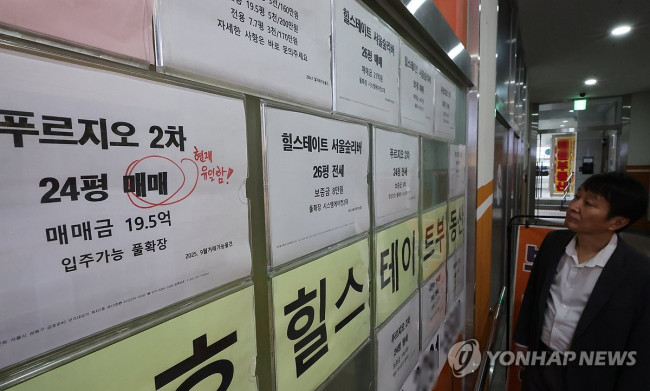 A real estate agency in Seongdong-gu [Yonhap News File Photo]
◇ Loans, Subscriptions, Taxes, and Redevelopment Regulations Tightened... Transactions Expected to Slump
With this measure, 27 locations in the Seoul metropolitan area will see tighter regulations on loans, subscriptions, and taxes, and gap investments involving *jeonse* (lump-sum deposit) rentals will be completely blocked, which is expected to rapidly shrink housing transactions.
First, loans in adjustment target areas and speculative districts will be significantly tightened compared to the previous June 27 measures.
The Loan-to-Value (LTV) ratio for households without homes (including one-home owners under disposal conditions) will be tightened from 70% to 40%, and loans will be completely prohibited for current homeowners.
The government has decided to differentiate LTV limits based on housing prices in regulated areas. While the 600-million-won limit for homes priced at 1.5 billion won or less from the June 27 measures remains, the limit will decrease to 400 million won for homes between 1.5 and 2.5 billion won, and to 200 million won for those exceeding 2.5 billion won.
Consequently, it is expected that purchasing homes will become significantly more difficult, particularly for high-priced properties in the "Han River Belt," such as the three Gangnam districts and the "Ma-Yong-Seong" areas, which have been the epicenter of recent price hikes, rather than in northern Seoul or Gyeonggi, where homes under 1.5 billion won are more common.
Additionally, one-home owners in regulated areas will be restricted from purchasing additional homes if they receive interim payment or relocation loans for reconstruction/redevelopment projects, and mortgage loans for housing purchase purposes (business loans) for entities other than housing sales/rental businesses will be prohibited.
Taxation will also be strengthened. In regulated areas, acquisition taxes will be heavily levied at 8% for two-home owners and 12% for three-home owners.
Furthermore, capital gains taxes for multi-home owners will be surcharged by 20 percentage points for two homes and 30 percentage points for three or more homes above the basic tax rate (6–45%), and deductions for long-term ownership will be completely excluded. However, as the surcharge on capital gains tax for multi-home owners is currently deferred until May 9 of next year, the actual surcharging is expected to be applied after May of next year.
In addition, private rental housing will be excluded from the comprehensive real estate tax exemption, and the requirements for capital gains tax exemption for one-home households will be updated to include a two-year residency requirement in addition to the two-year ownership requirement.
For housing subscriptions, the first-tier eligibility criteria for national and private housing will be strengthened to require at least two years of subscription account membership and being a head of household, the weighting of the point-based system will increase, and the restriction on re-subscription will be extended to a maximum of 10 years. These subscription regulations will apply to applications for occupancy recruitment approval filed after the announcement date of the regulated area designation.
In regulated areas, the resale of housing subscription rights will be prohibited for three years in the metropolitan area and one year in provincial areas. Office buildings with 100 units or more will also have a one-year resale restriction.
The Ministry of Land, Infrastructure and Transport plans to apply the resale restriction immediately from the date of announcement, but those who already hold subscription rights (winners and buyers of rights) at the time of designation will be allowed to resell once.
Urban renewal projects will also be hit by the regulated area designations.
Transfer of association member status will be prohibited after the establishment of the association for reconstruction projects, and after the authorization of the management disposal plan for redevelopment projects. Furthermore, the number of housing units provided per reconstruction association member will be limited to one.
In land transaction permit zones, purchasing a home requires government approval, and a two-year actual residency requirement is imposed, effectively making it impossible to purchase property with a *jeonse* tenant.
In these measures, the government also tightened the LTV for non-residential mortgage loans, such as for commercial properties or officetels, from 70% to 40%, making an impact on the non-residential market inevitable.
Experts expect the housing market in Seoul and the metropolitan area to shrink significantly due to these measures. Turmoil is inevitable, as those who transacted just before these regulations are scrambling to finish contracts, while some are demanding cancellations.
Some voices are also expressing concerns about a decrease in *jeonse* supply and an acceleration of the transition to monthly rent.
Park Won-gap, a senior real estate expert at KB Kookmin Bank, stated, "The 10·15 measures are focused on 'trading up' to higher-value areas through differentiated loan amounts and curbing apartment gap investments through land transaction permit zones." He added, "By blocking the spread of housing prices to the entire Seoul area as well as the southern metropolitan region, we expect properties in these areas to increase while prices decline." Yonhap News

 Iranian Foreign Ministry: "Continuing Message Exchanges with the U.S. and Activities of Mediating Countries"
Esmaeil Baghaei, Spokesperson for the Iranian Ministry of Foreign Affairs [Xinhua, Yonhap News file photo]Esmaeil Baghaei, spokesperson for the Iranian Ministry of Foreign Affairs, stated on the 26th
Iranian Foreign Ministry: "Continuing Message Exchanges with the U.S. and Activities of Mediating Countries"
Esmaeil Baghaei, Spokesperson for the Iranian Ministry of Foreign Affairs [Xinhua, Yonhap News file photo]Esmaeil Baghaei, spokesperson for the Iranian Ministry of Foreign Affairs, stated on the 26th
 President Yoon: "Do You Think You Are Safe from the Special Counsel?"... Final Statement Video Released
President Yoon Suk Yeol rebuking the special prosecutor on the 24th. [Court video / @birds_justice X account subtitle GIF] A video of President Yoon Suk Yeol's closing statement at his trial rega
President Yoon: "Do You Think You Are Safe from the Special Counsel?"... Final Statement Video Released
President Yoon Suk Yeol rebuking the special prosecutor on the 24th. [Court video / @birds_justice X account subtitle GIF] A video of President Yoon Suk Yeol's closing statement at his trial rega
 President Yoon, regarding the first-instance ruling on the Public Official Election Act: “An excessive political verdict that distorts the facts… We will appeal immediately.”
The first-instance sentencing hearing for President Yoon Suk Yeol regarding violations of the Public Official Election Act is being broadcast live at Seoul Station on the 27th. [Photo=Yonhap News]Pres
President Yoon, regarding the first-instance ruling on the Public Official Election Act: “An excessive political verdict that distorts the facts… We will appeal immediately.”
The first-instance sentencing hearing for President Yoon Suk Yeol regarding violations of the Public Official Election Act is being broadcast live at Seoul Station on the 27th. [Photo=Yonhap News]Pres
 WSJ: "SK Hynix ADR Premium Is a Sign of AI Trading Overheat"
Advertisement for SK Hynix ADR listing in New York's Times Square [Reuters=Yonhap News file photo]The Wall Street Journal (WSJ) has pointed out that the price of SK Hynix’s American Depositary Recei
WSJ: "SK Hynix ADR Premium Is a Sign of AI Trading Overheat"
Advertisement for SK Hynix ADR listing in New York's Times Square [Reuters=Yonhap News file photo]The Wall Street Journal (WSJ) has pointed out that the price of SK Hynix’s American Depositary Recei
 'Godfather of Japanese Mystery Novels' Keigo Higashino Passes Away After Battle with Cancer at 68
Famous Japanese mystery novelist Keigo Higashino [AFP=Yonhap News]It has been belatedly reported that Keigo Higashino, the "godfather of Japanese mystery novels" and author of bestsellers such as "The
'Godfather of Japanese Mystery Novels' Keigo Higashino Passes Away After Battle with Cancer at 68
Famous Japanese mystery novelist Keigo Higashino [AFP=Yonhap News]It has been belatedly reported that Keigo Higashino, the "godfather of Japanese mystery novels" and author of bestsellers such as "The
 [Park Pil-kyu Security Column] To the Ignorant Trying to Clothe a Beast in Sheep's Clothing
Rep. Kim Byung-joo of the Democratic Party of Korea [Photo=Yonhap News]“The Air Force Academy doesn't teach you how to fly a plane!” “The Army, Navy, and Air Force academies are exactly the
[Park Pil-kyu Security Column] To the Ignorant Trying to Clothe a Beast in Sheep's Clothing
Rep. Kim Byung-joo of the Democratic Party of Korea [Photo=Yonhap News]“The Air Force Academy doesn't teach you how to fly a plane!” “The Army, Navy, and Air Force academies are exactly the
 [Issue Diagnosis] Two Effects of the Election Petition Review
 [Photo] Evidence of Election Fraud Flooding U.S. Media… Trump Had 2.7 Million Votes Stolen
 [Video] U.S. Semiquincentennial Air Show... 'Art in the Sky' streaks across New York
 [Editorial Cartoon] A Draconian Law That Undermines Freedom of Expression

 List
List










