From Gilt-Bronze Crowns to Armor and Helmets… 1,600-Year-Old 'Silla Warrior' Tomb Discovered
The Korea Heritage Service excavates a tomb built between the late 4th and early 5th centuries in Hwangnam-dong, Gyeongju
Following the discovery at Jjoksaem Tomb C10, horse armor is unearthed again—will it help research into 'heavy cavalry'?
Traces of human sacrifice found beside the tomb occupant, estimated to be around 30 years old: "Evidence of top-tier status at the time"
 View of the Gyeongju Hwangnam-dong No. 1 wooden-chamber tomb [Provided by the Korea Heritage Service. Resale and DB prohibited]
A tomb, believed to house a young Silla warrior who commanded troops on horseback some 1,600 years ago, has been identified.
The discovery is drawing significant attention, as it includes not only armor for both human and horse but also artifacts that offer a glimpse into the status of the tomb's occupant.
On the 20th, the Korea Heritage Service and Gyeongju City announced that they had newly identified a tomb, estimated to have been constructed between the 4th and 5th centuries, while conducting an investigation in the area of the Hwangnam-dong No. 120 tomb complex in Gyeongju.
The Korea Heritage Service stated, "Considering the excavated artifacts and burial patterns, the tomb is presumed to belong to a Silla warrior of the highest status at the time, who also held a specific political role."
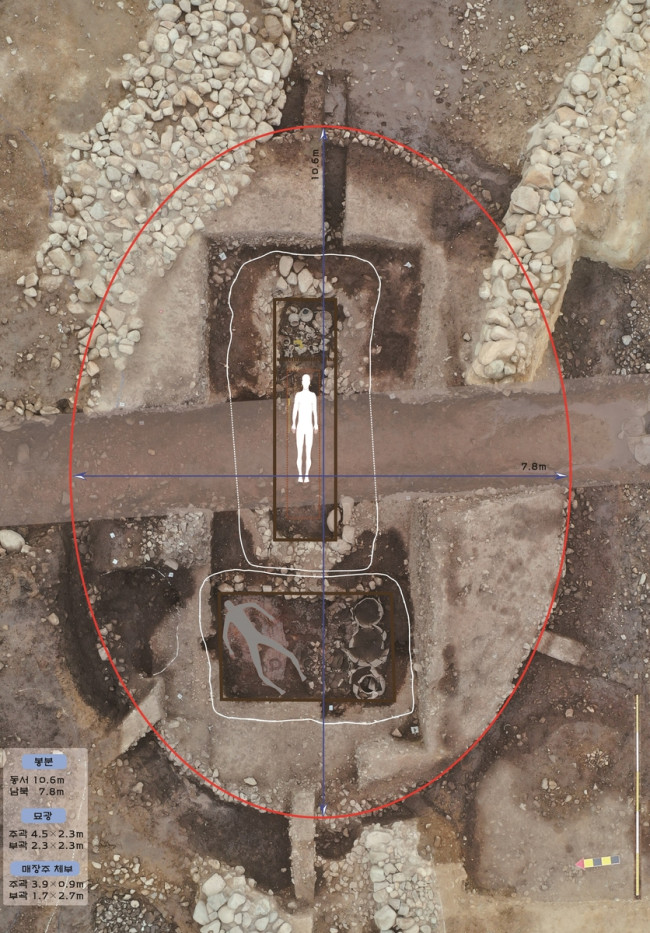 Gyeongju Hwangnam-dong No. 1 wooden-chamber tomb [Provided by the Korea Heritage Service. Resale and DB prohibited]
The Hwangnam-dong No. 120 tomb, located in the Daereungwon area of Gyeongju, was known to exist during the Japanese colonial period but was later damaged and gradually forgotten as residential houses were built over it.
Since 2018, the Korea Heritage Service and Gyeongju City have been excavating the area, identifying additional tombs, such as No. 120-1 to the north and No. 120-2 to the south, while uncovering various artifacts.
The tomb investigated this time was discovered near the northern guard stones (hoseok) of Tomb No. 120.
It is a wooden-chamber tomb (mokgakmyo), a burial structure where the coffin and grave goods are placed within a wooden frame, and it was located beneath the stone-mound wooden-chamber tomb (jeokseok-mokgakbun) of Tomb No. 120.
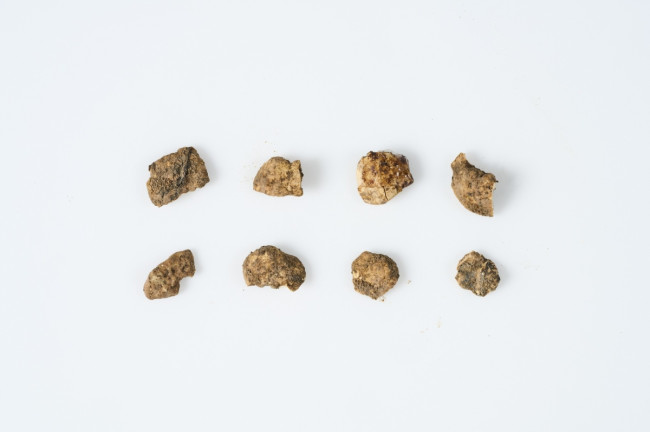 Teeth of the tomb occupant [Provided by the Korea Heritage Service. Resale and DB prohibited]
The burial mound measures 10.6 meters east-to-west and 7.8 meters north-to-south, and it has been named the 'Gyeongju Hwangnam-dong No. 1 wooden-chamber tomb.'
The Silla Cultural Heritage Research Institute, which conducted the excavation, estimates that the tomb was built between the late 4th and early 5th centuries, based on the evolution of Silla tomb styles and the artifacts recovered.
The institute emphasized the significance of the find, stating, "It is a valuable case that clearly demonstrates the transitional period when Silla's tomb style shifted from wooden-chamber tombs to stone-mound wooden-chamber tombs."
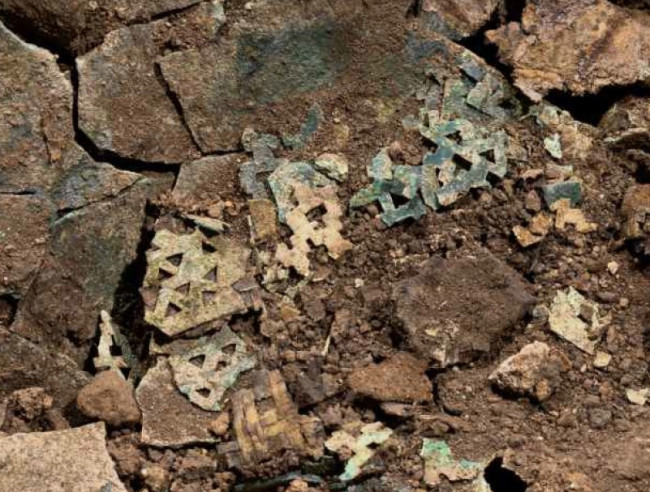 Condition of the gilt-bronze crown upon discovery [Provided by the Korea Heritage Service. Resale and DB prohibited]
As a result of investigations that began in late March of this year, a total of 165 artifacts were recovered from the tomb.
In the main chamber where the occupant was buried, a pair of gold earrings, a long sword with a ring-shaped pommel (hwangdudaedo), and fragments of teeth, likely worn or used by the deceased during his lifetime, were found.
No elaborate ornaments, such as necklaces or belt decorations, were found.
A Korea Heritage Service official explained, "Multiple tooth fragments were identified at the head of the tomb occupant; based on the wear on the second premolar, he is estimated to have been around 30 years old."
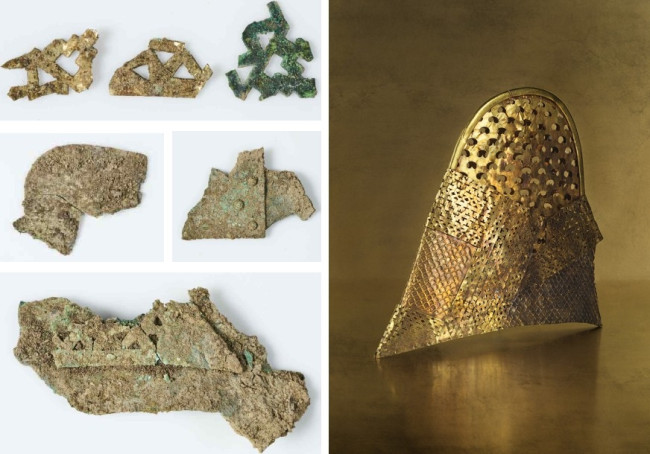 Presumed fragments of the gilt-bronze crown from Hwangnam-dong (left) and the gold cap from the Geumgwanchong tomb. The photo on the right was taken by photographer Koo Bohn-chang [Provided by the Korea Heritage Service/Gyeongju National Museum. Resale and DB prohibited]
The fragments of a gilt-bronze plate found above the main chamber are particularly noteworthy.
Several fragments featuring '△' or '凸' patterns created through openwork (an open-cutting technique in metalwork) were found in the burial chamber.
The Korea Heritage Service reported that these patterns are similar to Goguryeo gilt-bronze decorations reportedly found in the Ji'an region of Jilin Province, China, as well as the 'mogwan' (a cap-shaped Silla crown worn over the head) found in the Geumgwanchong tomb in Gyeongju.
Kim Jae-yeol, a section chief at the Korea Heritage Promotion Institute and an expert in gold crafts and crowns, explained, "Given the shape and patterns, the fragments from the Hwangnam-dong No. 1 tomb are presumed to be a (gilt-bronze) cap-shaped crown."
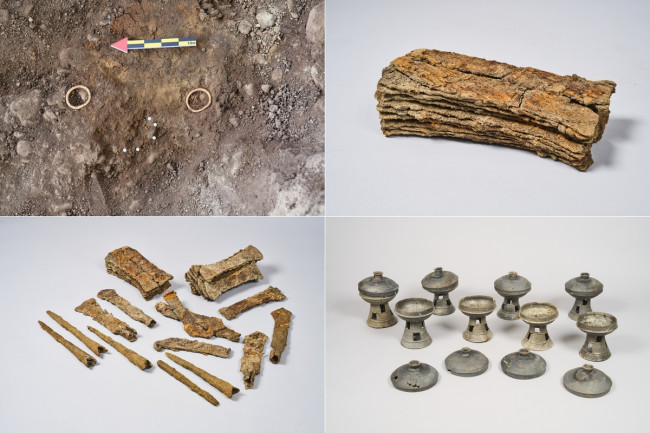 Major excavated artifacts. Clockwise from top left: gold earrings, iron ingots, earthenware, and weaponry [Provided by the Korea Heritage Service. Resale and DB prohibited]
The Korea Heritage Service and the research institute believe these fragments are part of a gilt-bronze crown.
An official from the institute explained, "This is the oldest gilt-bronze crown among those discovered in the Silla capital, and it demonstrates the metalworking technology and early forms of ornamentation of the 'Silla Gold Culture' of the late 4th to early 5th centuries."
This investigation also provided a 'clue' regarding the identity of the tomb's occupant.
In the secondary chamber, a burial facility attached to the main chamber, various horse-related artifacts were found, including armor and helmets for both the horse and the rider, as well as a saddle, stirrups, and a bit. This marks only the second time that horse armor (magap) has been found in Gyeongju, following the discovery at the Jjoksaem District C10 tomb.
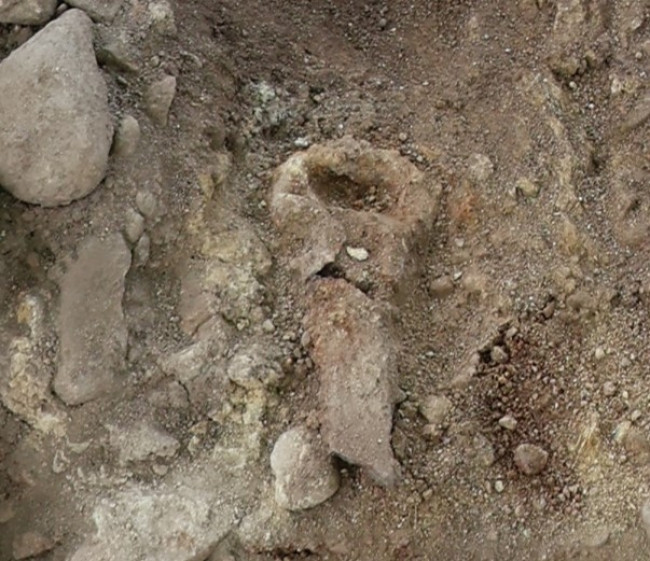 Part of the excavated sword [Provided by the Korea Heritage Service. Resale and DB prohibited]
Academics express hope that this will provide data to clarify the existence and history of the heavily armored Silla cavalry.
The Korea Heritage Service emphasized, "This is the second such discovery in a Silla tomb, and it serves as important data illustrating the strength of Silla’s military and the status of its ruling class around the 5th century, alongside the reality of its heavy cavalry."
The human armor is particularly eye-catching, as it was not made entirely of iron—some parts were made of leather—and it includes a complete set of accessories to protect the arms and legs.
The fact that the owner wore such lightweight yet high-performance armor indicates that he possessed a high social standing.
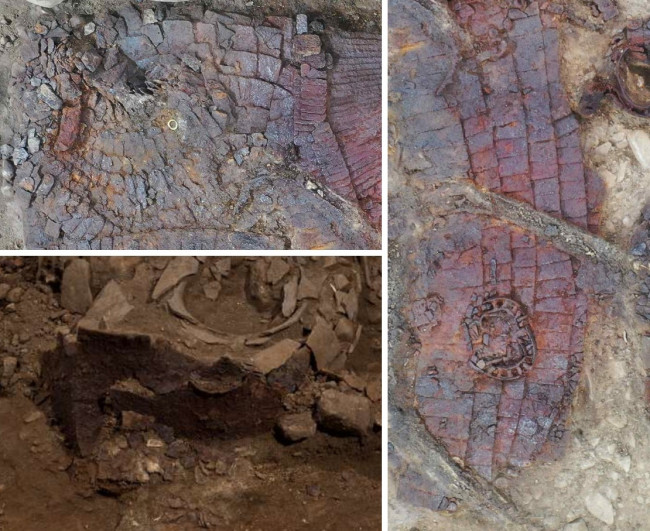 Excavated horse armor and artifacts [Provided by the Korea Heritage Service. Resale and DB prohibited]
Reflecting this, traces of a human sacrifice were found where the horse and human armor were unearthed, showing the individual with limbs stretched out. It is presumed that this person was an attendant who served the tomb's owner closely.
The Korea Heritage Service explained, "This is the first time we have confirmed the full remains of a sacrificed human in a top-tier tomb, where previously we could only estimate or confirm partial traces. It serves as empirical data for researching ancient funeral customs."
In line with the APEC summit held in Gyeongju, the Korea Heritage Service plans to open the excavation site and display some of the artifacts to the public for six days, from the 27th of this month to November 1st.
A Korea Heritage Service official stated, "This investigation goes beyond the discovery of a new tomb; it is highly significant in that it has provided decisive clues to uncovering the military and social structure of ancient Silla." Yonhap News
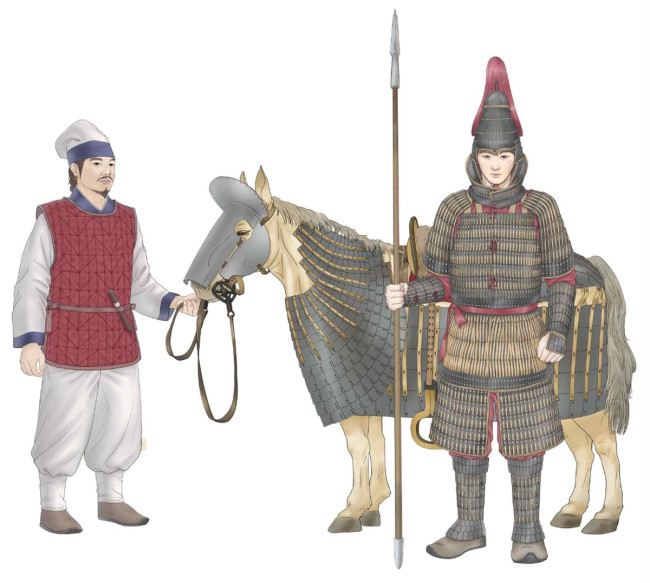 Reconstruction illustration of the figure in the tomb [Provided by the Korea Heritage Service. Resale and DB prohibited]

 Iranian Foreign Ministry: "Continuing Message Exchanges with the U.S. and Activities of Mediating Countries"
Esmaeil Baghaei, Spokesperson for the Iranian Ministry of Foreign Affairs [Xinhua, Yonhap News file photo]Esmaeil Baghaei, spokesperson for the Iranian Ministry of Foreign Affairs, stated on the 26th
Iranian Foreign Ministry: "Continuing Message Exchanges with the U.S. and Activities of Mediating Countries"
Esmaeil Baghaei, Spokesperson for the Iranian Ministry of Foreign Affairs [Xinhua, Yonhap News file photo]Esmaeil Baghaei, spokesperson for the Iranian Ministry of Foreign Affairs, stated on the 26th
 President Yoon: "Do You Think You Are Safe from the Special Counsel?"... Final Statement Video Released
President Yoon Suk Yeol rebuking the special prosecutor on the 24th. [Court video / @birds_justice X account subtitle GIF] A video of President Yoon Suk Yeol's closing statement at his trial rega
President Yoon: "Do You Think You Are Safe from the Special Counsel?"... Final Statement Video Released
President Yoon Suk Yeol rebuking the special prosecutor on the 24th. [Court video / @birds_justice X account subtitle GIF] A video of President Yoon Suk Yeol's closing statement at his trial rega
 President Yoon, regarding the first-instance ruling on the Public Official Election Act: “An excessive political verdict that distorts the facts… We will appeal immediately.”
The first-instance sentencing hearing for President Yoon Suk Yeol regarding violations of the Public Official Election Act is being broadcast live at Seoul Station on the 27th. [Photo=Yonhap News]Pres
President Yoon, regarding the first-instance ruling on the Public Official Election Act: “An excessive political verdict that distorts the facts… We will appeal immediately.”
The first-instance sentencing hearing for President Yoon Suk Yeol regarding violations of the Public Official Election Act is being broadcast live at Seoul Station on the 27th. [Photo=Yonhap News]Pres
 WSJ: "SK Hynix ADR Premium Is a Sign of AI Trading Overheat"
Advertisement for SK Hynix ADR listing in New York's Times Square [Reuters=Yonhap News file photo]The Wall Street Journal (WSJ) has pointed out that the price of SK Hynix’s American Depositary Recei
WSJ: "SK Hynix ADR Premium Is a Sign of AI Trading Overheat"
Advertisement for SK Hynix ADR listing in New York's Times Square [Reuters=Yonhap News file photo]The Wall Street Journal (WSJ) has pointed out that the price of SK Hynix’s American Depositary Recei
 'Godfather of Japanese Mystery Novels' Keigo Higashino Passes Away After Battle with Cancer at 68
Famous Japanese mystery novelist Keigo Higashino [AFP=Yonhap News]It has been belatedly reported that Keigo Higashino, the "godfather of Japanese mystery novels" and author of bestsellers such as "The
'Godfather of Japanese Mystery Novels' Keigo Higashino Passes Away After Battle with Cancer at 68
Famous Japanese mystery novelist Keigo Higashino [AFP=Yonhap News]It has been belatedly reported that Keigo Higashino, the "godfather of Japanese mystery novels" and author of bestsellers such as "The
 [Park Pil-kyu Security Column] To the Ignorant Trying to Clothe a Beast in Sheep's Clothing
Rep. Kim Byung-joo of the Democratic Party of Korea [Photo=Yonhap News]“The Air Force Academy doesn't teach you how to fly a plane!” “The Army, Navy, and Air Force academies are exactly the
[Park Pil-kyu Security Column] To the Ignorant Trying to Clothe a Beast in Sheep's Clothing
Rep. Kim Byung-joo of the Democratic Party of Korea [Photo=Yonhap News]“The Air Force Academy doesn't teach you how to fly a plane!” “The Army, Navy, and Air Force academies are exactly the
 [Issue Diagnosis] Two Effects of the Election Petition Review
 [Photo] Evidence of Election Fraud Flooding U.S. Media… Trump Had 2.7 Million Votes Stolen
 [Video] U.S. Semiquincentennial Air Show... 'Art in the Sky' streaks across New York
 [Editorial Cartoon] A Draconian Law That Undermines Freedom of Expression

 List
List









