이재명 대통령의 국정 수행은 긍정 49%, 부정 48%로 팽팽했다. 그러나 국민은 더 이상 ‘누가 잘하느냐’를 기준으로 정치인을 평가하지 않는다. 이번 고성국TV·미디어임(이영풍TV) 공동 의뢰, 한국여론평판연구소(KOPRA)의 10월 여론조사는 국민의 관심이 ‘결과’보다 ‘진심’, ‘성과’보다 ‘책임’으로 옮겨가고 있음을 보여준다. 정치의 기준이 “숨김이 없는가”로 옮겨가고 있다는 것이다.<편집자 주>

[Korea Opinion & Public Reputation Research Institute (KOPRA) Survey]
“The Direction of Public Sentiment Reads Not as Mere Approval Ratings, but as a ‘Demand for Verification’”
A year and a half into the Lee Jae-myung administration, while approval and disapproval of the overall state of governance remain closely split, public attention is increasingly shifting toward the inner workings of power. The influence of aides rather than the President himself, the clarification of allegations rather than policy achievements, and the sincerity of attitude rather than tangible results have emerged as the new benchmarks for public judgment.
The evaluation of state governance is neck-and-neck, and party support also shows a tight race within the margin of error, with the People Power Party at 41% and the Democratic Party at 40%. However, when delving into the specifics, the center of gravity in public opinion is clearly shifting.
A strong public desire for the verification of the periphery of power, the staff, and hidden matters has been expressed.
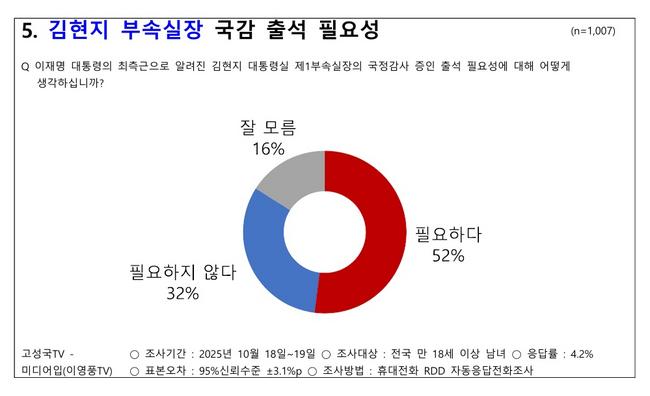
More than half of the respondents (52%) stated that the attendance of Kim Hyun-ji, Secretary to the President for the First Office, at the parliamentary audit is “necessary,” which is more than 20 percentage points higher than those who said it is “not necessary” (32%).
The demand that the President’s closest aides must be subject to public scrutiny has become a matter of basic common sense among the public, rather than merely a political judgment. It serves as a warning that without restoring the transparency of presidential power, trust in state governance will be structurally shaken.
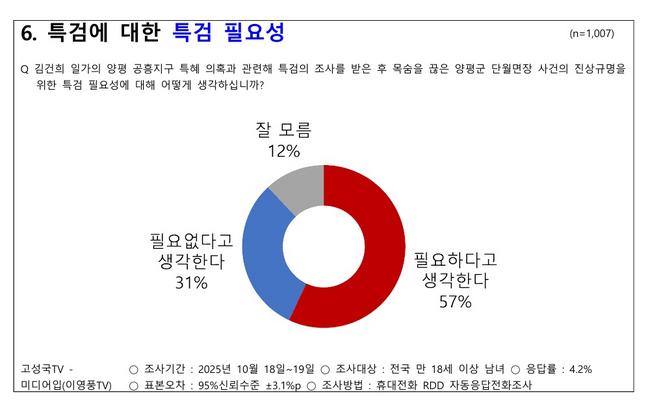
Public sentiment regarding the death of the Yangpyeong-gun Danwol-myeon head was similar.
Respondents who said a “special counsel is necessary” stood at 57%, significantly outstripping those who said it is “not necessary” (31%).
Moving beyond simple allegations, the public is questioning the fairness of the truth-finding process itself. The public demand that there should be no sanctuary for power has been expressed through the “necessity of a special counsel.” Even if political interpretations vary, the essence of public sentiment is simple: they want a power that hides nothing.
In the preference for the next political leader, Rep. Jang Dong-hyeok took first place with 17%.
Prime Minister Kim Min-seok (13%) and former Justice Minister Cho Kuk (12%) followed. Rep. Jung Chung-rae (10%), former Justice Minister Han Dong-hoon (9%), and New Reform Party leader Lee Jun-seok (6%) came next.
Rep. Jang Dong-hyeok, a former judge, is regarded as a figure who values legal principles while knowing how to temper political intensity. His rise does not merely reflect a change in personal preference, but rather the public's sense of direction, which favors “restraint over extremism and reflection over attacks.” Rep. Jang is recognized even within the ruling bloc as a “politician who speaks the language of law and balance.” This is the very aspect interpreted as a symbol of a “politician who hides nothing.”
President Lee Jae-myung’s state performance rating was tight, with 49% positive and 48% negative.
While superficially balanced, there is a distinct “political fatigue” in the depths of public opinion. As the divide between supporters and opponents becomes entrenched, the centrist group is reacting more to “fatigue” than to ideology. Political overexposure, emotional language, and constant conflict are leading to a fatigue of trust.
In this situation, what the public seeks is not greater reform or more policies. It is “attitude over words, and sincerity over results”—the restoration of a politics that hides nothing.
Party support was 41% for the People Power Party, 40% for the Democratic Party, 4% for the Rebuilding Korea Party, 3% for the New Reform Party, 3% for other parties, and 8% for independents.
Although the ruling and opposition parties are balanced, the growth of the third faction remains minimal.
The reality that alternative politics is absent even when political fatigue is maximized is the biggest structural risk factor in Korean politics. The fact that the public has begun to value “an individual’s conscience” more than “the logic of the two major parties” shows that the central axis of politics is already shifting.
Regarding President Lee Jae-myung’s appearance on an entertainment program, 49% said it was “inappropriate,” 46% said it was “no problem,” and 5% were “unsure.”
This is interpreted as the public backlash against his public activities immediately following a national network paralysis and a major fire. While the President’s friendliness can be seen as communication, if the timing and method are misaligned, it is read as “evading responsibility.” The public is demanding the weight of governance from the President, not humor. The danger of becoming a “lightweight president” while trying to be a “human president” arises when the sense of balance in leadership is lost.
Sympathy for prosecutorial reform was 45% in favor, 49% opposed, and 6% unsure.
This, too, reflects the public fatigue over “how long these reforms will continue,” beyond simple approval or disapproval. As the word "reform" is repeated, the public first reads the political intentions hidden within it.
If the “prosecutorial reform for the people” emphasized by the Lee Jae-myung administration sounds to the public like “just another political language,” the true meaning of reform fades.
The center of politics may seem unmoved, but the sentiment beneath the surface is clearly changing.
The public no longer wants the “politics of victory” more than the “politics of transparency.” The Kim Hyun-ji audit, the Yangpyeong special counsel, the rise of Jang Dong-hyeok, and the stagnation of state performance ratings all exist within that flow.
Politics still uses the language of factions, but the public now judges with the language of truth.
The moment “power that hides nothing” establishes itself as a new virtue, the framework of the next election will also change. The success or failure of politics is no longer a clash of ideologies, but can be summarized in that one single sentence: “Who hides nothing?”
This survey was conducted by the Korea Opinion & Public Reputation Research Institute (KOPRA) upon the joint request of Go Sung-kook TV and Media Im (Lee Young-poong TV). It was conducted on October 18-19, 2025, among 1,007 men and women aged 18 or older nationwide, using an automated response system (ARS) with mobile RDD (Random Digit Dialing). The sampling error is ±3.1%p at a 95% confidence level, and the response rate was 4.2%. Rim weighting was applied based on the resident registration population of the Ministry of the Interior and Safety as of September 2025 after proportional allocation by gender, age, and region.
#PublicSentiment #LeeJaeMyung #KimHyunJi #YangpyeongSpecialCounsel #JangDongHyeok #StatePerformanceEvaluation #ProsecutorialReform #PartySupport #HanMiIlbo #OpinionPoll #GoSungKookTV #LeeYoungPoongTV #KOPRA

 Iranian Foreign Ministry: "Continuing Message Exchanges with the U.S. and Activities of Mediating Countries"
Esmaeil Baghaei, Spokesperson for the Iranian Ministry of Foreign Affairs [Xinhua, Yonhap News file photo]Esmaeil Baghaei, spokesperson for the Iranian Ministry of Foreign Affairs, stated on the 26th
Iranian Foreign Ministry: "Continuing Message Exchanges with the U.S. and Activities of Mediating Countries"
Esmaeil Baghaei, Spokesperson for the Iranian Ministry of Foreign Affairs [Xinhua, Yonhap News file photo]Esmaeil Baghaei, spokesperson for the Iranian Ministry of Foreign Affairs, stated on the 26th
 President Yoon: "Do You Think You Are Safe from the Special Counsel?"... Final Statement Video Released
President Yoon Suk Yeol rebuking the special prosecutor on the 24th. [Court video / @birds_justice X account subtitle GIF] A video of President Yoon Suk Yeol's closing statement at his trial rega
President Yoon: "Do You Think You Are Safe from the Special Counsel?"... Final Statement Video Released
President Yoon Suk Yeol rebuking the special prosecutor on the 24th. [Court video / @birds_justice X account subtitle GIF] A video of President Yoon Suk Yeol's closing statement at his trial rega
 President Yoon, regarding the first-instance ruling on the Public Official Election Act: “An excessive political verdict that distorts the facts… We will appeal immediately.”
The first-instance sentencing hearing for President Yoon Suk Yeol regarding violations of the Public Official Election Act is being broadcast live at Seoul Station on the 27th. [Photo=Yonhap News]Pres
President Yoon, regarding the first-instance ruling on the Public Official Election Act: “An excessive political verdict that distorts the facts… We will appeal immediately.”
The first-instance sentencing hearing for President Yoon Suk Yeol regarding violations of the Public Official Election Act is being broadcast live at Seoul Station on the 27th. [Photo=Yonhap News]Pres
 WSJ: "SK Hynix ADR Premium Is a Sign of AI Trading Overheat"
Advertisement for SK Hynix ADR listing in New York's Times Square [Reuters=Yonhap News file photo]The Wall Street Journal (WSJ) has pointed out that the price of SK Hynix’s American Depositary Recei
WSJ: "SK Hynix ADR Premium Is a Sign of AI Trading Overheat"
Advertisement for SK Hynix ADR listing in New York's Times Square [Reuters=Yonhap News file photo]The Wall Street Journal (WSJ) has pointed out that the price of SK Hynix’s American Depositary Recei
 'Godfather of Japanese Mystery Novels' Keigo Higashino Passes Away After Battle with Cancer at 68
Famous Japanese mystery novelist Keigo Higashino [AFP=Yonhap News]It has been belatedly reported that Keigo Higashino, the "godfather of Japanese mystery novels" and author of bestsellers such as "The
'Godfather of Japanese Mystery Novels' Keigo Higashino Passes Away After Battle with Cancer at 68
Famous Japanese mystery novelist Keigo Higashino [AFP=Yonhap News]It has been belatedly reported that Keigo Higashino, the "godfather of Japanese mystery novels" and author of bestsellers such as "The
 [Park Pil-kyu Security Column] To the Ignorant Trying to Clothe a Beast in Sheep's Clothing
Rep. Kim Byung-joo of the Democratic Party of Korea [Photo=Yonhap News]“The Air Force Academy doesn't teach you how to fly a plane!” “The Army, Navy, and Air Force academies are exactly the
[Park Pil-kyu Security Column] To the Ignorant Trying to Clothe a Beast in Sheep's Clothing
Rep. Kim Byung-joo of the Democratic Party of Korea [Photo=Yonhap News]“The Air Force Academy doesn't teach you how to fly a plane!” “The Army, Navy, and Air Force academies are exactly the
 [Issue Diagnosis] Two Effects of the Election Petition Review
 [Photo] Evidence of Election Fraud Flooding U.S. Media… Trump Had 2.7 Million Votes Stolen
 [Video] U.S. Semiquincentennial Air Show... 'Art in the Sky' streaks across New York
 [Editorial Cartoon] A Draconian Law That Undermines Freedom of Expression

 List
List










