 Sila Ervin reads text with special glasses after chip implantation. Captured from Moorfields Eye Hospital website.
Blind patients have partially regained their vision through an international clinical trial involving the implantation of chips in the back of their eyes, the UK's Daily Telegraph reported on the 20th (local time).
Thirty-eight blind patients from five European countries, including the UK, France, Germany, Italy, and the Netherlands, participated in trials for the Prima implant, developed by the US-based biotech company Second Sight Medical Products.
Patients with dry age-related macular degeneration (AMD), also known as geographic atrophy (GA), had a micro-sized photovoltaic chip, about 2 millimeters in size and the thickness of a human hair, inserted beneath their retinas.
Subsequently, the patients wore special glasses with a built-in video camera. This camera converts images into infrared signals and transmits them to the chip in the eye, which then sends the signals to a small, portable processor where the images are enhanced and sharpened.
The processed images are then transmitted through the implant and the optic nerve to the patient's brain, enabling them to regain some of their vision.
The patients underwent several months of training to learn how to interpret this new form of visual information. As a result, 27 out of the 32 who received the chip implant were able to read again using their central vision.
"These were elderly patients who could no longer read, write, or recognize faces due to vision loss," said Professor Mahrub Mukti, a specialist at Moorfields Eye Hospital in London, who led the UK arm of the clinical trial. "They are emerging from darkness and beginning to utilize their vision again."
"This marks a new era in the history of artificial vision," he added. "It is an unprecedented achievement that blind patients can experience a meaningful recovery of their central vision."
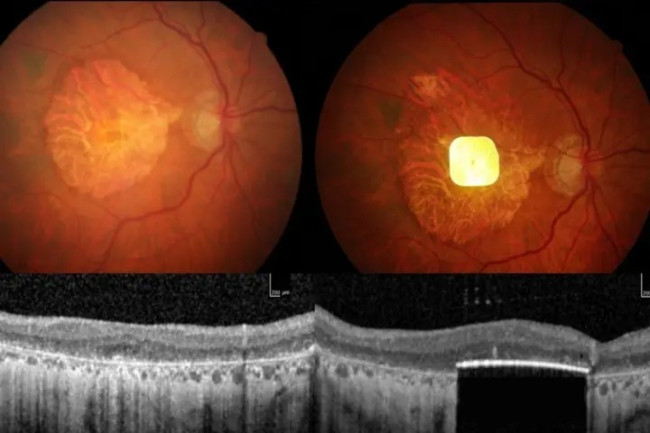 Before (left) and after chip implantation. Captured from Moorfields Eye Hospital website.
Professor Frank Holz, an ophthalmologist at the University of Bonn in Germany and lead author of the study published in The New England Journal of Medicine, stated, "This is the first time we have demonstrated that functional central vision can be restored in patients blinded by geographic atrophy. This implant signifies a paradigm shift in the treatment of late-stage AMD."
The patients who participated in the clinical trial expressed their joy at regaining their sight.
Sila Ervin, 70, who is registered as visually impaired, said that before the chip implantation, she saw two black discs in front of her eyes, making reading and driving impossible.
"I was an avid reader and wanted that life back," she recalled. "At first, I couldn't see anything at all, but one day the edges of the letters started to appear, and then seeing a single letter was incredibly exhilarating."
However, Ervin noted that reading with the special glasses requires immense concentration, and she must keep her head still to prevent the image from shaking, so she does not use the device outdoors.
The Prima implant has not yet received full approval and is only available through clinical trials. Its future cost also remains uncertain.
Professor Mukti expressed hope that the technology could be available through the UK's National Health Service (NHS) within the next few years. However, the BBC reported that individuals with congenital visual impairments may not benefit from this implant as they lack functional optic nerves to transmit signals to the brain.
Yonhap News Agency

 Iranian Foreign Ministry: "Continuing Message Exchanges with the U.S. and Activities of Mediating Countries"
Esmaeil Baghaei, Spokesperson for the Iranian Ministry of Foreign Affairs [Xinhua, Yonhap News file photo]Esmaeil Baghaei, spokesperson for the Iranian Ministry of Foreign Affairs, stated on the 26th
Iranian Foreign Ministry: "Continuing Message Exchanges with the U.S. and Activities of Mediating Countries"
Esmaeil Baghaei, Spokesperson for the Iranian Ministry of Foreign Affairs [Xinhua, Yonhap News file photo]Esmaeil Baghaei, spokesperson for the Iranian Ministry of Foreign Affairs, stated on the 26th
 President Yoon: "Do You Think You Are Safe from the Special Counsel?"... Final Statement Video Released
President Yoon Suk Yeol rebuking the special prosecutor on the 24th. [Court video / @birds_justice X account subtitle GIF] A video of President Yoon Suk Yeol's closing statement at his trial rega
President Yoon: "Do You Think You Are Safe from the Special Counsel?"... Final Statement Video Released
President Yoon Suk Yeol rebuking the special prosecutor on the 24th. [Court video / @birds_justice X account subtitle GIF] A video of President Yoon Suk Yeol's closing statement at his trial rega
 President Yoon, regarding the first-instance ruling on the Public Official Election Act: “An excessive political verdict that distorts the facts… We will appeal immediately.”
The first-instance sentencing hearing for President Yoon Suk Yeol regarding violations of the Public Official Election Act is being broadcast live at Seoul Station on the 27th. [Photo=Yonhap News]Pres
President Yoon, regarding the first-instance ruling on the Public Official Election Act: “An excessive political verdict that distorts the facts… We will appeal immediately.”
The first-instance sentencing hearing for President Yoon Suk Yeol regarding violations of the Public Official Election Act is being broadcast live at Seoul Station on the 27th. [Photo=Yonhap News]Pres
 WSJ: "SK Hynix ADR Premium Is a Sign of AI Trading Overheat"
Advertisement for SK Hynix ADR listing in New York's Times Square [Reuters=Yonhap News file photo]The Wall Street Journal (WSJ) has pointed out that the price of SK Hynix’s American Depositary Recei
WSJ: "SK Hynix ADR Premium Is a Sign of AI Trading Overheat"
Advertisement for SK Hynix ADR listing in New York's Times Square [Reuters=Yonhap News file photo]The Wall Street Journal (WSJ) has pointed out that the price of SK Hynix’s American Depositary Recei
 'Godfather of Japanese Mystery Novels' Keigo Higashino Passes Away After Battle with Cancer at 68
Famous Japanese mystery novelist Keigo Higashino [AFP=Yonhap News]It has been belatedly reported that Keigo Higashino, the "godfather of Japanese mystery novels" and author of bestsellers such as "The
'Godfather of Japanese Mystery Novels' Keigo Higashino Passes Away After Battle with Cancer at 68
Famous Japanese mystery novelist Keigo Higashino [AFP=Yonhap News]It has been belatedly reported that Keigo Higashino, the "godfather of Japanese mystery novels" and author of bestsellers such as "The
 [Park Pil-kyu Security Column] To the Ignorant Trying to Clothe a Beast in Sheep's Clothing
Rep. Kim Byung-joo of the Democratic Party of Korea [Photo=Yonhap News]“The Air Force Academy doesn't teach you how to fly a plane!” “The Army, Navy, and Air Force academies are exactly the
[Park Pil-kyu Security Column] To the Ignorant Trying to Clothe a Beast in Sheep's Clothing
Rep. Kim Byung-joo of the Democratic Party of Korea [Photo=Yonhap News]“The Air Force Academy doesn't teach you how to fly a plane!” “The Army, Navy, and Air Force academies are exactly the
 [Issue Diagnosis] Two Effects of the Election Petition Review
 [Photo] Evidence of Election Fraud Flooding U.S. Media… Trump Had 2.7 Million Votes Stolen
 [Video] U.S. Semiquincentennial Air Show... 'Art in the Sky' streaks across New York
 [Editorial Cartoon] A Draconian Law That Undermines Freedom of Expression

 List
List









