Treason Trial Court and Judicial Review Debated by Ruling and Opposition Parties: "Not Unconstitutional" vs. "Venezuelan Model"
Judiciary Committee Holds Inspection of National High Courts... Daejeon and Daegu High Court Chief Judges "May Contain Unconstitutional Elements"
Jeju District Court Chief Judge "Caution Regarding Judge's On-Duty Drinking"... Jang Kyung-tae "Is it Okay to Drink if There's No Disciplinary Action?"
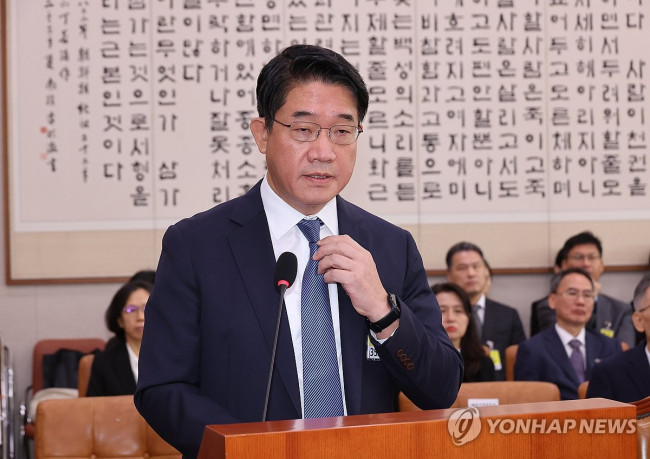
 Responding, Jin Sung-chul, Chief Judge of Daegu High Court (Seoul=Yonhap News) Reporter Park Dong-ju = Jin Sung-chul, Chief Judge of Daegu High Court, is responding to questions from lawmakers during the National Assembly's Legislation and Judiciary Committee's state audit held at the National Assembly in Yeouido, Seoul, on the 21st. 2025.10.21 pdj6635@yna.co.kr
On the 21st, the ruling and opposition parties engaged in a heated debate at the National Assembly's Legislation and Judiciary Committee's state audit regarding the Democratic Party of Korea's judicial reform proposals, including increasing the number of Supreme Court justices and judicial review.
The Democratic Party of Korea argued that the judicial review system, which allows the Constitutional Court to review final Supreme Court rulings, is not unconstitutional and emphasized the need to establish a specialized court for treason cases, which would handle incidents related to the December 3rd martial law situation.
Conversely, the People Power Party countered that the Democratic Party's attempts to alter the judicial system carry unconstitutional elements and infringe upon judicial independence.
Lee Sung-yoon, a lawmaker from the Democratic Party of Korea, questioned Chief Judge Lee Won-beom of Daejeon High Court and Chief Judge Jin Sung-chul of Daegu High Court during the state audit of national high courts and other judicial bodies, asking if the specialized treason trial court and judicial review were unconstitutional.
Regarding the specialized treason trial court, Chief Judge Lee responded, "Doubts about unconstitutionality can be raised," and Chief Judge Jin stated, "Depending on the composition of the specialized court, there is a possibility of unconstitutionality." In response, Rep. Lee asked again, "We are proposing a specialized court for treason cases involving over 100 defendants, so is it unconstitutional?"
Rep. Lee then repeatedly asked Chief Judge Jin, "You just answered with a smile, but do you know the content of judicial review? Have you seen the bill?"
When Chief Judge Jin replied, "I confirmed it through media reports," Rep. Lee raised his voice, saying, "You must speak accurately after understanding. It's a limited scope for rulings that clearly violate the Constitution and laws, and thereby infringe upon the fundamental rights of citizens. What is unconstitutional about that?"
In response, Rep. Park Joon-tae of the People Power Party also questioned the two chief judges about the introduction of the specialized treason trial court and judicial review.
Chief Judge Lee stated, "If a court is pre-determined or if its scope is somewhat limited in its composition, the constitutional independence of the court's composition could be undermined."
Chief Judge Jin responded, "I believe it could be in violation of the constitutional provision that judicial power is vested in the Supreme Court, the highest court, and courts at all levels."
Rep. Park Joon-tae of the People Power Party asserted, "The Democratic Party of Korea's judicial reform proposal is a declaration of judicial destruction. It is an attempt to reorganize the courts according to the Democratic Party's will. By the end of the Lee Jae-myung administration, 22 out of 26 Supreme Court justices will be judges appointed by President Lee Jae-myung. The Democratic Party's plan is precisely the Venezuelan model."
 Responding, Lee Heung-kwon, Chief Judge of Jeju District Court (Seoul=Yonhap News) Reporter Park Dong-ju = Lee Heung-kwon, Chief Judge of Jeju District Court, is responding to questions from lawmakers during the National Assembly's Legislation and Judiciary Committee's state audit held at the National Assembly in Yeouido, Seoul, on the 21st. 2025.10.21 pdj6635@yna.co.kr
The corruption and misconduct of judges belonging to the courts were also brought under scrutiny.
Among the lawmakers of the Democratic Party of Korea, repeated questions arose regarding Judge Oh Chang-hoon of Jeju District Court, who was also summoned as a witness to the state audit, concerning his on-duty drinking, his overbearing attitude towards spectators, and allegations of soliciting sponsorship for company dinners.
Lee Heung-kwon, Chief Judge of Jeju District Court, responded that he had "sternly admonished Judge Oh with a cautionary opinion."
When Democratic Party lawmaker Jang Kyung-tae asked, "Since he was not disciplined, is it permissible to drink during working hours? If there is no legal basis to impose discipline, we should strengthen the relevant laws," Chief Judge Lee bowed his head, saying, "I apologize for the concern caused by the actions of a judge in our jurisdiction." Yonhap News

 Iranian Foreign Ministry: "Continuing Message Exchanges with the U.S. and Activities of Mediating Countries"
Esmaeil Baghaei, Spokesperson for the Iranian Ministry of Foreign Affairs [Xinhua, Yonhap News file photo]Esmaeil Baghaei, spokesperson for the Iranian Ministry of Foreign Affairs, stated on the 26th
Iranian Foreign Ministry: "Continuing Message Exchanges with the U.S. and Activities of Mediating Countries"
Esmaeil Baghaei, Spokesperson for the Iranian Ministry of Foreign Affairs [Xinhua, Yonhap News file photo]Esmaeil Baghaei, spokesperson for the Iranian Ministry of Foreign Affairs, stated on the 26th
 President Yoon: "Do You Think You Are Safe from the Special Counsel?"... Final Statement Video Released
President Yoon Suk Yeol rebuking the special prosecutor on the 24th. [Court video / @birds_justice X account subtitle GIF] A video of President Yoon Suk Yeol's closing statement at his trial rega
President Yoon: "Do You Think You Are Safe from the Special Counsel?"... Final Statement Video Released
President Yoon Suk Yeol rebuking the special prosecutor on the 24th. [Court video / @birds_justice X account subtitle GIF] A video of President Yoon Suk Yeol's closing statement at his trial rega
 President Yoon, regarding the first-instance ruling on the Public Official Election Act: “An excessive political verdict that distorts the facts… We will appeal immediately.”
The first-instance sentencing hearing for President Yoon Suk Yeol regarding violations of the Public Official Election Act is being broadcast live at Seoul Station on the 27th. [Photo=Yonhap News]Pres
President Yoon, regarding the first-instance ruling on the Public Official Election Act: “An excessive political verdict that distorts the facts… We will appeal immediately.”
The first-instance sentencing hearing for President Yoon Suk Yeol regarding violations of the Public Official Election Act is being broadcast live at Seoul Station on the 27th. [Photo=Yonhap News]Pres
 WSJ: "SK Hynix ADR Premium Is a Sign of AI Trading Overheat"
Advertisement for SK Hynix ADR listing in New York's Times Square [Reuters=Yonhap News file photo]The Wall Street Journal (WSJ) has pointed out that the price of SK Hynix’s American Depositary Recei
WSJ: "SK Hynix ADR Premium Is a Sign of AI Trading Overheat"
Advertisement for SK Hynix ADR listing in New York's Times Square [Reuters=Yonhap News file photo]The Wall Street Journal (WSJ) has pointed out that the price of SK Hynix’s American Depositary Recei
 'Godfather of Japanese Mystery Novels' Keigo Higashino Passes Away After Battle with Cancer at 68
Famous Japanese mystery novelist Keigo Higashino [AFP=Yonhap News]It has been belatedly reported that Keigo Higashino, the "godfather of Japanese mystery novels" and author of bestsellers such as "The
'Godfather of Japanese Mystery Novels' Keigo Higashino Passes Away After Battle with Cancer at 68
Famous Japanese mystery novelist Keigo Higashino [AFP=Yonhap News]It has been belatedly reported that Keigo Higashino, the "godfather of Japanese mystery novels" and author of bestsellers such as "The
 [Park Pil-kyu Security Column] To the Ignorant Trying to Clothe a Beast in Sheep's Clothing
Rep. Kim Byung-joo of the Democratic Party of Korea [Photo=Yonhap News]“The Air Force Academy doesn't teach you how to fly a plane!” “The Army, Navy, and Air Force academies are exactly the
[Park Pil-kyu Security Column] To the Ignorant Trying to Clothe a Beast in Sheep's Clothing
Rep. Kim Byung-joo of the Democratic Party of Korea [Photo=Yonhap News]“The Air Force Academy doesn't teach you how to fly a plane!” “The Army, Navy, and Air Force academies are exactly the
 [Issue Diagnosis] Two Effects of the Election Petition Review
 [Photo] Evidence of Election Fraud Flooding U.S. Media… Trump Had 2.7 Million Votes Stolen
 [Video] U.S. Semiquincentennial Air Show... 'Art in the Sky' streaks across New York
 [Editorial Cartoon] A Draconian Law That Undermines Freedom of Expression

 List
List










