How was the tomb of a Silla princess built? Special Exhibition to Commemorate APEC
Gyeongju National Research Institute of Cultural Heritage Conducts 'Experiment' at Tomb No. 44 of Joksam After 10 Years of Investigation
 Stage 8 of the construction experiment for Tomb No. 44 of Joksam, Gyeongju [Photo courtesy of Gyeongju National Research Institute of Cultural Heritage. Reproduction and database prohibited]
How was the tomb, believed to be the burial place of a young Silla princess over 1,500 years ago, constructed?
The Gyeongju National Research Institute of Cultural Heritage announced on the 22nd that it will hold an explanatory session on the construction experiment of Tomb No. 44 at the Joksam Excavation Museum for three days, from October 30th to November 1st.
Tomb No. 44 is a tomb whose entire structure and interior have been revealed through approximately 10 years of investigation and research.
Its location was identified during the excavation of the Joksam area, which houses the tombs of Silla royalty and aristocracy from the 4th to 6th centuries. Recently, after completing the excavation, an experiment to reconstruct the tomb is underway.
The institute stated that this is a unique experiment in the history of world archaeology.
The institute is reconstructing Tomb No. 44, a characteristic Silla stone-mound tomb with a wooden coffin (Seok-mok-gwa-bun, 積石木槨墳), by rebuilding it step by step from its foundation, where stones were piled around a wooden coffin.
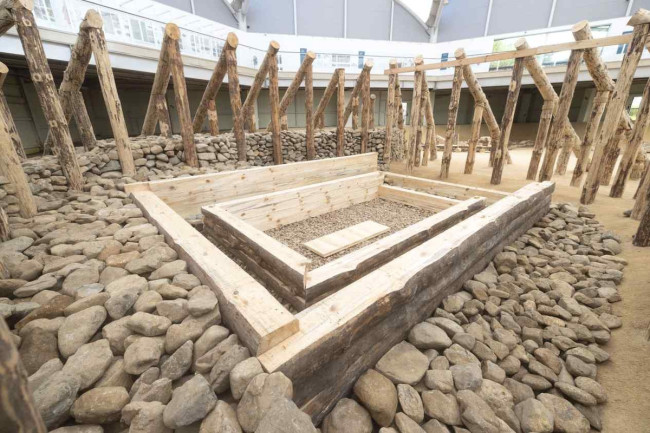 Construction of the coffin for Tomb No. 44 of Joksam, Gyeongju [Photo courtesy of Gyeongju National Research Institute of Cultural Heritage. Reproduction and database prohibited]
A representative from the institute explained, "We are in the process of creating part of the double coffin where the body and burial goods of the tomb's owner were placed after erecting the wooden structure, and then piling stones around it."
The current stage is the eighth out of a total of 21 stages.
The explanatory session will be held from 10 AM to 5 PM, coinciding with the Asia-Pacific Economic Cooperation (APEC) forum in Gyeongju.
Curators and researchers who participated in the excavation from 2014 to 2023 will present the significance of the tomb, the excavation process, and research achievements.
Information on how the main structures, such as the coffin and lid, were made, and the tools used, will also be provided. Excavated artifacts, including gold earrings, fragments of a gold crown, bracelets, and rings, will be displayed.
Replica items, such as horse trappings (panels hung under the saddle to prevent mud from splashing onto the rider's legs) known to have been elaborately made with jewel beetle wings, will also be exhibited.
The explanatory session is open to all without prior registration, and interpretation services in English, Japanese, and Chinese will be available. Yonhap News
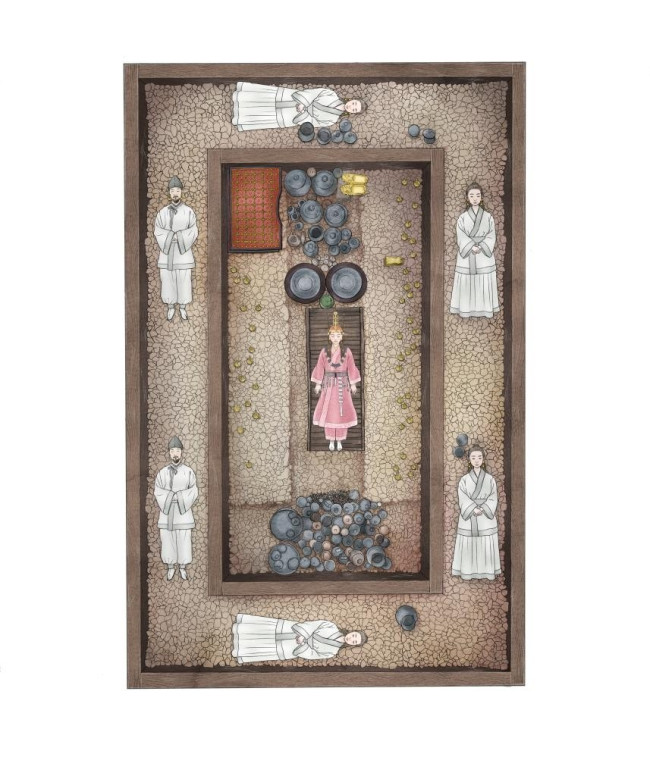 Illustration of the tomb containing the princess's body and burial goods [Photo courtesy of Gyeongju National Research Institute of Cultural Heritage. Reproduction and database prohibited]
What do you think of this article?

 Iranian Foreign Ministry: "Continuing Message Exchanges with the U.S. and Activities of Mediating Countries"
Esmaeil Baghaei, Spokesperson for the Iranian Ministry of Foreign Affairs [Xinhua, Yonhap News file photo]Esmaeil Baghaei, spokesperson for the Iranian Ministry of Foreign Affairs, stated on the 26th
Iranian Foreign Ministry: "Continuing Message Exchanges with the U.S. and Activities of Mediating Countries"
Esmaeil Baghaei, Spokesperson for the Iranian Ministry of Foreign Affairs [Xinhua, Yonhap News file photo]Esmaeil Baghaei, spokesperson for the Iranian Ministry of Foreign Affairs, stated on the 26th
 President Yoon: "Do You Think You Are Safe from the Special Counsel?"... Final Statement Video Released
President Yoon Suk Yeol rebuking the special prosecutor on the 24th. [Court video / @birds_justice X account subtitle GIF] A video of President Yoon Suk Yeol's closing statement at his trial rega
President Yoon: "Do You Think You Are Safe from the Special Counsel?"... Final Statement Video Released
President Yoon Suk Yeol rebuking the special prosecutor on the 24th. [Court video / @birds_justice X account subtitle GIF] A video of President Yoon Suk Yeol's closing statement at his trial rega
 President Yoon, regarding the first-instance ruling on the Public Official Election Act: “An excessive political verdict that distorts the facts… We will appeal immediately.”
The first-instance sentencing hearing for President Yoon Suk Yeol regarding violations of the Public Official Election Act is being broadcast live at Seoul Station on the 27th. [Photo=Yonhap News]Pres
President Yoon, regarding the first-instance ruling on the Public Official Election Act: “An excessive political verdict that distorts the facts… We will appeal immediately.”
The first-instance sentencing hearing for President Yoon Suk Yeol regarding violations of the Public Official Election Act is being broadcast live at Seoul Station on the 27th. [Photo=Yonhap News]Pres
 WSJ: "SK Hynix ADR Premium Is a Sign of AI Trading Overheat"
Advertisement for SK Hynix ADR listing in New York's Times Square [Reuters=Yonhap News file photo]The Wall Street Journal (WSJ) has pointed out that the price of SK Hynix’s American Depositary Recei
WSJ: "SK Hynix ADR Premium Is a Sign of AI Trading Overheat"
Advertisement for SK Hynix ADR listing in New York's Times Square [Reuters=Yonhap News file photo]The Wall Street Journal (WSJ) has pointed out that the price of SK Hynix’s American Depositary Recei
 'Godfather of Japanese Mystery Novels' Keigo Higashino Passes Away After Battle with Cancer at 68
Famous Japanese mystery novelist Keigo Higashino [AFP=Yonhap News]It has been belatedly reported that Keigo Higashino, the "godfather of Japanese mystery novels" and author of bestsellers such as "The
'Godfather of Japanese Mystery Novels' Keigo Higashino Passes Away After Battle with Cancer at 68
Famous Japanese mystery novelist Keigo Higashino [AFP=Yonhap News]It has been belatedly reported that Keigo Higashino, the "godfather of Japanese mystery novels" and author of bestsellers such as "The
 [Park Pil-kyu Security Column] To the Ignorant Trying to Clothe a Beast in Sheep's Clothing
Rep. Kim Byung-joo of the Democratic Party of Korea [Photo=Yonhap News]“The Air Force Academy doesn't teach you how to fly a plane!” “The Army, Navy, and Air Force academies are exactly the
[Park Pil-kyu Security Column] To the Ignorant Trying to Clothe a Beast in Sheep's Clothing
Rep. Kim Byung-joo of the Democratic Party of Korea [Photo=Yonhap News]“The Air Force Academy doesn't teach you how to fly a plane!” “The Army, Navy, and Air Force academies are exactly the
 [Issue Diagnosis] Two Effects of the Election Petition Review
 [Photo] Evidence of Election Fraud Flooding U.S. Media… Trump Had 2.7 Million Votes Stolen
 [Video] U.S. Semiquincentennial Air Show... 'Art in the Sky' streaks across New York
 [Editorial Cartoon] A Draconian Law That Undermines Freedom of Expression

 List
List









