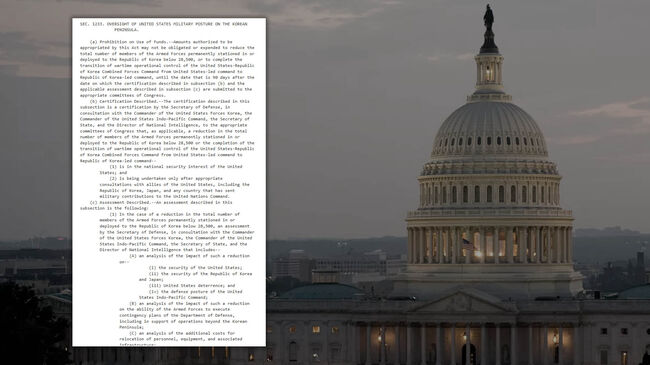
Reports indicate that the National Defense Authorization Act (NDAA) passed by the U.S. Senate on the 9th includes a provision to maintain the U.S. Forces Korea (USFK) troop level at 28,500. However, attention is drawn to the fact that the actual text presents more detailed exceptions.
A review of the full text of the Senate-passed NDAA, uploaded to the Federal Congressional Bill Information System on the 22nd (Wednesday), by News & Post, revealed that while it initially included provisions prohibiting the use of defense funds to reduce the USFK troop level or to transfer wartime operational control (OPCON), it also contains exceptions and provisions regarding OPCON transfer that were not present in the 2025 NDAA, drawing significant attention.
Prohibition of Funds.--None of the funds authorized to be appropriated by this Act may be obligated or expended to reduce the total number of forces permanently stationed or deployed in the Republic of Korea to less than 28,500, or to complete the transition of wartime operational control of Combined Forces Command from a U.S.-led to a Republic of Korea-led structure, until 90 days after the date on which the certifications described in subsection (b) and the assessments described in subsection (c) are submitted to the relevant committees of Congress.
Subsection (b) stipulates that the Secretary of Defense, in consultation with the Commander of USFK, the Commander of U.S. Indo-Pacific Command, the Secretary of State, and the Director of National Intelligence, shall submit certifications to the relevant committees of Congress if the Secretary of State and the Director of National Intelligence affirm that such a reduction "is consistent with the national security interests of the United States" and that "such measures are being taken in appropriate consultation with allies of the United States, including the Republic of Korea, Japan, and all nations contributing military forces to the United Nations Command."
Subsection (c) specifically directs that "If USFK is reduced to fewer than 28,500, the Secretary of Defense, in consultation with the Commander of USFK, the Commander of U.S. Indo-Pacific Command, the Secretary of State, and the Director of National Intelligence, shall conduct an assessment that includes the following:"
- An analysis of the impact of such a reduction on the security of the United States, the security of the Republic of Korea and Japan, the deterrence capabilities of the United States, and the defense posture of U.S. Indo-Pacific Command.
- An analysis of the impact of such a reduction on the Department of Defense's ability to execute contingency plans, including support for operations outside the Korean Peninsula.
- An analysis of the costs associated with the repositioning of personnel and equipment, and related infrastructure.
- An analysis of the impact of such a reduction on military exercises and major training events, particularly interoperability and joint activities with the Republic of Korea and Japan.
- A description of consultations with the Republic of Korea, Japan, and nations contributing military forces to the United Nations Command.
- An assessment of the impact of such a reduction on the credibility of the U.S. extended deterrence commitment to the Republic of Korea and Japan, and an evaluation of the potential for nuclear proliferation in the Indo-Pacific region.
- A review through an independent risk assessment conducted by the Commander of USFK, the Commander of U.S. Indo-Pacific Command, and the Chairman of the Joint Chiefs of Staff of the following:
(i) the impact of such a reduction on the security of the United States;
(ii) the ability of the Department of Defense to execute contingency plans, including support for operations outside the Korean Peninsula; and
(iii) the impact on military exercises and major training events (including interoperability and joint activities with the Republic of Korea and Japan).
The inclusion of provisions concerning the transfer of wartime operational control, which was absent in last year's NDAA, is drawing attention in this year's bill.
If the transfer of wartime operational control from the U.S.-led Combined Forces Command to a Republic of Korea-led Combined Forces Command is completed, the Secretary of Defense, in consultation with the Commander of USFK, the Commander of U.S. Indo-Pacific Command, the Secretary of State, and the Director of National Intelligence, shall conduct an assessment that includes the following:
- A description and assessment of the Republic of Korea's progress in achieving the three essential conditions specified in the conditionally approved plan for the transfer of operational control between the two countries.
- A detailed description of the reporting structure of a Republic of Korea-led Combined Forces Command to the national command authorities of the United States and the Republic of Korea.
- A detailed description of the planned command relationship between a Republic of Korea-led Combined Forces Command and a U.S.-led United Nations Command.
- A description of consultations with nations contributing military forces to the United Nations Command.
- An assessment of measures to prevent military operational conflicts between the U.S.-ROK alliance and the U.S.-Japan alliance, and a description of consultations regarding wartime operational control among the three countries of the U.S., ROK, and Japan.
- An assessment of the impact of the transfer of wartime operational control on the potential for nuclear proliferation in the Indo-Pacific region.
- An independent risk assessment conducted by the Commander of USFK, the Commander of U.S. Indo-Pacific Command, and the Chairman of the Joint Chiefs of Staff regarding:
(i) the ability of the Republic of Korea to meet the conditions for the transfer of wartime operational control from a U.S.-led command structure to a Republic of Korea-led command structure; and
(ii) the impact of such a transfer on the potential for nuclear proliferation in the Indo-Pacific region.
These changes highlight the growing importance of the "National Defense Strategy" (NDS), which addresses policy, rather than the NDAA, which deals with the budget.
The NDS serves as the strategic roadmap for the Department of Defense. The NDS to be released this year is particularly noteworthy as it is expected to provide clear direction to the Department of Defense in implementing President Trump's agenda of 'America First' and 'Peace Through Strength.'
In a directive issued on May 2nd, Secretary of Defense Hagge stated that the NDS development would commence with a priority on "defending the homeland of the United States, especially our airspace and borders, and deterring the military threat from China in the Indo-Pacific region, in accordance with the President's intent."
Although the NDS was initially scheduled for release in October, it has not yet been publicly disclosed due to the impact of the federal government shutdown.
By Sung Ku Hong, Editor-in-Chief, U.S. NNP / Special Correspondent NNP info@newsandpost.com

 Iranian Foreign Ministry: "Continuing Message Exchanges with the U.S. and Activities of Mediating Countries"
Esmaeil Baghaei, Spokesperson for the Iranian Ministry of Foreign Affairs [Xinhua, Yonhap News file photo]Esmaeil Baghaei, spokesperson for the Iranian Ministry of Foreign Affairs, stated on the 26th
Iranian Foreign Ministry: "Continuing Message Exchanges with the U.S. and Activities of Mediating Countries"
Esmaeil Baghaei, Spokesperson for the Iranian Ministry of Foreign Affairs [Xinhua, Yonhap News file photo]Esmaeil Baghaei, spokesperson for the Iranian Ministry of Foreign Affairs, stated on the 26th
 President Yoon: "Do You Think You Are Safe from the Special Counsel?"... Final Statement Video Released
President Yoon Suk Yeol rebuking the special prosecutor on the 24th. [Court video / @birds_justice X account subtitle GIF] A video of President Yoon Suk Yeol's closing statement at his trial rega
President Yoon: "Do You Think You Are Safe from the Special Counsel?"... Final Statement Video Released
President Yoon Suk Yeol rebuking the special prosecutor on the 24th. [Court video / @birds_justice X account subtitle GIF] A video of President Yoon Suk Yeol's closing statement at his trial rega
 President Yoon, regarding the first-instance ruling on the Public Official Election Act: “An excessive political verdict that distorts the facts… We will appeal immediately.”
The first-instance sentencing hearing for President Yoon Suk Yeol regarding violations of the Public Official Election Act is being broadcast live at Seoul Station on the 27th. [Photo=Yonhap News]Pres
President Yoon, regarding the first-instance ruling on the Public Official Election Act: “An excessive political verdict that distorts the facts… We will appeal immediately.”
The first-instance sentencing hearing for President Yoon Suk Yeol regarding violations of the Public Official Election Act is being broadcast live at Seoul Station on the 27th. [Photo=Yonhap News]Pres
 WSJ: "SK Hynix ADR Premium Is a Sign of AI Trading Overheat"
Advertisement for SK Hynix ADR listing in New York's Times Square [Reuters=Yonhap News file photo]The Wall Street Journal (WSJ) has pointed out that the price of SK Hynix’s American Depositary Recei
WSJ: "SK Hynix ADR Premium Is a Sign of AI Trading Overheat"
Advertisement for SK Hynix ADR listing in New York's Times Square [Reuters=Yonhap News file photo]The Wall Street Journal (WSJ) has pointed out that the price of SK Hynix’s American Depositary Recei
 'Godfather of Japanese Mystery Novels' Keigo Higashino Passes Away After Battle with Cancer at 68
Famous Japanese mystery novelist Keigo Higashino [AFP=Yonhap News]It has been belatedly reported that Keigo Higashino, the "godfather of Japanese mystery novels" and author of bestsellers such as "The
'Godfather of Japanese Mystery Novels' Keigo Higashino Passes Away After Battle with Cancer at 68
Famous Japanese mystery novelist Keigo Higashino [AFP=Yonhap News]It has been belatedly reported that Keigo Higashino, the "godfather of Japanese mystery novels" and author of bestsellers such as "The
 [Park Pil-kyu Security Column] To the Ignorant Trying to Clothe a Beast in Sheep's Clothing
Rep. Kim Byung-joo of the Democratic Party of Korea [Photo=Yonhap News]“The Air Force Academy doesn't teach you how to fly a plane!” “The Army, Navy, and Air Force academies are exactly the
[Park Pil-kyu Security Column] To the Ignorant Trying to Clothe a Beast in Sheep's Clothing
Rep. Kim Byung-joo of the Democratic Party of Korea [Photo=Yonhap News]“The Air Force Academy doesn't teach you how to fly a plane!” “The Army, Navy, and Air Force academies are exactly the
 [Issue Diagnosis] Two Effects of the Election Petition Review
 [Photo] Evidence of Election Fraud Flooding U.S. Media… Trump Had 2.7 Million Votes Stolen
 [Video] U.S. Semiquincentennial Air Show... 'Art in the Sky' streaks across New York
 [Editorial Cartoon] A Draconian Law That Undermines Freedom of Expression

 List
List









