[Seo Mi-sook's House Talk] Expansion of Land Transaction Permit Zones to All Areas Spurs Lease Renewals and Extension Rights
In Gangnam 3 Districts and Yongsan District, Lease Renewals Account for 46% After Designation as Permit Zones... Higher Than Non-Permit Zones (41%)
If a tenant is present in a permit zone, the house cannot be sold... 55% of tenants use extension rights due to landlord's demand for eviction
Expansion of Land Transaction Permit Zones by the 10/15 Measures Intensifies Freezing of Jeonse Properties... "Jeonse Prices Rise, Acceleration of Shift to Monthly Rent"
Since the expansion of land transaction permit zones to all apartments in Gangnam 3 Districts and Yongsan District on March 24, new jeonse and monthly rent contracts within these zones have sharply declined, while the proportion of renewed contracts and the use of contract renewal rights (hereinafter referred to as renewal rights) have significantly increased.
In permit zones, landlords cannot sell their properties if there are existing tenants. Consequently, tenants are increasingly responding to landlords' eviction demands by entering into new lease agreements or utilizing their renewal rights.
Experts express concern that the government's expansion of land transaction permit zones to all of Seoul and 12 locations in Gyeonggi Province through the 10/15 measures will exacerbate the freezing of new jeonse properties in these areas, leading to rising jeonse prices and making it difficult to move in or switch between jeonse and monthly rent.
 View of apartments in Seoul [Yonhap News Archive Photo]
◇ Intensified Freezing of New Jeonse Properties in 4 Permit Zones... Renewal Rights Usage Reaches 55%
According to an analysis of the Ministry of Land, Infrastructure and Transport's real transaction data system, the total number of jeonse and monthly rent transactions for apartments in Seoul reported from January 1 to October 22 this year was 204,895. Among these, renewed contracts (re-contracts) accounted for 41.4% (76,570 cases).
This means that more than 4 out of every 10 jeonse and monthly rent contracts reported during this period were re-contracts.
Compared to last year, when renewed contracts accounted for 31.4% (74,768 cases) of the total 250,977 jeonse and monthly rent transactions, the proportion has increased by approximately 10 percentage points.
Among renewed contracts, those using renewal rights amounted to 38,298 cases, representing 50.0%.
Half of the tenants who entered into renewed contracts this year exercised their renewal rights, a significant increase from 32.6% last year.
As of October this year, the number of cases where renewal rights were used has already significantly surpassed the total for the entire previous year (24,378 cases).
The increase in renewed contracts and the usage of renewal rights were influenced by the continuous rise in jeonse prices since last year, coupled with the tightening of jeonse loan regulations by financial authorities.
This trend was even more pronounced in land transaction permit zones.
In the four districts, including Gangnam 3 Districts and Yongsan District, where all apartments were designated as land transaction permit areas on March 24, a total of 36,341 jeonse and monthly rent contracts were reported by October 22. Among these, renewed contracts accounted for 15,080 cases, or 46.3%.
Of these, 8,315 contracts involved the use of renewal rights, reaching 55.1%.
These figures are significantly higher compared to the 21 non-permit districts (excluding some areas undergoing redevelopment) during the same period, where the proportion of renewed contracts was 40.9% and the usage of renewal rights was 49.1%.
Considering that during the same period last year (March 24 to October 22, 2024), before the entire districts were designated as permit zones, Gangnam 3 Districts and Yongsan District had only 32.9% of renewed contracts and 30.0% usage of renewal rights, and the other 21 districts had 30.3% of renewed contracts and 30.2% usage of renewal rights, the impact of the permit zone expansion is evident.
Among the four permit zones, Gangnam District had the highest proportion of renewed contracts at 48.9%, while Seocho District had the highest proportion of renewal rights usage at 57.8%.
The particularly high number of renewed contracts in permit zones is also related to the transaction restrictions within these areas.
In permit zones, buyers must reside in the property for at least two years immediately after purchase, which inevitably leads to a reduction in the supply of new jeonse properties.
Furthermore, in permit zones, if an existing tenant's jeonse period is still active, the property cannot be sold, and the tenant cannot be transferred to the new buyer. As a result, an increasing number of tenants are responding to landlords' eviction demands by using their renewal rights and entering into re-contracts.
Landlords, in particular, face difficulties selling their properties for up to four years if tenants exercise their renewal rights even after the lease term ends, leading to frequent disputes related to landlords' eviction demands in permit zones.
While sales are possible during the lease term if the landlord obtains an eviction confirmation from the tenant, persuading the tenant is difficult, and significant compensation is often required for eviction.
A real estate agent in Banpo-dong, Seocho-gu, Seoul, stated, "Since the Housing Lease Act does not have specific compensation standards for tenants, we have seen cases in Gangnam where compensation demands range from tens of millions to even 300 million won. Many homeowners are struggling because they cannot sell their homes if the tenant persists and uses their renewal rights, even in urgent situations."
Local real estate agencies also point to the strengthened jeonse loan regulations as a reason for the increase in re-contracts.
Since the 6/27 measures, jeonse loans for single-home owners have been blocked, and obtaining new jeonse loans has become difficult, leading to a high demand for re-contracts from tenants.
A real estate agent in Jamsil-dong, Songpa-gu, explained, "Even existing non-homeowner tenants have to repay their jeonse loans in full when they move after their jeonse expires, and since obtaining new loans is difficult, they are simply using their renewal rights and staying put. Structurally, re-contracts are bound to increase, and new jeonse properties are bound to decrease."
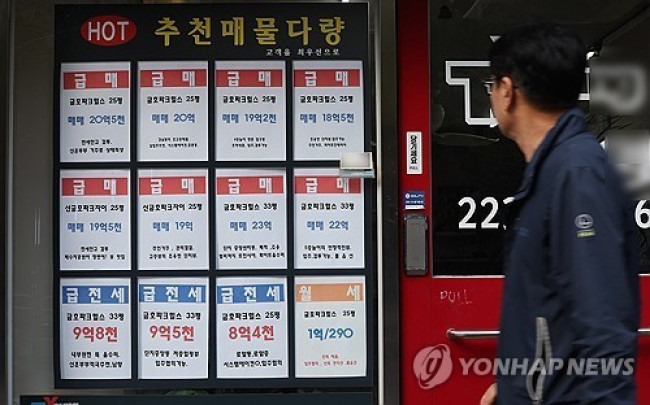 A real estate agency in Seongdong-gu, Seoul [Yonhap News Archive Photo]
◇ Widespread Designation of Land Transaction Permit Zones Hinders Both Sales and Jeonse Transactions... "Concerns of Market Distortion"
Experts believe that the government's widespread expansion of land transaction permit zones to all of Seoul and 12 locations in Gyeonggi Province through the 10/15 measures will further intensify the freezing of new jeonse properties in the Seoul metropolitan area.
Amidst a shortage of jeonse properties, particularly in newly built large apartment complexes, due to the recent autumn moving season, the designation of land transaction permit zones could exacerbate the jeonse shortage.
In Olympic Park Foreon, a large apartment complex in Dunchon-dong, Gangdong-gu, with a total of 12,000 households, there are fewer than 200 jeonse and monthly rent properties available. Jeonse properties for the highly sought-after 84㎡ unit are almost non-existent.
A real estate agent in Dunchon-dong commented, "Olympic Park Foreon, being a new apartment complex, had high jeonse demand, and with the autumn moving season overlapping, finding affordable jeonse is like searching for a needle in a haystack. With buyers now required to move in immediately, wouldn't the supply of jeonse properties decrease even further?"
A licensed real estate agent in Sanggye-dong, Nowon-gu, also stated, "Homeowners who couldn't sell their homes due to tenants have withdrawn their listings. For jeonse leases nearing expiration, if the homeowner intends to sell, they cannot offer new jeonse leases, so they have recovered the jeonse properties. Due to the land transaction permit system, it has become difficult to buy, sell, or rent out properties."
Consequently, there is growing criticism in the market regarding the broad designation of land transaction permit zones even in areas not experiencing market overheating.
Within permit zones, difficulties in switching to a new home purchase, coupled with a decrease in new jeonse properties, raise concerns about perennial jeonse shortages during moving seasons.
According to the Korea Real Estate Board, Songpa-gu, where the entire apartment complex was designated as a land transaction permit zone, saw its jeonse prices rise by 4.51% from April to September, the largest increase in Seoul. This is approximately 2.9 times the average jeonse price increase for apartments in Seoul during the same period (1.58%).
The shift from jeonse to monthly rent, driven by rising jeonse prices, is also expected to accelerate.
A real estate expert, who wished to remain anonymous, stated, "Using land transaction permit zones, originally designed to prevent speculation in new development areas, as a means to control housing prices in the heart of urban centers infringes upon the freedom of transaction. When combined with contract renewal rights and prolonged designation periods, it can lead to the distortion of the jeonse market." Yonhap News

 Iranian Foreign Ministry: "Continuing Message Exchanges with the U.S. and Activities of Mediating Countries"
Esmaeil Baghaei, Spokesperson for the Iranian Ministry of Foreign Affairs [Xinhua, Yonhap News file photo]Esmaeil Baghaei, spokesperson for the Iranian Ministry of Foreign Affairs, stated on the 26th
Iranian Foreign Ministry: "Continuing Message Exchanges with the U.S. and Activities of Mediating Countries"
Esmaeil Baghaei, Spokesperson for the Iranian Ministry of Foreign Affairs [Xinhua, Yonhap News file photo]Esmaeil Baghaei, spokesperson for the Iranian Ministry of Foreign Affairs, stated on the 26th
 President Yoon: "Do You Think You Are Safe from the Special Counsel?"... Final Statement Video Released
President Yoon Suk Yeol rebuking the special prosecutor on the 24th. [Court video / @birds_justice X account subtitle GIF] A video of President Yoon Suk Yeol's closing statement at his trial rega
President Yoon: "Do You Think You Are Safe from the Special Counsel?"... Final Statement Video Released
President Yoon Suk Yeol rebuking the special prosecutor on the 24th. [Court video / @birds_justice X account subtitle GIF] A video of President Yoon Suk Yeol's closing statement at his trial rega
 President Yoon, regarding the first-instance ruling on the Public Official Election Act: “An excessive political verdict that distorts the facts… We will appeal immediately.”
The first-instance sentencing hearing for President Yoon Suk Yeol regarding violations of the Public Official Election Act is being broadcast live at Seoul Station on the 27th. [Photo=Yonhap News]Pres
President Yoon, regarding the first-instance ruling on the Public Official Election Act: “An excessive political verdict that distorts the facts… We will appeal immediately.”
The first-instance sentencing hearing for President Yoon Suk Yeol regarding violations of the Public Official Election Act is being broadcast live at Seoul Station on the 27th. [Photo=Yonhap News]Pres
 WSJ: "SK Hynix ADR Premium Is a Sign of AI Trading Overheat"
Advertisement for SK Hynix ADR listing in New York's Times Square [Reuters=Yonhap News file photo]The Wall Street Journal (WSJ) has pointed out that the price of SK Hynix’s American Depositary Recei
WSJ: "SK Hynix ADR Premium Is a Sign of AI Trading Overheat"
Advertisement for SK Hynix ADR listing in New York's Times Square [Reuters=Yonhap News file photo]The Wall Street Journal (WSJ) has pointed out that the price of SK Hynix’s American Depositary Recei
 'Godfather of Japanese Mystery Novels' Keigo Higashino Passes Away After Battle with Cancer at 68
Famous Japanese mystery novelist Keigo Higashino [AFP=Yonhap News]It has been belatedly reported that Keigo Higashino, the "godfather of Japanese mystery novels" and author of bestsellers such as "The
'Godfather of Japanese Mystery Novels' Keigo Higashino Passes Away After Battle with Cancer at 68
Famous Japanese mystery novelist Keigo Higashino [AFP=Yonhap News]It has been belatedly reported that Keigo Higashino, the "godfather of Japanese mystery novels" and author of bestsellers such as "The
 [Park Pil-kyu Security Column] To the Ignorant Trying to Clothe a Beast in Sheep's Clothing
Rep. Kim Byung-joo of the Democratic Party of Korea [Photo=Yonhap News]“The Air Force Academy doesn't teach you how to fly a plane!” “The Army, Navy, and Air Force academies are exactly the
[Park Pil-kyu Security Column] To the Ignorant Trying to Clothe a Beast in Sheep's Clothing
Rep. Kim Byung-joo of the Democratic Party of Korea [Photo=Yonhap News]“The Air Force Academy doesn't teach you how to fly a plane!” “The Army, Navy, and Air Force academies are exactly the
 [Issue Diagnosis] Two Effects of the Election Petition Review
 [Photo] Evidence of Election Fraud Flooding U.S. Media… Trump Had 2.7 Million Votes Stolen
 [Video] U.S. Semiquincentennial Air Show... 'Art in the Sky' streaks across New York
 [Editorial Cartoon] A Draconian Law That Undermines Freedom of Expression

 List
List









