Ten days after the implementation of the October 15 real estate measures, which designated Seoul and 12 areas in Gyeonggi Province as regulated zones (adjustment target areas and speculative overheated zones) and land transaction permit zones, the local real estate market has noticeably cooled due to stricter loan regulations and the two-year residency requirement for home purchases.
While a contraction in transactions and a decrease in listings were somewhat expected given the strong demand-suppressing measures, attention is focused on whether this trend will lead to the price stabilization that the government aims for. The government is prioritizing the timely follow-up measures to the September 7 supply measures, announced earlier, to deliver clear signals of supply.
 Yonhap News Archive Photo.
◇ Transactions contract and listings decrease sharply under 'triple regulations'… "Price drop expected to be limited"
According to the Ministry of Land, Infrastructure and Transport's real transaction disclosure system, from October 16, when the October 15 measures were implemented, to the previous day, only 564 apartment sales contracts were concluded in Seoul over a ten-day period.
This figure is based on contracts reported up to the previous day, and actual transaction numbers may increase as housing sale transactions can be reported up to 30 days from the contract date, as per relevant laws. In comparison, the previous ten-day period (October 6-15), which included the Chuseok holiday, saw 2,679 transactions, indicating a 78.9% decrease in transactions after the implementation of the measures.
The primary reason for this is the significant tightening of loan regulations. The loan-to-value (LTV) ratio for those without housing and for homeowners selling their current homes under a condition has been reduced from 70% to 40%. Furthermore, loan limits have been differentiated for homes exceeding 1.5 billion won up to 2.5 billion won (loan limit of 400 million won) and for homes exceeding 2.5 billion won (loan limit of 200 million won).
The number of listings on the market also shows a significant decline.
According to Asil, a real estate platform, the number of apartments listed in Seoul decreased from 70,444 on October 16, the first day of the October 15 measures, to 66,647 the previous day, a 10% reduction.
This is attributed to the removal of listings from gap investors (purchasing homes with existing tenants) due to the designation of land transaction permit zones, as well as sellers who had planned to upgrade to a "better location" by selling their current homes and taking out loans, withdrawing their listings due to the tightened loan regulations.
![[Graphic] Additional Designated Areas for Real Estate Regulation Zones (Comprehensive)](/data/cheditor4/2510/GYH2025101500050004400_P2.jpg) [Graphic] Additional Designated Areas for Real Estate Regulation Zones. Yonhap News.
[Graphic] Additional Designated Areas for Real Estate Regulation Zones. Yonhap News.
The key question is whether the resulting price adjustments will be at the level the government expects.
While the weekly apartment price trends announced by the Korea Real Estate Board are due on October 30, a slowdown in the apartment price growth trend due to these measures is already being observed.
According to the weekly market trends for apartments nationwide compiled by Real Estate R114, the Seoul apartment sales price increase rate from October 20 to 24, the first day of the land transaction permit zone designation, was 0.08%, a significant slowdown compared to 0.42% in the previous week.
However, it is uncertain how significant the price adjustment will be following the implementation of the measures.
Despite the decrease in transactions and listings, sellers who expect prices to rise again after a certain period, believing the regulatory effects will diminish, may not lower their asking prices or could even increase them.
In such cases, if genuine buyers who must occupy the apartment agree to the price and transactions occur at high prices, it can lead to increased price volatility even with fewer listings.
However, considering that the government has announced real estate tax reforms in the October 15 measures, with discussions on property tax increases ongoing, and the possibility that the temporary exemption from capital gains tax surcharges for multiple homeowners selling homes in regulated areas may end in May next year, there is a possibility of urgent sale listings from multiple homeowners trying to dispose of their properties before then.
Considering these factors, there are projections that transaction contraction and limited price adjustments will occur from the implementation of the October 15 measures through the first half of next year at the longest.
Nam Hyuk-woo, a researcher at Woori Bank's Real Estate Research Institute, stated, "Some existing gap investors who are approaching the end of their lease agreements may try to sell their properties opportunistically, wondering how the capital gains tax surcharge exemption will be decided next year, thinking 'let's sort this out now'." He added, "However, due to the sharp decrease in listings resulting from the 'triple regulations,' the price drop is expected to be limited."
Park Won-gap, senior real estate expert at KB Kookmin Bank, commented, "The designation of land transaction permit zones is a drastic measure to reduce speculative demand, so a period of breathing room is expected amidst a transaction cliff. Due to buyers' wait-and-see attitude, it will be difficult to surpass previous record-high transactions for now." He predicted, "A period of adjustment is expected to continue for the next three to six months."
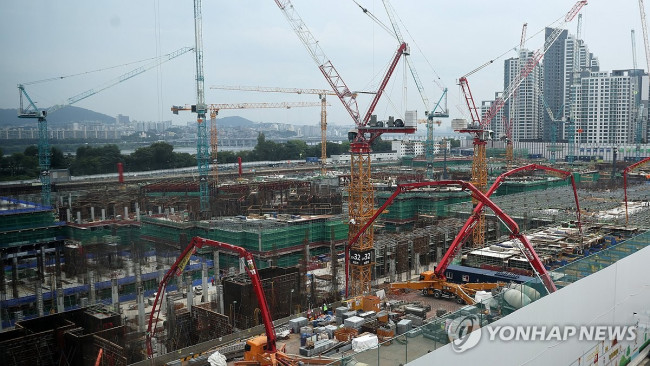 Apartment construction site. Yonhap News.
◇ The Key is Supply… Focusing on 'Supply Signals' by Accelerating Follow-up to September 7 Measures
The government, having curbed transactions with unprecedentedly strong demand-suppressing measures, is expected to focus on delivering 'supply signals' to the market by continuing follow-up work on the September 7 supply measures announced earlier.
This is because securing credibility in supply policies has become paramount, given the significant public criticism that the October 15 measures have restricted housing purchase opportunities for genuine buyers by designating an excessively broad area as regulated.
Another fundamental reason to accelerate supply is the difficulty of controlling prices solely through demand-suppressing measures, especially with the looming supply shortage starting next year due to a decrease in move-in volumes.
According to Real Estate R114, the estimated number of apartment move-ins nationwide is expected to decrease from 277,617 households this year to 210,483 households next year. In Seoul, this is projected to decrease from 42,684 households to 28,984 households during the same period, and excluding rental units, it will decrease from 32,810 to 17,687 households.
The ruling party and the government are considering announcing concrete supply plans for Seoul, broken down by year and district, within the year. This means presenting a detailed 'supply map' indicating the number of households to be supplied and by when in specific districts of Seoul.
Some within the ruling party are also discussing the abolition or extension of the grace period for the Reconstruction Excess Profit Recapture Act (Reconstruction Act), which has been cited as a major obstacle to housing supply through reconstruction. However, the ruling party's existing stance is negative towards easing the Reconstruction Act, and with opposition voices emerging from within and outside the party, it remains uncertain whether related discussions will gain momentum.
To provide a sense of relief to the market regarding supply, it is suggested that concrete plans should be presented, such as significantly increasing the floor area ratio for the third new cities and increasing the supply volume in urban areas by expanding the number of small and medium-sized units in line with population trends.
Park Hap-soo, an adjunct professor at Konkuk University's Graduate School of Real Estate, stated, "With the significant increase in single- and two-person households, and improved space utilization in small and medium-sized apartments compared to the past, the supply volume can be greatly increased by lowering the national housing size from 85㎡ to 60㎡ of exclusive area." He added, "Resolving the fundamental problem of insufficient move-in volume is the top priority."
Yonhap News

 Iranian Foreign Ministry: "Continuing Message Exchanges with the U.S. and Activities of Mediating Countries"
Esmaeil Baghaei, Spokesperson for the Iranian Ministry of Foreign Affairs [Xinhua, Yonhap News file photo]Esmaeil Baghaei, spokesperson for the Iranian Ministry of Foreign Affairs, stated on the 26th
Iranian Foreign Ministry: "Continuing Message Exchanges with the U.S. and Activities of Mediating Countries"
Esmaeil Baghaei, Spokesperson for the Iranian Ministry of Foreign Affairs [Xinhua, Yonhap News file photo]Esmaeil Baghaei, spokesperson for the Iranian Ministry of Foreign Affairs, stated on the 26th
 President Yoon: "Do You Think You Are Safe from the Special Counsel?"... Final Statement Video Released
President Yoon Suk Yeol rebuking the special prosecutor on the 24th. [Court video / @birds_justice X account subtitle GIF] A video of President Yoon Suk Yeol's closing statement at his trial rega
President Yoon: "Do You Think You Are Safe from the Special Counsel?"... Final Statement Video Released
President Yoon Suk Yeol rebuking the special prosecutor on the 24th. [Court video / @birds_justice X account subtitle GIF] A video of President Yoon Suk Yeol's closing statement at his trial rega
 President Yoon, regarding the first-instance ruling on the Public Official Election Act: “An excessive political verdict that distorts the facts… We will appeal immediately.”
The first-instance sentencing hearing for President Yoon Suk Yeol regarding violations of the Public Official Election Act is being broadcast live at Seoul Station on the 27th. [Photo=Yonhap News]Pres
President Yoon, regarding the first-instance ruling on the Public Official Election Act: “An excessive political verdict that distorts the facts… We will appeal immediately.”
The first-instance sentencing hearing for President Yoon Suk Yeol regarding violations of the Public Official Election Act is being broadcast live at Seoul Station on the 27th. [Photo=Yonhap News]Pres
 WSJ: "SK Hynix ADR Premium Is a Sign of AI Trading Overheat"
Advertisement for SK Hynix ADR listing in New York's Times Square [Reuters=Yonhap News file photo]The Wall Street Journal (WSJ) has pointed out that the price of SK Hynix’s American Depositary Recei
WSJ: "SK Hynix ADR Premium Is a Sign of AI Trading Overheat"
Advertisement for SK Hynix ADR listing in New York's Times Square [Reuters=Yonhap News file photo]The Wall Street Journal (WSJ) has pointed out that the price of SK Hynix’s American Depositary Recei
 'Godfather of Japanese Mystery Novels' Keigo Higashino Passes Away After Battle with Cancer at 68
Famous Japanese mystery novelist Keigo Higashino [AFP=Yonhap News]It has been belatedly reported that Keigo Higashino, the "godfather of Japanese mystery novels" and author of bestsellers such as "The
'Godfather of Japanese Mystery Novels' Keigo Higashino Passes Away After Battle with Cancer at 68
Famous Japanese mystery novelist Keigo Higashino [AFP=Yonhap News]It has been belatedly reported that Keigo Higashino, the "godfather of Japanese mystery novels" and author of bestsellers such as "The
 [Park Pil-kyu Security Column] To the Ignorant Trying to Clothe a Beast in Sheep's Clothing
Rep. Kim Byung-joo of the Democratic Party of Korea [Photo=Yonhap News]“The Air Force Academy doesn't teach you how to fly a plane!” “The Army, Navy, and Air Force academies are exactly the
[Park Pil-kyu Security Column] To the Ignorant Trying to Clothe a Beast in Sheep's Clothing
Rep. Kim Byung-joo of the Democratic Party of Korea [Photo=Yonhap News]“The Air Force Academy doesn't teach you how to fly a plane!” “The Army, Navy, and Air Force academies are exactly the
 [Issue Diagnosis] Two Effects of the Election Petition Review
 [Photo] Evidence of Election Fraud Flooding U.S. Media… Trump Had 2.7 Million Votes Stolen
 [Video] U.S. Semiquincentennial Air Show... 'Art in the Sky' streaks across New York
 [Editorial Cartoon] A Draconian Law That Undermines Freedom of Expression

 List
List









